admin
admin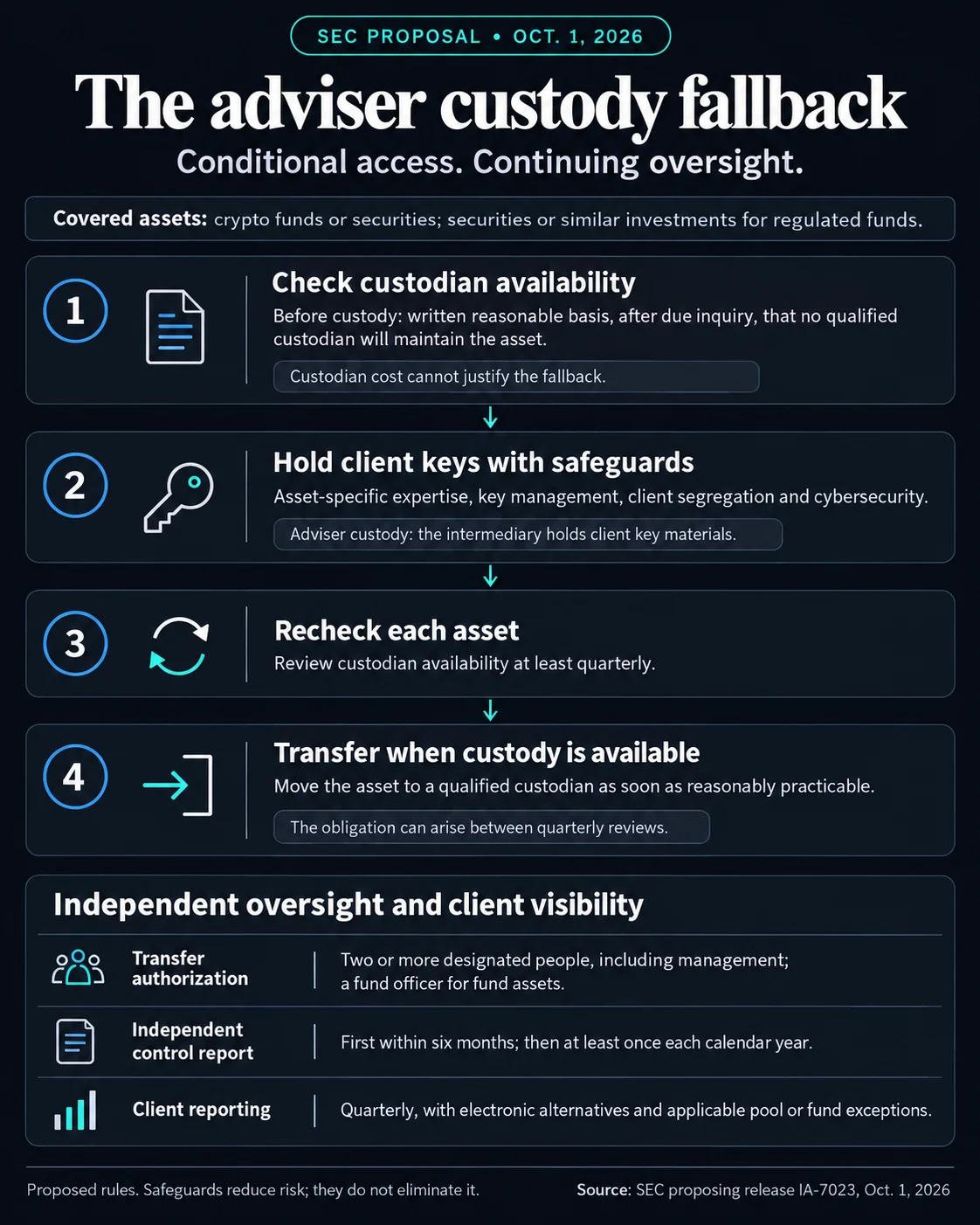
The U.S. Securities and Exchange Commission (SEC) has put forth a proposed rule that could significantly alter how investment advisers manage cryptocurrency assets for their clients. This proposed "crypto custody fallback" aims to broaden investment choices for clients by allowing advisers to hold certain crypto assets when a qualified custodian is unavailable. However, the move is accompanied by substantial compliance costs and safeguards, which the SEC’s own economic analysis suggests may disproportionately impact smaller advisory firms.
The proposal, officially approved on October 1st, allows registered investment advisers to hold "covered client crypto assets" under specific conditions. These conditions are designed to ensure client protection while addressing situations where traditional custodians might not be readily available for certain digital assets. The SEC’s economic analysis, a critical component of the rulemaking process, attempts to quantify the financial implications for advisers considering this option. A key figure highlighted is the estimated annual cost of $433,833 per adviser that chooses to utilize this fallback mechanism, according to Table 8 of the proposal.
This estimated expense is not a minor undertaking. It includes the cost of an independent internal control report, a crucial element for assuring the security and integrity of crypto asset holdings. However, the SEC acknowledges that this figure likely omits significant technology-related expenses, such as the acquisition and maintenance of specialized software, hardware, and associated operational systems. The implication for investors is clear: access to certain cryptocurrency assets through their chosen adviser could become a reality, but this access might be contingent on the adviser’s capacity to meet the proposed regulatory hurdles. Consequently, an asset might be available through an adviser with robust custody resources while remaining out of reach for another firm lacking such capabilities.
SEC Commissioner Hester Peirce, often a vocal proponent of innovation in the digital asset space, has drawn a distinction between an adviser’s "self-custody" under this proposed rule and an individual investor holding their own assets. In the context of the SEC’s proposal, "self-custody" refers to an intermediary, the investment adviser, holding the client’s essential digital asset management materials, such as private keys. This still implies a reliance on the adviser’s security protocols and operational integrity, even if the client retains ultimate beneficial ownership. For ordinary advisory clients, the proposed amendments primarily concern crypto assets that function as funds or securities. For regulated fund accounts, the scope extends to securities or similar investments.
Unpacking the Annual Cost Estimate: A Deep Dive into Compliance Burdens
The SEC’s economic analysis breaks down the estimated annual cost of the proposed crypto custody fallback, providing a granular view of the financial commitments involved. The most substantial component of the modeled annual expense is the independent internal control report, estimated by the SEC to cost an average of $376,000 per adviser. This is supplemented by $57,833 in recurring internal compliance work.
Table 8 of the proposal consolidates these figures, adding an initial internal compliance cost of $173,499. All figures are presented in 2026 dollars, reflecting an effort to account for potential inflation.
| Modeled Adviser Cost | Amount | Timing |
|---|---|---|
| Initial Internal Compliance Work | $173,499 | Initial |
| Recurring Annual Internal Compliance Work | $57,833 | Annually |
| Independent Internal Control Report | $376,000 | Annual |
| Total Annual Estimate (Table 8) | $433,833 | Internal Work + Control Report |
The internal compliance cost is based on assumptions of 300 initial hours and 100 recurring annual hours, with an hourly rate of $578.33. This internal work is understood to encompass establishing necessary information systems, communication protocols, and formal agreements with clients to treat the crypto assets as financial assets under applicable state laws.
It is crucial to reiterate that this subtotal for internal work and the control report does not represent the complete financial picture. The SEC explicitly states that significant technology costs—including software, hardware, and associated systems—are not included. Furthermore, the burdens related to recordkeeping and disclosure are addressed in separate tables within the broader rulemaking documentation, meaning this specific subtotal is not a comprehensive operating budget.
The figure for the independent accountant’s report is derived from an inflation-adjusted prior estimate from the Paperwork Reduction Act analysis. This methodology, rounded to the nearest $1,000, aligns with the SEC’s historical cost modeling approach. The actual costs of these reports could fluctuate significantly based on the specific assets being held, the complexity of the safeguarding systems employed, and the specialized expertise required to audit various blockchain networks.
The SEC’s economic analysis is predicated on the assumption that approximately 823 registered advisers, representing about 5% of the total 16,442 registered advisers, would elect to use this self-custody option. However, the agency prudently cautions that the actual adoption rate may be lower due to the considerable compliance demands.
Scale and Scope: How Firm Size Impacts Access and Affordability
A central theme emerging from the SEC’s economic analysis is the direct correlation between an advisory firm’s scale and its ability to absorb the costs associated with the proposed crypto custody fallback. The analysis explicitly anticipates that smaller advisory firms may find the expense prohibitive and elect not to offer this service. Conversely, larger firms, with greater financial resources and established infrastructure, are more likely to possess the capacity to meet the stringent safeguards outlined in the proposal.
Moreover, the analysis identifies potential cost-sharing mechanisms that could be leveraged by larger firms. These could include distributing certain expenses across a broader client base, managing multiple types of digital assets, or allocating costs across affiliated business entities. This creates a plausible competitive advantage for larger players without imposing a universal minimum firm size requirement, which could stifle smaller, innovative businesses.
For instance, an adviser managing substantial overall client assets might only have a small fraction dedicated to covered crypto assets requiring this fallback. In such a scenario, the fixed costs of compliance could be spread over a larger revenue base. Conversely, an adviser specializing in cryptocurrency services might already possess the requisite expertise and technological infrastructure, minimizing the need for new acquisitions.
The burden of shared costs also shifts depending on the volume of assets. A fixed cost weighs more heavily on a small pool of assets than on a large one. Firms could potentially absorb some of these costs by allocating them across their entire business operations rather than exclusively charging clients who utilize the fallback mechanism.

The SEC anticipates that many of these direct costs could ultimately be passed on to clients through increased fees or expenses. The complexity of managing more assets and navigating a greater number of blockchain networks would necessitate more intricate controls and specialized accounting work, thereby driving up absolute costs. The potential benefit for clients, therefore, lies in the ability of firms to spread or amortize portions of this infrastructure investment.
The pricing of accounting services presents a dual challenge. While increased demand for professionals capable of assessing crypto controls could lead to higher fees, the SEC also warns that this demand might make such services harder to obtain, particularly for smaller advisers with less bargaining power in the market.
The Fallback Mechanism: Conditions, Safeguards, and Evolving Availability
The proposed crypto custody fallback is not an open-ended permission slip for advisers to hold client crypto assets. It is contingent upon the adviser having a written, reasonable basis, established after due inquiry, that no qualified custodian is available to maintain each specific asset. This determination must be made before the adviser takes custody and must be re-evaluated at least quarterly thereafter. Critically, the cost of engaging a qualified custodian cannot be the sole justification for invoking the fallback. The relevant barrier must be the actual unavailability of an eligible custodian for the asset, assessed under the proposed conditions.
Once an adviser becomes aware that a qualified custodian has become available for an asset that was previously held under the fallback, the adviser is obligated to transfer that asset to the qualified custodian as soon as reasonably practicable. This obligation could arise at any point between the quarterly reviews. The proposal does not prescribe a uniform transfer deadline applicable to all situations.
This dynamic nature of custodian availability could lead to advisers incurring costs to support an asset, only to later be required to move it out of their direct custody. Furthermore, if custodian eligibility for certain assets shifts, a firm might be left with only a narrow set of unsupported assets, making it more challenging to spread the remaining compliance expenses.
A notable provision is that if no client crypto assets remain in self-custody by the due date of an independent report, the report itself would not be required. This could reduce costs for short-lived fallback arrangements. However, advisers retaining other covered client crypto assets in self-custody would still be subject to the applicable reporting obligations.
Independent Scrutiny: The Safeguards Designed to Mitigate Risk
The substantial costs associated with the proposed fallback are directly linked to the stringent safeguards designed to protect client assets and mitigate the inherent risks of digital asset custody. When an adviser takes on the role of holding client key materials, risks of misuse, misappropriation, and operational errors come into play. The SEC’s proposal aims to ensure that any lower-cost arrangement is rigorously assessed against these potential dangers.
As articulated in statements by SEC Commissioner Mark Uyeda, the proposed conditions for advisers engaging in this fallback include requirements for safeguarding expertise, robust cybersecurity protections, annual independent reviews, comprehensive reporting, and clear client disclosures. The adviser would need to demonstrate asset-specific expertise and implement systems for secure key management. Crucially, authorization for transactions would require the approval of two or more designated individuals, and each client’s assets must be segregated to prevent commingling.
The first independent control report would be due within six months of an adviser taking on self-custody of crypto assets and at least annually thereafter. This report would critically assess the design, implementation, and operational effectiveness of the adviser’s internal controls. It would also include a verification of asset reconciliation against the relevant blockchain network. This independent assessment provides a layer of scrutiny that goes beyond the adviser’s own internal evaluation of its capabilities.
In addition to the independent reports, quarterly client reporting would be mandated. Electronic alternatives and exceptions for qualifying audited pools and regulated funds are also provided. Enhanced client visibility into their balances and transactions is intended to complement the internal safeguards. The accountant’s independent work addresses critical assurance questions that a simple balance reconciliation alone cannot fully resolve.
It is important to note that these protections, while significant, do not eliminate custodial risk entirely. The SEC itself cautions that the mere act of spending money on compliance does not automatically equate to effective safeguarding competence. A firm’s financial capacity to absorb compliance costs is a distinct consideration from its actual ability to implement systems that effectively protect client assets.
Exploring Alternatives: Potential Mitigators for Scale-Based Advantages
In addition to the proposed fallback mechanism, the SEC is considering other avenues that could potentially soften the scale advantage for larger firms and provide more accessible options for clients. SEC Commissioner Hester Peirce, in a statement from September 30, 2025, highlighted conditional staff no-action relief for certain state trust companies and identified national and state banks as other permissible custodians for crypto assets.
The October proposal extends this by permitting eligible state trust companies to custody crypto assets, subject to initial and annual due diligence regarding their authorization and safeguarding capabilities. Where an eligible institution, such as a qualified bank or trust company, already supports a particular crypto asset, clients may gain access to that asset through their adviser without the adviser needing to construct the proposed fallback arrangement from scratch.
The cost-effectiveness of these alternative custodial arrangements would likely vary depending on the specific digital asset and the established custody infrastructure. A firm authorized to provide crypto custody services does not necessarily maintain custody for every digital asset a client might wish to hold. Therefore, the practical benefit for clients would hinge on the breadth of assets supported by these eligible custodians.
Ultimately, the central question for investors is whether this proposed regulatory framework will yield usable access to cryptocurrency assets at an acceptable cost and with an adequate level of protection. The SEC’s economic analysis suggests a potential advantage for advisers with substantial resources and reusable infrastructure. However, the extent to which clients broadly benefit will depend on a confluence of factors: the actual implementation costs incurred by advisory firms, the pricing structures of independent accountants, and the evolving landscape of digital assets supported by eligible custodians. The proposed rule represents a complex balancing act, seeking to foster innovation and investor choice while upholding the foundational principles of investor protection.