admin
admin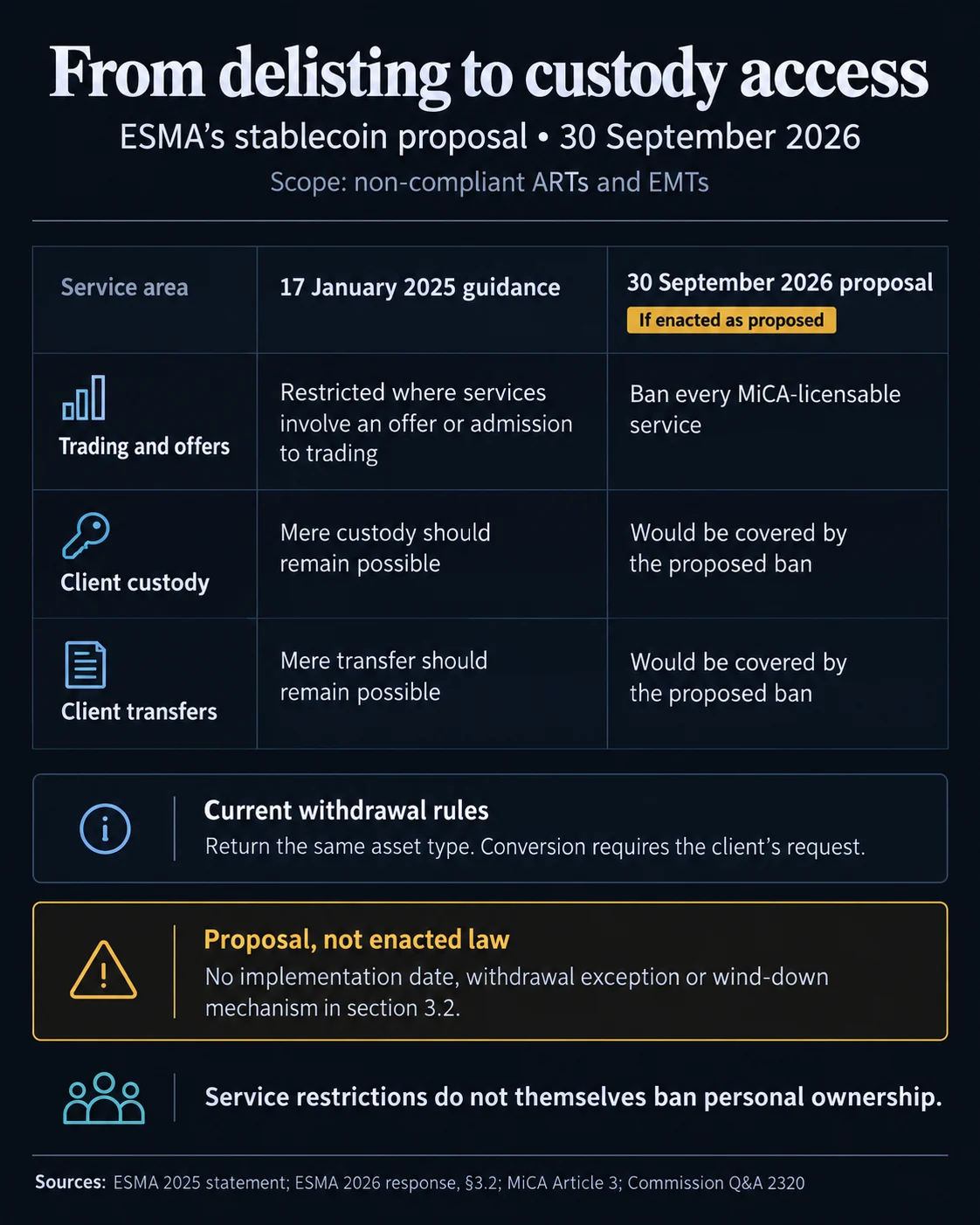
The European Securities and Markets Authority (ESMA) is advocating for a significant expansion of existing restrictions on stablecoins that fail to meet the bloc’s regulatory requirements. The proposed change, outlined in a recent response to a review of the Markets in Crypto-Assets (MiCA) regulation, would extend the prohibition beyond mere trading activities to encompass essential services like the safekeeping and movement of these digital assets. If adopted as proposed by ESMA, this measure would effectively eliminate the option for customers to leave non-compliant stablecoins with licensed custodians once their trading pairs are delisted, posing a substantial shift from the regulator’s earlier stance.
ESMA’s formal submission, dated September 30, 2026, to the European Commission’s consultation on the MiCA regulation review, requests a prohibition on all licensable crypto-asset services involving stablecoins that do not adhere to the regulation’s applicable criteria. This broad interpretation explicitly includes custody and transfer services. The ramifications would be felt by both existing holders of non-compliant stablecoins who may no longer be actively trading them, as well as potential new customers seeking to acquire them. This represents a notable hardening of ESMA’s position compared to its January 2025 guidance, which had suggested that basic custody and transfer services might still be permissible even after trading ceased. While the proposed change could confer a more pronounced competitive advantage to compliant stablecoins within the European market, it does not inherently mandate a specific timetable for forced conversion of existing holdings nor does it predict a global shift in demand.
Evolution of Regulatory Stance: From Trading Halts to Service Prohibitions
ESMA’s initial approach, detailed in a January 17, 2025 statement, had drawn a distinction between services that actively offered non-compliant stablecoins to the public or admitted them for trading, and those that simply involved holding or transferring them. At that time, platforms were expected to cease offering these tokens for trading, while other services were required to wind down if they constituted an offer to the public. Under this earlier framework, acquisition restrictions were anticipated by the end of January 2025, with a limited window for sell-only services extending through the end of the first quarter of 2025.
For investors, this distinction was crucial. The removal of a stablecoin’s trading pair did not automatically necessitate the termination of services that safeguarded existing balances or facilitated their withdrawal. ESMA had acknowledged that investors retaining such holdings might encounter less favorable execution conditions, even while custody and transfer functionalities remained available.
A practical illustration of this earlier distinction emerged in March 2025. CryptoSlate reported on March 3, 2025, that Binance had announced plans to delist nine stablecoin trading pairs for users within the European Economic Area (EEA) by March 31, 2025. However, the exchange indicated that deposit, withdrawal, conversion, and custody services would continue to be available for these tokens. This was the operational approach communicated by Binance at the time, aligning with the regulatory expectations set forth in early 2025.
The September 2026 submission, however, signals a departure from this activity-by-activity differentiation. ESMA now advocates for a more encompassing asset-compliance test, where the prohibition of services is directly tied to the stablecoin’s overall compliance status rather than the specific function being performed. The regulator argues that the absence of a clear and comprehensive prohibition creates uneven playing fields between compliant and non-compliant stablecoin issuers, thereby fostering opportunities for regulatory arbitrage.
The legal basis for this proposed expansion is rooted in the definitions provided within Article 3 of MiCA. Custody is defined to include the safekeeping or control of clients’ crypto-assets or the means of accessing them, such as private keys. Transfers, under the regulation, encompass the movement of assets on behalf of a client from one ledger address or account to another. Both of these are explicitly enumerated as licensable services. Article 82 of MiCA further stipulates client agreement requirements for the provision of transfer services.
It is important to note that provider permissions are distinct from token compliance. Article 59 of MiCA mandates that entities providing crypto-asset services must obtain authorization as a crypto-asset service provider (CASP) or qualify for specific permissions as designated financial entities. These authorizations are required to specify the exact services that are permitted. A license granted to a service provider does not, in itself, determine whether a particular stablecoin can be serviced.
Therefore, under the proposed framework, an existing holder would not be able to circumvent the restriction simply by deciding to cease trading activities. If ESMA’s proposed wording is enacted into law without specific carve-outs, the continued safekeeping of their assets by a custodian would itself be considered a prohibited service.
Implications for Existing Holders and Market Dynamics
The September submission from ESMA does not specify an implementation date, nor does it outline any exceptions for withdrawal or mechanisms for winding down existing operations. This omission is significant, particularly because the termination of custody services necessitates a clear process for returning assets that a provider is already safeguarding. The proposed prohibition also extends to transfer services, further complicating the exit strategy for affected users.
Current custody rules, as defined in Article 75 of MiCA, provide a framework for asset return. These rules mandate that procedures must be in place to return clients’ crypto-assets or their means of access as promptly as possible. Furthermore, client assets must be segregated from the provider’s own holdings.

An interpretive clarification from ESMA, dated February 18, 2026, addressed questions regarding asset returns. It stated that the assets returned must be of the same type as those held when the client requests withdrawal. While a provider may offer conversion into fiat currency or another crypto-asset, this can only occur if the client explicitly requests it at the time of withdrawal, and the provider must possess the necessary authorization for the additional service being offered.
This existing interpretation does not definitively resolve how a future blanket prohibition on custody services would handle client exits. However, it does underscore why the delisting of a trading pair, the termination of custody, and compulsory conversion cannot be treated as interchangeable outcomes. Legislators would need to carefully consider how any new prohibition aligns with the existing obligation to facilitate the return of client assets.
It is crucial to emphasize that the stablecoin proposal currently targets professional services related to non-compliant stablecoins. It does not, in itself, ban personal ownership of these assets, nor does it mandate the freezing of tokens or prescribe compulsory conversion. The ability of an individual holder to retain an asset and the capacity of a licensed business to hold or move that asset on behalf of a customer represent distinct legal and operational questions.
Trading Volume Shifts: A Limited Indicator of Custodial Exposure
Previous instances of stablecoin delistings have demonstrated how trading activity on European-facing venues can shift without necessarily reflecting a comparable movement across the broader global market. This highlights the potential for localized regulatory impacts to diverge from global trends.
A research paper published in July 2026 by Nicola Borri and Kirill Shakhnov examined trading patterns of the dollar-linked stablecoins USDT and USDC across 14 exchanges selected from CoinMarketCap’s top 30 centralized venues. Their analysis of daily pair-volume data, sourced from CryptoCompare and spanning from January 1, 2024, to December 7, 2025, provides some insight into market dynamics.
The researchers classified exchanges such as Bitstamp, Coinbase, Gemini, and Kraken as "regulated-facing" due to their significant audience share in the EU (exceeding 10% of Similarweb EU audience) and also in the US (above 10% audience share). The remaining ten venues were categorized as globally oriented, including Binance, despite its earlier delistings in the EEA. This audience-based classification serves as a proxy and does not definitively identify individual EU-resident trades or provide a precise division of legal exposure.
Around the study’s estimated event date of April 1, 2025, the authors calculated that USDC’s share of combined USDT and USDC trading volume increased by approximately six percentage points on regulated-facing exchanges relative to global exchanges. This estimate, derived from a 30-day window using smoothed and detrended data, measures a relative shift in trading activity across different groups of venues.
The study’s findings indicated that USDT trading volume on regulated-facing exchanges decreased by roughly 20% compared to global venues, while the estimated impact on USDC trading volume was not statistically significant. This suggests that USDC gained market share primarily because USDT trading contracted in this specific comparison, rather than due to a corresponding expansion in USDC trading volume itself.
Importantly, the aggregate USDC-to-USDT trading-volume ratios across the sampled exchanges remained largely stable around the event date. This observation pertains to the turnover on the sampled exchanges and does not offer a definitive measure of worldwide demand or the extent of custodial balances held within the EU. Neither the legal documents nor the academic study provide concrete figures for the total holdings that could be affected by a future custody restriction.
The Path Forward: Legislative Action and Investor Protection
Should ESMA’s proposal be adopted into law in its current form, compliant stablecoins would likely retain access to regulated custody and transfer channels, while non-compliant tokens would be excluded. For customers who rely on service providers to safeguard and move their stablecoin balances, this regulatory distinction could significantly impact the utility of their assets, extending beyond the mere availability of trading pairs.
The subsequent legislative amendment will be a critical juncture. Its specific scope, the effective date of its application, and its provisions for handling existing balances will be paramount. The manner in which such legislation reconciles the prohibition of custody services with the fundamental obligation to return clients’ assets will ultimately determine how, and if, existing holders of non-compliant stablecoins must transition away from regulated services. The regulatory landscape for stablecoins in Europe is poised for a significant evolution, with ESMA’s latest proposal signaling a more stringent approach to asset compliance and service provision.