admin
admin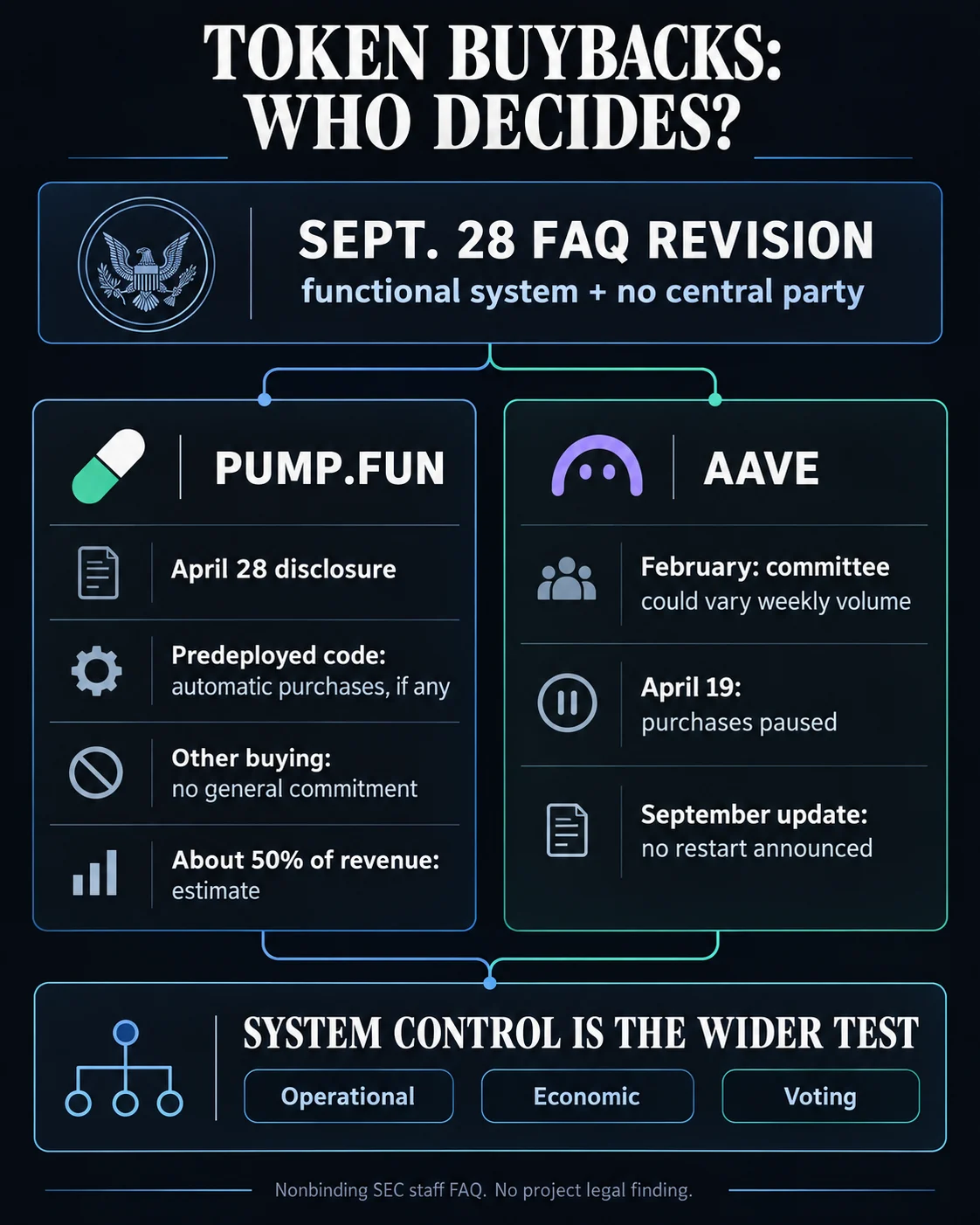
The U.S. Securities and Exchange Commission (SEC) has swiftly revised its guidance on cryptocurrency token buybacks, introducing a significant new condition just three days after its initial release. This rapid alteration from the agency’s staff underscores the evolving regulatory landscape for digital assets and presents new challenges for projects utilizing buyback mechanisms.
Initially, on September 25th, SEC staff indicated that a token issuer could announce a buyback without such an announcement being construed as a promise to actively manage the token’s value, provided the underlying crypto system was already operational. However, by September 28th, the agency amended this stance, adding a critical prerequisite: the crypto system must also possess "no central party." This nuanced addition has far-reaching implications, as many cryptocurrency projects currently rely on buyback programs while maintaining some degree of centralized control over their execution.
The updated guidance, published within the SEC staff’s frequently asked questions (FAQs) concerning crypto assets, now explicitly states that an announcement of a buyback for a non-security crypto asset will not, in isolation, be interpreted as an implicit promise of managerial efforts if the system is both functional and lacks a central party. This distinction is crucial for projects aiming to avoid classifications that could lead to stricter regulatory oversight.
A Shifting Regulatory Tide: The Evolution of Buyback Guidance
The SEC’s initial FAQ, released on September 25th, offered a degree of clarity for token issuers. It suggested that a public declaration of intent to repurchase tokens would not automatically trigger concerns about a central party managing the token’s value, as long as the underlying blockchain network was operational. This was seen by many in the industry as a positive step, acknowledging the practicalities of tokenomics and market stabilization efforts.
However, the rapid amendment just three days later signals a more cautious and perhaps more complex approach from the SEC. The addition of the "no central party" requirement injects a significant layer of scrutiny. Many decentralized finance (DeFi) protocols and tokenized ecosystems, while striving for decentralization, still incorporate elements of human or organizational oversight in treasury management and tokenomics. This includes the decision-making processes behind initiating, structuring, or discontinuing token buyback programs.
The revised FAQ now reads: "An announcement of a buyback for a non-security crypto asset would not, by itself, amount to a promise of essential managerial efforts when the system is both functional and has no central party." The emphasis on "no central party" is the key differentiator from the earlier guidance.
The Growing Prominence of Token Buybacks in the Crypto Market
The timing of this regulatory adjustment is particularly noteworthy given the surging popularity and financial scale of token buyback programs within the cryptocurrency sector. According to previous reporting by CryptoSlate, crypto projects collectively spent a record $638 million on token buybacks through the end of August. This substantial financial commitment highlights the perceived value and strategic importance of these initiatives for project developers seeking to manage token supply, enhance value for holders, or signal confidence in their ecosystem.
Token buybacks can serve multiple purposes. They can reduce the circulating supply of a token, potentially increasing its scarcity and thus its value. They can also be used to reward token holders by effectively increasing their stake in the overall supply. Furthermore, buyback announcements themselves can act as a positive signal to the market, indicating that a project’s management is actively working to support the token’s performance.
Deconstructing "Central Party" in the Crypto Context
To understand the implications of the SEC’s revised guidance, it is essential to revisit the agency’s definition of a "central party." In its March crypto-asset interpretation, the SEC provided a framework for identifying such entities. A central party is defined as a person, company, or group that exercises operational, economic, or voting control over a crypto system. Conversely, a decentralized system is characterized by the absence of such centralized control.
This definition is applied to the crypto system in its entirety. Therefore, merely having control over a project’s treasury or a specific buyback program does not automatically equate to the existence of a central party for the entire system. However, it can serve as a significant piece of evidence when evaluating who holds economic control.
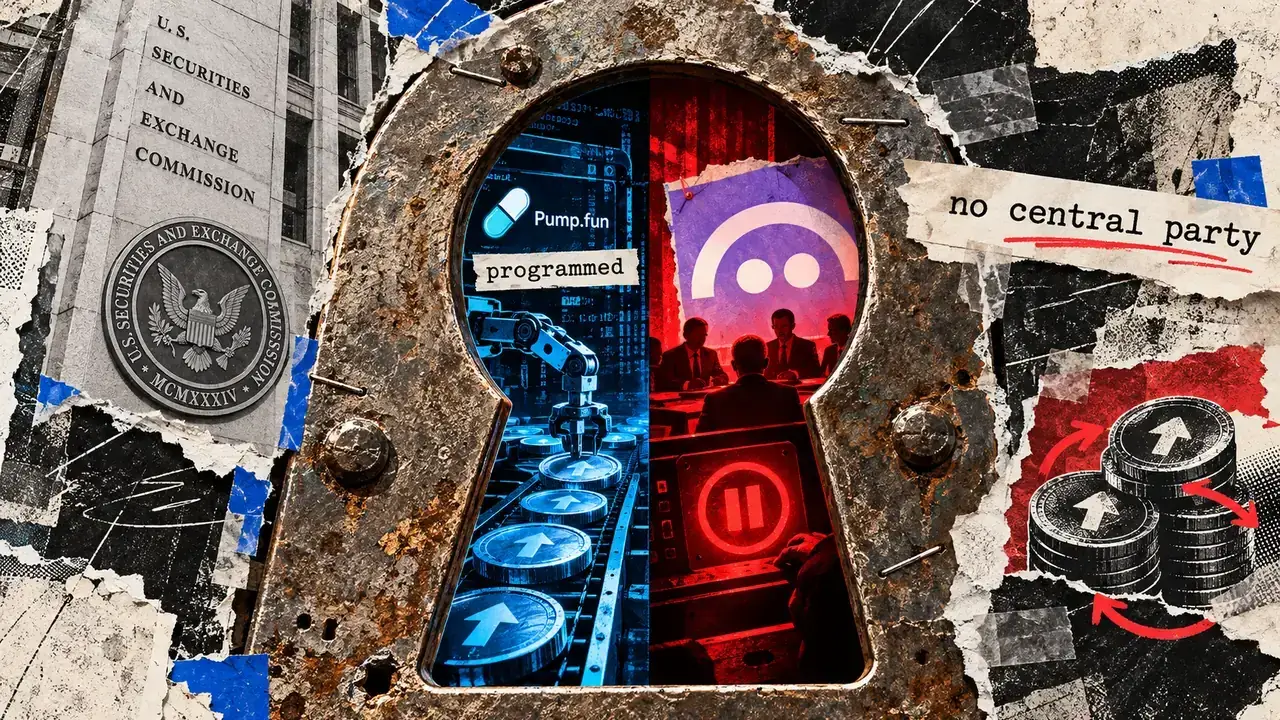
The complexity arises when projects blend automated buyback mechanisms with human-driven decision-making. For instance, a smart contract might be programmed to execute token purchases under certain predefined conditions. Simultaneously, a company, a committee, or a decentralized autonomous organization (DAO) might retain the authority to decide whether additional purchases occur, their size, or the overall duration of the buyback program.
The critical question, therefore, shifts from merely observing whether buybacks are happening automatically to assessing whether human actors still wield significant influence over the system’s economic decisions.
Case Study 1: Pump.fun’s Dual Approach to Buybacks
The platform Pump.fun offers a compelling illustration of this dynamic. In an April 28th disclosure, the platform clarified that references to PUMP purchases and a "buyback program" generally described planned initiatives or smart-contract functionalities rather than an immutable commitment to buy tokens. An exception was made for purchases that were already programmed to occur automatically via on-chain code deployed before April 28, 2026, UTC.
Pump.fun further stated that assertions regarding the allocation of approximately 50% of platform revenue towards token purchases were estimates, not guarantees. The platform also noted that third parties could, in some instances, execute certain purchases.
The platform’s PUMP token page specifies that 50% of defined platform revenue was programmatically locked and earmarked for burning over a one-year period commencing April 28th. However, it also indicates that future purchases could generally be initiated, halted, or modified, unless they were already pre-programmed to execute automatically.
A subtle discrepancy exists between the two disclosures regarding the specific cutoff dates for purchases considered automatic. The April 28th disclosure refers to code deployed before April 28th UTC, while the token page references activity programmed before April 29th. Regardless of these minor date variations, the core distinction remains: Pump.fun delineates two categories of activity.
Some token purchases are pre-programmed and executed autonomously. Others remain contingent on future human decisions. Whether Pump.fun possesses a "central party" under the SEC’s definition is not definitively established by this information alone. A comprehensive assessment would necessitate an examination of who controls the broader system, not solely its buyback mechanisms.
Case Study 2: Aave’s Discretionary Buyback Program and Pauses
The decentralized lending protocol Aave provides another relevant example of how human discretion can be integrated into token buyback programs. In a February 28th funding update, DAO service provider TokenLogic reported that the Aave Finance Committee held the authority to adjust weekly AAVE buyback volumes within a 75% range. These adjustments could be made based on a variety of factors, including liquidity conditions, market volatility, timing considerations, and protocol revenue. TokenLogic further noted that the DAO had allocated $42 million towards the purchase of over 205,000 AAVE during the program’s initial ten months.
The committee’s discretionary power became particularly evident in April. An April 22nd governance notice announced that AAVE buybacks had been paused effective April 19th, following an rsETH bridge incident that occurred the previous day. TokenLogic explained that the pause was intended to provide the treasury with greater flexibility while the repercussions of the incident were being assessed. The notice also stated that any resumption of buybacks would be communicated through a standard funding update.
A subsequent funding update covering August and September included AAVE among the assets eligible for purchase under updated token budgets. However, this update did not definitively confirm the resumption of AAVE buybacks, nor did it provide a record of completed purchases following the pause.
The April notice unequivocally confirms that the buyback program was suspended at that time. The later update indicates that the capacity to purchase AAVE was re-established, but it does not clearly ascertain whether actual purchases had recommenced.
Aave’s experience underscores the significance of the SEC’s newly emphasized wording. The ability of human actors to modify the scope of the buyback program and subsequently halt purchases in response to changing circumstances is a key takeaway. This does not automatically classify Aave as having a central party under the SEC’s definition. The SEC’s assessment is holistic, examining operational, economic, or voting control over the entire crypto system.
However, for investors and market participants endeavoring to gauge the true decentralization of a buyback initiative, a clear question emerges: who possesses the authority to initiate, terminate, or alter future token purchases, and what broader influence do they exert over the underlying crypto system?
Broader Implications for the Crypto Industry
The SEC’s rapid recalibration of its guidance on crypto token buybacks has significant implications for the broader digital asset ecosystem. Projects that rely on buyback mechanisms to support token value or manage supply now face increased pressure to demonstrate genuine decentralization or risk falling under stricter regulatory scrutiny.
For tokens that may already be classified or considered securities by the SEC, this guidance adds another layer of complexity to their operational frameworks. The distinction between a functional system with no central party and one that retains elements of centralized control will be a critical factor in future regulatory interpretations.
The SEC’s approach highlights a growing concern within regulatory bodies regarding the potential for token buybacks to be used as a form of market manipulation or as an implicit promise of returns, particularly when executed by entities with significant control over the project’s ecosystem. The "no central party" condition appears designed to push projects towards truly autonomous, code-driven buyback mechanisms, devoid of human intervention in decision-making regarding their initiation, duration, or volume.
This development also raises practical challenges for projects that have historically operated with a degree of centralized oversight, often for pragmatic reasons such as efficient decision-making, security oversight, and adapting to unforeseen market conditions. These projects may need to undertake significant architectural changes to their tokenomics and governance structures to align with the SEC’s increasingly stringent interpretation of decentralization.
The ongoing debate and evolving guidance from regulatory bodies like the SEC underscore the need for greater clarity and more robust dialogue between the crypto industry and regulators. As the digital asset market continues to mature, the interplay between innovation and regulation will remain a central theme, shaping the future trajectory of tokenized economies worldwide. The recent SEC guidance on buybacks is a potent reminder of this dynamic, signaling a more vigilant stance on the operational realities behind seemingly decentralized financial instruments.