admin
admin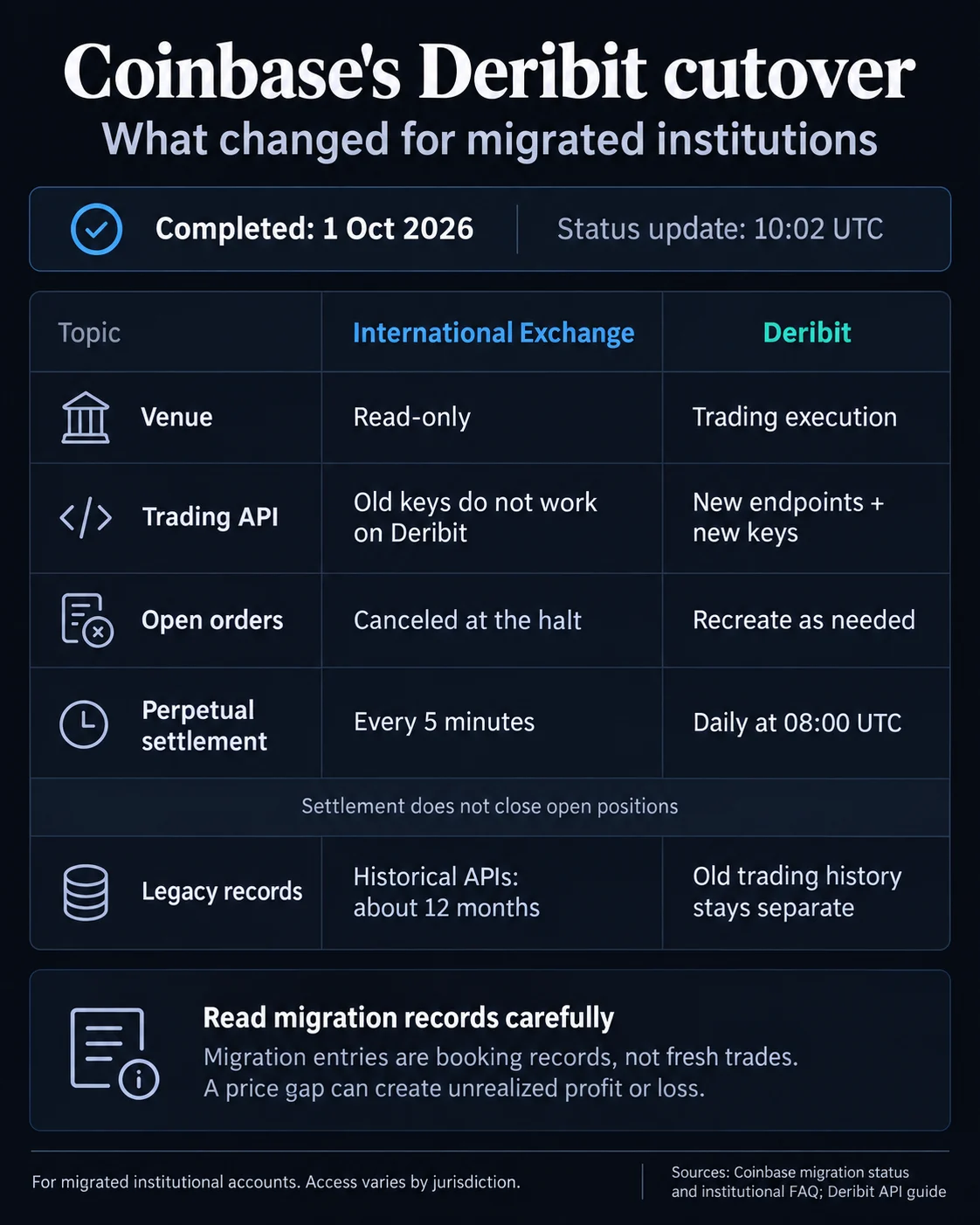
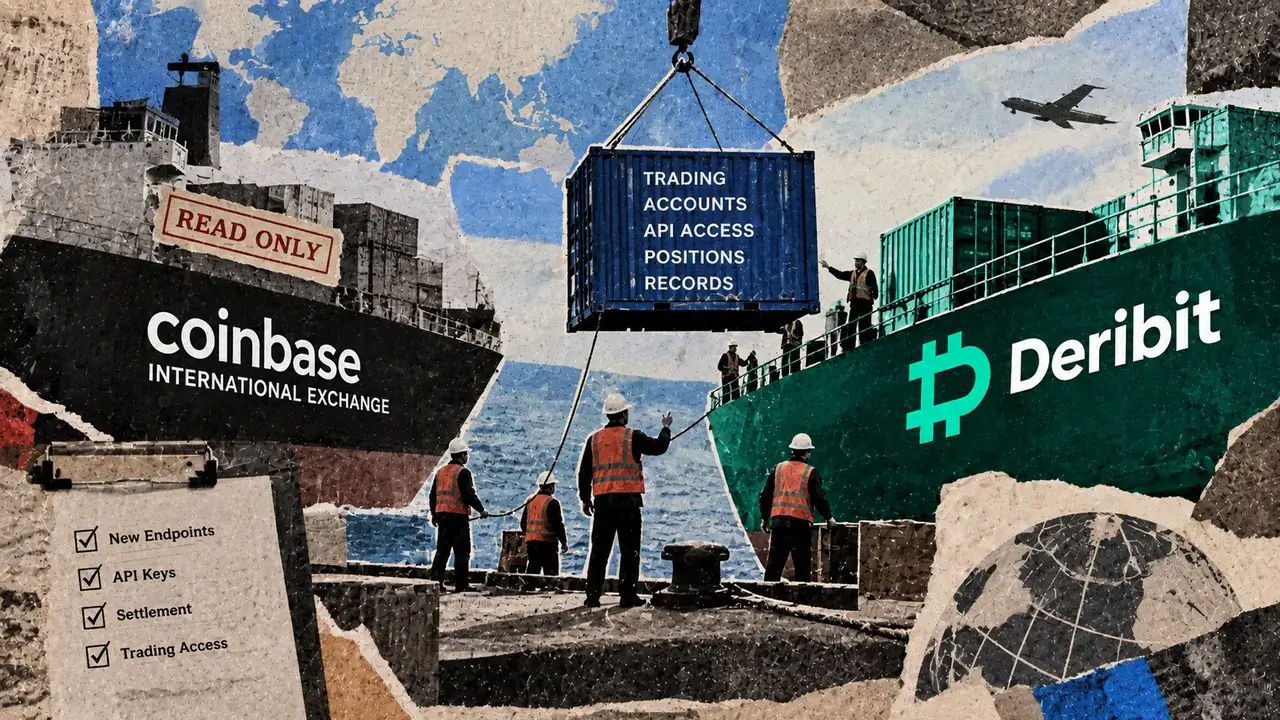
The transition of Coinbase’s International Exchange (CIE) to Deribit, a significant strategic move for the cryptocurrency exchange, was successfully completed on October 1, 2026. This migration marks the definitive closure of trading operations on the former Coinbase international venue, which has now transitioned to a read-only status. The operational shift has immediate implications for institutional clients, affecting their trading access, settlement processes, and historical data management.
Strategic Rationale Behind the Migration
Coinbase’s decision to consolidate its international derivatives trading operations onto the Deribit platform stems from a strategic imperative to enhance liquidity and streamline its offerings for institutional clients. By pooling previously fragmented liquidity from the Coinbase International Exchange into Deribit, the exchange aims to provide a more robust and efficient trading environment. This consolidation is particularly relevant in the competitive landscape of institutional crypto derivatives, where deep liquidity and advanced trading infrastructure are paramount. The move is also indicative of a broader trend among major crypto exchanges to specialize and leverage partnerships to optimize their product suites.
Detailed Operational Changes for Institutional Clients
For the affected institutional clients, primarily non-US entities operating in selected jurisdictions, the migration introduces several immediate operational considerations. The October 1st cutover, which concluded at 10:02 UTC according to Coinbase’s migration status report, signifies a complete cessation of new trading activity on the legacy platform.
Trading Access and Connectivity:
Institutional clients who previously utilized API or FIX connections for trading on Coinbase International Exchange must now reconfigure their systems to connect with Deribit’s infrastructure. This involves obtaining new Deribit API keys and utilizing Deribit’s designated endpoints. Crucially, existing Coinbase International Exchange API keys are no longer functional, and there is no provision for a parallel trading window on the old venue during the transition. Deribit’s comprehensive API migration guide explicitly states that IP allowlists configured for the previous platform will not be transferred, requiring clients to re-establish these security measures on the new system.
Order Management:
A critical aspect of the migration is the handling of open orders. Coinbase International Exchange’s policy was to cancel all open orders upon the trading halt rather than transferring them. This necessitates that clients who wish to reinstate their previous order intentions must manually recreate them on the Deribit platform. This requirement underscores the importance of meticulous planning and execution by institutional traders to avoid missing market opportunities or unintended position adjustments.
Settlement Cycles and Funding:
The migration introduces a significant change to the settlement cycle for perpetual positions. Previously, Coinbase International Exchange operated with a five-minute settlement cycle. The new arrangement on Deribit shifts this to a once-daily settlement at 08:00 UTC. During this daily settlement, profits are credited and losses are debited from cash balances without the positions themselves being closed. Funding rates, which reflect the cost of holding perpetual futures contracts, accrue continuously and are cash-settled at the same daily time. It is important to note that the quoted eight-hour funding rate is a separate convention and not directly tied to the settlement process itself.
Historical Data and Reporting:
The management of historical trade data presents another complex aspect of the migration. Legacy trading history from Coinbase International Exchange will not be directly accessible on Deribit. Instead, Coinbase has implemented a system where block-trade entries are tagged with "Migration" to represent the reopening of positions at the Coinbase International Exchange settlement price. These are essentially booking artifacts designed to reflect the state of positions at the time of the transition, not new trades. Any difference between this migration settlement price and Deribit’s mark price at the time of reopening can result in immediate unrealized profit or loss.
Coinbase has committed to maintaining access to historical trade and order APIs for a period of approximately 12 months following the migration. This provides institutions with a window to retrieve and integrate their legacy data, ensuring they maintain separate, albeit contiguous, records of their trading activity before and after the platform switch.
Legal and Structural Relationship
While execution now occurs on Deribit, the institutional legal relationship with clients has been structured to maintain a degree of familiarity and compliance. Coinbase Bermuda Limited acts as the broker, custodian, and primary counterparty for these institutional clients. This entity is responsible for routing orders to Deribit, as detailed in Coinbase’s institutional guidance. This layered approach ensures that clients maintain a direct legal relationship with a Coinbase entity while benefiting from the trading capabilities of Deribit.
User Experience and Product Availability
The impact of the migration varies depending on the user’s engagement with Coinbase’s platforms. For users accessing derivatives through the Coinbase app and website, the transition is designed to be more seamless. These users retain their existing Coinbase accounts and core workflows, although certain interface elements and market data displays may be updated to reflect the Deribit integration. However, clients utilizing the Coinbase Advanced Trade API for derivatives will still need to adapt to the new Deribit-powered gateway.
Furthermore, the availability of specific derivatives products is subject to regulatory frameworks and account types. Coinbase continues to distinguish its CFTC-regulated Coinbase Derivatives futures, which operate under a separate regulatory regime. Access to US Prime options, for instance, follows a different timeline. Coinbase has indicated plans to introduce in-app options trading for eligible users in selected non-US jurisdictions from late October, contingent on regulatory approvals and platform readiness.
Background and Timeline of the Deribit Partnership
The strategic alliance between Coinbase and Deribit has been developing over a period, culminating in this significant migration. Deribit, a prominent derivatives exchange known for its robust technology and deep liquidity in Bitcoin and Ether options and futures, represents a strong partner for Coinbase’s institutional ambitions. The decision to integrate with Deribit rather than developing a competing international derivatives platform internally suggests a focus on leveraging specialized expertise and existing market infrastructure.
The migration process itself likely involved extensive testing, API development, and client communication to ensure a smooth transition. The date of October 1, 2026, was a critical deadline, necessitating a complete operational cutover to minimize disruption. This timeline aligns with Coinbase’s broader strategy to refine its institutional product offerings and enhance its global competitive standing in the derivatives market.

Market Implications and Future Outlook
The consolidation of Coinbase’s international derivatives trading onto Deribit is likely to have several implications for the broader crypto derivatives market.
Increased Liquidity on Deribit: The influx of trading volume and open interest from Coinbase International Exchange is expected to further deepen liquidity on Deribit, potentially attracting more institutional participants to the platform. This could lead to tighter bid-ask spreads and more efficient price discovery.
Competitive Landscape: This move intensifies competition among crypto exchanges offering institutional-grade derivatives. Coinbase’s strategy of partnership over direct competition in this specific segment allows it to offer a sophisticated product without the full burden of building and maintaining a separate, complex trading engine.
Regulatory Considerations: The migration also highlights the ongoing efforts by major crypto players to navigate complex international regulatory landscapes. By leveraging Deribit’s established presence and operational framework, Coinbase can potentially streamline its compliance efforts in various jurisdictions.
Client Adoption and Adaptation: The success of this migration hinges on the ability of institutional clients to adapt to the new systems and processes. The initial period may see some friction as clients reconfigure their trading strategies and infrastructure. However, the long-term benefits of enhanced liquidity and a more streamlined offering are expected to outweigh these initial challenges.
Future Product Development: This partnership could pave the way for future collaborations between Coinbase and Deribit, potentially leading to the development of new derivatives products or the expansion of offerings into new asset classes.
In conclusion, the October 1st cutover represents a pivotal moment for Coinbase’s institutional strategy in the derivatives market. By successfully migrating its International Exchange operations to Deribit, Coinbase is positioning itself to offer a more robust, liquid, and integrated trading experience for its global institutional clientele, while simultaneously streamlining its own operational footprint. The long-term success of this initiative will be measured by client adoption, market share gains, and the continued evolution of institutional crypto derivatives trading.