Dwi Wanna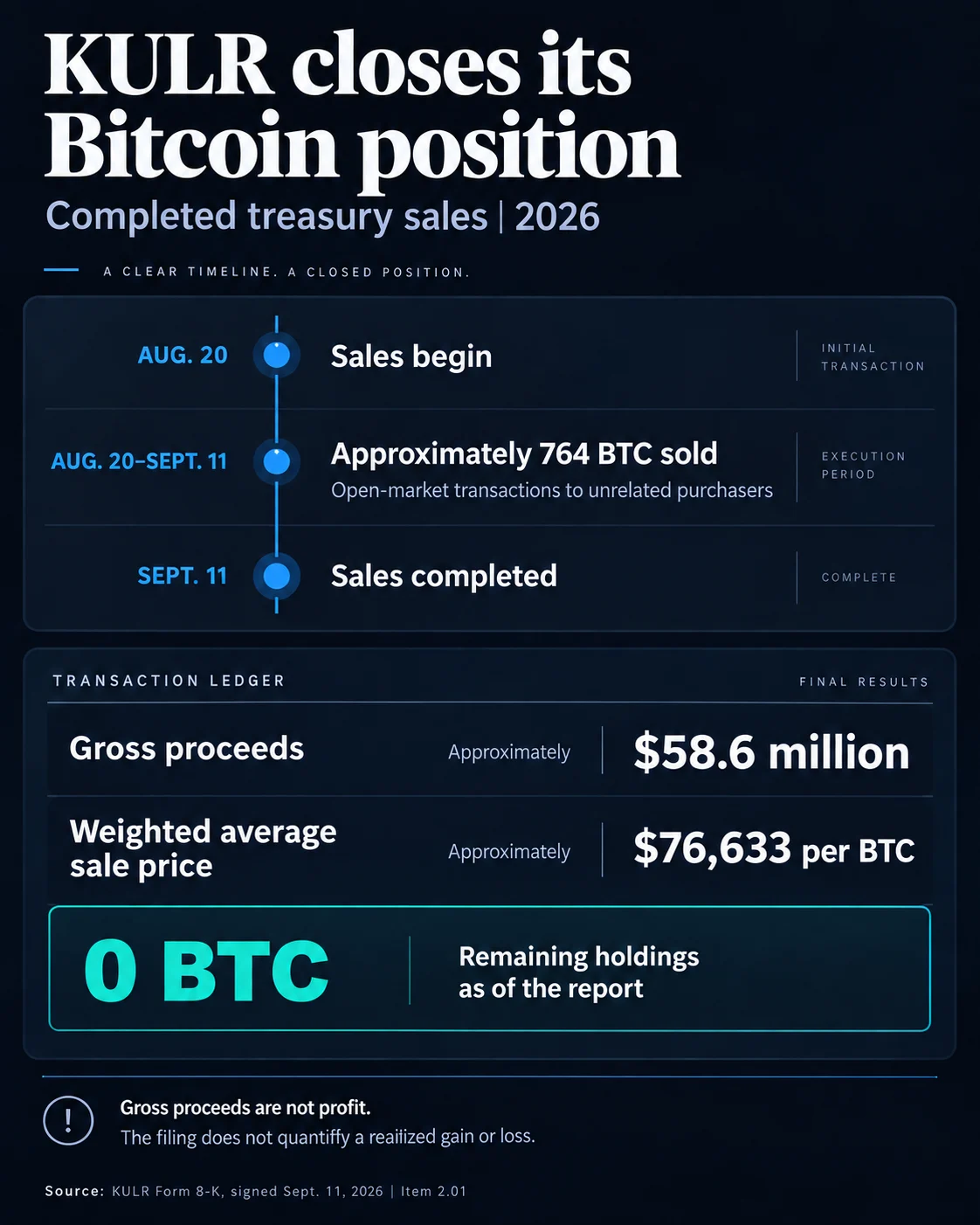
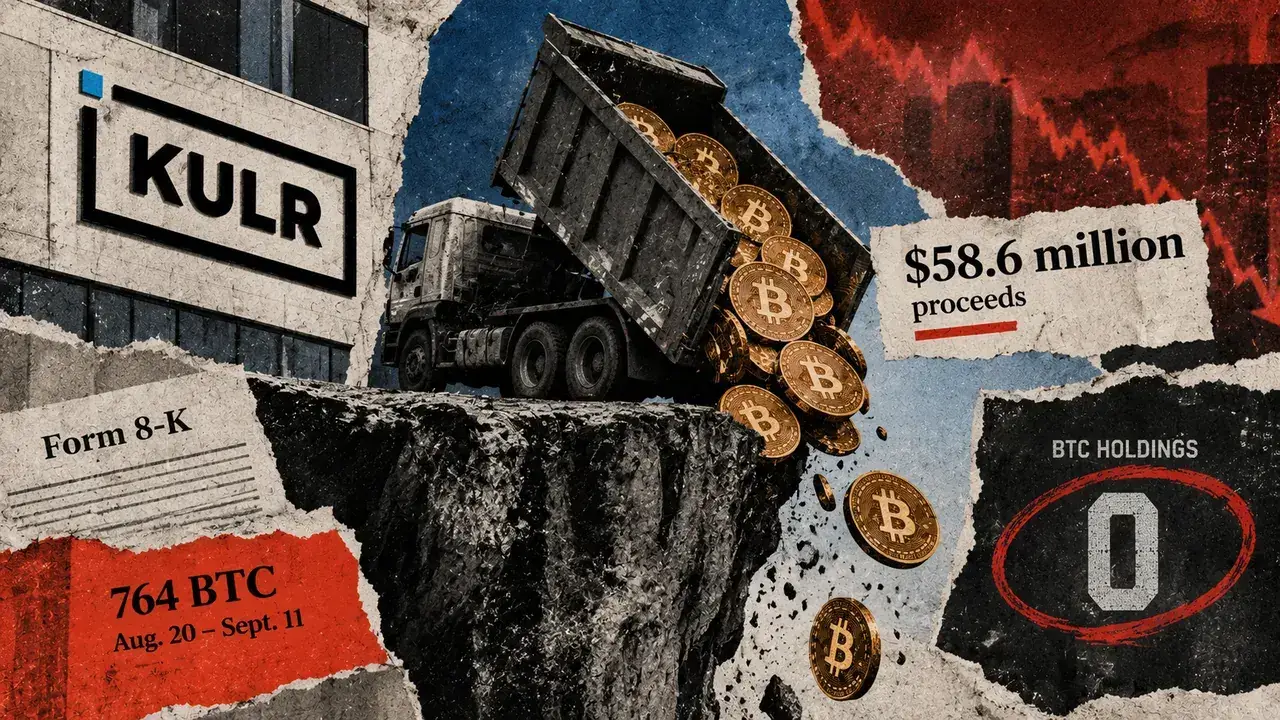
KULR Technology Group, a prominent developer of sustainable energy management and thermal safety solutions, has officially concluded its experimental foray into cryptocurrency by liquidating the remainder of its Bitcoin holdings. In a series of strategic financial moves executed between late August and mid-September 2026, the company divested its final 764 BTC, generating approximately $58.6 million in gross proceeds. This final sale marks the total abandonment of a Bitcoin treasury strategy that the company had once embraced as a means of asset diversification and capital growth. The decision to exit the digital asset market entirely reflects a broader corporate trend toward consolidating liquidity and refocusing on core industrial competencies amid a volatile macroeconomic landscape.
The liquidation process was detailed in a recent regulatory filing with the Securities and Exchange Commission (SEC), which revealed that the transactions occurred between Aug. 20 and Sept. 11, 2026. According to the filing, KULR offloaded the 764 BTC through open-market transactions to unrelated third-party buyers. The weighted average price for these sales was approximately $76,633 per Bitcoin. This divestment effectively brings KULR’s Bitcoin balance to zero, closing a chapter that had seen the company’s balance sheet fluctuate significantly due to the inherent volatility of the cryptocurrency markets.
A Phased Retreat from Digital Assets
The total liquidation of KULR’s Bitcoin reserves was not an impulsive reaction but rather the final step in a phased retreat that began earlier in the third quarter of 2026. In August, the company disclosed that it had already started unwinding its crypto positions. Between June 30 and mid-August, KULR sold approximately 333 BTC, which netted the firm roughly $21.5 million.
The primary motivation for that initial sale was the urgent need to address balance sheet liabilities. Specifically, KULR utilized approximately $20 million of those proceeds to repay the principal owed to Coinbase, the primary custodian and financing partner for its crypto operations. By settling this debt, KULR managed to eliminate a significant source of financial pressure and interest expense, but it also signaled to the market that its appetite for maintaining a Bitcoin-heavy treasury was waning.
When combining the August sales with the final September liquidation, KULR has generated more than $80 million in gross proceeds from its Bitcoin exit within a single quarter. This influx of cash provides the company with a substantial liquidity cushion, though the SEC filing remained silent on the specific cost basis of the coins or whether the final disposals resulted in a net realized gain or loss for the fiscal year.
The Chronology of KULR’s Bitcoin Strategy
To understand the significance of this exit, it is necessary to examine the timeline of KULR’s involvement with digital assets. KULR Technology Group initially entered the Bitcoin space with high ambitions, viewing the asset not just as a treasury reserve but as an operational extension of its energy business.
- Accumulation Phase (2024–2025): KULR began accumulating Bitcoin as a hedge against inflation and a potential high-yield asset. During this period, the company also invested in Bitcoin mining infrastructure, leveraging its expertise in thermal management to optimize the efficiency of mining rigs.
- Operational Integration: The company briefly operated a dedicated Bitcoin mining division, intending to showcase how its cooling technologies could be applied to high-performance computing and crypto-mining environments.
- Financial Volatility and Debt Accumulation: As the price of Bitcoin experienced sharp swings, the company’s equity value became increasingly correlated with the crypto market rather than its performance in the battery technology sector. To maintain its positions, KULR entered into financing agreements, including the notable debt facility with Coinbase.
- The Strategic Pivot (August 2026): Management determined that the volatility of the Bitcoin "playbook" was overshadowing the company’s core growth in the aerospace, defense, and electric vehicle (EV) sectors. The first major sale of 333 BTC was executed to clear debt.
- Final Liquidation (September 2026): The remaining 764 BTC were sold, and the mining operations were fully decommissioned, returning the company to a "Bitcoin-free" balance sheet.
Realigning with Core Energy and Thermal Management
The decision to abandon the Bitcoin treasury is rooted in KULR’s desire to refocus its capital and human resources on its primary business: thermal management and battery safety. KULR is a key player in providing specialized cooling solutions for lithium-ion batteries, a sector that is seeing explosive growth due to the global transition toward electrification and the expansion of the commercial space industry.
By liquidating its Bitcoin holdings, KULR has effectively de-risked its balance sheet. For institutional investors, the presence of a large, volatile asset like Bitcoin can often complicate valuation models. By removing this variable, KULR’s management is betting that the market will assign a more stable and higher valuation to its recurring revenue streams from aerospace contracts and energy storage solutions.
Industry analysts suggest that the $58.6 million in fresh capital will likely be deployed into research and development (R&D) or used to scale production facilities to meet the rising demand for the company’s "KULR VIBE" and "KULR SafeCase" products. These technologies are critical for preventing thermal runaway in battery packs—a major safety concern for EV manufacturers and NASA, both of which are long-standing partners of the firm.
Inferred Market Reactions and Stakeholder Sentiment
While KULR has not issued a formal press release detailing shareholder sentiment, the market’s reaction to similar moves by other public companies provides a roadmap for expectations. Generally, "pure-play" technology investors prefer that companies remain focused on their specific niche. When a battery tech company acts like a hedge fund by holding significant amounts of Bitcoin, it can lead to a "conglomerate discount," where the stock trades for less than the sum of its parts because of the added risk.
The move to liquidate was likely welcomed by conservative institutional shareholders who viewed the Bitcoin strategy as a distraction. Conversely, the "crypto-adjacent" retail investors who may have bought KULR stock as a proxy for Bitcoin exposure may view the move as a loss of upside potential. However, the $76,633 average exit price suggests that KULR exited at a historically strong price point, potentially preserving capital that can now be used to fund operations without the need for dilutive equity raises.

Broader Implications for Corporate Bitcoin Adoption
KULR’s total exit highlights a growing divide in how public companies view Bitcoin. On one side are the "maximalist" firms like MicroStrategy and Metaplanet, which have doubled down on Bitcoin as their primary treasury reserve. On the other side are companies like KULR and several smaller tech firms that have found the volatility of Bitcoin to be a hindrance to their operational goals.
The KULR case study serves as a cautionary tale for mid-sized public companies. While Bitcoin can provide significant treasury gains during a bull market, the financing costs and the impact on financial reporting can be onerous. For a company like KULR, which operates in the capital-intensive hardware and manufacturing sector, the need for "dry powder"—liquid cash—often outweighs the long-term "HODL" philosophy championed by crypto enthusiasts.
Furthermore, the closure of KULR’s mining operation reflects the increasing difficulty for non-specialized firms to remain competitive in the mining sector. As the hash rate increases and energy costs fluctuate, industrial companies are finding that their capital is better spent on their own proprietary technologies rather than on the highly competitive and low-margin business of securing the Bitcoin network.
Future Outlook: A "Bitcoin-Free" KULR
As of mid-September 2026, KULR Technology Group stands as a leaner, more focused entity. With zero Bitcoin on its books and approximately $58.6 million in new liquidity, the company is well-positioned to navigate the next phase of the energy transition. Investors will now be looking closely at the company’s upcoming quarterly earnings reports to see exactly how this cash is being utilized.
Key areas to watch include:
- Debt Reduction: Whether the company continues to aggressively pay down any remaining high-interest liabilities.
- Expansion in AI Cooling: KULR has previously hinted at applying its thermal technologies to AI data centers, a sector that requires massive amounts of capital but offers high margins.
- Strategic Acquisitions: The crypto exit proceeds could fund the acquisition of smaller firms with complementary battery patents.
While KULR’s filing did not explicitly rule out a return to Bitcoin in the future, the language of the disposal suggests a definitive shift in philosophy. For now, KULR has chosen to place its bets on the tangible world of thermal physics and energy storage, leaving the digital gold rush to others. The company’s journey from Bitcoin miner and holder back to a pure-play energy technology firm marks a significant moment of maturation in its corporate history.