Dwi Wanna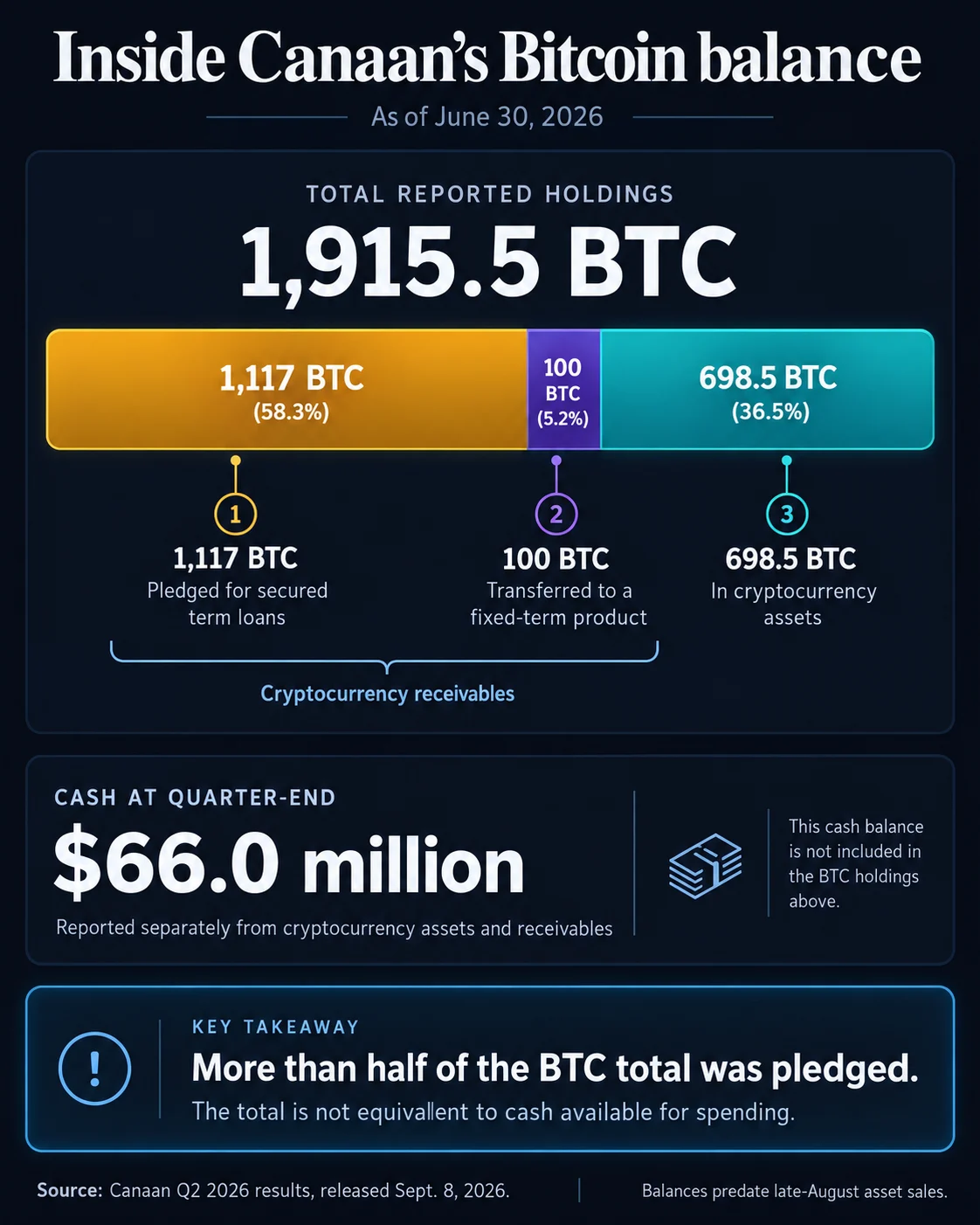
Canaan Inc., a pioneer in the Bitcoin mining hardware industry, has released its unaudited financial results for the second quarter of 2026, revealing a complex fiscal landscape characterized by declining product demand, significant net losses, and a strategic pivot toward liquidating cryptocurrency assets to fund corporate share repurchases. The company reported total revenue of $31.9 million for the three-month period ending June 30, 2026, a figure that notably failed to meet the lower bound of its previously issued guidance of $35 million to $45 million. This shortfall highlights the intensifying pressure on hardware manufacturers within the volatile digital asset ecosystem, where shifting market sentiment and rising mining difficulty have dampened the appetite for new application-specific integrated circuit (ASIC) equipment.
The financial report underscores a challenging period for the Singapore-based company, which saw its product revenue—primarily derived from the sale of its Avalon-branded mining rigs—plummet to $13.6 million. This represents a staggering decrease from the $42.9 million in product revenue recorded in the first quarter of 2026. Management attributed this sharp contraction to a combination of reduced total computing power sold and a decrease in average selling prices, reflecting a broader cooling of the hardware market as mining entities grapple with tighter margins.
Detailed Financial Performance and Net Losses
Canaan’s net loss for the second quarter reached $97.6 million, a figure that reflects both operational headwinds and significant non-cash accounting adjustments. While the headline loss is substantial, a granular analysis of the company’s expenses reveals that a large portion was tied to inventory and asset adjustments. Specifically, the company recorded $25.3 million in inventory write-downs, prepayment write-downs, and provisions for purchase commitments. These charges suggest that Canaan is holding stock that has depreciated in value or is facing commitments for raw materials and components that exceed current market demand.
Furthermore, the company recognized $9.2 million in impairment charges related to property and equipment. These non-cash charges, while not immediately impacting the company’s liquid cash reserves, indicate a downward revision in the long-term value of the firm’s productive assets. Despite these losses, the company’s cash position showed a moderate recovery during the quarter. Canaan reported $66 million in cash and cash equivalents as of June 30, 2026, up from $43.5 million at the end of the first quarter, though still well below the $80.8 million held at the conclusion of 2025.
The discrepancy between the massive net loss and the rising cash balance is partly explained by the company’s ability to generate liquidity through its own mining operations and financing activities. During the second quarter, Canaan’s mining segment remained a vital contributor to its top line, producing 243 BTC and generating $17.7 million in revenue. Management noted that these mining operations provided a positive cash contribution before accounting for depreciation, serving as a critical buffer against the volatility of the hardware sales market.
Treasury Management and the Pledging of Bitcoin
One of the most critical aspects of Canaan’s Q2 disclosure is the state of its cryptocurrency treasury. As of June 30, 2026, Canaan held a total of 1,915.5 BTC. However, a closer inspection of the balance sheet reveals that a significant portion of these holdings is not readily available for operational spending. Of the total balance, 1,117 BTC were pledged as collateral for secured term loans, and an additional 100 BTC were locked in a fixed-term investment product.

This leaves only 698.5 BTC—approximately 36% of the total holdings—categorized as unrestricted cryptocurrency assets. The pledging of more than half of its Bitcoin treasury indicates that Canaan has been leveraging its digital assets to secure traditional financing, likely to maintain liquidity without being forced to sell its Bitcoin at unfavorable prices during the quarter. These pledged and fixed-term assets were recorded as cryptocurrency receivables valued at $70.9 million, while the unrestricted assets were valued at $47 million.
This "narrow cash-flow system," as described by industry analysts, creates a delicate balancing act. By using Bitcoin as collateral, Canaan avoids immediate capital gains taxes and maintains exposure to potential Bitcoin price appreciation, but it also exposes the company to margin call risks if the price of Bitcoin were to drop significantly. The restricted nature of these assets means that the headline Bitcoin balance cannot be viewed as a liquid reserve for immediate corporate maneuvers.
Chronology of Share Repurchases and Crypto Liquidations
The timeline of Canaan’s financial activities in the third quarter of 2026 further illuminates the company’s strategy for managing its share price and liquidity. Following the close of the second quarter, Canaan took decisive action to bolster its cash reserves through the sale of digital assets. In late August 2026, the company sold 3,952 ETH and 54 BTC, netting approximately $13.9 million in proceeds.
These funds were promptly utilized to support the company’s stock price through an aggressive share repurchase program. By September 8, 2026, Canaan had repurchased approximately 16.4 million American depositary shares (ADS) for a total consideration of $7.4 million. Notably, $5.4 million of this spending occurred in the final days of August, immediately following the liquidation of the Ethereum and Bitcoin holdings.
This move has drawn mixed reactions from the investment community. On one hand, share buybacks are often viewed as a signal of management’s confidence in the company’s intrinsic value, especially when the stock is perceived to be undervalued. On the other hand, using depleted cash reserves and liquidated crypto assets to fund buybacks during a period of massive operational losses and declining revenue guidance can be seen as a risky use of capital. For Canaan, the priority appears to be stabilizing shareholder sentiment as the company enters what is projected to be an even more difficult third quarter.
Operational Challenges and Sector-Wide Context
Canaan’s struggle to maintain revenue targets is symptomatic of a broader trend within the Bitcoin mining hardware sector. The industry is currently grappling with the aftermath of the most recent Bitcoin halving event, which reduced the block reward and forced miners to seek maximum efficiency. This has led to a "survival of the fittest" environment where only the most energy-efficient machines, such as Canaan’s A14 and A15 series or competitors’ latest models from Bitmain and MicroBT, remain viable.
The decline in "computing power sold" mentioned by Canaan management suggests that even major mining farms are slowing their expansion plans or opting for secondary-market hardware to preserve capital. Additionally, the global hash rate has continued to climb, increasing the difficulty of mining and further squeezing the margins of the very companies that buy Canaan’s equipment.

In comparison to its peers, Canaan has historically maintained a smaller market share than the industry leader, Bitmain. While Bitmain often benefits from larger economies of scale and earlier access to cutting-edge chip fabrication nodes, Canaan has attempted to differentiate itself through transparency as a publicly traded company on the NASDAQ and through its diversification into AI chip development. However, as the Q2 results show, the company’s fortunes remain heavily tethered to the Bitcoin mining cycle.
Future Outlook and Market Implications
The outlook for the remainder of 2026 remains cautious. Canaan’s management has issued a conservative revenue guidance for the third quarter, projecting earnings between $11 million and $15 million. This forecast represents a further decline from the already disappointing Q2 figures and suggests that the "crypto winter" for hardware manufacturers may persist longer than initially anticipated.
The strategic decision to sell Ethereum holdings is also noteworthy. While Bitcoin is the primary focus of Canaan’s hardware and mining operations, the Ethereum sale indicates a liquidation of non-core assets to protect the core business and satisfy shareholder demands. It also suggests that the company may be streamlining its treasury to focus exclusively on the Bitcoin ecosystem.
Industry analysts suggest that Canaan’s path to recovery will depend on several factors:
- Technological Breakthroughs: The successful roll-out and mass production of next-generation chips that offer superior joules-per-terahash efficiency.
- Bitcoin Price Stability: A higher and more stable Bitcoin price would improve the ROI for miners, incentivizing them to upgrade their fleets with new Canaan hardware.
- Liquidity Management: The company must navigate its debt obligations and pledged collateral carefully to avoid forced liquidations during market downturns.
As Canaan navigates these turbulent waters, the distinction between its total treasury holdings and its available "spendable" cash will remain a key metric for investors. With equipment revenue weakening and a smaller third-quarter revenue range ahead, the company’s ability to balance operational costs, research and development for new ASIC miners, and its commitment to share repurchases will be the ultimate test of its long-term viability in the competitive high-performance computing market.
The reported $97.6 million loss, while heavy with non-cash charges, serves as a stark reminder of the volatility inherent in the infrastructure layer of the cryptocurrency industry. As the sector matures, companies like Canaan are being forced to adopt more sophisticated—and sometimes more aggressive—financial strategies to bridge the gap between innovation cycles and market demand. For now, the manufacturer remains a central player in the Bitcoin story, albeit one currently navigating a significant liquidity and demand squeeze.