admin
admin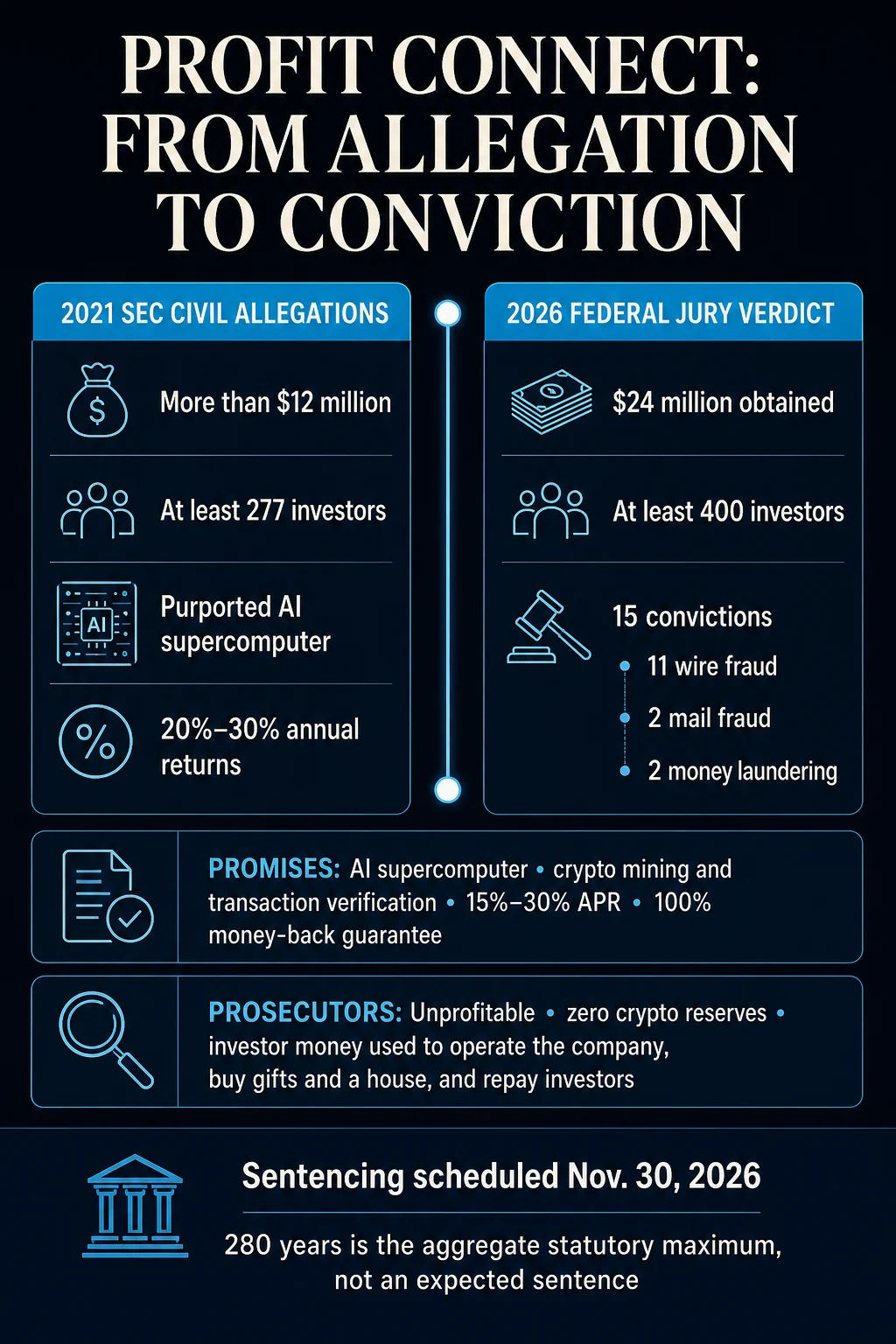
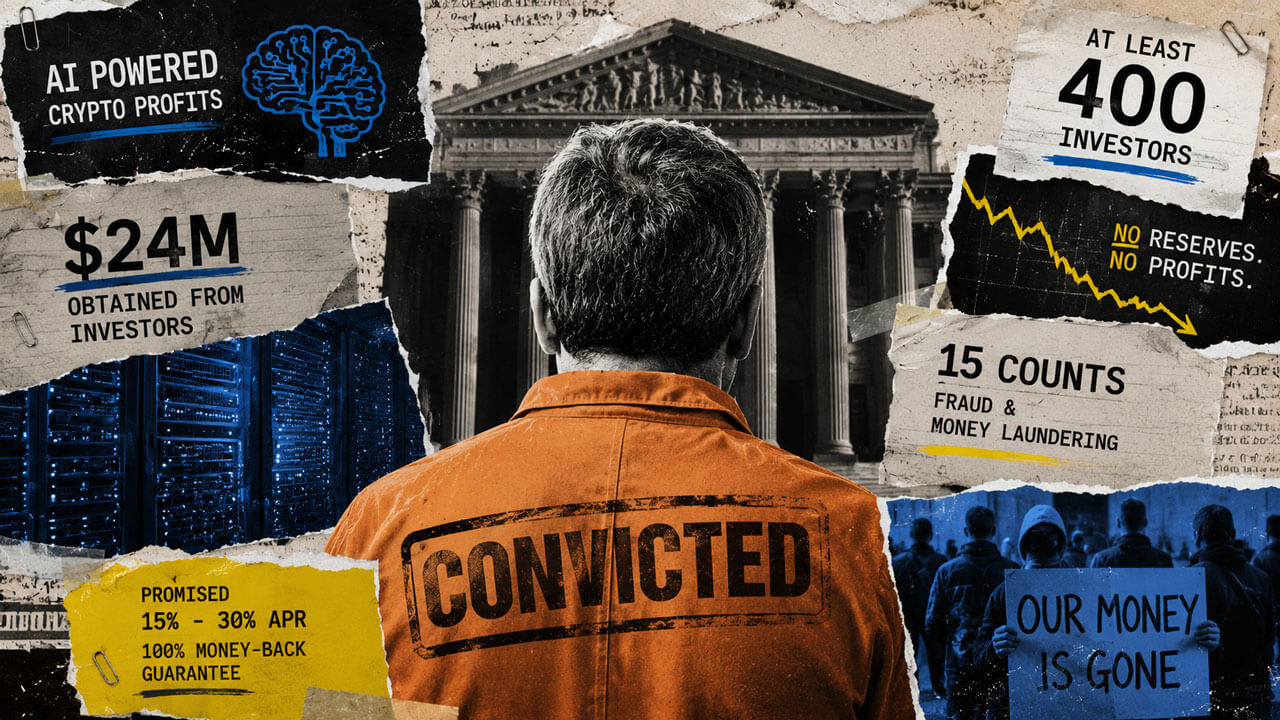
A federal jury has convicted Brent C. Kovar, the owner of Profit Connect, on 15 counts of fraud and money laundering, concluding a nine-day trial that revealed a sophisticated scheme to defraud at least 400 investors out of an estimated $24 million. Prosecutors successfully argued that Kovar employed deceptive claims about an artificial intelligence-powered cryptocurrency operation to solicit funds, ultimately operating a fraudulent enterprise that masked its true nature through a Ponzi-like structure. The verdict marks a significant victory for law enforcement in the ongoing battle against cryptocurrency-related financial crimes.
The jury’s decision, rendered after extensive deliberation, found Kovar guilty of 11 counts of wire fraud, two counts of mail fraud, and two counts of money laundering. These charges stem from activities that allegedly transpired between late 2017 and July 2021, during which Kovar consistently misrepresented Profit Connect as a highly profitable technology business capable of generating substantial returns for its investors. The Justice Department, through its U.S. Attorney’s Office for the District of Nevada, detailed the prosecution’s case, emphasizing the elaborate deceptions used to build and sustain the alleged fraud.
At the heart of the prosecution’s argument was Kovar’s narrative surrounding Profit Connect’s operations. He purported that the company utilized advanced AI software running on a supercomputer to engage in cryptocurrency mining and to verify complex cryptocurrency transactions. These claims were central to reassuring investors about the legitimacy and profitability of their investments. Kovar further bolstered these assurances by promising fixed annual returns ranging from 15% to 30% Annual Percentage Rate (APR), a highly attractive proposition in the investment landscape. Crucially, he also offered a 100% money-back guarantee, a provision that prosecutors contend was never intended to be honored and served as another layer of misdirection.
Adding to the facade of legitimacy, Kovar allegedly claimed that Profit Connect maintained substantial cryptocurrency reserves, reportedly in the hundreds of millions of dollars. This assertion was designed to instill confidence in the company’s financial stability and its capacity to meet its obligations. However, the Justice Department presented evidence to the contrary, asserting that the company was, in reality, unprofitable, held no significant reserves, and lacked any genuine source for the promised returns or the guaranteed refunds. The jury evidently found these assertions to be credible, leading to Kovar’s conviction.
The modus operandi, as outlined by the prosecution, involved a classic Ponzi scheme structure. Instead of generating profits through legitimate cryptocurrency operations as advertised, Kovar allegedly diverted investor funds to sustain the operation of Profit Connect itself. This included covering operational expenses, purchasing gifts for employees, acquiring a personal residence for himself, and, most critically, using new investor money to make payments to earlier investors. These repayments were then presented to investors as genuine proceeds derived from mining and transaction verification, effectively creating a false impression of a thriving and profitable enterprise.
A Detailed Chronology of Allegations and Conviction
The legal journey for Brent Kovar and Profit Connect began with civil allegations before escalating to criminal charges. A significant milestone in this process was the Securities and Exchange Commission’s (SEC) civil action filed in 2021. In that action, the SEC alleged that Joy and Brent Kovar had amassed over $12 million from at least 277 retail investors since approximately May 2018. The SEC’s complaint mirrored many of the allegations later pursued by the Justice Department, focusing on the promotion of 20% to 30% annual returns purportedly linked to an AI supercomputer. CryptoSlate extensively covered these SEC allegations at the time, highlighting the initial scrutiny faced by the Profit Connect operation.
It is important to distinguish between the SEC’s civil case and the federal jury’s criminal verdict. The SEC’s allegations formed the basis for a civil lawsuit aimed at disgorgement of funds and injunctive relief, while the federal jury’s conviction addresses criminal liability for fraud and money laundering. The figures presented in each case, while related, reflect different stages of investigation and legal proceedings. The SEC’s 2021 civil case cited over $12 million raised from at least 277 investors. In contrast, the August 2026 jury verdict established Brent Kovar’s criminal culpability concerning an estimated $24 million obtained from at least 400 investors. This increase in both the financial scope and the number of affected individuals underscores the perceived growth and deepening of the alleged fraudulent activities over time.
The disparity in figures between the SEC’s civil complaint and the criminal conviction is attributable to several factors. Firstly, the cases cover different timeframes. The criminal case likely encompassed a broader period of Kovar’s alleged illicit activities, extending further into 2021. Secondly, the investigative methods and evidence-gathering capabilities of the Department of Justice in a criminal investigation may uncover a more comprehensive picture of the financial flows and investor base than what was available to the SEC at the time of their civil filing. While the SEC’s initial figures provided a snapshot of the alleged scheme, the criminal proceedings have led to a more extensive accounting of the financial impact on victims. Precise investor losses and the extent of any potential recoveries will likely be determined through separate court or receivership proceedings, which will meticulously trace the flow of funds and assess the ultimate financial damage to those who invested in Profit Connect.
The Role of AI and Sophisticated Deception
The incorporation of "AI" and "supercomputer" into the marketing of Profit Connect was not merely incidental; it was a deliberate strategy to leverage emerging technologies and create an aura of cutting-edge innovation and unparalleled profit generation. In an era where artificial intelligence is rapidly transforming various industries, claims of AI-powered investment strategies can easily capture the attention and trust of investors, particularly those who may not fully grasp the complexities of AI or cryptocurrency markets. Prosecutors argued that Kovar exploited this fascination, using sophisticated technological jargon as a smokescreen for a fundamentally fraudulent operation.

The promise of guaranteed high returns, coupled with the allure of advanced technology and a money-back guarantee, created a powerful incentive for investors to part with their funds. The AI narrative provided a seemingly robust and futuristic explanation for how such returns could be consistently generated, masking the reality that the company was likely burning through investor capital. This tactic is a common thread in many Ponzi schemes, where the perceived legitimacy of the underlying business model is crucial to attracting and retaining investors.
Broader Implications for the Cryptocurrency Landscape
The conviction of Brent Kovar sends a clear and unequivocal message to those who seek to exploit the cryptocurrency space for illicit gains. It reinforces the commitment of law enforcement agencies to investigate and prosecute complex financial crimes, even those involving novel technologies. The increasing prevalence of cryptocurrency fraud underscores the need for enhanced investor education and regulatory vigilance. As the digital asset market continues to mature, so too do the methods employed by fraudsters.
This case highlights several critical implications:
- Increased Scrutiny on AI-driven Investments: As AI plays a more prominent role in finance, regulators and law enforcement will likely increase their scrutiny of investment schemes that claim to leverage AI. The burden of proof for demonstrating the legitimacy and efficacy of such AI applications in generating returns will be significant.
- Enforcement Against Ponzi Schemes in Crypto: The conviction demonstrates that traditional financial crime methodologies, such as Ponzi schemes, are readily adaptable to the cryptocurrency environment. Law enforcement agencies are developing expertise in tracing digital assets and dismantling these operations.
- Importance of Due Diligence for Investors: The case serves as a stark reminder for investors to exercise extreme caution and conduct thorough due diligence before committing funds to any investment, especially those promising exceptionally high or guaranteed returns. Verifying the underlying business model, the credentials of the operators, and the regulatory compliance of the entity is paramount.
- Inter-Agency Cooperation: The collaboration between the SEC and the Justice Department in pursuing cases like this is crucial. The SEC’s initial civil action likely provided valuable information and laid the groundwork for the subsequent criminal investigation and prosecution by federal authorities.
Sentencing and Future Proceedings
Following the jury’s verdict, Brent Kovar now faces sentencing. The Justice Department has indicated that the convictions carry a potential aggregate statutory maximum of 280 years in prison. This figure represents the combined maximum penalties across all the counts of which Kovar was found guilty. The final sentence will be determined by a federal judge, who will take into account the U.S. Sentencing Guidelines, as well as other statutory factors and any mitigating or aggravating circumstances presented during the sentencing hearing. The sentencing is scheduled for November 30th.
The outcome of the sentencing will provide further closure for the investors who were allegedly defrauded. While the conviction is a significant step, the recovery of lost funds remains a primary concern for victims. The process of asset forfeiture and potential restitution, often initiated in conjunction with criminal convictions, will be a critical aspect of the post-verdict proceedings. The detailed tracing of funds undertaken during the investigation will be instrumental in identifying assets that can be seized and potentially distributed to those who suffered financial losses. The ongoing legal processes will continue to shed light on the full extent of the financial impact and the avenues for victim compensation.