admin
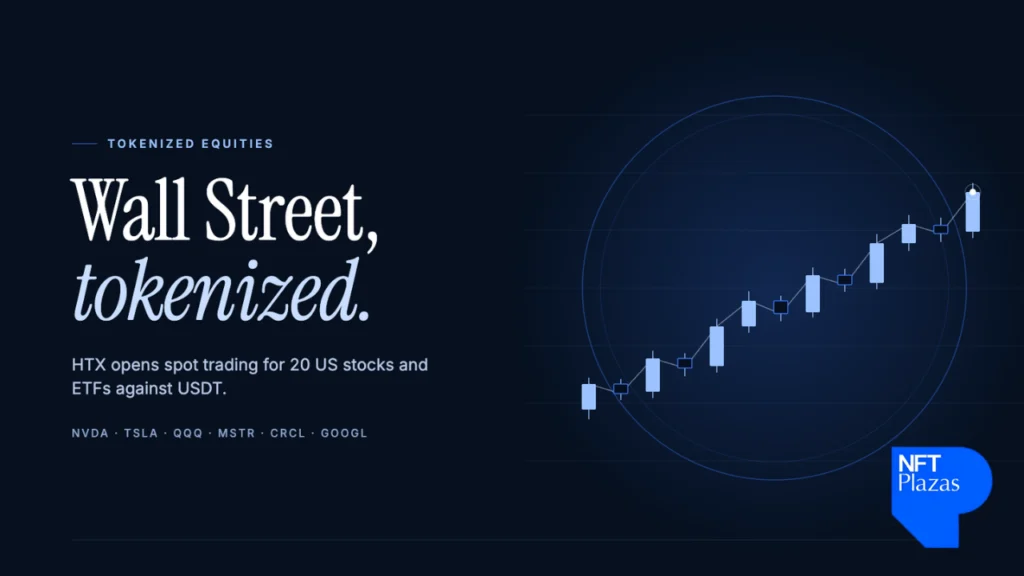
HTX, the global cryptocurrency exchange backed by Justin Sun, has officially launched tokenized U.S. stock and exchange-traded fund (ETF) trading, introducing 20 products available with USDT trading pairs. The significant rollout, announced on November 9, marks a strategic expansion for the platform as digital asset exchanges increasingly bridge the gap between blockchain-based trading and conventional financial markets. This initiative positions HTX at the forefront of a growing trend to democratize access to traditional securities through the efficiency and borderless nature of distributed ledger technology.
Justin Sun, a prominent figure in the cryptocurrency space and an advisor to HTX, confirmed the launch via an X post, stating, "US stock spot trading has officially launched on Huobi HTX." This announcement underscores HTX’s ambition to diversify its offerings beyond cryptocurrencies, catering to a broader investor base seeking exposure to major global equities without navigating traditional brokerage complexities. The move reflects a broader industry shift towards tokenization, where real-world assets are represented as digital tokens on a blockchain, promising enhanced liquidity, fractional ownership, and 24/7 trading capabilities.
A New Gateway to U.S. Equities: The bStocks Series
The initial offering on HTX features 20 tokenized assets under its "bStocks series," initially supported on the BNB Smart Chain (BSC). This selection includes some of the most actively traded and influential companies in the U.S. market, alongside popular ETFs. Among the individual stocks, users can now gain exposure to technology giants such as Nvidia (NVDA), Tesla (TSLA), Alphabet (GOOGL), Intel (INTC), AMD, and Micron Technology (MU). The inclusion extends to companies with significant ties to the crypto space, like Circle (CRCL), a major stablecoin issuer, and Strategy (MSTR), known for its substantial Bitcoin holdings.
For investors seeking diversified exposure or leveraged plays, HTX has also introduced tokenized versions of key ETFs. These include the Invesco QQQ Trust (QQQ), which tracks the Nasdaq-100 Index, the ProShares UltraPro QQQ (TQQQ), a leveraged ETF designed to deliver three times the daily performance of the Nasdaq-100, and the Direxion Daily Semiconductor Bull 3X Shares (SOXL), another leveraged ETF focused on semiconductor companies. The inclusion of leveraged ETFs, while offering potentially amplified returns, also introduces significantly higher risks compared to conventional, unleveraged stocks or ETFs, necessitating careful consideration by traders. All 20 assets are paired with USDT, allowing eligible customers to seamlessly trade these stock-linked tokens directly within HTX’s spot market.
Operational Mechanics and Key Distinctions
The operational rollout commenced with deposits opening at 08:00 UTC on November 9. Trading for specific pairs, such as SPCX/USDT and CRCL/USDT, was scheduled for 09:00 UTC and 10:00 UTC, respectively, with additional pairs expected to become active as sufficient liquidity is established. A notable aspect of the launch, however, is that HTX has not yet confirmed a timeline for when withdrawals of these tokenized assets will be enabled. Contract addresses for all 20 bStocks assets were published as part of the initial BNB Smart Chain deployment, offering transparency regarding their on-chain representation.
Crucially, HTX has emphasized a fundamental distinction: while these products track the economic performance of publicly traded securities, purchasing them does not confer direct ownership of the underlying company shares. An HTX representative clarified that the initial offering provides eligible customers with economic exposure to underlying securities through blockchain-based tokens, which are considered tokenized derivatives. The exchange states that these tokens are backed by the underlying securities or other eligible assets, with custody and redemption arrangements governed by the relevant issuer’s documentation.
This distinction carries several important implications for investors. Holders of HTX’s bStocks generally cannot exercise shareholder voting rights, a fundamental aspect of direct equity ownership. Furthermore, corporate actions such as dividends, stock splits, and other capital adjustments are subject to the issuer’s terms and may not directly mirror the benefits received by traditional shareholders. HTX explicitly warns that the trading prices of these tokenized derivatives may diverge from the underlying securities, particularly during periods outside regular U.S. market hours, given the 24/7 nature of crypto markets. This highlights the unique market dynamics and potential risks associated with tokenized products compared to their traditional counterparts. Currently, the bStocks series is supported on BNB Smart Chain, but HTX has indicated that support for additional issuers and blockchain networks could be introduced in the future, signaling a potential multi-chain strategy.
Incentivizing Adoption: Zero Fees and Trading Rewards

To catalyze trading activity and attract users to its new tokenized offerings, HTX has rolled out an aggressive promotional campaign. Running from November 9, 2026, through February 9, 2027, the exchange is offering zero maker fees for eligible orders on all 20 tokenized stock and ETF pairs. This extended fee waiver is designed to incentivize liquidity providers, encouraging them to place limit orders and contribute to the depth and stability of the order books. While maker orders benefit from this promotion, regular taker fees will continue to apply, meaning users who execute market orders immediately will still incur trading costs.
Beyond the fee reductions, HTX has introduced volume-based incentives through a separate campaign active from November 9 to December 9. During this period, users generating at least 10,000 USDT in daily trading volume can qualify for a 100% rebate on the actual trading fees paid that day, effectively making their trades cost-free for significant volumes. High-volume traders are further incentivized: those reaching 500,000 USDT in cumulative trading volume can qualify for a share of a 50,000 USDT prize pool. The top three participants, each achieving a cumulative trading volume of at least 5 million USDT, will receive rewards equivalent to an iPhone Duo 1TB, signaling a strong push to attract institutional or professional traders. These multi-faceted incentives underscore HTX’s commitment to rapidly build liquidity and user engagement for its new tokenized securities segment.
Broader Trends and HTX’s Strategic Positioning
HTX’s entry into tokenized U.S. equities is not an isolated event but rather reflects a significant and accelerating trend across the broader cryptocurrency industry. Major exchanges worldwide are increasingly exploring avenues to integrate traditional financial assets onto blockchain-based platforms. Competitors such as Binance and Kraken have also ventured into tokenized equities or similar stock-linked products, recognizing the demand from crypto investors for diversified portfolios that include exposure to conventional markets. This convergence is driven by the potential for increased market efficiency, reduced settlement times, and broader accessibility offered by blockchain technology.
For HTX, the introduction of 20 U.S. stock and ETF-linked tokens represents a pivotal moment in expanding its trading ecosystem beyond its core cryptocurrency offerings. This move is strategically aimed at attracting a new demographic of investors who may be interested in combining the innovative aspects of digital assets with the perceived stability and familiarity of traditional securities. By offering USDT-denominated access, HTX removes many of the friction points associated with traditional international stock trading, such as fiat currency conversions and complex brokerage accounts, potentially appealing to a global audience.
However, geographic restrictions remain a critical consideration. HTX has stated its commitment to complying with applicable regulatory requirements in all markets where it operates, explicitly noting that it does not provide services to users in restricted jurisdictions. Despite this, the exchange has not publicly identified specific eligible countries or explicitly clarified whether U.S. residents can access these tokenized products. Given the stringent regulatory environment surrounding securities in the United States, particularly for derivatives offered by crypto platforms, the accessibility for U.S. customers is a key unanswered question that will heavily influence the market reach of this initiative.
Regulatory Context and Future Outlook
The launch also occurs against a backdrop of recent regulatory developments involving Justin Sun and HTX. In March 2023, the U.S. Securities and Exchange Commission (SEC) initiated a lawsuit against Sun and several related entities, alleging unregistered cryptocurrency offerings and wash trading activities. However, in March 2026, the SEC dismissed its claims against Sun, the Tron Foundation, and the BitTorrent Foundation with prejudice, signaling a resolution for those specific allegations. Rainberry, another defendant in the case, agreed to a $10 million civil penalty under the settlement, with the defendants neither admitting nor denying the allegations. This dismissal, coming eight months prior to the tokenized stock launch, provides a clearer regulatory landscape for Sun’s ventures in the U.S. context, at least concerning past crypto offerings.
Separately, HTX reached an agreement with the UK’s Financial Conduct Authority (FCA) in October 2026, addressing financial promotion restrictions and its activities within the British market. This agreement highlights the ongoing global regulatory scrutiny faced by cryptocurrency exchanges and their efforts to operate within established legal frameworks. These recent regulatory engagements underscore the complex and evolving compliance environment that HTX, and indeed the entire crypto industry, must navigate as it expands into more traditional financial products.
HTX’s latest move to embrace tokenized U.S. equities is a significant marker of the intensifying convergence between the cryptocurrency and traditional finance sectors. While tokenized equities promise convenient, USDT-denominated access and potential fractional ownership, their long-term success and widespread adoption will hinge on several critical factors: the depth of liquidity, the transparency and reliability of the underlying asset issuers, robust redemption arrangements, and critically, clearer regulatory access and frameworks across different jurisdictions. With 20 assets available at launch, coupled with compelling promotional trading incentives, HTX is strategically positioning tokenized securities as a major, integral component of its expanding digital asset ecosystem, aiming to capture a significant share of the evolving market where blockchain meets Wall Street. The coming months will be crucial in observing how HTX’s bStocks series performs and how regulators and investors react to this ambitious push into new financial frontiers.