admin
admin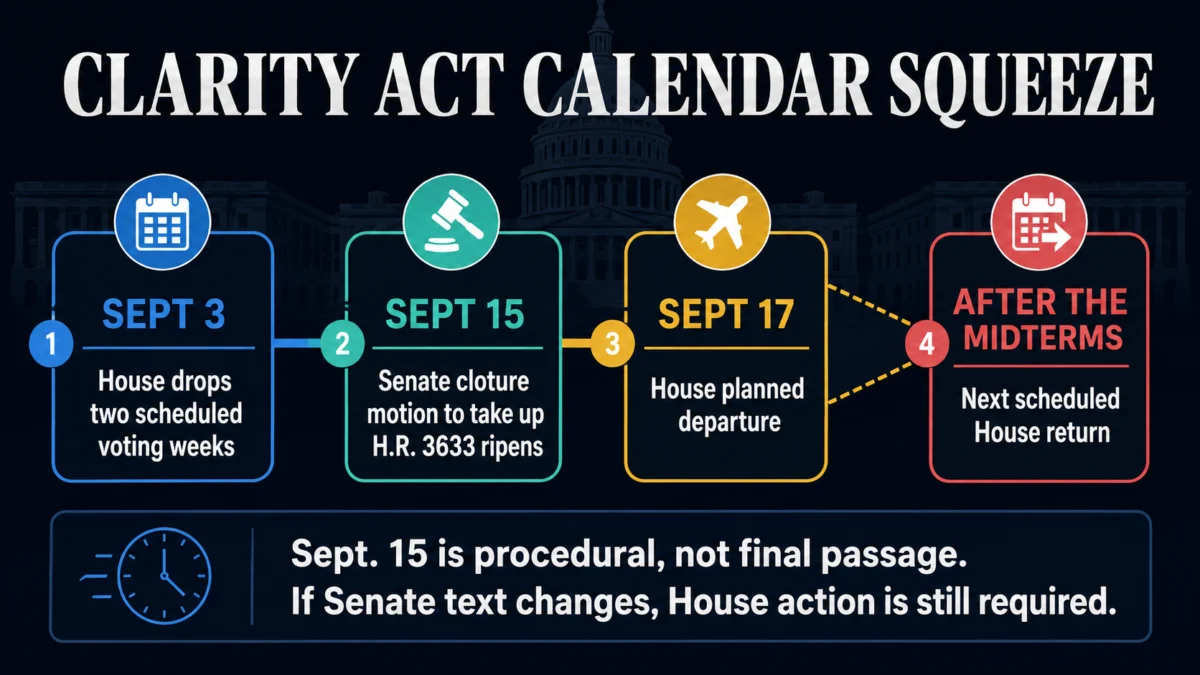
The already compressed legislative timeline for the CLARITY Act, a pivotal piece of crypto market-structure legislation, has been dramatically shortened by House Republicans, significantly diminishing its prospects for passage before the upcoming November midterm elections. This development comes despite escalating calls for action from key stakeholders, including the White House, congressional leaders, and industry proponents, who argue that such a bill is crucial for establishing regulatory clarity and fostering American leadership in the burgeoning digital asset sector.
The unexpected shift in the House’s schedule, announced with little advance warning, effectively truncates the remaining pre-election legislative window. House Republican leadership recently canceled scheduled voting sessions for the weeks of September 21st and September 28th. Crucially, the chamber’s departure for the midterm recess has been moved forward to September 17th, a substantial acceleration from the previously planned October 1st adjournment. The House is slated to reconvene on September 14th for a brief, four-day voting period before its members depart Washington D.C. until after the November elections conclude.
This abrupt calendar adjustment presents an immediate and formidable obstacle for the CLARITY Act. The Senate, which has been deliberating on amended language for the bill, has its first major procedural vote scheduled for September 15th. This date falls a mere two days before the House is set to adjourn, creating a logistical challenge for reconciling any Senate-passed version with the bill already approved by the House in July 2025 with a significant bipartisan majority of 294-134.
A Tightening Timeline: From July’s Passage to September’s Squeeze
The journey of the CLARITY Act to this critical juncture has been marked by intense lobbying and a clear, albeit narrowing, legislative path. Following its decisive passage in the House, the Senate embarked on its own review process, incorporating amendments and engaging in discussions that have extended the legislative timeline. This process, while necessary for consensus-building, has now collided with the House’s accelerated departure.
Alex Thorn, Head of Research at Galaxy Digital, a prominent firm in the digital asset space, articulated the severity of the situation in a recent public statement. He characterized the calendar change as making the bill’s passage before the midterms "extremely unlikely." While the Senate retains approximately three weeks of legislative session stretching into early October, any legislative text emerging from the upper chamber must ultimately align with the House’s approved version to proceed to President Donald Trump’s desk for signature. The necessity for this reconciliation means that even a Senate victory alone would not finalize the bill’s enactment.
Prior to the House’s schedule revision, there was a degree of optimism regarding the remaining legislative runway. Brendan Pedersen, a reporter for Punchbowl News, had previously indicated that senators could potentially navigate the required procedural steps within roughly a week and a half, assuming smooth proceedings and a manageable number of amendments. This projection suggested that even with the Senate’s ongoing work, there would still be sufficient time for the House to swiftly consider and potentially approve any Senate-amended version of the CLARITY Act. However, the cancellation of the late-September House voting days has effectively eliminated this crucial "late-September cushion."
Rising Pressure and the Imperative for Clarity
The current legislative crunch intensifies against a backdrop of escalating pressure from multiple fronts. The White House, influential congressional figures, and regulatory bodies have all amplified their calls for legislative action, underscoring the perceived urgency of addressing the regulatory landscape for digital assets.

President Donald Trump last week publicly urged Congress to enact "a fair version of the Clarity Act," signaling his administration’s support for comprehensive legislation. Similarly, SEC Chair Paul Atkins has consistently emphasized the "indispensable" nature of legislative clarity, even as the Securities and Exchange Commission continues to develop its own regulatory frameworks for the crypto industry. This dual approach highlights a recognized need for a definitive legislative mandate that can complement or guide agency rulemaking.
House Financial Services Committee Chairman French Hill has also been a vocal advocate for Senate action. He has frequently pointed to the broad bipartisan support the CLARITY Act garnered in the House, noting the significant contingent of 78 Democrats who joined Republicans in voting for its passage. In a statement on the social media platform X, Chairman Hill posed a rhetorical question that encapsulates the broader ambition behind the legislation: "Can Democrats work with Republicans and make sure America leads the world in distributed ledger technology and financial services?" This statement underscores the geopolitical and economic implications tied to establishing a clear regulatory environment for innovation.
Senator Cynthia Lummis, a key proponent of the CLARITY Act in the Senate, had previously issued a stark warning about the diminishing legislative window. Upon releasing updated text for the CLARITY Act in July, she cautioned that the ensuing weeks represented likely the "last real chance" for several years to finalize market-structure legislation. Her assessment, made before the House’s recent schedule acceleration, now appears prescient, as the available time has been further constricted.
Skepticism and Alternative Pathways
Despite the concerted push from proponents, the immediate outlook for the CLARITY Act remains uncertain, with prediction markets reflecting a degree of skepticism. Traders on Polymarket, a prominent prediction market platform, are currently pricing in a less than 20% probability that the CLARITY Act will become law by the end of the calendar year. This sentiment suggests that the market anticipates further legislative hurdles or delays.
However, the abrupt change in the House calendar does not necessarily signify the definitive end of the bill’s legislative journey. Experts and industry observers point to the potential for action during a post-election "lame-duck" session. Lauren Belive, Ripple’s head of policy, has argued that such sessions have historically proven to be fertile ground for the passage of significant, negotiated legislation, even in circumstances where control of Congress has shifted following an election.
This argument effectively shifts the immediate onus back to the Senate. If senators can coalesce around a sufficiently settled and bipartisan version of the CLARITY Act before Election Day, there remains a possibility for the House to take up and pass the bill during a lame-duck session. This scenario, however, carries its own distinct political risks. The outcome of the November elections could significantly alter the incentives and priorities of lawmakers upon their return, potentially impacting their willingness to engage with or vote on legislation that was debated and shaped in a different political environment.
The September 15th Senate Vote: A Critical Juncture
For the time being, the procedural vote scheduled in the Senate for September 15th emerges as the immediate and critical test for the CLARITY Act. While the path to President Trump’s desk in 2026 remains theoretically open, the House’s revised calendar has undeniably rendered the prospect of enacting this significant piece of crypto legislation before the upcoming midterms exceptionally challenging. The industry and its advocates will be closely monitoring the Senate’s proceedings, acutely aware that the window for legislative action has narrowed to a razor’s edge. The coming weeks will be decisive in determining whether the CLARITY Act can overcome these logistical and political obstacles, or if its proponents will need to regroup and strategize for a future legislative battle. The fight for regulatory clarity in the digital asset space has entered a critical phase, with the House’s scheduling decisions casting a long shadow over its immediate prospects.