admin
admin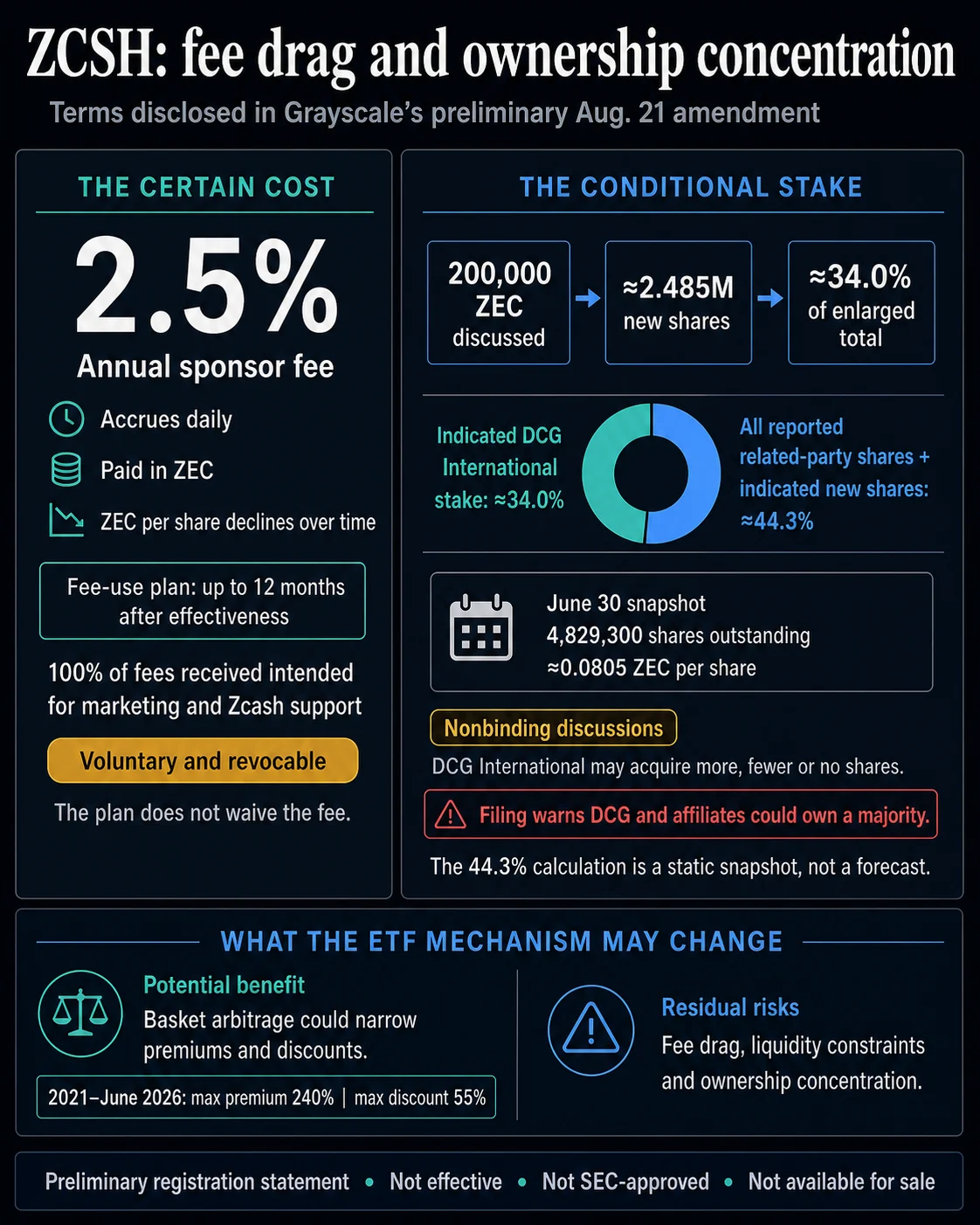
Grayscale Investments has filed an amendment with the U.S. Securities and Exchange Commission (SEC) for a proposed Zcash Exchange Traded Fund (ETF), outlining a significant 2.5% annual sponsor fee and detailing a potential ownership stake for an affiliate of Digital Currency Group (DCG) that could reach approximately 34% of the enlarged fund. This development, presented in an Aug. 21 SEC filing, signals a move to transform the existing Grayscale Zcash Trust into a publicly traded ETF, to be listed on NYSE Arca under the ticker symbol ZCSH. It is crucial to note that the registration remains preliminary, meaning the securities are not yet available for sale, and the SEC has neither approved nor disapproved the proposal.
The Rationale Behind the ETF Structure: Addressing Persistent Tracking Issues
The primary objective behind converting the Grayscale Zcash Trust into an ETF structure is to rectify the persistent and often extreme price-tracking discrepancies that have plagued the trust since its inception. Historically, the trust’s market price has deviated significantly from the net asset value (NAV) of the underlying Zcash (ZEC) holdings. This deviation has manifested as substantial premiums and discounts, eroding investor confidence and undermining the trust’s utility as a reliable investment vehicle for ZEC.
The proposed ETF structure aims to leverage the established arbitrage mechanism involving "authorized participants" (APs). These are large market intermediaries tasked with creating or redeeming blocks of 10,000 ETF shares. When the market price of ZCSH diverges from its NAV, APs will step in. If ZCSH trades at a premium to its NAV, APs will create new shares by acquiring the underlying ZEC and delivering it to the fund, thereby increasing supply and pushing the price down towards NAV. Conversely, if ZCSH trades at a discount, APs will redeem existing shares by taking the underlying ZEC and selling it on the open market, reducing supply and driving the price up towards NAV. Grayscale anticipates that this dynamic arbitrage will effectively bridge the gap between the ETF’s market price and the value of its ZEC holdings.
A History of Volatility: Premiums and Discounts
The historical performance data presented in the filing starkly illustrates the extent of the tracking problem. Between October 18, 2021, and June 30, 2026, the Grayscale Zcash Trust (prior to the proposed ETF conversion) experienced a maximum premium of 240% and a maximum discount of 55% relative to its NAV. On average, the trust traded at a 53% premium and a 19% discount during this period. The shares closed below NAV on an alarming 700 separate days. Even as of August 20, just before the latest amendment, the filing notes that ZCSH was trading at a discount of 1%, indicating a current improvement in tracking, though the ETF structure is not yet operational. This historical volatility underscores the pressing need for a more robust mechanism to ensure price stability and alignment with the underlying asset.
Unpacking the 2.5% Sponsor Fee and its Implications
The proposed 2.5% annual sponsor fee is a critical component of the ETF structure, directly impacting the economics for investors and the overall management of the fund. This fee is not new; it is the same rate that has been applied to the existing trust. The fee accrues daily and is paid in ZEC, which has the effect of gradually reducing the amount of ZEC represented by each outstanding share over time.
Grayscale has outlined a temporary incentive program to potentially mitigate the immediate impact of the fee on fund growth and Zcash ecosystem development. For a period of up to 12 months following the ETF’s effectiveness, Grayscale intends to allocate all fees collected from the trust towards marketing initiatives and programs that support Zcash development, marketing, and educational efforts. This plan is explicitly stated as voluntary and revocable, meaning Grayscale can alter or discontinue it at any time, while the 2.5% fee itself remains in place.
The Potential Dominance of DCG: Ownership Dynamics and Conflict Concerns
A significant point of contention and a key disclosure within the SEC amendment pertains to the potential ownership stake of Digital Currency Group (DCG) and its affiliates. The filing explicitly warns that DCG, through entities like DCG International Investments Ltd., could acquire a majority stake in the enlarged fund. Such a dominant position could grant DCG considerable influence over the trust’s limited shareholder votes, potentially creating conflicts of interest with other investors and impacting the fund’s governance.

To illustrate the potential ownership scenario, the filing references a June 30 snapshot of the trust’s holdings. On that date, the trust had 4,829,300 shares outstanding, with each share representing approximately 0.0805 ZEC. If DCG International were to contribute a nonbinding amount of 200,000 ZEC, this would translate into the creation of roughly 2.485 million new shares. Based on these figures, this contribution would represent approximately 34% of the enlarged total share count, assuming no other creations, redemptions, or changes to the ZEC-to-share ratio occur.
The filing also provides context on related-party holdings as of the same June 30 quarter-end report. These classified holdings amounted to 757,202 shares. When aggregated with the potential DCG contribution, this would bring the total DCG-affiliated ownership to roughly 44.3% of the enlarged fund. However, it is critical to understand that this figure treats these shares as a collective group and does not attribute them to a single DCG holder. Furthermore, this calculation serves solely as a snapshot; any variation in DCG’s actual contribution, the total number of affiliate holdings, or the overall share base could lead to a substantially different ownership outcome. The conditional nature of these discussions underscores the uncertainty surrounding DCG’s final stake.
Challenges to Arbitrage and Market Stability
While the ETF structure is designed to enhance price tracking, the filing acknowledges several factors that could potentially disrupt the intended arbitrage mechanism and introduce market instability. These challenges include:
- Cash-Order Constraints: Limitations in the ability to execute transactions entirely in cash could hinder the seamless creation and redemption process.
- Unavailable Liquidity Providers: The absence of sufficient liquidity providers could impede APs from efficiently acquiring or selling the necessary assets to fulfill their obligations.
- Suspended Creations or Redemptions: In extreme market conditions or due to operational issues, the SEC or the fund’s administrator could suspend the creation or redemption of ETF shares, breaking the arbitrage link.
- Limited ZEC Market Liquidity: The overall liquidity of the Zcash market itself can impact the efficiency with which APs can source or offload ZEC, potentially affecting their ability to keep the ETF price aligned with NAV.
- Concentrated Ownership: The risk of concentrated ownership, as highlighted with DCG, could also impede active trading. Large sell-offs by major holders, or even the perception of impending large sales, could trigger significant price volatility, leading to sharp declines and the re-emergence of substantial discounts.
A Tentative Step for Zcash in the ETF Landscape
The proposed Grayscale Zcash ETF represents a significant development in the ongoing push for broader cryptocurrency adoption through regulated investment products. However, the substantial sponsor fee and the potential for concentrated ownership by a major player like DCG raise important questions for potential investors. The success of the ETF will hinge on its ability to deliver on its promise of improved price tracking, overcome market microstructure challenges, and navigate the regulatory landscape effectively. Investors will be closely watching the SEC’s decision and the subsequent market performance of ZCSH should it receive approval. The journey from trust to ETF is a complex one, fraught with both opportunity and potential pitfalls for the Zcash ecosystem.