admin
admin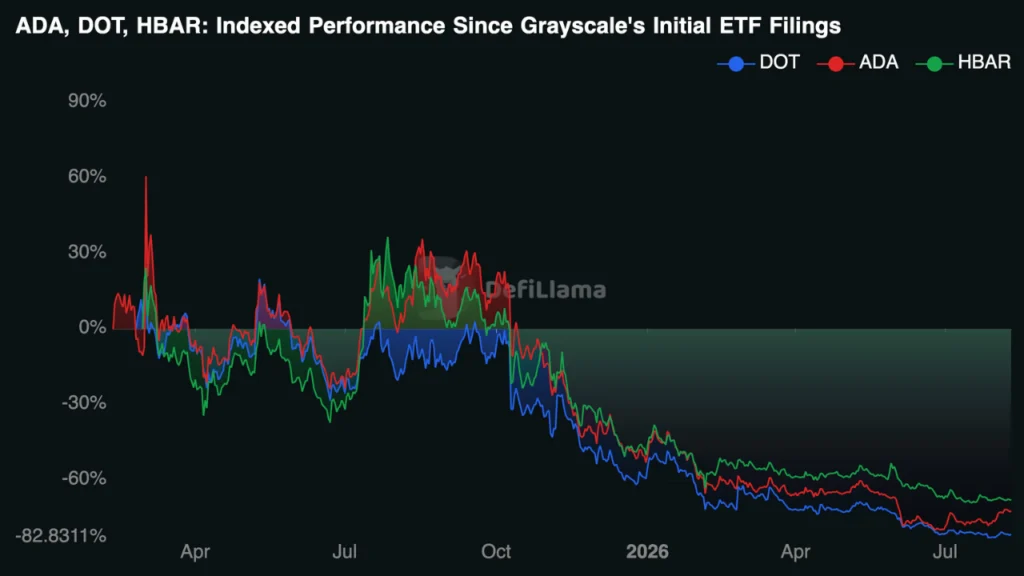
Grayscale Investments, a leading digital asset manager, has formally withdrawn its registration statements for three proposed spot crypto exchange-traded funds (ETFs) linked to Cardano’s ADA, Hedera’s HBAR, and Polkadot’s DOT. The filings, submitted to the U.S. Securities and Exchange Commission (SEC) on August 7, confirm the cessation of plans for the Grayscale Cardano Trust ETF, Grayscale Hedera Trust ETF, and Grayscale Polkadot Trust ETF. This strategic move, conveyed through separate Form RW requests, indicates Grayscale’s decision not to proceed with the planned distribution of shares for these specific trusts.
The withdrawals are significant not as SEC rejections but as voluntary requests from Grayscale, with each filing explicitly stating that the sponsor "does not intend to proceed with the planned distribution" of the trust’s shares. The documents further clarify that none of the registration statements had become effective, no securities had been issued or sold under these registrations, and no preliminary prospectuses had been distributed to potential investors. This action signals a pivotal moment in Grayscale’s evolving ETF strategy and reflects broader market and regulatory considerations impacting the nascent spot altcoin ETF landscape in the United States.
A Detailed Chronology of the Proposed Altcoin ETFs
The journey for these proposed altcoin ETFs began amidst a palpable wave of institutional interest in single-asset crypto products, spurred by the landmark approval of spot Bitcoin and later Ethereum ETFs in the United States. Grayscale, a pioneer in the crypto investment space, was quick to capitalize on this momentum, initiating its foray into altcoin-specific products.
- February 2025: Grayscale first proposed a Cardano ETF, signaling its intent to offer investors direct exposure to the ADA token. This move came on the heels of renewed optimism in the crypto market following the initial success of spot Bitcoin ETFs.
- Late February 2025: Shortly after the Cardano announcement, Grayscale followed up with a proposal for a Polkadot ETF, indicating a broader strategy to diversify its altcoin offerings beyond just the most prominent cryptocurrencies.
- August 2025: The asset manager submitted the corresponding Form S-1 registration statements for the ADA and DOT products to the SEC. An S-1 filing is a preliminary registration form required by the SEC for new securities offerings, providing detailed information about the fund, its assets, and its operations.
- September 2025: The Hedera registration statement (Form S-1) was subsequently filed, completing the trio of altcoin ETF applications.
- September 2025: In a precursor to the recent withdrawals, NYSE Arca, the proposed listing exchange for the Cardano ETF, withdrew its 19b-4 proposal. A 19b-4 filing is a rule change proposal submitted to the SEC by an exchange, necessary for listing new types of investment products. The withdrawal of this proposal indicated early challenges in securing exchange approval.
- November 2025: Nasdaq, the proposed listing exchange for the Polkadot and Hedera ETFs, followed suit by withdrawing its respective 19b-4 proposals. This development further underscored the hurdles faced by these specific altcoin products in gaining regulatory and exchange acceptance.
- August 7, 2026: Grayscale formally submitted Form RW requests to the SEC, requesting the withdrawal of the S-1 registration statements for the Grayscale Cardano Trust ETF, Grayscale Hedera Trust ETF, and Grayscale Polkadot Trust ETF. These withdrawals were made within minutes of each other, starting with Cardano, then Hedera, and finally Polkadot.
This timeline illustrates a multi-stage process where both the trust’s registration (S-1 with the SEC) and the exchange’s listing proposal (19b-4 with the SEC) must navigate regulatory scrutiny and eventual approval. The current withdrawals effectively close the chapter on these specific S-1 filings, removing the separate Securities Act registration statements associated with the proposed trusts.
The Broader Context of Crypto ETFs and Regulatory Landscape
The journey of crypto ETFs in the United States has been marked by cautious regulatory approaches and significant industry perseverance. For years, the SEC resisted spot Bitcoin ETF applications, citing concerns over market manipulation and investor protection. This stance shifted dramatically in January 2024 with the approval of several spot Bitcoin ETFs, a decision largely influenced by Grayscale’s legal victory against the SEC, which mandated a review of its Bitcoin Trust (GBTC) conversion application. The subsequent approval of spot Ethereum ETFs further broadened the scope of accepted digital asset products in traditional finance.
The enthusiasm generated by these approvals led many asset managers, including Grayscale, to explore single-asset ETFs for other prominent altcoins. The underlying rationale was that if Bitcoin and Ethereum, the two largest cryptocurrencies by market capitalization, could gain spot ETF status, then other well-established altcoins might follow. These proposed funds were designed as passive investment vehicles, aiming to provide traditional investors with exposure to the price movements of their respective cryptocurrencies, less fees and expenses, within a regulated and easily accessible wrapper.

However, the regulatory environment for altcoins remains far more complex than for Bitcoin and Ethereum. A primary challenge is the lack of clear classification for many digital assets. The SEC, under Chairman Gary Gensler, has consistently asserted that many cryptocurrencies beyond Bitcoin are unregistered securities, subjecting them to stringent securities laws. This ambiguity creates significant legal and compliance risks for asset managers seeking to launch related investment products.
Adding another layer of complexity, the SEC recently introduced "generic listing standards" for certain commodity-based trust shares. While this move could streamline the approval process for future crypto ETFs that clearly fall under a commodity classification, it simultaneously highlights the regulatory distinction between various digital assets. It implies that altcoins not readily classified as commodities might face a steeper climb to approval, potentially requiring bespoke regulatory pathways or a re-evaluation of product structures. Grayscale’s decision to withdraw older S-1 filings might be a strategic response to these evolving standards, indicating a preference to pursue new structures that align better with current regulatory expectations or future guidance.
Market Performance of Affected Altcoins
The withdrawals also coincide with a challenging period for the underlying tokens: Cardano (ADA), Polkadot (DOT), and Hedera (HBAR). Investor interest and demand for an ETF are inextricably linked to the performance and perceived potential of the underlying asset.
According to data referenced in the filings-related reports, the price performance of these altcoins has been notably weak. As of the time of the withdrawals:
- Cardano (ADA): Down more than 41% year-to-date. From the period when Grayscale initially announced its ETF plans in early 2025, ADA has experienced a considerably deeper drawdown of approximately 70%. Its market capitalization, while still substantial, has seen erosion, reflecting a broader bearish sentiment in the altcoin sector.
- Polkadot (DOT): Has fallen roughly 54% year-to-date. From its initial ETF proposal in early 2025, DOT has seen a staggering decline of approximately 80%. Polkadot, known for its interoperability framework, has struggled to maintain investor enthusiasm amid broader market downturns and competition.
- Hedera (HBAR): Down about 35% year-to-date. From the time its ETF plans were initially discussed in 2025, HBAR has also suffered a significant drawdown of more than 70%. Despite its enterprise-grade network and focus on real-world utility, HBAR has not been immune to the broader market pressures affecting altcoins.
These substantial losses highlight a critical challenge for asset managers attempting to build dedicated investment products around individual altcoins. While an ETF can democratize access to an asset for traditional investors, its success fundamentally relies on sustained investor interest, robust liquidity in the underlying market, and a positive long-term outlook for the token. Prolonged periods of price depreciation can significantly diminish perceived demand, making the launch of a new investment product less viable. The lack of upward price momentum and significant capital inflows into these specific altcoins likely played a role in Grayscale’s strategic re-evaluation.
Analysis: Why the Withdrawals?
While Grayscale did not provide a specific explanation in its SEC filings, market analysts and industry observers have put forth several plausible interpretations for the decision. These factors are not mutually exclusive and likely represent a confluence of strategic considerations:
- Changing Market Conditions and Product Demand: The most apparent reason is the significant underperformance of ADA, DOT, and HBAR. ETFs require substantial assets under management (AUM) to be profitable and attractive to institutional investors. With these tokens experiencing deep drawdowns since the initial proposals, the anticipated institutional demand might have waned. Launching an ETF for assets that are struggling to attract investor interest would be an uphill battle, potentially leading to low AUM and limited trading volume.
- Evolving Regulatory Strategy: The SEC’s stance on altcoins, particularly those it views as unregistered securities, remains a significant hurdle. Unlike Bitcoin and Ethereum, which have a clearer (though still debated for Ethereum) classification, many other altcoins operate in a gray area. Grayscale might be anticipating stricter regulatory requirements for these types of products or deciding to prioritize assets with clearer regulatory pathways. The introduction of "generic listing standards" might have prompted Grayscale to reconsider existing filings in favor of potentially refiling under new, more favorable frameworks.
- Streamlining the Product Pipeline: Grayscale maintains an extensive pipeline of proposed crypto products, including those focused on staking and other digital assets like Bittensor, Aave, BNB, NEAR, and Zcash. With limited resources and an increasingly competitive market, the firm may be pruning its less promising or more challenging proposals to focus on those with higher probabilities of success or greater strategic alignment. This is a common practice for large asset managers.
- Lack of Exchange Listing Approval: The prior withdrawal of 19b-4 proposals by NYSE Arca and Nasdaq for these specific ETFs was a significant indicator. Without an exchange willing and able to list the product, the S-1 registration statement, which details the trust itself, becomes moot. While an S-1 withdrawal is voluntary, it often follows the realization that the exchange listing approval is unlikely or has already been abandoned.
- Focus on Staking-Enabled Products: Grayscale has shown interest in advancing staking-focused products, which could offer an additional yield component attractive to investors. This suggests a shift towards more innovative product designs that might capture a different segment of the market or provide a competitive edge over simple price-tracking vehicles.
Implications for Grayscale’s Strategy and the Altcoin Market
The withdrawal of these three altcoin ETF filings carries significant implications for Grayscale’s overall strategy, the specific altcoins involved, and the broader institutional interest in the altcoin market.

For Grayscale Investments:
This move appears to be a pruning of Grayscale’s product pipeline rather than a retreat from the broader crypto ETF market. Grayscale remains a dominant player, continuing to offer a range of crypto investment products, including its flagship Bitcoin and Ethereum funds. The company’s ongoing pursuit of other altcoin products, such as those linked to Bittensor, Aave, BNB, NEAR, and Zcash, and its advancement of staking-focused products, demonstrates a sustained commitment to diversifying its digital asset offerings. The withdrawals suggest a strategic recalibration, focusing resources on products with clearer paths to market or stronger perceived demand, rather than an abandonment of altcoins altogether. Grayscale may eventually return with revised filings or new structures for ADA, HBAR, or DOT if market conditions or regulatory clarity improves.
For Cardano (ADA), Hedera (HBAR), and Polkadot (DOT):
The withdrawal removes a potential institutional-access catalyst. The prospect of a spot ETF can generate significant excitement and attract new capital from traditional financial institutions and retail investors who prefer regulated investment vehicles. The absence of such an ETF might dampen short-term sentiment for these tokens. However, it’s crucial to note that the withdrawal does not directly alter the underlying networks, their technological fundamentals, or their development roadmaps. The long-term success of ADA, HBAR, and DOT will continue to depend on adoption, technological innovation, and ecosystem growth. The decision simply underscores the difficulty for individual altcoins, especially outside of Bitcoin and Ethereum, to attract dedicated institutional investment products in the current regulatory and market environment.
For the Broader Altcoin ETF Market:
Grayscale’s decision may signal a more cautious approach for other asset managers considering similar single-asset altcoin ETFs. It highlights the dual challenge of navigating complex regulatory landscapes while simultaneously gauging sufficient investor demand for specific, often volatile, digital assets. The emphasis might shift towards multi-asset crypto funds, actively managed crypto strategies, or products that incorporate additional features like staking rewards, which could offer more compelling value propositions in a competitive market. It reinforces the idea that regulatory clarity and demonstrable market depth are paramount for the successful launch of crypto ETFs beyond the top two assets.
Future Outlook
The immediate future holds no indication from SEC filings that Grayscale plans to replace the three withdrawn registrations. The decision merely confirms the asset manager’s choice not to proceed with the existing ADA, HBAR, and DOT offerings as initially conceived.
Investors, analysts, and the crypto community will be closely watching Grayscale’s subsequent moves. The critical questions remain: Will Grayscale eventually return with revised filings, potentially leveraging new regulatory frameworks or improved market conditions? Or do these withdrawals mark a more permanent strategic shift, indicating a refinement in which altcoins the asset manager believes can truly attract meaningful and sustainable institutional demand within the complex U.S. regulatory landscape? The evolution of the crypto ETF market continues, with innovation and adaptation serving as key drivers in this dynamic financial frontier.