admin
admin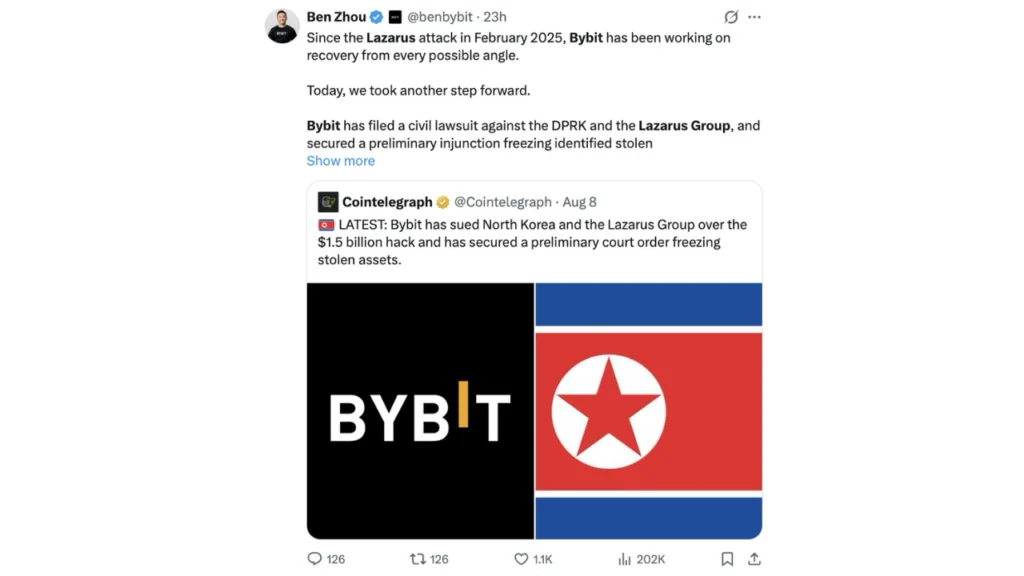
Cryptocurrency exchange Bybit has initiated a significant civil lawsuit against the Democratic People’s Republic of Korea (DPRK), its powerful Reconnaissance General Bureau (RGB) intelligence agency, and the infamous Lazarus Group, seeking to recover approximately $1.5 billion in digital assets stolen in a sophisticated cyberattack in February 2025. Filed in the U.S. District Court for the District of Columbia, this legal action represents a pivotal escalation in Bybit’s multifaceted campaign to reclaim the pilfered funds and hold the alleged state-sponsored perpetrators accountable. Alongside the lawsuit, Bybit successfully secured a preliminary injunction, a critical measure designed to freeze specific digital assets identified as linked to the theft, currently held by unidentified individuals and entities listed as "John Doe" defendants. This injunction is a proactive step to preserve these identifiable assets as the complex litigation unfolds, with Bybit indicating plans to pursue further relief as investigators meticulously trace the flow of the stolen cryptocurrency across global networks.
The Anatomy of the $1.5 Billion Breach: February 2025
The incident at the heart of Bybit’s lawsuit occurred on February 21, 2025, when hackers executed a massive draining of more than 400,000 ETH and stETH from a Bybit cold wallet. At the time of the breach, the stolen cryptocurrency was valued at approximately $1.5 billion, instantly marking it as the largest known crypto theft in history. The sheer scale and precision of the attack immediately raised alarms across the digital asset industry, prompting extensive investigations.
Initial forensic analyses swiftly pointed to the Lazarus Group, a notorious North Korean state-linked hacking collective with a long and documented history of targeting cryptocurrency companies and blockchain projects globally. However, the modus operandi of this particular attack revealed a concerning evolution in their tactics. Rather than a direct penetration of Bybit’s robust cold-storage defenses, the attackers reportedly compromised the infrastructure used to manage the wallet. Investigations uncovered that a developer associated with SafeWallet, the multisignature wallet infrastructure utilized by Bybit, had been targeted and compromised. This sophisticated supply-chain attack allowed malicious code to be injected, manipulating what appeared to be a legitimate transaction. By altering the wallet’s underlying logic, the attackers were able to redirect the substantial funds, bypassing standard security protocols.
This incident served as a stark reminder that even the most advanced security measures, such as cold storage and multisignature protections, can be undermined when attackers gain access to the human element or the auxiliary software surrounding them. It underscored the critical importance of holistic security strategies that extend beyond the immediate digital perimeter to encompass the entire operational ecosystem, including third-party software providers and their personnel.
Lazarus Group: North Korea’s Digital Marauders
The Lazarus Group, also known by aliases such as APT38, Guardians of Peace, and Hidden Cobra, operates under the direct command of North Korea’s Reconnaissance General Bureau (RGB). For years, this state-sponsored entity has emerged as one of the most persistent and sophisticated cyber threats on the global stage, particularly within the financial and cryptocurrency sectors. Their primary objective is widely understood to be the generation of illicit revenue for the DPRK regime, crucial for funding its weapons programs and circumventing international sanctions.
The group’s methodology often involves highly targeted phishing campaigns, zero-day exploits, and, increasingly, supply-chain attacks like the one seen with Bybit. They exhibit remarkable patience and technical prowess, often spending months or even years infiltrating networks before executing their final objectives. Their attacks are characterized by sophisticated malware, advanced evasion techniques, and a relentless pursuit of high-value targets.
Before the Bybit incident, Lazarus Group was implicated in several other monumental crypto heists. In March 2022, they were identified as the perpetrators behind the $620 million Ronin Network bridge hack, which targeted Axie Infinity’s play-to-earn gaming ecosystem. Just months later, in June 2022, they were linked to the $100 million Harmony Horizon Bridge exploit. These incidents, among numerous others, collectively demonstrate their sustained focus on exploiting vulnerabilities within cross-chain bridges, decentralized finance (DeFi) protocols, and centralized exchanges. The U.S. government, including the FBI and Treasury Department, has repeatedly attributed these attacks to Lazarus Group and imposed sanctions against entities and individuals associated with their activities, underscoring the severity of their operations and their direct link to national security concerns.
North Korea’s Illicit Funding Pipeline: A Geopolitical Threat
The Bybit attack, due to its unprecedented scale, accounted for the majority of North Korea’s cryptocurrency theft in 2025, significantly bolstering the regime’s illicit financial reserves. According to data from blockchain analytics firm Chainalysis, North Korean hackers stole approximately $2.02 billion in cryptocurrency last year, representing a staggering 51% increase from 2024. Cumulatively, Chainalysis estimates that DPRK-linked hackers have pilfered an astonishing $6.75 billion in crypto over time.

This burgeoning scale of state-sponsored cyber theft has become a major concern for governments worldwide and a critical challenge for the digital asset industry. The international consensus is that these stolen cryptocurrency funds directly contribute to the North Korean regime’s ability to finance its weapons of mass destruction (WMD) programs, including ballistic missile development and nuclear ambitions. By leveraging the pseudonymous nature of cryptocurrency transactions and the relative difficulty of tracing funds across various blockchain networks and jurisdictions, North Korea effectively circumvents traditional financial sanctions, posing a direct threat to global peace and stability.
The consistent and escalating success of Lazarus Group in siphoning vast sums of digital assets has solidified North Korea’s position as one of the most prominent and dangerous state-linked cyber threats facing not only the crypto industry but also the broader international community. Their operations highlight a critical intersection of cybersecurity, financial crime, and geopolitical strategy, compelling a coordinated global response.
The Intricate Dance of Digital Asset Tracing and Recovery
Recovering the assets stolen from Bybit has presented immense technical and logistical challenges, primarily due to the attackers’ swift and sophisticated methods of obfuscation following the theft. Immediately after the breach, investigators observed the cryptocurrency being moved rapidly across thousands of wallet addresses and multiple blockchain networks. Large portions of the stolen Ethereum (ETH) were converted into Bitcoin (BTC), a common tactic used by hackers to diversify and further complicate tracing efforts. Other funds were funneled through cross-chain bridges, which allow assets to move between disparate blockchain ecosystems, and through "mixers" or "tumblers"—crypto services specifically designed to pool and commingle funds from various sources, making individual transactions incredibly difficult to follow and attribute.
Despite these advanced obfuscation techniques, the inherent transparency of public blockchains has proven to be a double-edged sword for the attackers. Blockchain analytics firms, equipped with sophisticated tools and algorithms, have been instrumental in monitoring many of these movements, mapping out transaction flows, and identifying clusters of associated addresses. However, while tracing can reveal where funds have moved, it does not guarantee recovery. Once assets are fragmented across thousands of addresses, rapidly moved between different networks, or processed through privacy-enhancing services, identifying their ultimate holders and establishing a clear chain of custody becomes significantly more arduous.
In its concerted recovery efforts, Bybit has collaborated extensively with leading blockchain analytics firms, other cryptocurrency exchanges, regulatory bodies, and law enforcement agencies across multiple jurisdictions. This multi-pronged approach is essential, as freezing or seizing assets often requires the cooperation of centralized entities that operate under specific legal frameworks. These partnerships aim to leverage both advanced technological forensics and traditional legal and investigative avenues to maximize the chances of asset recovery.
The Power of Legal Intervention: Bybit’s New Weapon
The filing of a civil lawsuit in the U.S. District Court for the District of Columbia, coupled with the securing of a preliminary injunction, marks a significant new phase in Bybit’s recovery campaign. This legal action provides Bybit with a powerful new tool beyond purely technical tracing and inter-exchange cooperation.
The preliminary injunction specifically prevents certain unidentified holders (the "John Doe" defendants) connected to the stolen assets from transferring, selling, or otherwise disposing of the funds while the case proceeds. Bybit has emphasized that this measure is crucial for preserving assets that investigators have successfully identified and linked to the February 2025 heist. It essentially creates a legal freeze on these specific digital assets, preventing them from being further laundered or dissipated.
Beyond this immediate freeze, Bybit is seeking comprehensive relief, including the direct recovery of the stolen cryptocurrency itself and substantial damages. The exchange has clarified that this civil lawsuit operates distinctly and separately from ongoing criminal investigations being conducted by various U.S. authorities. While criminal investigations aim to prosecute the perpetrators, Bybit’s civil suit is focused squarely on asset recovery and establishing legal liability.
In a public statement, Bybit CEO Ben Zhou reiterated the company’s unwavering priority: "Our focus has never changed: protect our users first, recover what we can, and make sure the people behind these attacks are held accountable." Zhou further described the Lazarus attack not merely as an assault on Bybit, but as a broader "attack on trust across the cryptocurrency industry," underscoring the systemic implications of such sophisticated state-sponsored cybercrime. This legal offensive is a testament to Bybit’s commitment to its users and its determination to pursue every available avenue for justice and recovery.
Navigating Uncharted Legal Waters: Sovereign Immunity and Enforcement

The lawsuit against North Korea and its state apparatus presents a highly unusual and complex legal challenge. Suing a sovereign nation, particularly one with strained international relations and subject to extensive sanctions, introduces unique hurdles. The principle of sovereign immunity generally protects states from being sued in foreign courts without their consent. However, exceptions exist, such as for commercial activity or acts of terrorism, which Bybit’s legal team will likely argue apply in this case, framing the cyberattack as an illicit commercial venture or a state-sponsored criminal act.
Even if Bybit were to win the case and secure a judgment against the DPRK, enforcing that judgment directly against the North Korean government would prove exceedingly difficult. North Korea possesses minimal assets identifiable and reachable within U.S. jurisdiction that could be seized to satisfy a judgment.
The more immediate and practical impact of the lawsuit may, therefore, revolve around the unidentified "John Doe" defendants and any intermediaries holding traceable stolen assets. If portions of the stolen funds eventually reach cryptocurrency exchanges, custodians, or other financial entities that operate under U.S. jurisdiction or have a presence there, court orders issued in this case could compel these entities to freeze assets and provide critical information needed for recovery. This approach leverages the legal reach of the U.S. court system to target entities that are subject to its authority, thereby potentially creating pathways for asset recovery even if directly suing the DPRK is primarily symbolic. This strategy highlights the increasing convergence of traditional legal frameworks with cutting-edge blockchain forensics, where the transparency of the ledger meets the power of the courtroom.
Broader Implications for the Cryptocurrency Industry and Cybersecurity
Bybit’s landmark lawsuit carries significant implications for the wider cryptocurrency industry and the evolving landscape of global cybersecurity. Firstly, it sends a strong message that major players in the digital asset space are prepared to leverage all available legal and technical tools to combat sophisticated state-sponsored cyber threats. This proactive stance could encourage other exchanges and blockchain projects to pursue similar legal avenues when faced with large-scale thefts, potentially establishing new precedents for asset recovery.
Secondly, the case further emphasizes the need for enhanced security protocols across the entire crypto ecosystem, extending beyond internal defenses to include third-party vendors and supply chains. The compromise of a developer associated with SafeWallet highlights that even robust cold storage and multisignature solutions are vulnerable if the surrounding infrastructure or personnel are targeted. This will likely lead to increased scrutiny on vendor security, more stringent vetting processes, and a greater emphasis on decentralized security practices.
Furthermore, this lawsuit underscores the growing synergy between traditional legal action and advanced blockchain analytics. While blockchain transparency provides invaluable data for tracing stolen funds, the ultimate recovery often necessitates cooperation from exchanges, custodians, regulators, and law enforcement, backed by the authority of court orders. This integration of legal and technological approaches is becoming the standard for combating complex financial cybercrime in the digital age.
Finally, the case against North Korea directly confronts the geopolitical dimension of crypto theft. Bybit’s action aims to disrupt a critical funding mechanism for a rogue state, aligning with broader international efforts to curb illicit finance and proliferation activities. The outcome of this lawsuit, even if partial, could serve as a powerful deterrent against future state-sponsored cyberattacks on financial institutions, both traditional and digital.
Conclusion: A Long Road Ahead
For Bybit, the civil lawsuit is the latest and arguably most assertive step in a comprehensive recovery campaign that commenced immediately after the February 2025 breach. It reflects an unwavering commitment to protecting its users and holding the perpetrators accountable. For the wider cryptocurrency industry, this case represents a critical test: can traditional legal systems effectively help reclaim digital assets after highly sophisticated, state-linked hackers employ advanced techniques to move funds across multiple blockchains and international jurisdictions?
The path to full recovery will undoubtedly be long and fraught with complexities, given the unique nature of the defendants and the challenges of enforcing judgments in the digital realm. However, Bybit’s courageous legal offensive marks a significant moment, signaling a new era where victims of large-scale crypto theft are increasingly prepared to harness the full power of legal systems in their fight against illicit actors, including state-sponsored cybercriminals, in the global pursuit of justice and asset recovery.