admin
admin
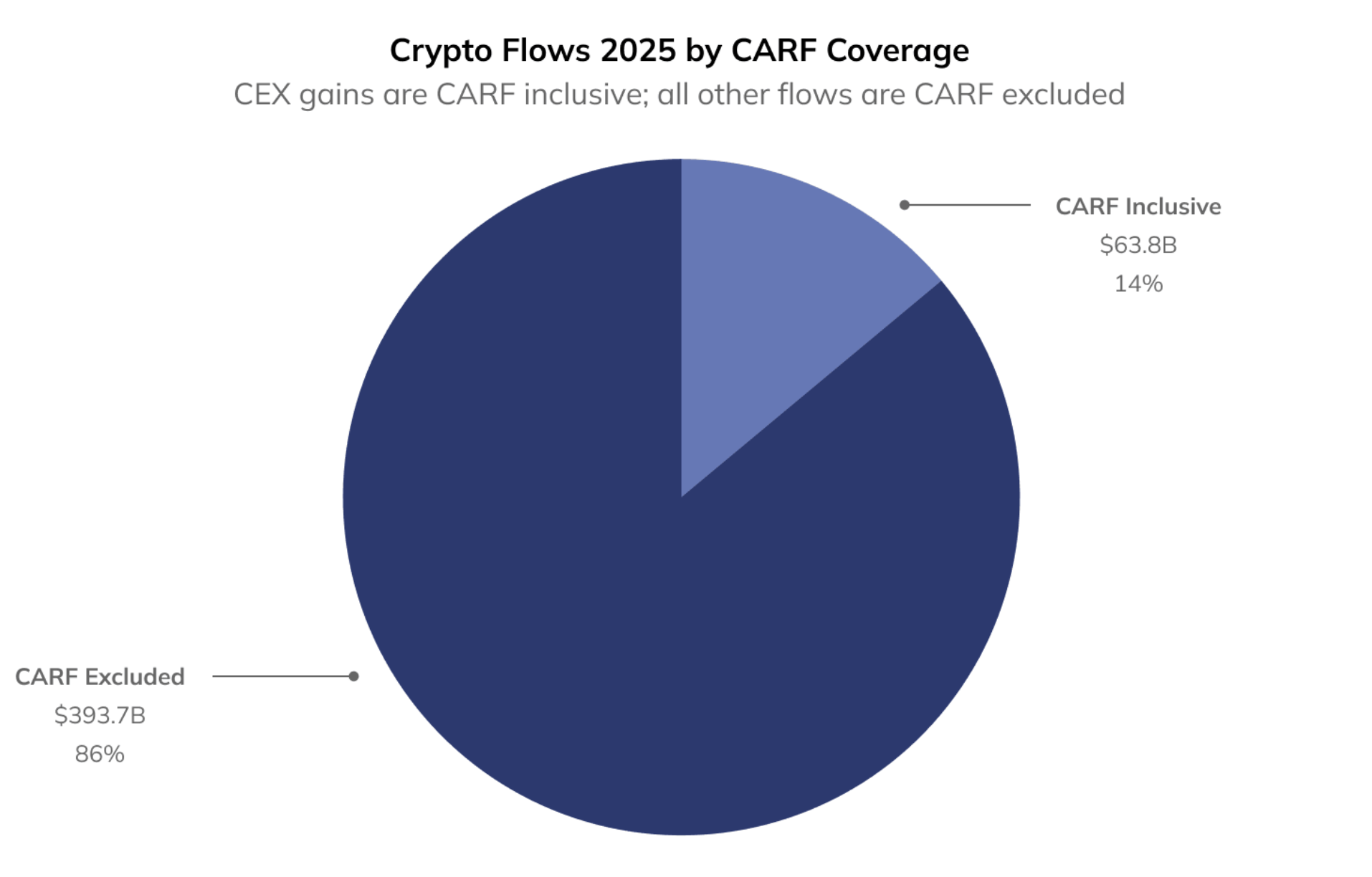
A recent Chainalysis report has cast a stark light on the burgeoning, yet largely untaxed, on-chain crypto economy, revealing that potentially taxable activity reached at least $457 billion globally in 2025. This staggering figure underscores a significant challenge for tax authorities worldwide, as current international reporting frameworks, such as the Organisation for Economic Co-operation and Development’s (OECD) Crypto-Asset Reporting Framework (CARF), are estimated to capture only a fraction – specifically 14% – of this vast sum. The findings highlight a critical gap between the rapid evolution of the crypto landscape and the regulatory mechanisms designed to ensure tax compliance.
The United States alone accounted for an estimated $112.6 billion of this global total, demonstrating its prominent position in the crypto market. Regionally, North America led all continents with $134.6 billion in potentially taxable on-chain activity, closely followed by the European Union at $125.1 billion. These figures are not mere speculative estimates; they encompass a range of specific activities including realized gains from crypto asset sales, income derived from various blockchain-based endeavors such as mining, staking, and lending, as well as crypto-denominated payments across six major blockchains. Crucially, these estimates exclude trading and other transactional activities conducted within centralized exchanges, which are generally more amenable to existing reporting structures. The exclusion of centralized exchange data from Chainalysis’s $457 billion total is significant because CARF does aim to cover these entities, thereby emphasizing the sheer volume of activity occurring outside these regulated perimeters.
The Untapped Billions: Unpacking Chainalysis’s Findings
The Chainalysis report, a leading voice in blockchain data analytics, serves as a crucial barometer for understanding the financial flows within the decentralized ecosystem. By meticulously analyzing on-chain data, the firm has provided an unprecedented look into the scale of economic activity that falls outside the purview of traditional financial oversight. The $457 billion figure represents an aggregated estimate of economic value generated through direct interactions on various blockchain networks, signaling a mature and highly active ecosystem.
The inclusion criteria for this sum are broad, reflecting the diverse ways individuals and entities engage with cryptocurrencies beyond simple speculative trading on regulated platforms. Realized gains, for instance, refer to profits made when a crypto asset is sold for a higher price than its purchase price, a common taxable event in most jurisdictions. Income from mining, staking, and lending represents compensation received for contributing computational power, securing networks, or providing liquidity, respectively – activities that generate taxable income similar to interest or wages in traditional finance. Crypto-denominated payments further indicate the growing utility of digital assets as a medium of exchange for goods and services, another clear taxable event. The exclusion of centralized exchange activity from this particular Chainalysis calculation is key to understanding the report’s focus: it’s not about the entirety of crypto activity, but specifically the "on-chain" portion that poses the greatest challenge for current reporting frameworks like CARF, which primarily target intermediaries.
CARF: An Ambitious Framework with Inherent Limitations
The Crypto-Asset Reporting Framework (CARF) was developed by the OECD in 2022 as a direct response to the escalating challenges posed by the global and decentralized nature of crypto assets to tax transparency and compliance. Its primary objective is to provide a standardized framework for the automatic exchange of information on crypto-asset transactions between tax authorities globally, mirroring the success of the Common Reporting Standard (CRS) for traditional financial assets.
A Chronology of CARF’s Development and Implementation:
- 2021: The OECD begins work on a new global tax transparency framework for crypto-assets, recognizing the rapid growth and cross-border nature of the industry.
- October 2022: The OECD formally releases the Crypto-Asset Reporting Framework (CARF) and amendments to the Common Reporting Standard (CRS) for financial account information. This marks a significant step towards harmonizing crypto tax reporting globally. The framework is accompanied by Commentaries and an XML Schema for data exchange.
- Early 2023: The OECD commences work on implementation packages, including guidance on the legal and administrative aspects of CARF, as well as technical solutions for data exchange.
- January 1, 2026: Data collection under CARF officially began in 48 participating jurisdictions. These jurisdictions, which include major economic blocs like the United Kingdom and the European Union, committed to implementing the framework. This date signifies the operational start of CARF, requiring covered crypto service providers to begin collecting additional customer and tax residency information.
Under CARF, in-scope crypto service providers are mandated to collect specific customer and tax residency information, as well as detailed transaction data. This information is then reported to their respective domestic tax authorities. A cornerstone of CARF’s design is the subsequent automatic exchange of this information across international borders, enabling tax authorities to receive comprehensive data on crypto transactions undertaken by their residents with service providers located in other participating jurisdictions. The goal is to prevent tax evasion by closing the information gap that crypto’s borderless nature has previously exploited.
The 86% Blind Spot: Why CARF Falls Short
Despite its ambitious scope and widespread adoption, the Chainalysis report starkly illustrates CARF’s inherent limitations. The framework, in its current iteration, is designed around the traditional regulatory paradigm of intermediaries. Colby Mangels, a former OECD adviser who played a role in CARF’s development, articulated this foundational principle in an interview with Cointelegraph in January. He explained that CARF was conceived to regulate "intermediaries that facilitate crypto transactions as a business."
This design philosophy inherently creates a massive "tax gap" in the decentralized crypto ecosystem. Chainalysis found that a staggering 86% of the on-chain taxable activity it identified falls outside CARF’s reporting perimeter. This includes:
- Decentralized Exchanges (DEXs): These platforms facilitate peer-to-peer crypto trading directly via smart contracts, without a central custodian or operator. Since there’s no identifiable "service provider" in the traditional sense, applying CARF’s reporting requirements becomes structurally challenging, if not impossible.
- Peer-to-Peer (P2P) Transfers: Direct transfers between individuals’ wallets, bypassing any centralized or even decentralized exchange. These transactions are purely on-chain and leave no reporting trail with an intermediary.
- On-Chain Income Streams: Income generated directly on the blockchain through activities like providing liquidity to a decentralized lending protocol, yield farming, or participating in a DAO, where no centralized entity collects or reports the income.
- Direct Crypto Payments: Payments for goods and services made directly from one crypto wallet to another, without involving a payment processor that falls under CARF’s scope.
The core issue lies in the absence of a "responsible person" or "covered entity" in many decentralized finance (DeFi) interactions. CARF relies on the existence of a regulated entity that can be compelled to collect and report data. In DeFi, where smart contracts automate transactions and users retain self-custody of their assets, this intermediary often simply does not exist. This structural difference creates a vast blind spot for tax authorities, leaving billions in potentially taxable activity unmonitored and unreported.
Statements and Reactions: The Regulatory Dilemma
While specific reactions to this particular Chainalysis report might not be widely published yet, the underlying sentiment from regulatory bodies and governments has been consistently clear: there is a pressing need to address tax evasion in the crypto space.
- OECD’s Stance (Inferred): The OECD’s commitment to CARF itself is a testament to its recognition of the problem. They view CARF as a crucial step towards ensuring a "level playing field" between traditional finance and crypto, preventing tax base erosion, and protecting the integrity of tax systems. They would likely acknowledge the challenges posed by DeFi but emphasize the necessity of adapting regulatory frameworks. Their ongoing work on implementation packages and engagement with jurisdictions suggests a long-term strategy to refine and expand crypto tax transparency.
- National Tax Authorities (Inferred): Tax agencies worldwide, such as the IRS in the US, HMRC in the UK, and various European tax bodies, have been increasingly active in issuing guidance and pursuing enforcement actions related to crypto taxation. They consistently reiterate that existing tax laws apply to crypto assets, regardless of whether a reporting framework captures the transaction. The Chainalysis report would likely be viewed as further evidence of the scale of the compliance gap and a spur for intensified efforts, possibly leveraging blockchain analytics tools themselves to identify non-compliant taxpayers.
- Crypto Industry Bodies (Inferred): While acknowledging the need for regulatory clarity and combating illicit finance, many in the crypto industry, particularly within the DeFi sector, would likely advocate for frameworks that are technologically neutral and foster innovation rather than stifle it. They might express concerns about over-regulation or the imposition of traditional financial reporting burdens on truly decentralized protocols, arguing that such measures could drive innovation offshore or render certain decentralized applications unviable. There’s a strong call for clear, practical guidance that balances compliance with the unique characteristics of blockchain technology.
- Legal and Tax Experts: Experts often point to the complexity of crypto taxation, emphasizing the need for taxpayers to proactively track their transactions and seek professional advice. They frequently highlight the enforcement challenges for authorities, especially concerning truly decentralized or anonymous activities. The Chainalysis report would likely reinforce their calls for greater public education on crypto tax obligations and for regulators to explore innovative ways to address the DeFi gap, potentially through updated definitions of "intermediaries" or new compliance technologies.
The Broader Impact and Implications
The findings of the Chainalysis report carry significant implications for various stakeholders:
1. For Tax Authorities and Governments:
The $457 billion figure represents a massive potential loss in tax revenue at a time when governments globally are seeking to shore up public finances. It underscores the urgency for regulators to accelerate their understanding and oversight of the decentralized crypto space. The current focus on intermediaries, while a pragmatic starting point, is clearly insufficient. Authorities will likely intensify their efforts in two key areas:
- Enhanced Analytics: Leveraging advanced blockchain analytics tools, similar to those developed by Chainalysis, to identify patterns, trace funds, and potentially unmask individuals engaged in large-scale non-compliance, even in P2P or DEX environments.
- Evolving Regulatory Scopes: Regulators are actively watching developments in anti-money laundering (AML) regulation, particularly efforts to define when DeFi platforms or their operators should be treated as regulated crypto service providers. This could lead to new legislative frameworks that attempt to impose reporting requirements on entities or individuals that exert significant control or influence over DeFi protocols, or even on the developers themselves. The concept of "responsible persons" within Decentralized Autonomous Organizations (DAOs) is also under discussion.
2. For Crypto Users and Investors:
The report serves as a stark reminder that participation in the crypto economy, regardless of whether it occurs on a centralized exchange or a DeFi protocol, generally carries tax obligations. Even if transactions are not automatically reported via CARF, the onus remains on individual taxpayers to accurately declare their crypto income and gains. Failure to do so carries legal risks, including penalties, fines, and even criminal charges. The growing sophistication of blockchain analytics means that the perception of anonymity in crypto is increasingly a myth, and tax authorities are steadily improving their capabilities to identify non-compliant taxpayers.
3. For the Crypto Ecosystem and Innovation:
The challenge for the crypto industry is to balance innovation with compliance. While DeFi champions decentralization and permissionless access, the sheer scale of untaxed activity highlights a systemic issue that could attract more stringent, potentially stifling, regulation. The industry needs to engage proactively with regulators to help shape frameworks that are effective in preventing tax evasion without undermining the core principles and benefits of decentralization. This could involve developing privacy-preserving compliance tools or exploring new architectural designs that allow for regulatory oversight where appropriate, while maintaining user autonomy. The tension between fostering technological advancement and ensuring financial integrity will continue to be a defining characteristic of the crypto regulatory debate.
4. Global Harmonization and Future of CARF:
The limitations exposed by Chainalysis suggest that CARF, while a crucial first step, may need to evolve. The OECD and participating jurisdictions might consider amendments or entirely new frameworks specifically designed to address the unique challenges of DeFi. This could involve exploring concepts such as "protocol-level compliance" or new definitions of "taxable events" that are better suited to automated smart contract interactions. However, achieving global harmonization for such complex and rapidly evolving technology remains an immense challenge, given the varying legal traditions and economic priorities of different nations.
In conclusion, the Chainalysis report paints a compelling picture of a dynamic and economically significant on-chain crypto landscape, with hundreds of billions of dollars in potentially taxable activity currently operating largely outside the reach of conventional international tax reporting. While the OECD’s CARF represents a significant stride towards global tax transparency in crypto, its foundational reliance on intermediaries leaves a vast 86% of this on-chain economy uncaptured. This gap presents a dual challenge: for governments, it signifies lost revenue and a potential for illicit financial flows; for the crypto industry, it necessitates a proactive approach to compliance that balances innovation with regulatory responsibility. As the digital asset space continues its relentless evolution, the ongoing efforts to bridge this regulatory chasm will undoubtedly shape the future of finance and the relationship between decentralized technology and sovereign oversight.