admin
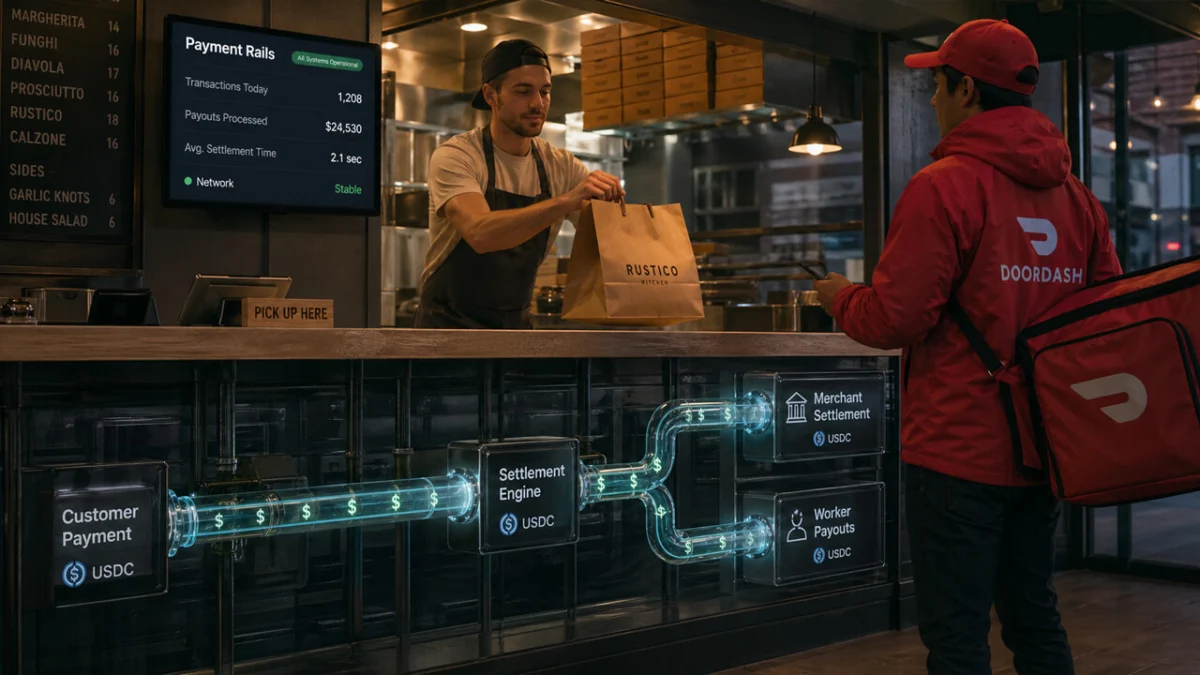
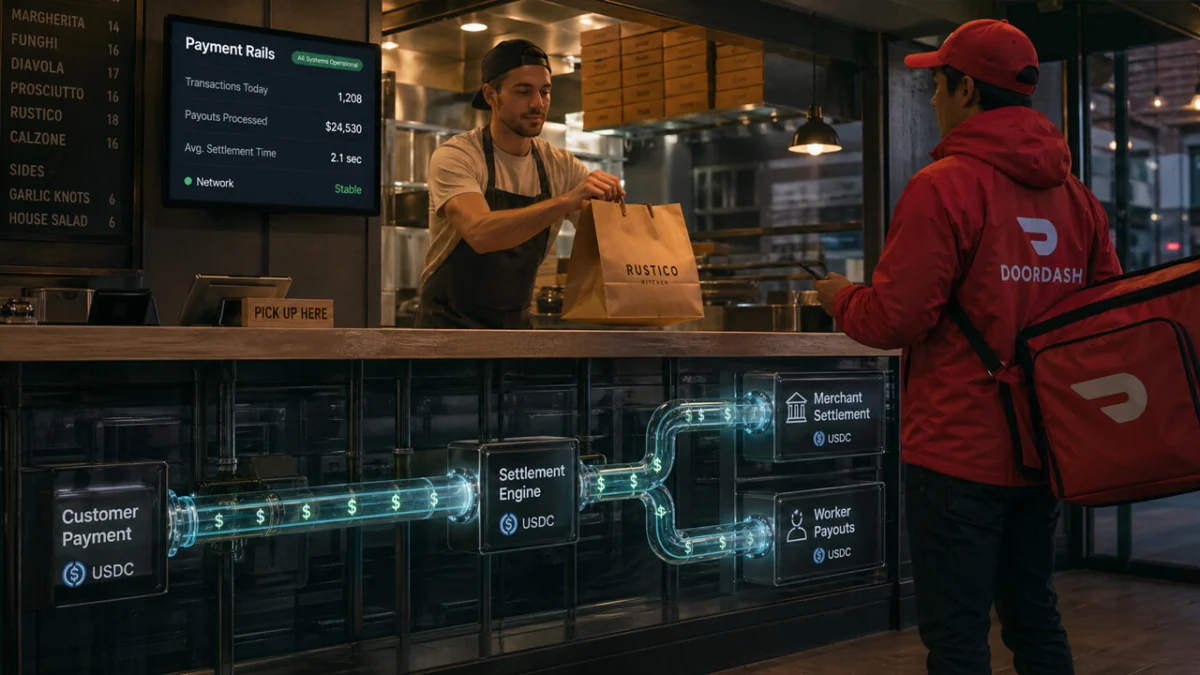
DoorDash has officially announced a strategic partnership with Tempo, a high-performance Layer-1 blockchain backed by Stripe and Paradigm, to integrate stablecoin-powered payouts into its global delivery marketplace. The move signals one of the most significant adoptions of blockchain technology by a major consumer-facing platform to date, moving crypto-based financial tools out of the realm of speculation and into the core operating infrastructure of the gig economy. Operating across more than 40 countries, DoorDash manages a complex ecosystem where capital must flow seamlessly between customers, merchants, and independent contractors known as Dashers. By utilizing stablecoins—digital assets typically pegged to the value of the U.S. Dollar—DoorDash aims to bypass the traditional banking bottlenecks that have historically slowed the movement of money across borders and through various regional banking rails.
The partnership involves a consortium of financial and technology leaders, including Stripe, Coastal Bank, and ARQ, all of which will utilize Tempo’s infrastructure to facilitate stablecoin payments. According to DoorDash co-founder Andy Fang, the decision to pivot toward stablecoin rails was driven by a need to solve tangible operational problems. While the front-end consumer experience of ordering food or groceries has been optimized into a near-instant process, the backend financial settlement process remains fragmented. Traditional systems are often constrained by banking cutoffs, weekend delays, and the high costs associated with foreign exchange (FX) friction. For a global platform like DoorDash, these delays can stretch from several hours to several business days, depending on the jurisdiction and the specific payout method utilized by the recipient.
The Mechanics of the Payout Problem in Global Marketplaces
To understand the significance of DoorDash’s integration with Tempo, one must first examine the inefficiencies inherent in the current global financial plumbing. When a customer in Toronto or Melbourne places an order, the funds must eventually be distributed to a local merchant for the cost of goods and to a Dasher for the delivery service. In a traditional setup, this involves multiple intermediaries, including acquiring banks, issuing banks, and regional clearinghouses such as ACH in the United States or SEPA in Europe.
These legacy systems operate on a batch-processing model, meaning transactions are not settled individually in real-time but are grouped together and processed at specific intervals. This creates a liquidity gap. Merchants, who often operate on thin margins, require rapid access to working capital to manage payroll, purchase inventory, and maintain short-term liquidity. Similarly, Dashers—many of whom rely on daily earnings to cover immediate expenses like fuel and maintenance—face significant pressure when payouts are delayed by bank holidays or processing windows.
DoorDash has previously attempted to mitigate these pressures through traditional financial products. For example, in early 2024, the company announced gas relief measures and emergency support programs for Dashers in the U.S. and Canada to offset rising living costs. However, these are reactionary measures. By integrating stablecoin payouts via Tempo, DoorDash is attempting a structural fix. Stablecoins allow for "T+0" settlement, meaning the moment a transaction is verified on the blockchain, the value is transferred and becomes usable by the recipient, regardless of the time of day or the day of the week.
The Role of Tempo and Stripe in the Ecosystem
Tempo was introduced last year as a payments-centric blockchain designed specifically to address the shortcomings of earlier decentralized networks. While Bitcoin serves as a store of value and Ethereum provides a platform for complex smart contracts, these networks have often struggled with high transaction fees and slow finality times during periods of peak demand. Tempo, developed with the backing of the payment giant Stripe and the venture capital firm Paradigm, was built with "sub-second finality" and high throughput as its core features.
The network’s partner list is a testament to its enterprise-grade ambitions. Beyond DoorDash, the ecosystem includes heavyweights such as Deutsche Bank, Shopify, OpenAI, Revolut, and Visa. The design of Tempo focuses on "stablecoin-native fees," allowing users to pay for network transactions using the stablecoins themselves rather than a volatile native utility token. This reduces the complexity for corporate treasury departments and non-crypto-native users, making the technology feel more like a standard payment API than a radical departure from traditional finance.
Stripe’s involvement is particularly noteworthy. After ending its initial support for Bitcoin payments in 2018 due to volatility and technical hurdles, the company has spent the last two years aggressively rebuilding its crypto suite. Stripe’s leadership has argued that stablecoins represent the most practical application of blockchain technology because they combine the speed of digital assets with the price stability of fiat currency. By providing the bridge between traditional bank accounts and the Tempo blockchain, Stripe acts as the critical layer of "financial plumbing" that allows DoorDash to scale this technology without requiring its users to become experts in private key management or decentralized finance.
Chronology of DoorDash’s Technological Evolution
The integration of stablecoins is the latest step in a multi-year effort by DoorDash to optimize its logistics and financial stack.
- 2013-2018: Growth and Fragmented Payouts. In its early years, DoorDash relied on standard weekly payout cycles, common in the gig economy. As the company expanded into Canada and Australia, the complexity of managing multiple currencies and local banking regulations began to mount.
- 2019-2021: Fast Pay and Instant Payouts. DoorDash introduced "Fast Pay," allowing Dashers to cash out their earnings daily for a small fee. This was a significant improvement but still relied on the Visa/Mastercard "push-to-card" rails, which, while faster than ACH, still incurred fees and were subject to occasional bank-side delays.
- 2022-2023: The Rise of Stablecoin Infrastructure. During the "crypto winter," the industry shifted focus from speculative trading to "Real-World Assets" (RWA) and utility. Stripe began pilot programs for USDC (USD Coin) payouts on the Polygon network, laying the groundwork for what would eventually become the Tempo partnership.
- Late 2023: The Launch of Tempo. Stripe and Paradigm revealed Tempo as a dedicated Layer-1 blockchain for stablecoin payments, specifically designed to handle the volume of global commerce.
- 2024: Full Integration. DoorDash joins the Tempo ecosystem, moving from pilot phases to a deep integration that targets the core of its marketplace settlement.
Supporting Data and Economic Context
The scale of the stablecoin market provides a clear rationale for DoorDash’s move. In the first quarter of 2024, stablecoin transaction volume reached a staggering $28 trillion. While a significant portion of this volume—approximately 76%—is attributed to automated bots and high-frequency trading between exchanges, the remaining 24% represents a rapidly growing sector of organic, peer-to-peer, and merchant-to-worker transfers.
For a company like DoorDash, which operates in 40+ countries and serves millions of Dashers, the cost savings of moving even a fraction of its volume to stablecoin rails are substantial. Cross-border transfers via traditional banks can cost anywhere from 1% to 5% in fees and currency spreads. In contrast, stablecoin transactions on a high-throughput network like Tempo typically cost a fraction of a cent. Across billions of dollars in annual payout volume, these savings can be reinvested into lower fees for customers or higher incentives for Dashers.
Furthermore, the demand for instant liquidity is at an all-time high. Economic data from the gig economy suggests that nearly 40% of independent contractors use their earnings to cover immediate daily costs. When fuel prices spike—as they did in early 2024—the delay between completing a delivery and receiving the funds can become a barrier to work. Stablecoin payouts eliminate this gap, providing a form of "streaming payroll" that matches the real-time nature of the work performed.
Industry Implications and the "Invisible" Crypto Future
The DoorDash-Tempo partnership suggests a shift in how the public will interact with blockchain technology. For years, the narrative around crypto was centered on consumer-facing applications: wallets, exchanges, and NFTs. However, the most durable path to mainstream adoption appears to be through "invisible" infrastructure.
Most Dashers and merchants using DoorDash may never realize they are interacting with a blockchain. They will simply experience a system where money arrives faster and with lower fees. This "backend-first" approach avoids the steep learning curve and security risks associated with self-custody wallets while still capturing the efficiency gains of the technology.
Industry analysts suggest that if DoorDash successfully scales stablecoin payouts, other major platforms in the "sharing economy"—such as Uber, Lyft, and Airbnb—will likely follow suit. These companies all share the same fundamental challenge: they are global entities that must function like local businesses in every market they enter. Stablecoins provide a universal settlement layer that treats the entire world as a single, 24/7 financial jurisdiction.
Challenges and the Path Forward
Despite the optimism, the transition to stablecoin-powered infrastructure is not without hurdles. Regulatory compliance remains the primary concern. DoorDash and its partners must navigate a patchwork of global regulations concerning Anti-Money Laundering (AML) and Know Your Customer (KYC) requirements. This is likely why the partnership includes Coastal Bank and ARQ, as these institutions provide the necessary regulatory oversight and "fiat on-ramps" to ensure that digital dollars can be easily converted back into local bank deposits.
Additionally, the technical implementation will likely be a hybrid model. DoorDash has not yet disclosed the exact percentage of its flows that will move on-chain. It is expected that the company will start with specific corridors—likely cross-border payouts where friction is highest—before expanding to domestic transfers in more mature markets.
Ultimately, DoorDash’s move into the Tempo ecosystem is a bellwether for the future of fintech. It demonstrates that for large-scale enterprises, the "why" of crypto is no longer about decentralization for its own sake. It is about the cold, hard logic of operational efficiency. If stablecoins can prove they are a more reliable, faster, and cheaper way to move money through the complex plumbing of global commerce, they will become as foundational to the internet economy as the cloud and the smartphone. DoorDash is not just delivering food; it is now helping to deliver the next generation of financial infrastructure.