admin

In an unprecedented event shaking the foundations of the global cryptocurrency market, Binance, the world’s largest digital asset exchange by trading volume, was targeted in an estimated $6.3 billion hack, marking the largest crypto theft in history. The sophisticated attack, which commenced at 8:04 pm UTC on a Thursday, saw perpetrators swiftly move to convert billions in stolen digital assets, triggering a high-stakes race against time as centralized stablecoin issuers and decentralized protocols scrambled to freeze the illicit proceeds. Despite concerted efforts that have successfully immobilized a significant portion of the stolen funds, the attackers, strongly linked to notorious North Korean cybercrime syndicates, still maintain control over billions of dollars in highly liquid and difficult-to-trace cryptocurrencies.
Unprecedented Scale and Attribution
The sheer scale of the Binance hack dwarfs previous incidents in the crypto space, redefining the landscape of digital asset security. At an estimated $6.3 billion, it surpasses other infamous breaches like the Ronin Bridge exploit ($625 million) and the Mt. Gox collapse (around $460 million at the time), underscoring the escalating sophistication and ambition of cybercriminals targeting the burgeoning digital economy. The immediate aftermath saw investigators and blockchain analytics firms quickly point fingers at the same North Korean state-sponsored hacking groups believed to be behind last month’s Bitget hack, specifically entities like the Lazarus Group, often operating under aliases such as "TraderTraitor." These groups are notorious for their prolific cyber activities aimed at funding North Korea’s illicit weapons programs and bolstering its struggling economy, presenting a formidable and persistent threat to the global financial system. Their modus operandi frequently involves exploiting vulnerabilities in cryptocurrency platforms, executing elaborate phishing schemes, and leveraging advanced social engineering tactics to gain access to vast digital reserves.
The Attack Unfolds: A Chronology of Conversion and Counteraction
The attack unfolded with remarkable speed and strategic precision. The perpetrators’ primary "game plan" was immediately apparent: convert assets that possessed a centralized "off switch" – such as stablecoins like Tether (USDT) and USD Coin (USDC) – into decentralized cryptocurrencies like Bitcoin (BTC) and Ether (ETH), which lack a central issuer capable of freezing transactions. This rapid conversion strategy aimed to circumvent the very mechanisms designed to protect users and facilitate recovery in the event of theft.
Within minutes of the initial breach, an intricate web of transactions began to form on the blockchain. CertiK engineer Dickson Wu, a prominent voice in blockchain security, meticulously traced approximately $500 million in USDT funneled to a single attacker-controlled address. A staggering $325 million of this sum was then swiftly sold to market makers for ETH by 20:59 UTC, less than an hour after the hack commenced. This rapid liquidation highlighted the attackers’ efficiency and their deep understanding of market liquidity and blockchain mechanics. The speed of these conversions was a direct challenge to the "gatekeepers" of the crypto world: the centralized issuers of stablecoins. Tether and Circle, recognizing the severity of the situation, had already initiated the blacklisting of addresses associated with the theft, effectively rendering the tokens held in those wallets unusable. This race against the clock became a defining characteristic of the immediate response, with billions hanging in the balance.
The Swift Response: Centralized Control vs. Decentralized Assets
The ability of stablecoin issuers to freeze funds stems from their centralized nature. Unlike truly decentralized cryptocurrencies like Bitcoin or Ethereum, which operate on permissionless networks with no central authority to halt transactions, stablecoins like USDT and USDC are typically issued by companies (Tether and Circle, respectively) that maintain control over their smart contracts. These contracts often include functions that allow the issuer to blacklist addresses, thereby preventing any further movement or use of the tokens held therein. This inherent feature, often criticized by decentralization maximalists as a point of vulnerability or censorship, proved to be a critical defense mechanism in this crisis.

Tether acted decisively, freezing an astonishing $1.567 billion in USDT in total. The first significant freeze occurred just 37 minutes after the stolen funds landed in the attacker’s main Ethereum wallet, demonstrating a remarkable level of coordination and responsiveness. Circle followed suit almost immediately, immobilizing approximately $823 million in USDC a mere three minutes later. Other issuers, including Ripple and World Liberty Financial, also joined the collective effort, blacklisting addresses associated with their respective tokens. These actions collectively amounted to roughly $2.84 billion frozen by 7:00 am UTC on Friday, a significant blow to the attackers’ profit potential.
However, the "off switch" is not exclusive to stablecoins. Even some decentralized protocols, despite lacking a central issuer, demonstrated an ability to intervene. Arbitrum, a prominent Layer 2 scaling solution for Ethereum, saw its Security Council move approximately $30.5 million in ARB and ETH into an intermediary frozen wallet. These funds can only be moved after further action by the council or a vote by the Arbitrum DAO governance, illustrating a hybrid approach to security in the decentralized ecosystem.
It is crucial to distinguish between "frozen" and "recovered" funds. While immobilizing assets prevents the suspected attackers from spending them, it does not automatically return them to Binance or its affected users. The frozen funds represent a substantial victory in preventing further illicit gains, but the complex process of legal recovery and repatriation still lies ahead, involving law enforcement agencies and potentially protracted legal battles across jurisdictions.
DeFi’s Dilemma: The Aave Complication
The hack also exposed a unique layer of complexity introduced by decentralized finance (DeFi) protocols. Between 20:58 and 21:01 UTC, a wallet linked to the attackers deposited $60 million in USDT into Aave V3 on Ethereum, a leading decentralized lending protocol. Subsequently, the attackers borrowed $44.6 million of wrapped Ether (WETH) against this collateral, approximately 40 minutes before the first freezes were enacted.
LlamaRisk, an Aave risk service provider, later reported that the attacker’s position held around $59.9 million in USDT collateral against $43.8 million in debt. Critically, Aave confirmed that this position remained overcollateralized and did not immediately put the protocol’s suppliers at risk. However, the situation presented a dilemma: since the USDT had already been deposited into Aave’s lending pool as collateral, merely blacklisting the attacker’s wallet could not automatically retrieve the funds held within the protocol’s smart contracts.
Marc Zeller, founder of the Aave Chan Initiative, articulated the challenge: "USDT is real money backed by dollars, and the position is criminal but overcollateralized in the eyes of the protocol." The decentralized, permissionless nature of Aave means that once funds are locked as collateral, the protocol’s rules dictate their release, not an external blacklist. To mitigate further risk and prevent additional malicious activity, Aave temporarily froze markets across its V3 and V4 deployments. While existing users could still withdraw funds, repay loans, and liquidate positions, new deposits and borrowings were halted. Aave later lifted this precautionary freeze, confirming that its contracts were unaffected and all positions remained securely overcollateralized, with Zeller remarking, "Just another day in crypto." This incident highlights the intricate interplay between centralized controls and decentralized autonomy in the event of a major security breach, showcasing how the unique architecture of DeFi can complicate recovery efforts even when the underlying assets are technically frozen.
The Broader Implications: Security, Recovery, and the Future of Crypto
The Binance hack serves as a stark reminder of the persistent security challenges facing the cryptocurrency industry, particularly as it continues to grow in scale and complexity. While approximately $3 billion of the estimated $6.3 billion stolen assets were frozen on-chain, the attackers still control around $3.33 billion in assets that issuers could not immobilize, primarily Bitcoin and Ether. These decentralized assets, once converted, are exceedingly difficult to trace and freeze, posing a long-term recovery challenge for law enforcement and Binance.
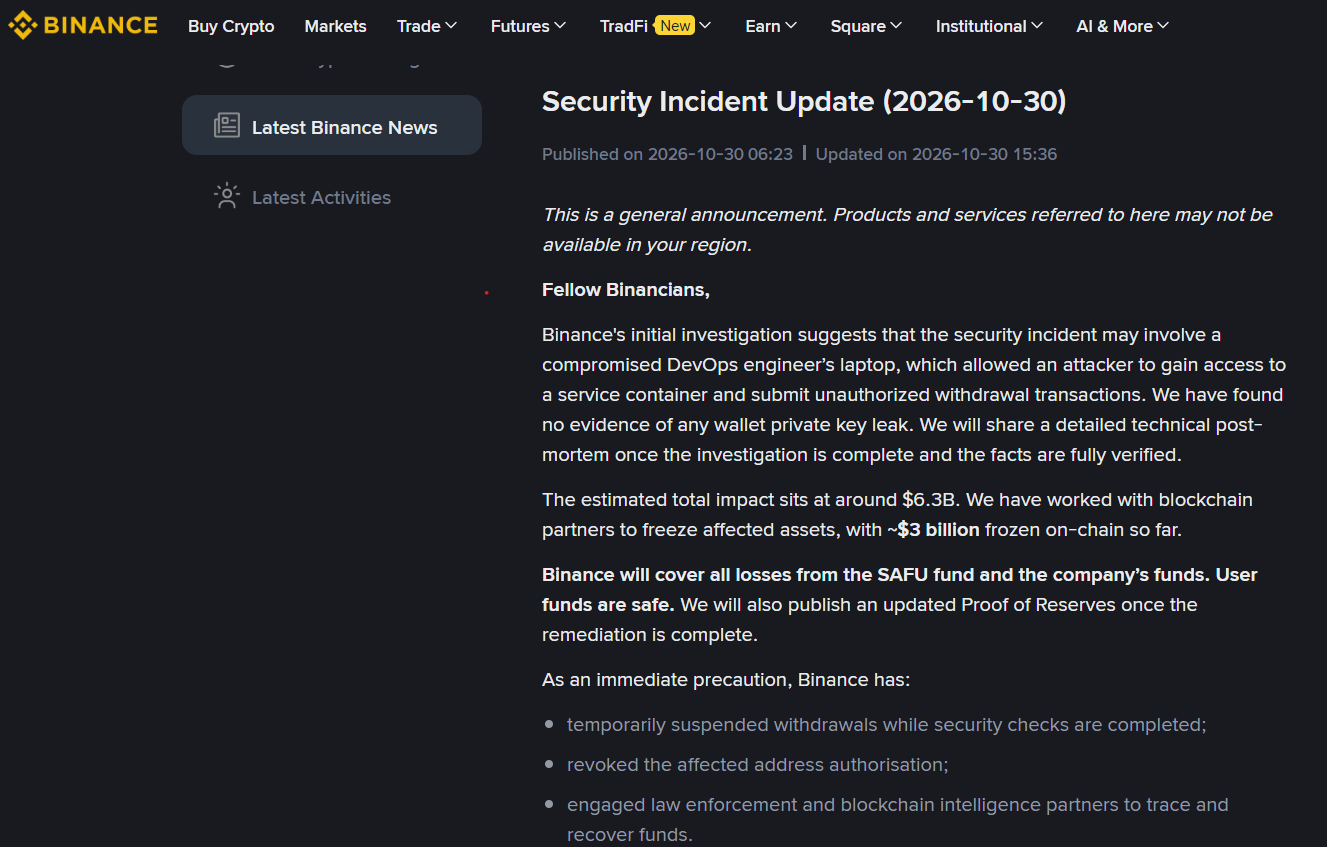
Binance has moved swiftly to reassure its user base and the broader market. The exchange announced its commitment to cover all losses using its Secure Asset Fund for Users (SAFU) and company funds, a dedicated insurance fund established to protect users in extraordinary circumstances. Binance CEO Richard Teng provided an update, stating that the exchange is already "recovering stolen assets for users," though the specifics of this recovery process and the timeline remain under wraps. The exchange is working closely with law enforcement agencies, token issuers, and blockchain analytics firms to trace additional funds and explore all avenues for recovery.
The incident is likely to intensify regulatory scrutiny on the crypto space. Governments and financial watchdogs worldwide are increasingly concerned about illicit finance within the digital asset ecosystem, and large-scale hacks like this only fuel calls for stricter regulations, enhanced Know Your Customer (KYC) and Anti-Money Laundering (AML) compliance, and potentially more centralized controls. The ability of stablecoin issuers to freeze funds, while beneficial in this context, also reignites debates about the trade-offs between decentralization and security, and the potential for censorship in the digital realm.
The Unspent Billions: A Lingering Threat
The fact that billions remain under the control of the attackers, largely in untraceable Bitcoin and Ether, represents a significant ongoing threat. These funds could be laundered through various methods, including mixing services, privacy coins, or through intricate networks of smaller transactions across multiple exchanges, making their ultimate recovery a monumental task. The perpetrators, with a track record of state-sponsored operations, are highly sophisticated and are expected to employ advanced techniques to obfuscate the origin and destination of these funds, further complicating the efforts of law enforcement.
A Continuous Battle: State-Sponsored Hacking
This incident further underscores the grave and persistent threat posed by state-sponsored cyber actors, particularly those from North Korea. Groups like the Lazarus Group are not merely opportunistic criminals; they are strategic players in a geopolitical chess game, using cybercrime as a critical tool for national funding and resource acquisition. Their targeting of cryptocurrency exchanges and DeFi protocols highlights a systemic vulnerability that extends beyond individual platforms, challenging the entire digital asset ecosystem. The fight against these adversaries requires not only robust technical defenses but also international cooperation, intelligence sharing, and concerted diplomatic and economic pressure.
In conclusion, the Binance hack stands as a watershed moment in cryptocurrency history. While the rapid and coordinated response from centralized entities managed to freeze a substantial portion of the stolen funds, the inherent characteristics of decentralized assets mean that billions remain in the hands of sophisticated attackers. The incident reinforces the critical need for continuous innovation in security protocols, robust collaboration between exchanges, issuers, and law enforcement, and an ongoing reevaluation of the balance between decentralization and regulatory oversight to safeguard the integrity and future of the digital economy. The road to full recovery will be long and arduous, but the lessons learned from this unprecedented event will undoubtedly shape the future of cybersecurity in the crypto world.