admin
admin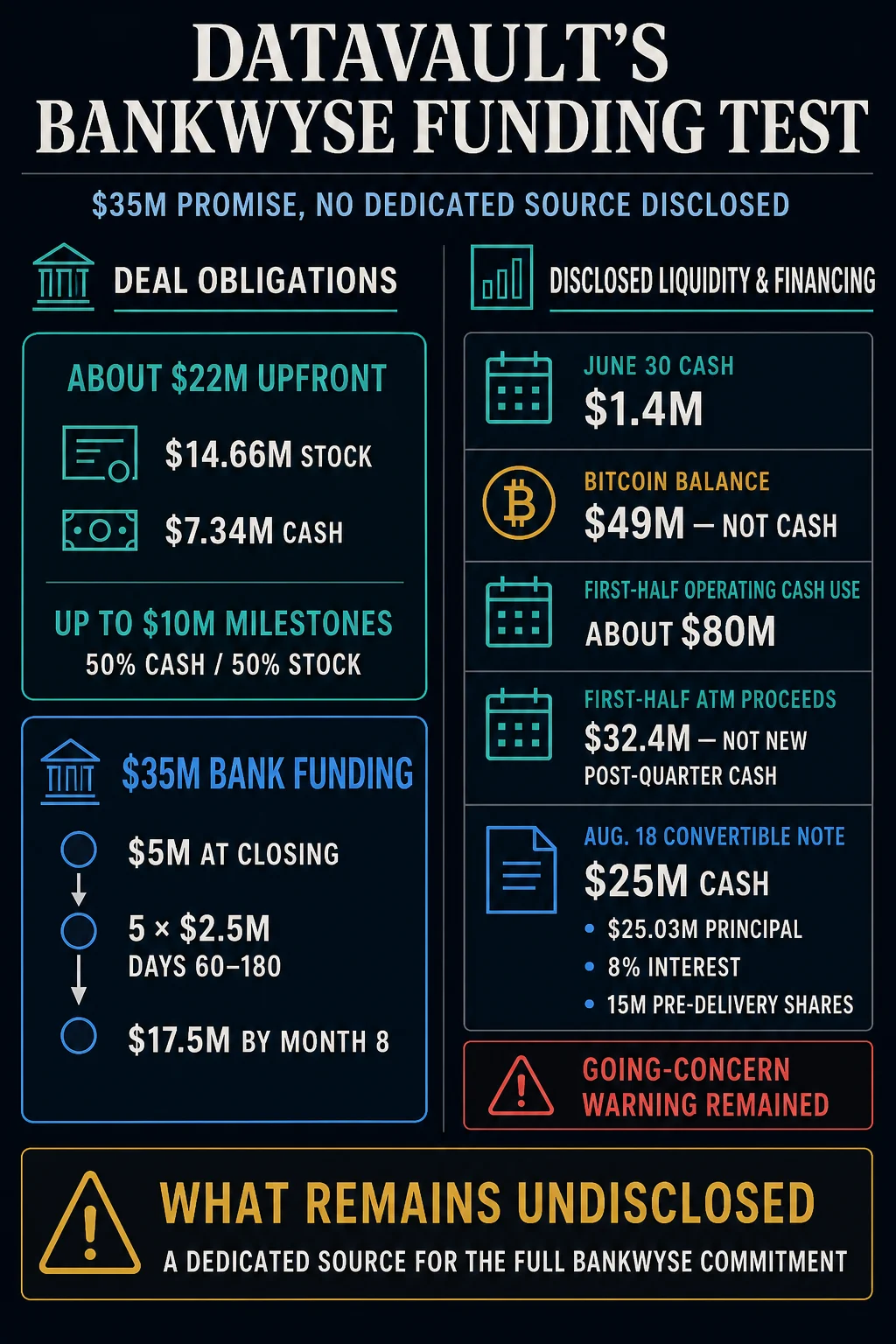
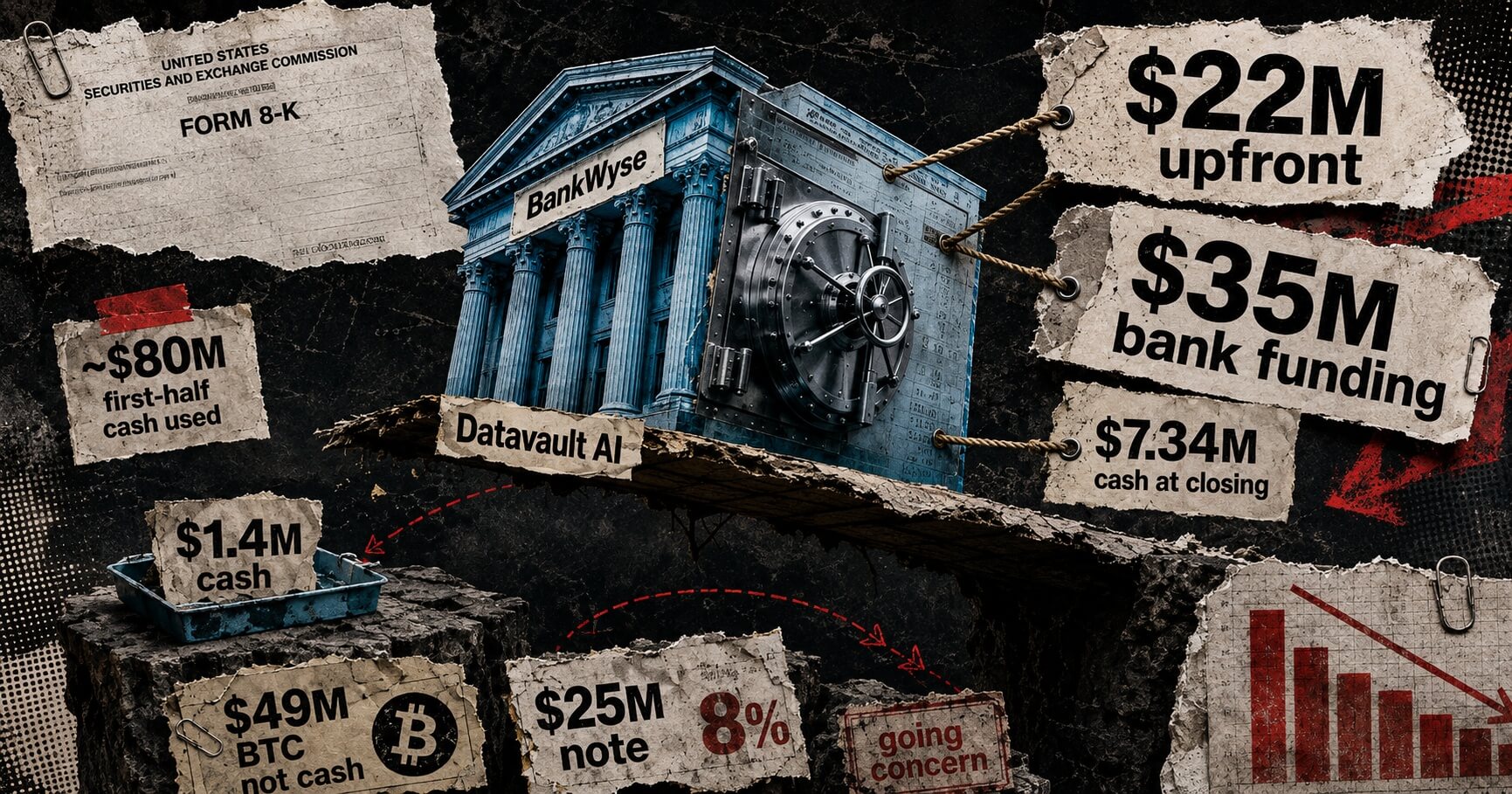
Datavault AI’s ambitious plan to acquire Wyoming-based BankWyse is facing intense scrutiny, as the company’s disclosed financial position presents a stark contrast to the substantial funding required for the transaction. The proposed acquisition, valued at approximately $22 million in initial consideration, necessitates an additional $35 million for BankWyse’s capitalization and operational needs. This financial chasm is further widened by Datavault’s recent disclosure of a "going concern" warning, indicating substantial doubt about its ability to continue operations for the next twelve months, coupled with a reported cash balance of just $1.4 million as of June 30.
The Complex Web of the BankWyse Acquisition
The agreement, formally disclosed on August 19, outlines a multi-faceted financial structure for the acquisition of BankWyse. The initial consideration comprises $14.66 million in Datavault stock and $7.34 million in cash. The sellers of BankWyse also stand to receive an additional $10 million in potential earn-out payments, to be split equally between cash and stock, contingent upon the achievement of specific performance milestones. This means the total potential value of the acquisition, if all milestones are met, could reach $32 million.
Beyond the purchase price, Datavault AI has committed to injecting $35 million into BankWyse to ensure its financial stability and operational capacity. This substantial capital infusion is scheduled in stages: $5 million is due at the closing of the acquisition, followed by five installments of $2.5 million each, distributed between day 60 and day 180 post-closing. A significant final payment of $17.5 million is slated for the eighth month after closing.
Regulatory Hurdles and Immediate Financial Demands
The successful completion of the BankWyse acquisition is contingent upon several key approvals and financial prerequisites. Foremost among these is the requirement for either approval or a non-objection from the Wyoming Division of Banking, a critical regulatory step for any change in ownership of a state-chartered bank.
Simultaneously, Datavault AI must demonstrate it possesses immediately available financing sufficient to cover its immediate closing obligations. These obligations include the $7.34 million cash component of the initial purchase price, the $5 million initial capital injection into BankWyse, and the assumption or settlement of certain other liabilities associated with the transaction. This upfront financial demand places significant pressure on Datavault’s current liquidity.
A Stark Financial Reality: The Going Concern Dilemma
The financial disclosures made by Datavault AI paint a concerning picture when juxtaposed with the demands of the BankWyse acquisition. As of its June 30 balance sheet, the company reported a mere $1.4 million in cash. While it holds a substantial $49 million in Bitcoin, the liquidity of this asset in the short term for such large cash outlays is questionable. Furthermore, the company revealed that it had consumed approximately $80 million in cash for its operations during the first half of the fiscal year.
This operational burn rate, combined with limited cash reserves, led Datavault’s management to issue a stark warning in its filings: "existing resources were insufficient to fund the next 12 months and that substantial doubt remained about the company’s ability to continue as a going concern." This statement, a standard disclosure when financial viability is in question, underscores the significant challenge Datavault faces in securing the necessary funds for the BankWyse deal without jeopardizing its own operational continuity.
Unpacking Datavault’s Financing Efforts
Datavault AI has been actively pursuing various avenues to bolster its financial position, though the effectiveness and sufficiency of these efforts in meeting the BankWyse acquisition’s demands remain uncertain.
In a separate development, Datavault had previously proposed selling 837 Bitcoin to Scilex Holding for $50 million. However, this transaction was not assured, with Scilex having the option to pay in cash, securities, or a combination thereof. The initial payment for this proposed sale was $30 million, with the remaining $20 million scheduled for payment through 2028, indicating a staggered and potentially uncertain inflow of capital.
The company also reported raising $32.4 million through its at-the-market (ATM) stock program during the first half of the year. While this represents a significant capital inflow, it’s crucial to note that the quarterly filing repeated this cumulative figure in an "as of Aug. 15" disclosure. This repetition suggests that the $32.4 million may not represent new funds raised after June 30, potentially leading to a double-counting of disclosed proceeds if considered as fresh post-quarter liquidity.
More recently, on August 18, Datavault announced the sale of an unsecured convertible note with a principal value of $25.03 million for $25 million. This note carries an 8% interest rate and was accompanied by 15 million pre-delivery shares. A significant factor of concern is the conversion mechanism of this note, which can convert at a fixed price of $1.55 or, at a later stage, be subject to market-price mechanics. This latter option introduces the potential for substantial dilution to existing shareholders, as the conversion price could fluctuate based on market performance.

Furthermore, an investor option to purchase an additional $25 million of these convertible notes exists. However, this capital is not committed and remains contingent upon the investor’s decision to exercise this option and subsequently fund the purchase.
The Critical Timeline and Unresolved Funding Gap
The acquisition agreement between Datavault AI and BankWyse has a defined timeline. The company’s public SEC filings point to September 30 as a termination date for certain arrangements. The signed agreement itself establishes an "outside date" 30 days after signing for the closing of the acquisition. This date can be automatically extended by another 30 days if the Wyoming regulatory approval remains pending. The agreement also allows for further written extensions, providing flexibility but also prolonging the period of uncertainty.
As of August 20, a review of Datavault’s public SEC submissions revealed no subsequent filings announcing a closing of the acquisition, receipt of regulatory approval, or any extensions to the agreed-upon deadlines. This lack of definitive updates further intensifies the focus on Datavault’s ability to meet its financial obligations.
The core of the execution risk for this ambitious deal lies in the undisclosed source of funds for the full $35 million BankWyse capitalization commitment. While the filings clearly mandate that financing must be in place for the closing, they do not identify a dedicated and secure source for this substantial amount. The current disclosed terms suggest that bridging this significant financial gap without resorting to additional debt, further equity dilution beyond what is already contemplated, or uncertain asset monetization presents the most critical challenge to the successful completion of the BankWyse acquisition. The market and stakeholders will be closely watching for Datavault’s next moves in securing this vital funding.