Dwi Wanna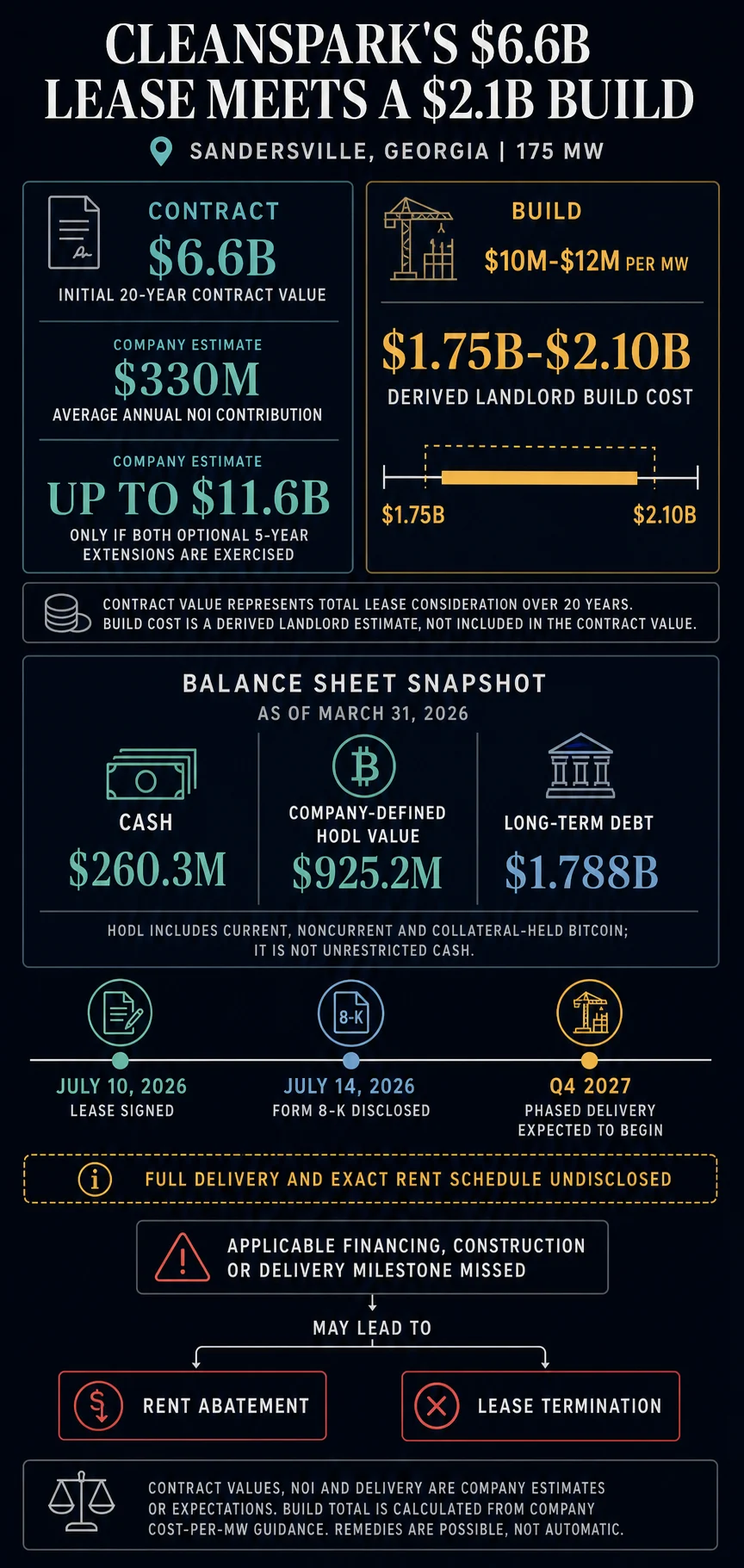
CleanSpark, a prominent Bitcoin mining and data center developer, has reached a pivotal milestone in its strategic pivot toward artificial intelligence (AI) infrastructure by entering into a 20-year triple-net lease for 175 megawatts (MW) of critical IT load at its Sandersville, Georgia, campus. The agreement, signed on July 10, 2026, and disclosed in a Form 8-K filing on July 14, marks one of the most significant infrastructure commitments in the company’s history, with an estimated initial contract value of $6.6 billion. While the deal positions CleanSpark as a major player in the burgeoning AI data center market, it also presents a formidable financial challenge, as the company must navigate a projected build cost ranging between $1.75 billion and $2.10 billion.
The Sandersville agreement involves an anonymous tenant described as a "high-investment-grade global technology company," a designation that typically refers to the upper echelon of Silicon Valley’s hyperscalers or established enterprise technology firms. Under the terms of the binding infrastructure lease, CleanSpark will provide the power and physical shell, while the tenant assumes responsibility for various operational costs, charges, and indemnities. The contract includes annual escalators and offers the tenant two optional five-year extensions. If these extensions are exercised, the total contract value could escalate from the initial $6.6 billion to as much as $11.6 billion over a 30-year period.
The Financial Landscape and the Funding Gap
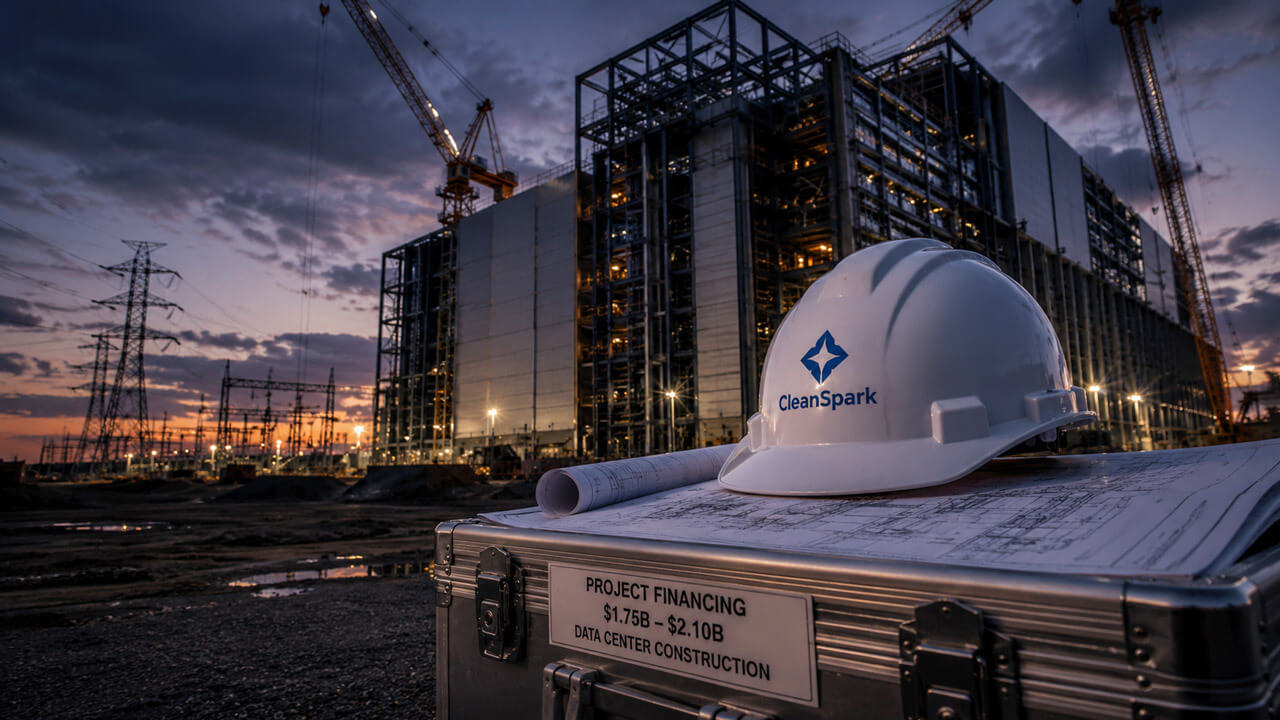
The scale of the Sandersville project is unprecedented for CleanSpark, and the projected capital expenditure (CapEx) requirements far exceed the company’s current liquid reserves. Based on CleanSpark’s own estimates of $10 million to $12 million in landlord project costs per MW, the total construction cost for the 175 MW facility is calculated to be between $1.75 billion and $2.10 billion.
As of the fiscal quarter ended March 31, 2026, CleanSpark reported a balance sheet that highlights the necessity for external financing. The company held $260.3 million in unrestricted cash and a company-defined Bitcoin "HODL" value of $925.2 million. Even when combining these two figures, the total liquidity of approximately $1.18 billion remains significantly short of the minimum $1.75 billion required for the Sandersville build. Furthermore, the HODL value is not entirely liquid; it includes current and noncurrent Bitcoin, as well as assets held by counterparties under collateral arrangements.
The project’s cost is approximately 6.7 to 8.1 times the company’s cash balance as of late March and represents roughly 98% to 117% of its existing long-term debt, which stood at $1.788 billion. With total liabilities reaching $1.927 billion and a reported net loss of $378.3 million for the quarter—driven largely by a $224.1 million Bitcoin fair-value loss—the company’s ability to fund the project through internal cash flow appears limited.
Chronology of the Sandersville Development
The timeline for the Sandersville project suggests a multi-year execution phase that will test CleanSpark’s operational and financial stamina.
- July 10, 2026: CleanSpark enters into the 20-year triple-net lease agreement for 175 MW at the Sandersville campus.
- July 14, 2026: The agreement is officially disclosed via an SEC Form 8-K filing.
- Q4 2027: Phased delivery of the IT load is expected to commence. This marks the beginning of the revenue-generation phase, though the full rent schedule depends on the completion of subsequent phases.
- Post-2027: Full delivery and rent-commencement schedules remain undisclosed, but the 20-year term begins as phases are handed over to the tenant.
The agreement includes strict performance milestones. According to the 8-K filing, CleanSpark must adhere to specific financing, construction, and delivery schedules. Failure to meet these milestones could result in rent abatements or, in extreme cases, the termination of the lease. This structure places the execution risk squarely on CleanSpark, as the $6.6 billion in projected revenue is contingent upon the successful and timely build-out of the 175 MW capacity.
Strategic Financing Paths and Risk Distribution
CleanSpark has indicated that the tenant’s high-investment-grade credit profile is a key asset in securing the necessary capital. In the world of infrastructure development, a long-term lease with a creditworthy tenant often serves as the "collateral" for project-level financing. This approach allows developers to borrow against the future cash flows of the lease rather than relying solely on the corporate balance sheet.
However, the specific terms of this financing—which have not yet been disclosed—will determine the ultimate risk profile for CleanSpark shareholders. There are several potential paths the company might take:
- Project-Level Debt: This is the most likely route, where lenders provide capital based on the $330 million in average annual net operating income (NOI) expected from the lease. While this limits direct recourse to the parent company, lenders may still require sponsor equity contributions or guarantees.
- Bitcoin-Backed Financing: CleanSpark has historically used its Bitcoin holdings as a source of liquidity. As of March 31, the company had $400 million in unused Bitcoin-backed credit lines. Utilizing these would require pledging more Bitcoin as collateral, exposing the company to margin call risks if the price of Bitcoin fluctuates significantly.
- Equity Dilution: To cover the "equity" portion of project financing, CleanSpark could issue new common stock or equity-linked securities. While this provides "free" capital in terms of debt obligations, it dilutes existing shareholders.
- Corporate Debt: Adding to the existing $1.788 billion in long-term debt, which includes zero-coupon convertible notes, would increase the company’s leverage.
Industry analysts note that CleanSpark’s move mirrors strategies seen by other Bitcoin miners, such as Hut 8 and Core Scientific, who have increasingly sought to diversify their revenue streams by hosting AI workloads. These "AI-Bitcoin hybrids" seek to balance the volatile, high-reward nature of mining with the stable, long-term cash flows of enterprise data center leases.
The Georgia and Texas Infrastructure Context
The Sandersville project is the cornerstone of CleanSpark’s current AI ambitions, but it is not the only large-scale project on the horizon. The company also holds a massive 718-acre portfolio in Texas. The same anonymous tenant involved in the Sandersville deal has executed a letter of intent (LOI) and an exclusivity agreement covering up to 885 MW of secured and planned power capacity in Texas.
It is important to distinguish between the two: the Sandersville deal is a signed, binding lease, whereas the Texas arrangement remains an LOI. If the Texas deal progresses to a formal lease, the capital requirements would dwarf those of the Sandersville project, potentially requiring tens of billions of dollars in infrastructure investment. This highlights CleanSpark’s transition from a Bitcoin mining firm into a massive-scale infrastructure developer.
The Sandersville campus itself has been a focal point of CleanSpark’s regional growth. Georgia has become an attractive hub for data centers due to its relatively stable power grid and favorable tax environment for large-scale technology investments. By securing 175 MW for AI, CleanSpark is maximizing the utility of its power purchase agreements in the state.
Broader Implications for the Bitcoin Mining Industry
CleanSpark’s pivot comes at a time of significant transition for the Bitcoin mining sector. Following the most recent halving events, miners have faced compressed margins and increased competition for power. AI infrastructure offers a compelling alternative use for high-voltage power assets.
The $10 million to $12 million per MW build cost estimated by CleanSpark reflects the high density and specialized cooling requirements of AI hardware, such as NVIDIA’s H100 and Blackwell chips. These facilities require significantly more robust cooling and power distribution systems than traditional Bitcoin mining "warehouses." By successfully transitioning to these higher-spec builds, CleanSpark is attempting to move up the value chain.
However, the transition is not without its detractors. Critics point out that the capital intensity of AI data centers can strain the balance sheets of companies that were originally built for the leaner CapEx model of crypto mining. The market’s reaction to CleanSpark’s eventual financing package will be a bellwether for how investors view the "AI-crypto" crossover.
Conclusion: Execution as the Final Hurdle
The $6.6 billion contract value represents a transformative opportunity for CleanSpark, promising to deliver an average of $330 million in annual net operating income. This would provide a steady, predictable counterweight to the volatility of Bitcoin mining rewards. Yet, the path to Q4 2027 is paved with significant financial and operational hurdles.
CleanSpark must secure roughly $2 billion in financing in a macroeconomic environment where interest rates and construction costs remain elevated. It must also manage the technical complexities of building high-tier AI infrastructure while maintaining its core Bitcoin mining operations.
The identity of the tenant, the specific terms of the project debt, and the company’s ability to hit its Q4 2027 delivery milestones will ultimately determine whether this lease is a masterstroke of diversification or a bridge too far for the company’s balance sheet. For now, CleanSpark has successfully moved from the "pitch" phase to the "execution" phase, setting the stage for a high-stakes transformation of its business model.