admin
admin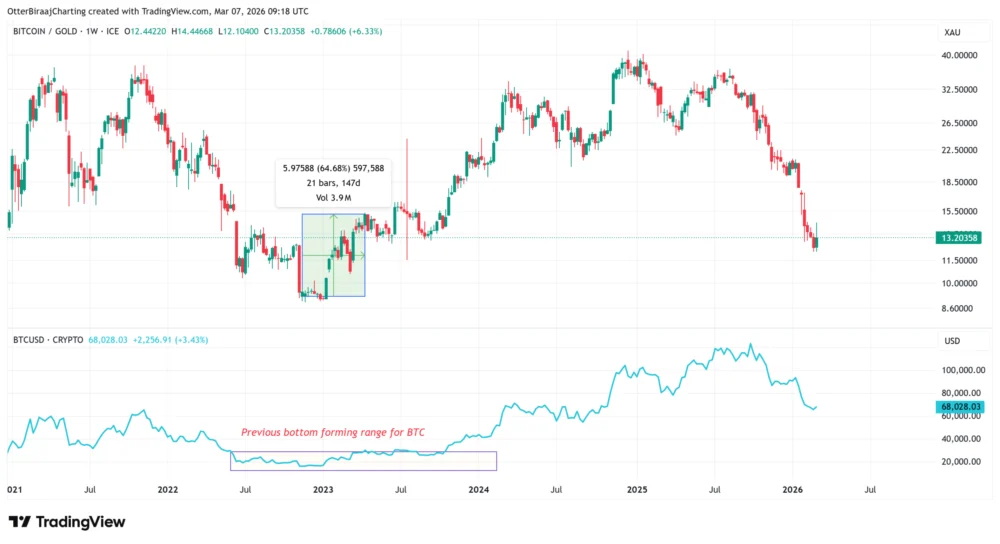
A significant shift in investor sentiment is becoming evident as exchange-traded fund (ETF) flows for Bitcoin (BTC) have turned net positive over the past month, coinciding with a noticeable slowdown in demand for gold ETFs. This pivot comes after nine consecutive months of robust inflows into gold-backed funds, even as gold prices remain at elevated levels and the broader sentiment around Bitcoin has experienced a recent cooling period. This contrasting trend in asset allocation is prompting analysts to closely examine underlying data, suggesting a gradual but potentially impactful reallocation of capital between these two prominent stores of value.
Gold’s Momentum Wanes as Bitcoin Recovers
For much of 2025 and early 2026, gold had been a favored safe-haven asset, attracting substantial capital amidst persistent global uncertainties. The metal’s impressive performance culminated in a 65% return in 2025, marking its fourth-largest annual gain since the end of the gold standard, as highlighted by Fidelity Digital Assets analyst Chris Kuiper in a "2026 Look Ahead" report. This rally was fueled by a confluence of factors, including escalating geopolitical tensions, particularly the ongoing US-Israel and Iran conflict, concerns over persistent fiscal deficits, and a search for inflation hedges in a volatile macroeconomic environment. Investors flocked to gold, viewing it as a reliable bastion against economic instability and currency devaluation.
The momentum, however, began to show cracks in early March. On a pivotal Wednesday, the largest U.S. gold-backed ETF, GLD, recorded a staggering $3 billion outflow. This represented the single largest daily withdrawal in over two years, according to data cited by the Kobeissi Letter. This sharp exodus followed a 4.4% decline in gold prices, the most significant drop since a similar sell-off observed on January 30. The sudden downturn in gold prices and subsequent outflows indicate a potential wave of profit-taking by investors who capitalized on gold’s substantial rally throughout 2025 and into the first two months of 2026. Prior to this, gold ETFs had commenced the year with unprecedented strength, accumulating $18.7 billion in January and an additional $5.3 billion in February, extending a remarkable nine-month streak of inflows. This historical performance now appears to be moderating, suggesting a recalibration of investor portfolios.
Conversely, Bitcoin ETF flows have demonstrated a noticeable reversal in fortunes over the last month. Data reveals that the 30-day net flow for Bitcoin ETFs shifted dramatically from a $1.9 billion outflow recorded on February 6 to a net inflow of $273 million by March 6. This turnaround is particularly significant given the earlier period of market apprehension surrounding Bitcoin’s price volatility and the initial post-launch adjustments of spot Bitcoin ETFs. The approval of spot Bitcoin ETFs in the U.S. earlier in the year marked a watershed moment for institutional adoption, providing a regulated and accessible avenue for mainstream investors to gain exposure to the digital asset. While initial flows were mixed, reflecting both enthusiasm and some profit-taking by early investors, the recent positive turn indicates renewed confidence and a potential re-engagement from institutional and retail capital.
Decoding the Shift: Native Units and Investor Sentiment

To gain a clearer understanding of the underlying asset accumulation, analysts often scrutinize holdings data in native units rather than just dollar values, which can be distorted by price fluctuations. This method isolates the actual amount of the asset being held or divested by the funds. For Bitcoin, ETF balances moved from a net decrease of 42,275 BTC on February 6 to a net increase of 4,021 BTC by March 6. This tangible accumulation of Bitcoin by ETF products underscores a real demand surge, independent of Bitcoin’s price movements during that period. In stark contrast, gold ETF holdings experienced a substantial decline during the same timeframe, falling from 1.4 million ounces to 621,100 ounces. This divergence in native unit holdings provides compelling evidence of a genuine rotation of capital away from gold and towards Bitcoin.
Industry observers are interpreting these movements as indicative of an underlying shift in market dynamics. Joe Consorti, Head of Growth at Horizon, succinctly summarized the evolving trend: “Gold is stalling out while Bitcoin is soaring. BTC is set to overtake gold’s % growth over the last month as the U.S. economy accelerates and risk sentiment improves. The anticipated risk-off → risk-on rotation could be underway.” This perspective suggests that as global economic indicators show signs of strengthening and investor appetite for risk assets improves, capital previously parked in safe-haven gold is now seeking higher-growth opportunities, with Bitcoin emerging as a prime beneficiary. The narrative of Bitcoin as a "digital gold" or a superior store of value, especially in an accelerating economy, appears to be gaining traction among a segment of the investment community.
Historical Precedents and Performance Cycles
The idea of a rotational cycle between gold and Bitcoin is not new. Fidelity Digital Assets’ Chris Kuiper elaborated on this historical pattern in his "2026 Look Ahead" report, noting that "Historically, gold and Bitcoin have taken turns outperforming. With gold shining in 2025, it would not be surprising if Bitcoin takes the lead next." This observation frames the current shift as part of a larger, cyclical dynamic where different assets assume leadership roles based on prevailing market conditions and investor preferences.
Examining the Bitcoin-to-gold ratio offers further insight into these performance cycles. After Bitcoin’s market bottom in 2022, it took approximately 147 days, or 21 weeks, for the digital asset to establish a sustained trend of outperforming gold. This period was characterized by a consolidation phase, during which the market absorbed new information and adjusted expectations before the ratio began its upward trajectory. Interestingly, the BTC-to-gold ratio is currently trading near a similar consolidation zone observed during the earlier rotation phases of 2022-2023. This historical parallel suggests that while a significant shift may be underway, the full extent of Bitcoin’s potential outperformance could unfold over a period of several months, requiring investors to maintain a long-term perspective. Macroeconomic strategist Lyn Alden, a respected voice in financial analysis, further reinforces this view, expecting Bitcoin to outperform gold over the next two to three years, building on gold’s recent strong rally.
Broader Macroeconomic and Geopolitical Implications
Beyond the immediate ETF flow data, the broader macroeconomic and geopolitical landscape continues to exert significant influence on both gold and Bitcoin. Kuiper’s analysis points out that both assets can benefit from persistent fiscal deficits, ongoing trade tensions, and global geopolitical uncertainty, as investors increasingly seek neutral stores of value outside traditional monetary systems.

The ongoing conflict between the US, Israel, and Iran, for instance, has traditionally bolstered demand for gold as a conventional safe haven. However, the current environment presents a nuanced picture where Bitcoin, with its decentralized nature and limited supply, is also being considered as a potential hedge against such instabilities. The debate over which asset provides a more effective hedge against inflation and geopolitical risk is intensifying. While gold has centuries of proven history, Bitcoin’s proponents argue its digital scarcity, global accessibility, and resistance to censorship make it a superior alternative in the modern era.
Moreover, central bank policies, particularly concerning interest rates and quantitative easing or tightening, play a crucial role. When real interest rates are low or negative, the opportunity cost of holding non-yielding assets like gold and Bitcoin decreases, making them more attractive. Conversely, rising real interest rates can make traditional fixed-income assets more appealing. The Federal Reserve’s stance on monetary policy, coupled with inflation expectations, will undoubtedly continue to shape the investment landscape for both assets. The narrative of a "risk-on" environment, as suggested by Joe Consorti, implies a belief that central banks may be nearing the end of their tightening cycles, or that economic growth is robust enough to absorb higher rates, thereby encouraging investment in growth-oriented or speculative assets like Bitcoin.
The Maturation of Digital Gold and Future Outlook
The current rotation in ETF flows underscores a critical phase in the maturation of Bitcoin as an institutional asset. The launch of spot Bitcoin ETFs has not only democratized access but also brought the digital asset into the mainstream financial ecosystem, subject to the same institutional scrutiny and trading patterns as traditional assets like gold. This increased legitimacy and accessibility are fundamental to Bitcoin’s long-term growth trajectory and its potential to firmly establish itself as a "digital gold."
While gold will undoubtedly retain its historical significance as a store of value, particularly for those seeking traditional hedges against uncertainty, Bitcoin is increasingly carving out its own niche. Its unique attributes – programmability, divisibility, and ease of transfer across borders – position it as a complementary, and in some views, superior alternative for a new generation of investors and institutions. The shift in ETF flows, therefore, is not merely a short-term market fluctuation but potentially a harbinger of a more profound structural change in how investors perceive and allocate capital between these two iconic stores of value. The coming months will be crucial in determining whether this nascent rotation evolves into a sustained trend, solidifying Bitcoin’s position in the global financial architecture alongside, or even ahead of, its ancient counterpart.
This article does not contain investment advice or recommendations. Every investment and trading move involves risk, and readers should conduct their own research when making a decision. While we strive to provide accurate and timely information, Cointelegraph does not guarantee the accuracy, completeness, or reliability of any information in this article. This article may contain forward-looking statements that are subject to risks and uncertainties. Cointelegraph will not be liable for any loss or damage arising from your reliance on this information.