Dwi Wanna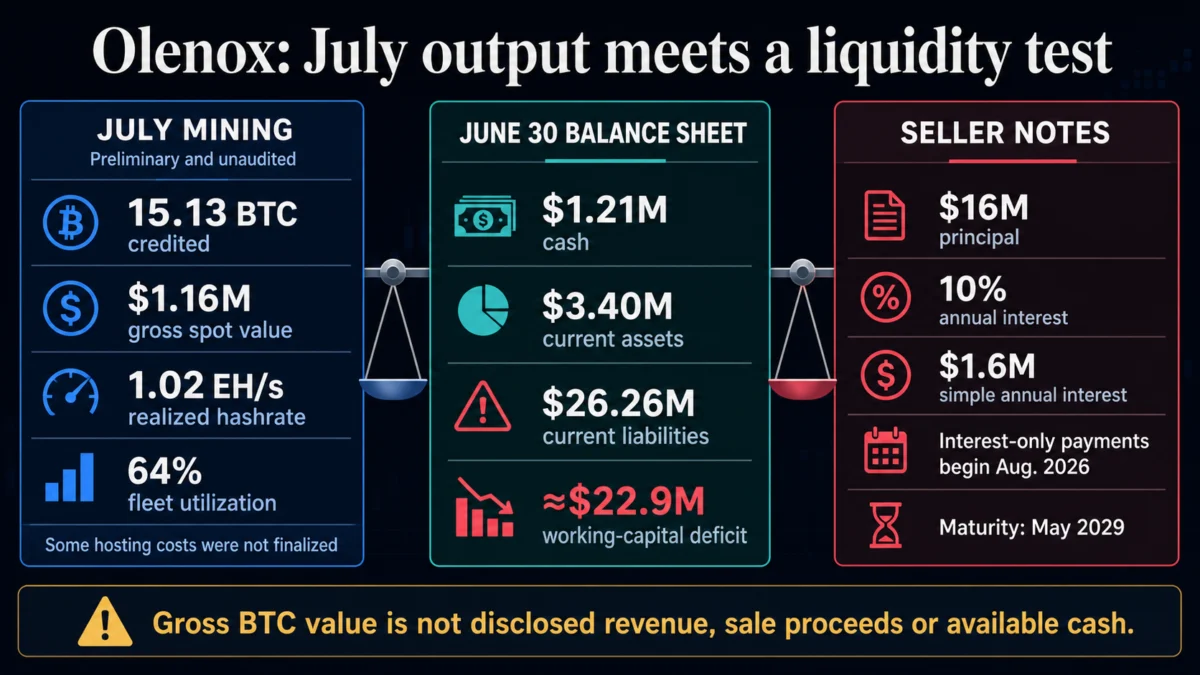
As of June 30, Olenox reported a cash balance of just $1.21 million, set against a staggering $26.26 million in current liabilities. This disparity has resulted in a working-capital deficit of approximately $22.9 million, a figure that has sent ripples of concern through the investment community and prompted the company to issue a "going concern" warning in its recent regulatory filings. The financial strain comes at a critical juncture as the company attempts to move its mining operations off-grid to capitalize on proprietary energy sources.
Financial Architecture and the Liquidity Gap
The fiscal health of Olenox Industries has come under intense scrutiny following the release of its August 19 quarterly filing. While the company holds total current assets of $3.40 million, the weight of its short-term obligations remains the primary obstacle to its operational stability. The $26.26 million in current liabilities is a multifaceted burden, comprising $14.55 million in accounts payable and accrued expenses, alongside lease maturities, derivative liabilities, convertible notes, and the current portions of long-term debt.
The company’s management has been candid about the risks associated with this balance sheet. In official statements, Olenox acknowledged that its persistent losses, negative working capital, and negative operating cash flows raise substantial doubt about its ability to continue as a going concern. Without a committed source of additional financing as of the end of the second quarter, the firm warned that it might be forced to delay, scale back, or entirely curtail its planned industrial activities if it cannot secure an immediate infusion of capital.
This liquidity squeeze is further complicated by the terms of the CS Digital Ventures acquisition. To finalize the $30 million deal, Olenox utilized a combination of $14 million in Series E preferred stock and $16 million in unsecured promissory notes. These "seller notes" carry a 10% annual interest rate and are set to mature in May 2029. Crucially, the grace period for these notes ended in August 2026, marking the commencement of mandatory interest-only payments. With a principal of $16 million, the company faces an annual interest obligation of $1.6 million, or roughly $400,000 per quarter, adding a fixed cash drain to an already depleted treasury.
Operational Performance Amid Environmental Headwinds
In July, Olenox reported a preliminary Bitcoin production of 15.13 BTC. At the spot price of $76,371.25 recorded on August 21, this output carries a gross theoretical value of approximately $1.16 million. However, this figure does not translate directly to net revenue or available cash flow. The company operates part of its fleet through third-party hosting providers in Texas, and as of the latest reporting period, finalized hosting invoices—covering electricity, management fees, and profit-sharing agreements—remained unsettled.
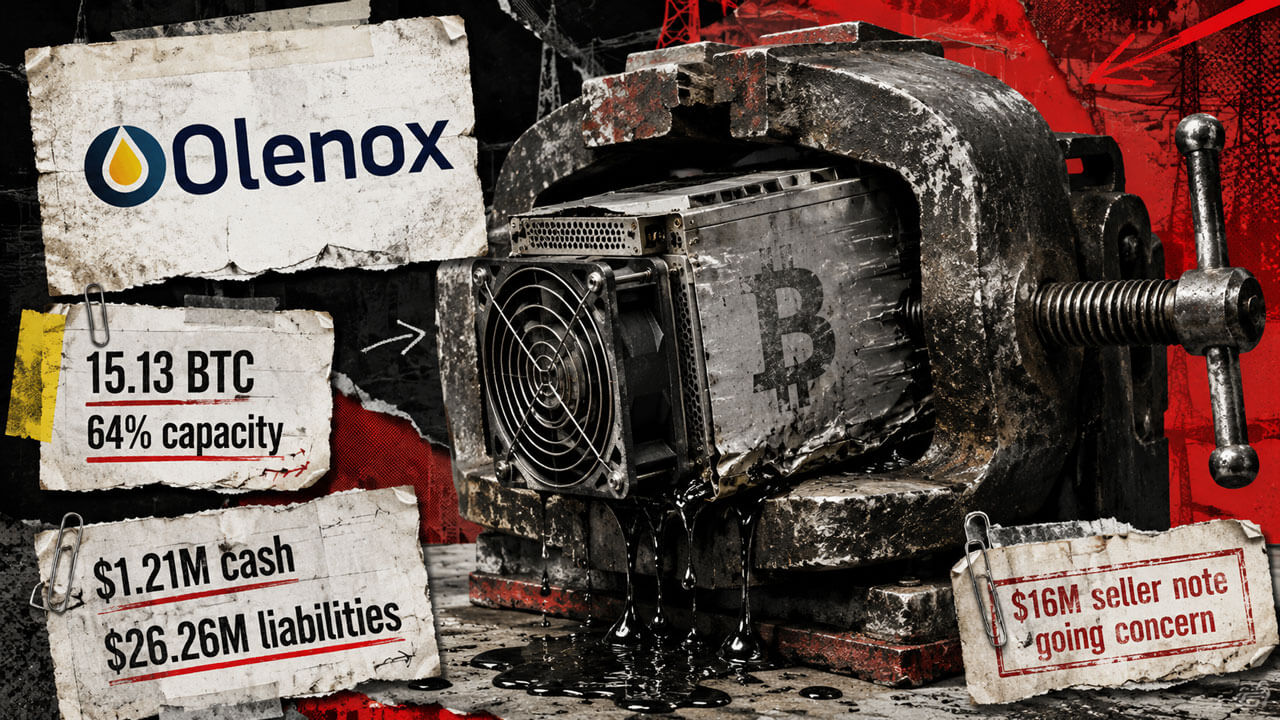
Operationally, the company maintained an average operational hashrate of 1.02 exahash per second (EH/s) during July. This figure represents approximately 64% of the fleet’s total economic capacity. Olenox attributed this performance gap to three primary factors: the extreme summer heat characteristic of the Texas climate, the deliberate operation of machines in "low-power mode" to manage thermal loads, and standard equipment maintenance cycles.
In the Bitcoin mining industry, "curtailment" is a common practice, particularly in the ERCOT (Electric Reliability Council of Texas) grid. During periods of peak demand and high temperatures, miners often power down their rigs to stabilize the grid or to avoid exorbitant "spot" electricity prices. While this protects the hardware and assists the local infrastructure, it results in a lower realized hashrate and reduced monthly BTC production. For Olenox, these environmental challenges have highlighted the urgency of their proposed shift toward an off-grid model.
The Strategy: Transitioning to Off-Grid Compute
The central pillar of Olenox’s turnaround plan is the integration of its legacy energy assets with its new mining capabilities. Currently, the company’s miners rely on grid power, which exposes the firm to market volatility and the aforementioned environmental curtailments. The company’s stated objective is to convert its own natural gas reserves into off-grid electricity to power its compute clusters.
By utilizing "behind-the-meter" energy, Olenox targets a power cost of below $0.02 per kilowatt-hour (kWh). If achieved, this would place the company among the most cost-efficient Bitcoin producers globally. For comparison, many industrial-scale miners operating on the grid face costs ranging from $0.04 to $0.07 per kWh. The transition to off-grid mining is intended to decouple the company’s operational expenses from the fluctuations of the Texas energy market and provide a consistent, low-cost fuel source for its 1.02 EH/s fleet.
However, the capital required to build out the infrastructure for gas-to-power conversion—including generators, switchgear, and site preparation—is significant. With a $22.9 million working capital deficit, the path to funding this transition remains unclear. The company’s future hinges on its ability to leverage its existing energy assets to secure new financing or to significantly improve its mining margins in the coming months.
Chronology of Key Events
The following timeline illustrates the rapid transformation and subsequent financial tightening of Olenox Industries over the mid-2026 period:

- May 26, 2026: Olenox completes the acquisition of CS Digital Ventures for $30 million, officially entering the Bitcoin mining sector. The deal includes $16 million in seller-financed debt.
- June 30, 2026: The company closes its second-quarter books, revealing a cash-to-liability ratio of nearly 1-to-22 and a total working capital deficit of $22.9 million.
- July 2026: CS Digital Ventures records its first full month of production under Olenox ownership, yielding 15.13 BTC.
- August 1, 2026: Interest-only payments on the $16 million unsecured promissory notes begin, creating a new recurring monthly liability.
- August 19, 2026: Olenox files its quarterly report with the SEC, including the "going concern" warning. Simultaneously, the company announces a non-binding Letter of Intent (LOI) for a new $20 million acquisition, signaling continued expansion despite liquidity woes.
- August 21, 2026: Bitcoin spot prices reach $76,371.25, providing a temporary valuation boost to the company’s July output.
New Acquisitions and Future Implications
In a move that surprised some market analysts, Olenox announced on August 19 that it had signed a non-binding LOI to acquire an additional energy-integrated entity for approximately $20 million. The proposed deal structure relies heavily on the issuance of preferred and common stock, with a smaller cash component. This suggests that management is leaning into equity-based financing to fuel growth while preserving what little cash remains in the treasury.
The broader implications of Olenox’s current situation reflect the high-stakes nature of the modern Bitcoin mining industry. As the network hashrate continues to climb and the difficulty of mining increases, firms that lack "fortress" balance sheets are increasingly vulnerable to operational hiccups. For Olenox, the pivot to off-grid mining is not merely a strategic choice but a necessary evolution for survival.
If the company can successfully navigate its current debt obligations and secure the funding needed for its gas-to-power infrastructure, it could emerge as a highly profitable, vertically integrated energy and compute firm. However, the immediate hurdles are formidable. The company must bridge the gap between its headline production numbers and actual cash generation, all while managing a massive accounts payable balance and the onset of debt service payments.
The "missing bridge" in the company’s current financial narrative remains the final hosting costs for July. Until those figures are audited and released, investors remain in the dark regarding the actual net margin of the 15.13 BTC produced. In an industry where margins are everything, Olenox Industries finds itself in a race against time, attempting to build a sustainable energy-mining ecosystem before its capital deficit leads to a total operational stall.
As the Bitcoin market enters the latter half of 2026, the fate of Olenox will likely serve as a case study in the risks of aggressive, debt-funded expansion within the volatile intersection of energy production and digital asset mining. For now, the firm remains operational, but its ability to survive the summer of its discontent depends entirely on its access to new capital and the efficiency of its upcoming off-grid transition.