admin
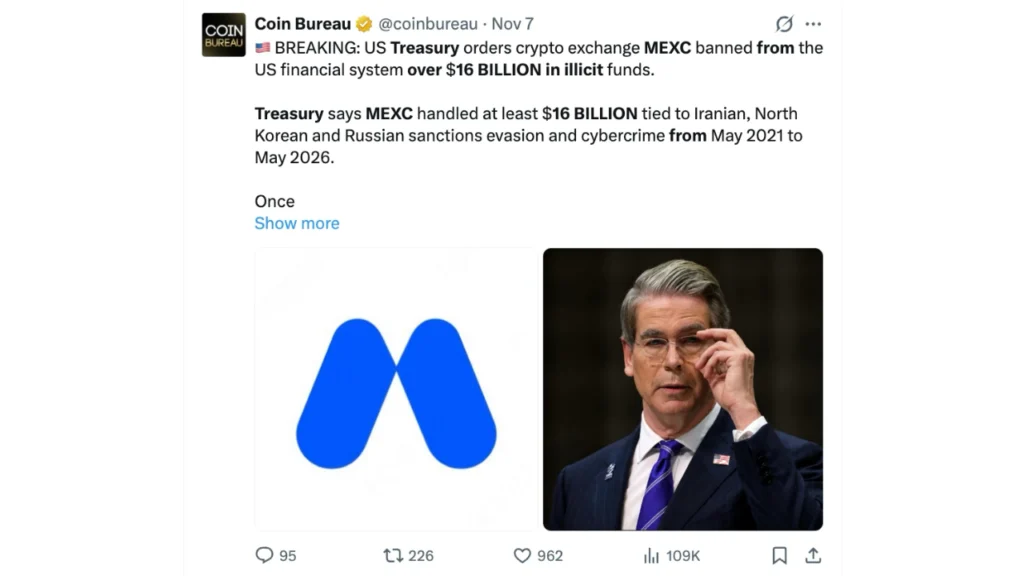
The United States Treasury Department has taken decisive action to sever one of the world’s largest cryptocurrency exchanges, MEXC Global, from the American financial system. On Friday, the department’s Financial Crimes Enforcement Network (FinCEN) issued a groundbreaking order, effectively barring U.S. financial institutions from processing any funds transfers to or from MEXC Global. This extraordinary measure comes amidst grave accusations that the exchange has facilitated at least $16 billion in illicit money transfers linked to sanctioned entities in Iran, North Korea, and Russia.
The directive, which represents a significant escalation in the U.S. government’s campaign against illicit finance within the digital asset space, is set to take effect 30 days after its official publication in the Federal Register. Following this deadline, any U.S. institution found to be continuing financial transactions with MEXC Global will face the severe consequences of civil or criminal penalties. This move underscores the Treasury’s unwavering commitment to enforcing sanctions and preventing hostile regimes from leveraging cryptocurrencies to circumvent international financial safeguards.
Treasury Secretary Scott Bessent issued a stern warning reflecting the administration’s zero-tolerance stance: "Financial institutions cannot have it both ways: Either you support the Iranian regime, or you have access to the U.S. financial system." He further emphasized the Treasury’s ongoing strategy to dismantle the economic lifelines of sanctioned entities and to meticulously block their attempts to exploit digital assets for illicit purposes. This statement serves as a clear message to the broader cryptocurrency industry that compliance with anti-money laundering (AML) and sanctions regulations is not negotiable.
FinCEN’s Comprehensive Findings Against MEXC Global
FinCEN’s exhaustive 24-page order provides a detailed account of the alleged illicit activities. MEXC, founded in 2018, is far from a minor player in the cryptocurrency landscape. It ranks among the top 20 largest crypto exchanges globally, processing over $1 billion in trades daily and holding approximately $5 billion in reserves across more than 3,000 listed tokens. The order highlights that MEXC is registered in the Seychelles, notably operates without a virtual asset service provider (VASP) license, and serves users in over 170 countries. As of December 2025, the exchange commanded roughly 9% of the global centralized crypto exchange market, making its alleged illicit activities a concern of significant systemic impact.
The core of FinCEN’s accusation centers on the staggering figure of approximately $16.7 billion connected to illicit activities that reportedly transited through the MEXC platform between May 2021 and May 2026. While the precise breakdown of these transactions across all nefarious actors was not fully detailed in the initial release, the order explicitly cites more than $13 billion in transactions with at least four high-risk exchangers previously sanctioned by the United Kingdom. This extensive exposure to sanctioned entities paints a concerning picture of MEXC’s compliance failures.
Perhaps the most damning revelation involves MEXC’s continued engagement with Garantex, a Russian exchange that the U.S. sanctioned in 2022 following Russia’s full-scale invasion of Ukraine. FinCEN’s investigation found that MEXC maintained trading relationships with Garantex and its successor, Grinex, as recently as June 2026. This continued interaction, more than four years after Garantex’s initial designation, led FinCEN to classify MEXC as a "primary money laundering concern" in connection with Russian illicit finance. This designation, reserved for entities posing significant threats to the U.S. financial system, underscores the severity of MEXC’s alleged transgressions.
Despite having stated anti-money laundering policies and explicit prohibitions against users from sanctioned jurisdictions like Iran and North Korea, FinCEN concluded that MEXC’s compliance program suffered from "severe deficiencies." These systemic failures allegedly allowed the exchange to be exploited by malicious actors, facilitating a wide array of illicit financial flows.
A Targeted Regulatory Tool: Section 9714(a)
It is crucial to understand that this action against MEXC Global does not stem from the Office of Foreign Assets Control’s (OFAC) standard sanctions list. Instead, FinCEN issued the order under section 9714(a) of the Combating Russian Money Laundering Act. This distinction carries significant weight. While the measure effectively cuts off U.S. institutions from any transfers involving MEXC, it does not constitute a worldwide asset freeze, nor does it automatically place MEXC on a global sanctions list.

FinCEN has increasingly utilized this specific authority to target cryptocurrency platforms operating outside the traditional correspondent banking system, where conventional sanctions often struggle to exert their full impact. This provision offers FinCEN a powerful tool to disrupt illicit financial networks that leverage the decentralized nature of digital assets. A precedent for this approach was set in 2024 when FinCEN employed the same provision against the Russian exchanger PM2BTC, signaling a consistent strategy in combating crypto-related illicit finance. This strategic use of Section 9714(a) highlights a growing sophistication in the U.S. Treasury’s regulatory toolkit, adapting to the evolving landscape of global financial crime.
Operation Economic Outcast: A Wider Campaign Against Illicit Networks
The action against MEXC Global is not an isolated event but rather a critical component of a broader, comprehensive U.S. Treasury initiative known as Operation Economic Outcast. Launched on August 24, 2026, this "whole-of-Treasury" effort aims to systematically dismantle Iran’s global financial, trade, and logistics connections. MEXC’s alleged ties to Garantex, Grinex, and the A7A5 network place it squarely within a complex sanctions-evasion web that the Treasury Department has been diligently unraveling piece by piece.
Just last month, the Treasury designated Russia’s A7 Network as a transnational criminal organization, proposing to sever its front companies from U.S. finance. Investigations revealed that more than $179 billion in transactions, largely routed through the A7A5 token, passed through Garantex and Grinex, further underscoring the interconnectedness of these illicit financial ecosystems. The campaign has also extended its reach into Iran’s crypto sector, where the Treasury has gained broad authority to sanction any entity operating within it. Notably, the Iranian exchange Nobitex was blacklisted for allegedly funneling cryptocurrency to the Islamic Revolutionary Guard Corps (IRGC), a designated terrorist organization. In parallel with the MEXC order, the Treasury also sanctioned eight Canadian companies accused of assisting Iran, Russia, and North Korea in evading sanctions and facilitating funds linked to cybercrime and drug trafficking.
North Korea remains a particularly pressing concern for U.S. financial intelligence and national security agencies. Its state-sponsored hackers, notably groups like Lazarus, have become prolific perpetrators of cryptocurrency theft, amassing over $6.7 billion in stolen crypto since 2016, according to industry tallies. A significant portion of this, approximately $2 billion, was stolen in 2025 alone. In the first four months of 2026, North Korean actors were responsible for $577 million in crypto losses, accounting for roughly 76% of all crypto-related thefts during that period. The use of exchanges like MEXC by such state-sponsored actors provides crucial liquidity and obfuscation for their illicit gains, directly funding weapons programs and other destabilizing activities.
MEXC’s Response and Immediate Market Impact
In the immediate aftermath of FinCEN’s announcement, MEXC Global issued a public statement acknowledging the November 6 order. The exchange affirmed that it was "reviewing it closely with its legal and compliance teams" and asserted that its "operations were normal, [and] user assets were safe." MEXC also expressed its intent to "engage constructively with FinCEN" and disclosed that it had initiated an independent review of its anti-money laundering and sanctions controls. This response, while standard, faces skepticism given the severe nature of FinCEN’s findings.
However, users and market participants did not wait for the outcome of MEXC’s internal review. On-chain data quickly revealed a significant reaction, with approximately $126 million in net outflows from MEXC in the 24 hours surrounding the announcement. This exodus of funds indicates a palpable loss of user confidence and a swift move by investors to protect their assets from potential future disruptions or regulatory fallout. Beyond individual users, at least one token issuer, NatGold Digital, took immediate action, requesting the delisting of its NATG token from MEXC following the order, signaling a broader industry-wide concern about association with the sanctioned entity.
The Road Ahead: Implications for MEXC and the Crypto Industry
While the 30-day clock for the ban to take full legal effect has not yet officially started—it commences only upon the order’s publication in the Federal Register—the practical implications are already manifesting. Payment processors, wallet providers, other cryptocurrency exchanges with U.S. exposure, and even global financial institutions are expected to begin proactively screening or outright rejecting MEXC-linked funds well in advance of the legal deadline. The risk of incurring penalties or being associated with a designated "primary money laundering concern" is a powerful deterrent that often prompts immediate de-risking actions across the financial ecosystem.
For the wider cryptocurrency industry, the message emanating from Washington is stark and unambiguous. The U.S. Treasury Department has unequivocally demonstrated that an exchange’s size, global reach, or claims of decentralization will not provide immunity or protection if it continues to facilitate business with sanctioned networks and illicit actors. The implications are clear: if financial flows are traced back to regimes like Tehran, Moscow, or Pyongyang, the Treasury is not only willing but increasingly able to leverage its formidable powers to sever access to the U.S. dollar and the broader international financial system entirely. This marks a critical juncture in the ongoing effort to bring the rapidly evolving digital asset space into alignment with global anti-money laundering and counter-terrorism financing standards, signaling a new era of assertive regulatory enforcement against platforms perceived as enabling illicit finance.