admin
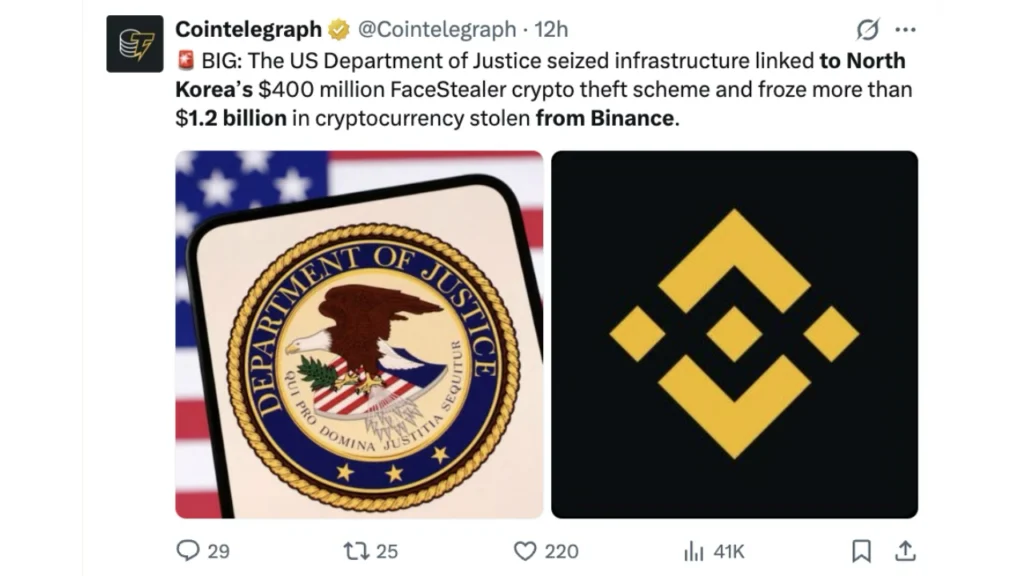
In a significant escalation against North Korea’s state-sponsored cyber warfare, the United States government has announced a sweeping set of actions targeting Pyongyang’s vast network of cryptocurrency theft and money laundering. The U.S. Department of Justice (DOJ) has secured court authorization to seize or restrain more than $1.2 billion in cryptocurrency, directly linked to the monumental October 29 heist from Binance, the world’s largest cryptocurrency exchange. This move represents the most substantial legal and financial blow yet against an incident attributed by the FBI to North Korea’s military-linked hacking collective, often identified as the Lazarus Group or TraderTraitor.
The announcement, made on Thursday, November 12, underscored a multi-pronged approach to disrupt North Korea’s illicit funding streams. Alongside the unprecedented crypto seizure, federal agents also successfully dismantled the sophisticated cloud infrastructure underpinning "FaceStealer," another insidious North Korean cyber campaign. This operation, notorious for employing AI-generated deepfakes and elaborate social engineering tactics, has reportedly siphoned over $400 million in cryptocurrency from unsuspecting victims over the past 18 months. These coordinated actions collectively signify Washington’s most aggressive and comprehensive efforts to date in severing the financial lifelines that U.S. officials assert directly fund the Kim Jong Un regime and its prohibited weapons programs, including ballistic missile and nuclear development.
The Anatomy of a Gigantic Heist: The Binance Breach of October 29
The October 29, 2026, attack on Binance stood out not just for its audacious execution but for the sheer scale of assets stolen, estimated at approximately $6.3 billion. While the initial reports and attribution were swift, the magnitude of the theft sent ripples across the global cryptocurrency market, highlighting persistent vulnerabilities within the nascent digital asset ecosystem. Investigators, including the FBI, quickly pointed fingers at "TraderTraitor," a moniker used for a specific facet of North Korea’s broader cyber warfare apparatus, widely believed to be a component of the notorious Lazarus Group. This group, officially designated by the U.S. government as a state-sponsored entity, has a long history of targeting financial institutions and cryptocurrency exchanges worldwide, leveraging sophisticated phishing, malware, and social engineering techniques.
The modus operandi for such large-scale breaches often involves a protracted period of reconnaissance and infiltration. Hackers might spend months or even years gaining access to internal systems, compromising employee credentials, or exploiting software vulnerabilities before executing a coordinated theft. The Binance hack, given its scale, likely involved a meticulous understanding of the exchange’s internal architecture and security protocols, allowing the attackers to bypass multiple layers of defense and exfiltrate a vast array of digital assets.
Washington’s Decisive Counterstrike: Seizure and Infrastructure Takedown
The U.S. government’s response to these digital assaults has been multifaceted, combining legal authority with advanced cyber forensics. The $1.2 billion seizure order is a critical component of a larger collaborative effort involving U.S. authorities and private-sector cybersecurity partners, who together have managed to freeze more than $2.7 billion of the total $6.3 billion stolen from Binance. This $1.2 billion now under court order represents the portion the government has formally moved to take legal control of, marking a crucial step towards its potential forfeiture.
M. Scott Proctor, Principal Deputy Assistant Attorney General for National Security, emphasized the strategic importance of these actions: "North Korea’s government bankrolls its rogue regime and illicit weapons program through cryptocurrency theft. Today’s announcement shows that America will fight back against that corrupt regime’s effort to profit through cybercrime. The National Security Division will use every tool at its disposal to seize and return North Korea’s ill-gotten gains." This statement underscores the direct link the U.S. government draws between Pyongyang’s cybercriminal activities and its proliferation of weapons of mass destruction, framing these seizures as a national security imperative rather than solely a criminal matter. Assistant Attorney General Tysen Duva further commended the rapid response of the department’s Criminal Division and its digital asset industry liaisons for their role in halting nearly half of the breached funds.
"FaceStealer": The Deceptive Art of Social Engineering with AI
Beyond the brute-force financial expropriation of the Binance hack, the takedown of "FaceStealer" infrastructure highlights the ingenuity and evolving sophistication of North Korean cyber tactics. This campaign, which the FBI estimates has netted over $400 million in 18 months, represents a dangerous fusion of social engineering and cutting-edge technology. The scheme weaponizes everyday video conferencing platforms like Zoom and Microsoft Teams, leveraging hijacked accounts to invite targets to fake meetings.
The core of the deception lies in the visual element. Attackers would present a "familiar face" to the victim, either through secretly recorded footage from earlier victims or, more alarmingly, through AI-generated deepfakes. This visual mimicry builds immediate trust and lowers the victim’s guard. The trap is then sprung: claiming a technical glitch, the attackers instruct the victim to install seemingly innocuous software or execute a command to "fix" the issue. This "fix" is, in reality, malware designed to infiltrate the victim’s system, allowing the hackers to empty cryptocurrency wallets, exfiltrate sensitive data, and gain backdoor access to other critical systems. The FBI noted that in some instances, the ultimate theft and communication account takeover occurred months, or even over a year, after the initial computer compromise, demonstrating the patience and long-term planning of these attackers.
Patrick Grandy, Assistant Director in Charge of the FBI’s Los Angeles Field Office, issued a stern warning: "It exploits our trust in ubiquitous video conference platforms and valued personal relationships. If you can’t imagine a scenario where you might fall prey to it, you are not thinking creatively enough." The FBI’s seizure of over 900 webcam videos of FaceStealer victims and subsequent guidance to those affected underscores the personal and pervasive nature of this threat. Particularly concerning to investigators is the hackers’ practice of using stolen contacts to target developers maintaining widely used open-source software. Compromising a single maintainer could grant attackers a critical entry point into countless downstream systems, transforming one fooled engineer into a catastrophic supply-chain breach, capable of impacting global software infrastructure.
North Korea’s Digital Warfare Economy: A Global Threat
North Korea’s extensive involvement in cybercrime is not merely opportunistic; it is a strategic pillar of the regime’s survival. Faced with crippling international sanctions designed to curb its nuclear and ballistic missile programs, Pyongyang has increasingly turned to illicit cyber activities to generate foreign currency, bypass financial restrictions, and fund its state apparatus. The Lazarus Group, and its various sub-groups like TraderTraitor, APT38, and Kimsuky, have been active for over a decade, evolving from traditional espionage to sophisticated financial crime.
Estimates from various cybersecurity firms and government agencies suggest that North Korea has stolen billions of dollars in cryptocurrency over the years, with some reports indicating totals exceeding $2 billion in a single year. These funds are meticulously laundered through a complex web of intermediaries, mixers, and exchanges, making them difficult to trace and recover. The proceeds are then funneled into state coffers, directly supporting the development and procurement of advanced weaponry, including intercontinental ballistic missiles (ICBMs) and nuclear devices, posing a direct threat to regional and global security. The current actions by the DOJ, therefore, are not just about recovering stolen funds but about directly undermining the financial stability of a rogue state.
The Laundering Labyrinth: Following the Digital Trail
Despite the significant seizures, investigators acknowledge that billions of dollars remain "in motion," highlighting the formidable challenges of tracing and recovering stolen digital assets. North Korean hackers employ sophisticated laundering techniques to obfuscate the origin and destination of funds. These methods often involve "blockchain bridges," which allow assets to move between different blockchain networks, "mixers" or "tumblers" like Tornado Cash, which pool and scramble cryptocurrencies from various sources to break transaction links, and rapid movements through multiple exchanges.

On-chain analytics firms play a crucial role in these investigations. Accounts like Onchain Lens, citing data from Arkham Intelligence, have provided detailed insights into the laundering process. For instance, after the Binance hack, roughly $2.85 billion was still accessible to the attackers, while about $891 million had already been moved or laundered. The hackers have recently been observed pushing funds through cross-chain protocols such as THORChain and Chainflip—a familiar tactic for rapidly moving assets between blockchains, often faster than defenders can react or exchanges can impose restrictions. Blockchain analytics firm Elliptic tracked approximately 1,650 Bitcoin, converted from other stolen assets, landing in fresh addresses by November 6, with some later routed through the Tornado Cash mixer.
Law enforcement agencies, including the FBI, Secret Service, and IRS Criminal Investigation, have proactively urged cryptocurrency providers to block addresses linked to laundering activities. However, the speed and agility of the attackers pose a constant challenge, leading some analysts to question how much more cryptocurrency the hackers could move before protocols like THORChain and Chainflip can restrict linked wallets, emphasizing the race against time in digital asset recovery.
Implications for Binance Users and the Broader Crypto Ecosystem
For Binance customers affected by the October 29 hack, the government’s seizure actions will not directly alter their account balances. Binance had previously acknowledged the estimated $6.3 billion loss and proactively set aside an equivalent amount from its own treasury and insurance funds to cover all affected users. On the day of the U.S. announcement, Binance confirmed it had completed coverage of all affected assets and published a new proof-of-reserves snapshot to reassure its user base. Therefore, any funds eventually forfeited by the U.S. government would not flow back into user accounts, as their losses have already been absorbed by the exchange.
The broader implications, however, are significant for the cryptocurrency industry. These incidents underscore the persistent security risks associated with digital assets and the critical need for robust security protocols, swift incident response, and continuous collaboration with law enforcement. The scale of the Binance hack and the sophistication of the FaceStealer campaign serve as stark reminders that the crypto space remains a prime target for state-sponsored and organized cybercriminals. It reinforces the call for enhanced regulatory frameworks, stricter KYC (Know Your Customer) and AML (Anti-Money Laundering) compliance, and advanced threat intelligence sharing across the industry.
Broader Geopolitical Ramifications and the Ongoing Cyber Front
The U.S. government’s recent actions carry substantial geopolitical weight. Every dollar of stolen cryptocurrency that is frozen or seized represents a direct impediment to North Korea’s ability to fund its illicit weapons programs and evade international sanctions. These efforts are part of a broader strategy to exert financial pressure on the Kim regime, hoping to compel it to abandon its nuclear ambitions. However, the sheer volume of funds still in motion indicates that Pyongyang’s digital warfare economy remains robust and highly adaptable.
This week’s coordinated strikes demonstrate that the fight against North Korean cybercrime is being waged on multiple fronts: the intricate, high-stakes pursuit of stolen coins across complex blockchain networks, and the proactive dismantling of the social-engineering machinery designed for future heists. Washington has undeniably scored significant victories in both arenas. Yet, the open question remains whether law enforcement and cybersecurity agencies can consistently keep pace with an adversary as fast, innovative, and relentless as North Korea’s state-sponsored hacking groups. The evolving nature of cryptocurrency, combined with rapid advancements in AI and social engineering, ensures that the digital battlefield will continue to be a dynamic and challenging environment for the foreseeable future. The battle to secure the digital frontier and cut off illicit financial flows to rogue states is far from over, representing an enduring challenge for global security and economic stability.