admin
admin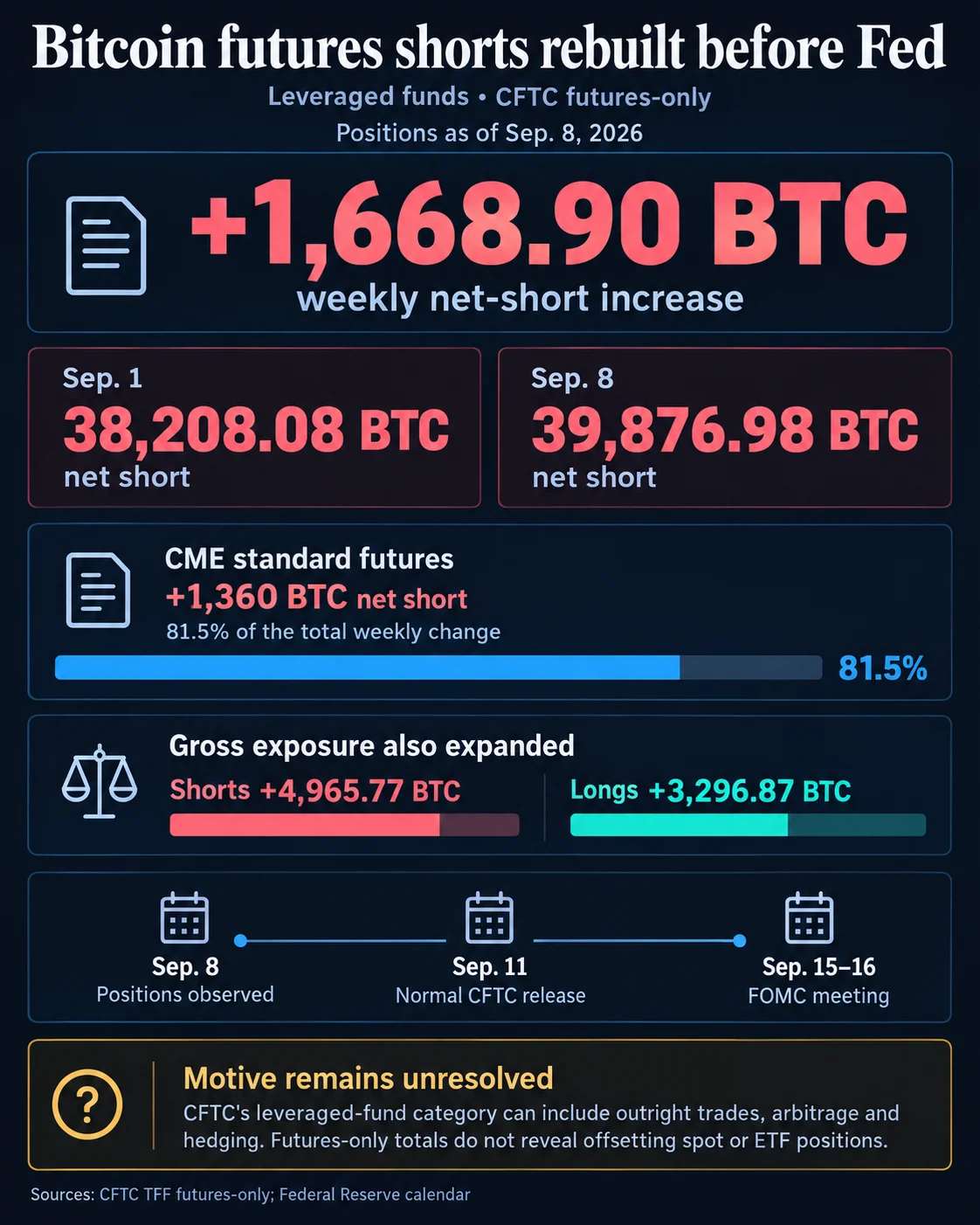
Leveraged funds, a significant category of market participants encompassing hedge funds and other asset managers, amplified their net short positions across four regulated Bitcoin futures markets by 1,668 BTC in the week concluding September 8th. This augmentation has brought their combined net short exposure to 39,876 BTC, a notable increase from the 38,208 BTC recorded the prior week, according to the latest Commodity Futures Trading Commission (CFTC) futures-only data. This aggregated metric, which encompasses Bitcoin futures contracts on the CME (Chicago Mercantile Exchange) standard and micro contracts, as well as Coinbase Derivatives’ nano and perpetual-style nano contracts, utilizes each market’s specified Bitcoin multiplier for normalization. It is crucial to understand that this aggregate measure reflects futures exposure exclusively and does not definitively distinguish between outright speculative bets and hedging strategies.
The primary driver behind this shift in leveraged fund positioning was observed in CME’s standard five-Bitcoin contract. Within this market, leveraged funds added 888 short contracts while simultaneously increasing their long positions by 616 contracts. This activity resulted in a net short widening of 272 contracts, equivalent to 1,360 BTC. This specific market segment accounted for a substantial 81.5% of the total combined change in leveraged fund net shorts observed during that week.
Beyond the direct net position changes, there was also a notable expansion in both long and short exposure outside of the CFTC’s specifically designated "spreading" category across all four contracts. Over the course of that week, total short exposure increased by 4,965 BTC, while long exposure saw a rise of 3,296 BTC. This simultaneous growth on both sides of the market, while contributing to a wider net short, also suggests a more complex array of trading strategies at play than a simple unidirectional bearish bet.
Understanding the Nuances of Leveraged Fund Positioning
The CFTC’s explanatory notes provide critical context for interpreting the actions of leveraged funds. This category is defined to include entities such as hedge funds, commodity trading advisors (CTAs), commodity pool operators (CPOs), and other professional money managers. Their trading activities are diverse, often incorporating outright directional bets as well as sophisticated arbitrage strategies that span across different markets. The CFTC categorizes these traders based on their predominant business activity rather than the specific purpose or intent behind each individual trade.
This distinction is particularly significant for Bitcoin futures. A short futures position, for instance, can serve a dual purpose: it might represent a speculative bet on a price decline, or it could be employed as a hedge against a long position in the underlying spot Bitcoin market or an investment in a Bitcoin Exchange Traded Fund (ETF). CME itself has highlighted this dynamic, describing such a structure as a "basis trade." This type of strategy is designed to profit from the price differential, or "basis," between futures contracts and the spot market. Publicly available CFTC commitment of traders (COT) reports, by their nature, do not directly disclose the existence of these offsetting legs, leaving the interpretation of leveraged fund activity open to various plausible explanations, including directional bearish bets, hedging activities, or a combination of both.
As of September 12th, Bitcoin’s market price was hovering around the $77,300 mark, according to CryptoSlate’s comprehensive Bitcoin market data. The reported increase in leveraged fund short exposure therefore occurred in the immediate lead-up to the Federal Open Market Committee (FOMC) meeting scheduled for September 15th-16th. This meeting is a pivotal event for financial markets, often influencing macroeconomic sentiment and asset valuations.

The standard publication schedule for CFTC reports dictates that they are released on Fridays at 3:30 p.m. Eastern Time, reflecting the positions held as of the preceding Tuesday. This timeline creates a four-day interval between the public availability of the data and the commencement of the Federal Reserve’s policy-setting meeting. This gap means that by the time market participants could analyze the CFTC data, a significant portion of the market’s anticipation and potential reaction to the Fed’s decision-making might have already been priced in.
The Unresolved Motive: Hedging vs. Speculation
While the 1,669 BTC increase in leveraged fund futures shorts undeniably indicates a buildup of bearish sentiment or hedging activity prior to the FOMC meeting, the precise motive remains obscured by the reporting methodology. The data provides evidence of increased short positioning, but it falls short of definitively proving that these traders were making an unhedged speculative wager on a post-Fed decline in Bitcoin’s price. The possibility of these positions serving as a hedge against existing long exposures in the spot market or other related assets cannot be discounted.
The CME’s standard Bitcoin futures contract, with its 5 BTC denomination, played a central role in this activity. The net increase in shorts here suggests that traders were actively seeking to benefit from or protect against potential downside price movements in the benchmark cryptocurrency. The simultaneous increase in long positions, however, complicates a purely bearish interpretation. It suggests that some market participants were simultaneously increasing their bullish exposure, possibly as part of more complex strategies such as volatility trading or arbitrage.
The broader context of the cryptocurrency market in early September 2026 reveals a period of heightened anticipation surrounding the Federal Reserve’s monetary policy decisions. Inflationary pressures and the ongoing debate about interest rate trajectories are key factors that typically influence risk asset performance, including Bitcoin. Analysts and traders closely watch FOMC meetings for any signals that might indicate a shift in the Fed’s stance on monetary tightening or easing, which can have profound implications for liquidity and investment appetite across global markets.
Historically, Bitcoin has demonstrated a sensitivity to macroeconomic events and shifts in central bank policy. Periods of quantitative easing or low-interest rates have often been associated with asset price inflation, while tightening cycles can exert downward pressure. The leveraged funds’ positioning ahead of the FOMC meeting could therefore be interpreted as a strategic move to capitalize on anticipated market volatility or to de-risk portfolios in advance of potential policy announcements.
Broader Market Implications and Historical Context
The CFTC data provides a granular look into the behavior of a specific cohort of sophisticated investors. Their actions, while not indicative of the entire market, can often serve as leading indicators or at least highlight significant shifts in sentiment among institutional players. The fact that leveraged funds are increasing their net short positions suggests a degree of caution or bearish conviction that warrants attention from other market participants.
It is also important to consider the historical performance of Bitcoin in relation to FOMC meetings. While past performance is not indicative of future results, patterns can emerge. In some instances, markets have reacted with volatility immediately following Fed announcements, either positively or negatively, depending on whether the outcome met, exceeded, or fell short of expectations. The absence of clear directional signals from the CFTC data leaves room for speculation about the ultimate impact of these leveraged fund positions on Bitcoin’s price trajectory.

The role of CME and Coinbase derivatives in offering these futures contracts is critical for the institutional adoption and price discovery of Bitcoin. These regulated venues provide a framework for traders to express their views on the cryptocurrency’s future price movements, thereby contributing to market liquidity and efficiency. The data generated from these exchanges offers invaluable insights into the evolving landscape of institutional participation in the digital asset space.
Furthermore, the concept of "basis trading" as mentioned in relation to CME’s commentary is a sophisticated strategy that highlights the interconnectedness of the futures and spot markets. Basis traders aim to profit from the difference between the futures price and the spot price of an asset. This can involve taking offsetting positions in both markets. For example, a trader might buy Bitcoin in the spot market and sell Bitcoin futures contracts to lock in a profit based on the existing spread. Such strategies are often employed to capture risk-free or low-risk returns and do not necessarily reflect a directional view on the asset’s price. The presence of such activities among leveraged funds can therefore mute the directional interpretation of net short positions.
The Road Ahead: Data Limitations and Future Outlook
The inherent limitations of the CFTC reporting structure mean that a definitive conclusion regarding the motivations behind the leveraged funds’ actions cannot be drawn solely from this data. The aggregation of diverse trading strategies under a single category, coupled with the lack of information on offsetting positions, presents a challenge for precise interpretation.
As the market looks ahead, several factors will be crucial in determining Bitcoin’s price trajectory. The Federal Reserve’s upcoming policy decisions will undoubtedly remain a primary driver. Additionally, broader macroeconomic conditions, regulatory developments concerning cryptocurrencies, and the ongoing adoption of digital assets by institutional and retail investors will all play significant roles.
The continued growth in Bitcoin futures trading volume and open interest on regulated exchanges like CME and Coinbase suggests a maturing market. This increased participation from institutional players, as reflected in the CFTC data, underscores the growing integration of Bitcoin into the broader financial ecosystem. While the current data paints a picture of increased bearish positioning among leveraged funds, the ultimate outcome will depend on a complex interplay of market forces, macroeconomic factors, and the evolving nature of cryptocurrency adoption. The period leading up to and following the FOMC meeting will likely be a critical juncture for observing how these positions unfold and how the market reacts.