Dwi Wanna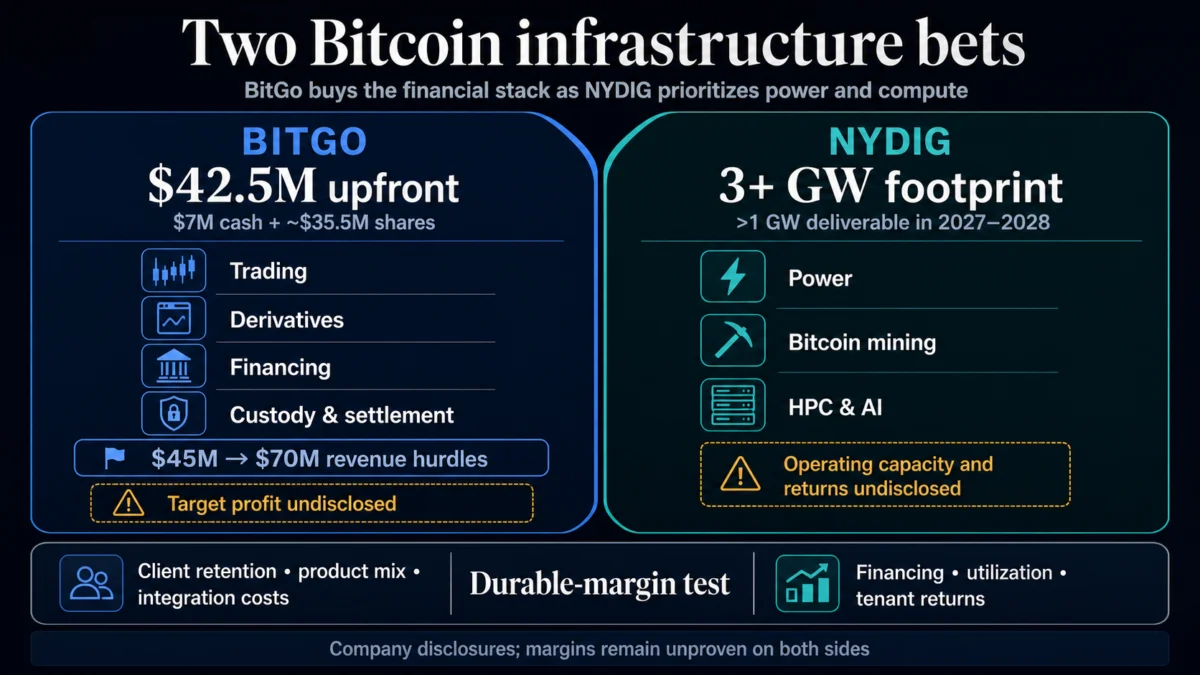
The digital asset landscape underwent a significant structural shift as BitGo, a leading provider of digital asset custody and infrastructure, finalized its acquisition of NYDIG’s institutional trading business. The deal, valued at approximately $42.5 million in upfront consideration, represents a decisive realignment for both organizations. While BitGo aggressively expands its suite of financial products to include derivatives, structured products, and financing, NYDIG is pivoting its long-term strategy toward energy infrastructure, high-performance computing (HPC) data centers, and large-scale Bitcoin mining operations.
This transaction highlights a growing trend in the cryptocurrency sector: the separation of financial service providers from infrastructure and power specialists. As the market matures, firms are finding that the capital requirements and operational expertise needed to run a global trading desk differ vastly from those required to manage gigawatt-scale power footprints for AI and mining.
Detailed Financial Terms and Transaction Structure
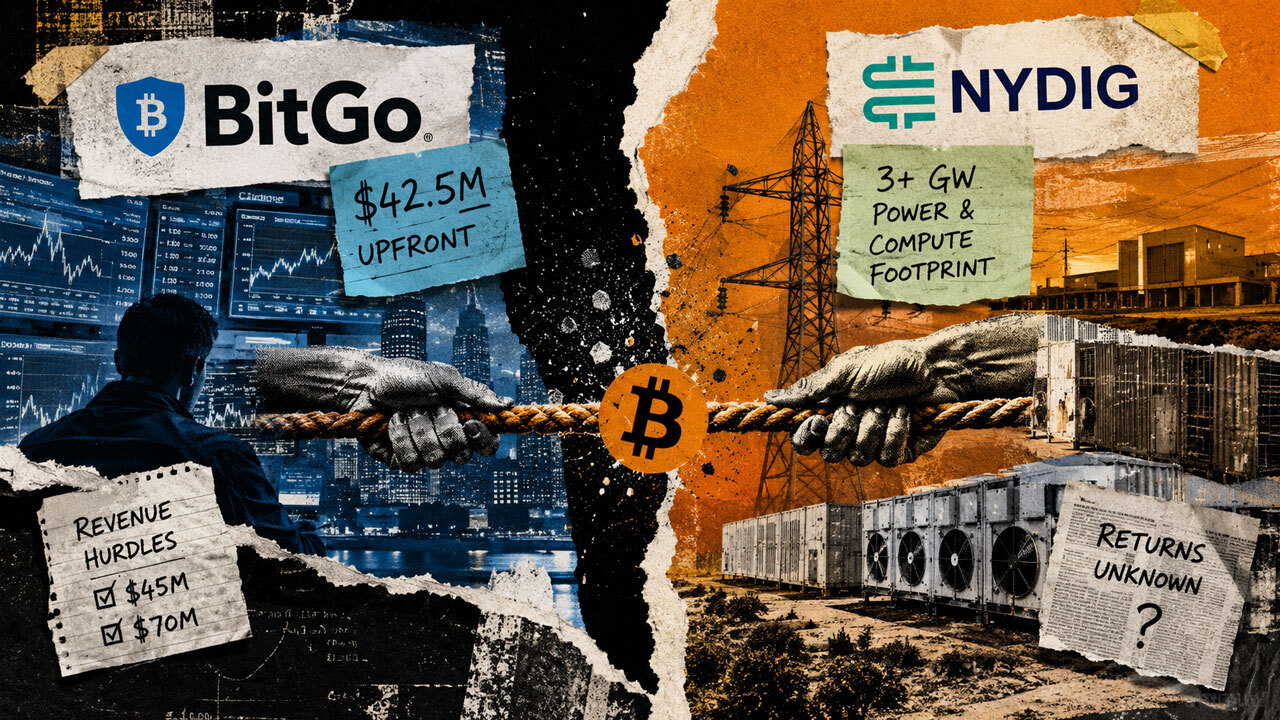
According to recent filings with the Securities and Exchange Commission (SEC), the closing terms of the deal involve a sophisticated mix of cash, equity, and performance-based milestones. The upfront consideration consists of $7 million in cash—subject to standard adjustments and holdbacks—and 5,933,577 shares of BitGo equity. Using a reference price of $5.9829 per share, the equity portion is valued at roughly $35.5 million, bringing the total immediate value of the deal to $42.5 million.
However, the total value of the acquisition could increase significantly based on future performance. The agreement outlines two distinct earn-out tiers:
- First Earn-Out: A $10 million cash payment triggered if the acquired business reaches a trailing-12-month revenue hurdle of $45 million.
- Second Earn-Out: A combined payment of $5 million in cash and 835,715 BitGo shares (valued at approximately $5 million) if the business achieves a trailing-12-month revenue hurdle of $70 million.
These benchmarks are set through February 2028, providing a clear three-year window for BitGo to integrate the new unit and scale its operations. Additionally, separate incentive awards totaling $10 million have been earmarked for the approximately 30 NYDIG employees transitioning to BitGo. These awards are designed to ensure talent retention during the critical integration phase and are distinct from the purchase price paid to the seller.
Chronology of the Strategic Realignment
The seeds for this transaction were sown throughout late 2024 and early 2025 as both companies reassessed their core competencies in a post-ETF market environment.
- March 2025: NYDIG announces its intent to acquire Crusoe’s Bitcoin mining business. This move signaled NYDIG’s growing interest in the intersection of energy, climate-aligned mining technology, and high-performance computing.
- June 2026: BitGo’s second-quarter financial filings reveal a massive scale of digital asset sales but highlight the narrow margins inherent in pure spot trading, prompting a search for higher-value financial services.
- August 2026: BitGo and NYDIG reach a definitive agreement. The deal excludes NYDIG’s custody and mining businesses, focusing solely on the transfer of the institutional trading desk, borrowing and lending operations, and derivatives platform.
- August 27, 2026: The transaction officially closes. BitGo begins the process of onboarding NYDIG’s institutional client relationships and its team of capital markets experts.
BitGo’s Expansion Strategy: Seeking Yield and Stickiness
For BitGo, the acquisition is a calculated move to diversify its revenue streams away from low-margin spot trading and custody. In its second-quarter filing for 2026, BitGo reported a "Digital Asset Sales" line of $4.197 billion. However, the direct costs associated with these sales were $4.190 billion, leaving a gross spread of only $7.082 million. This equates to approximately 16.9 basis points.
While these billions of dollars in volume look impressive on a top-line revenue report, the actual profitability is thin. By acquiring NYDIG’s trading unit, BitGo gains access to:
- Derivatives and Structured Products: These instruments typically offer higher margins than spot trading and allow institutional clients to hedge risks or gain leveraged exposure.
- Financing and Loan Servicing: Borrowing and lending services create "sticky" relationships, as clients who rely on a platform for capital are less likely to migrate their custody or settlement business elsewhere.
- Institutional Client Book: The transfer of established relationships with hedge funds, family offices, and corporate treasuries provides an immediate boost to BitGo’s market share.
BitGo’s management has characterized the move as a way to deepen its "financial infrastructure" stack. By providing a "one-stop-shop" that includes custody, settlement, and now advanced trading and financing, BitGo aims to capture a larger portion of the institutional value chain.
NYDIG’s Pivot: The Power and Compute Thesis
While BitGo is doubling down on financial services, NYDIG is moving toward the "physical" layer of the digital economy. The company has disclosed a North American power and compute footprint exceeding 3 gigawatts (GW). To put this in perspective, 3 GW is enough to power over two million homes or support some of the largest AI training clusters in existence.
NYDIG’s strategy is built on the scarcity of power and data center capacity. As artificial intelligence and high-performance computing demand continue to surge, the ability to control grid positions and power generation assets becomes a massive competitive advantage. NYDIG’s "Power & Compute" division now focuses on:
- Grid Positions and Generation: Owning the assets that provide electricity to data centers.
- AI Inference and Training: Utilizing data center halls for more than just Bitcoin mining, catering to the burgeoning AI industry.
- Bitcoin Mining Technology: Maintaining a footprint in mining as a way to monetize power when it is not being used for higher-value compute tasks.
The company has stated that more than 1 GW of its pipeline is expected to be deliverable between 2027 and 2028. By divesting its trading arm, NYDIG can reallocate capital and executive focus toward the intensive construction and financing requirements of these massive infrastructure projects.
Industry Implications and Market Analysis
The BitGo-NYDIG deal serves as a microcosm for the broader maturation of the digital asset industry. Analysts suggest several key takeaways from this realignment:
1. The End of the "Generalist" Crypto Firm
In the early years of the industry, firms like NYDIG and BitGo attempted to do everything—custody, trading, mining, and lending. This deal suggests that the era of the generalist may be ending. The specialized knowledge required to navigate global derivatives regulations is fundamentally different from the engineering expertise required to manage a 500 MW data center.
2. Margin Compression in Spot Trading
BitGo’s 16.9 basis point margin on digital asset sales is a stark reminder that spot trading has become a commoditized service. To remain profitable, firms must either achieve massive scale or offer value-added services like derivatives and custom financing.
3. The Convergence of Crypto and AI Infrastructure
NYDIG’s pivot toward HPC and AI training reflects a wider trend among Bitcoin miners. Companies like Core Scientific and Hive Digital Technologies have similarly repurposed their power capacity for AI. This shift suggests that "Bitcoin companies" are increasingly being viewed—and valued—as "energy and compute companies."
4. Regulatory Transparency
The disclosure of these deal terms through SEC filings highlights the increasing transparency of the sector. As these companies prepare for potential public listings or engage in large-scale M&A, the "black box" nature of crypto-firm financials is being replaced by standard GAAP accounting and detailed merger agreements.
Unresolved Questions and Future Scorecards
Despite the transparency provided by the filings, several unknowns remain. For BitGo, the primary question is whether the acquired NYDIG unit can hit the $45 million and $70 million revenue hurdles without significantly increasing the company’s risk profile. Derivatives and lending carry balance sheet risks that pure custody does not. Investors will be watching future filings to see if the "asset stickiness" BitGo hopes for actually translates into consolidated net profit, rather than just higher gross volume.
For NYDIG, the challenge lies in execution. A 3 GW footprint is an ambitious "claim," but turning that into "financed, contracted, and operating" capacity is a multi-year endeavor fraught with construction risks, regulatory hurdles, and fluctuating energy prices. The returns on these infrastructure projects remain undisclosed, leaving it to be seen if the pivot to power will yield better long-term results than the financial services business they left behind.
Conclusion
The acquisition of NYDIG’s institutional trading business by BitGo marks a definitive moment in the evolution of both companies. BitGo has secured the tools necessary to compete as a full-service institutional prime broker, while NYDIG has cleared the path to become a titan in the North American power and compute market. As both companies move forward, their success will be measured by two very different scorecards: BitGo by its income statement and revenue hurdles, and NYDIG by its deliverable gigawatts and data center utilization rates. This strategic decoupling underscores a broader industry realization: in the world of digital assets, you can be a bank or you can be a power plant, but it is increasingly difficult to be both.