Dwi Wanna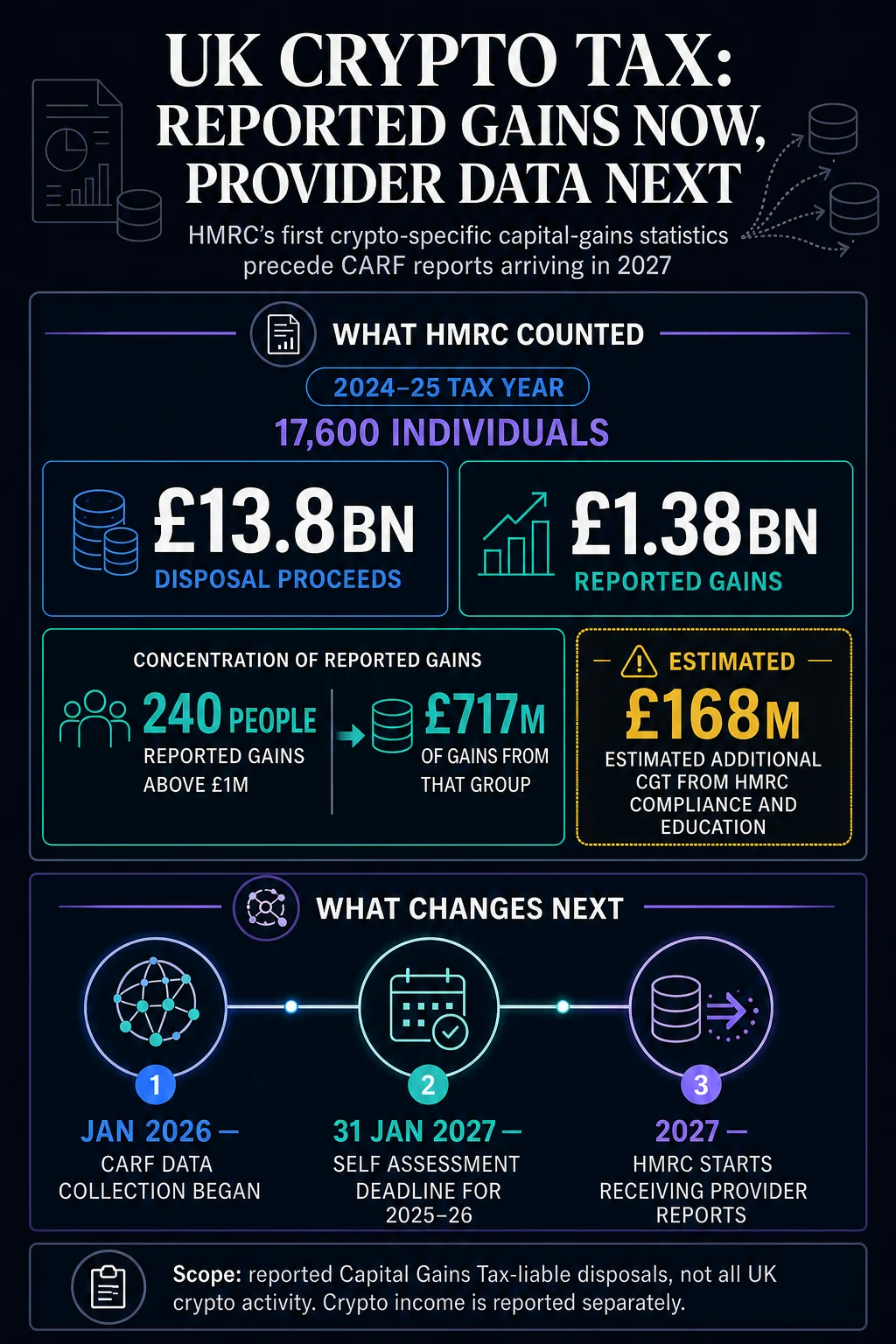
The data reveals a stark disparity in the distribution of profits among the UK’s crypto-investing public. Out of the 17,600 individuals who reported disposals of cryptoassets, the total gains reached £1.38 billion. However, a tiny elite—just 240 individuals—accounted for £717 million of that total, representing more than 50% of all declared gains. These "crypto millionaires" each reported gains exceeding £1 million, highlighting how a small cohort of high-net-worth investors continues to dominate the realized profit landscape in a market often characterized by its volatility and retail participation.
A Detailed Breakdown of the HMRC Statistics
The statistics provided by HMRC are drawn from a newly implemented dedicated section within the Self Assessment tax returns. This structural change was designed to capture more granular data on digital asset activity, which previously might have been obscured or bundled with other capital gains.
According to the report, the total proceeds from the disposal of cryptoassets—which includes selling for fiat, trading one token for another, or using crypto to purchase goods and services—amounted to a staggering £13.8 billion. The £1.38 billion in gains represents the profit remaining after the original acquisition costs and allowable expenses were deducted from these disposal proceeds.
While the 17,600 individuals who declared their gains represent a significant portion of the tax-paying crypto community, the figures only reflect those who proactively reported their liabilities. HMRC noted that these statistics do not account for activity that went unreported, nor do they capture the full breadth of the UK crypto market, which some estimates suggest includes millions of casual users.
The concentration of gains is further illustrated by the following tiers:
- The Elite Tier: 240 individuals reported gains over £1 million, totaling £717 million.
- The Mid-to-High Tier: Thousands of investors reported gains in the tens or hundreds of thousands, contributing to the remaining £663 million.
- The Volume of Activity: The £13.8 billion in total disposal proceeds suggests a high frequency of trading or large-scale liquidations, even if the resulting taxable gains were a fraction of the total turnover.
The Compliance Surge and "Nudge" Campaigns
HMRC has not been passive in its approach to the digital asset sector. The agency estimated that its targeted compliance and education initiatives generated an additional £168 million in Capital Gains Tax revenue during the 2024 to 2025 period.
For several years, HMRC has utilized "nudge letters"—formal correspondence sent to taxpayers whom the agency suspects have undeclared crypto gains. These letters are often informed by data shared by UK-based exchanges under existing information-sharing agreements. By prompting taxpayers to review their filings and utilize the "voluntary disclosure" facility, HMRC has successfully clawed back millions in revenue that might otherwise have remained in the shadow economy.
The £168 million yield from compliance work underscores the agency’s increasing sophistication in tracking blockchain transactions. While the decentralized nature of cryptoassets once presented a challenge for tax authorities, the growth of centralized exchanges and the "Know Your Customer" (KYC) requirements they must follow have provided HMRC with a robust trail of data to follow.

The Shift Toward Global Transparency: CARF and Beyond
The current data release serves as a baseline for what HMRC describes as a new era of transparency. The United Kingdom is a leading signatory to the OECD’s Crypto-Asset Reporting Framework (CARF), an international standard designed to facilitate the automatic exchange of information between tax authorities globally.
The implementation of CARF represents a fundamental shift from self-reporting to automated oversight. Under this framework, cryptoasset service providers—including exchanges, wallet providers, and certain decentralized finance (DeFi) platforms—are required to collect detailed information on their users’ transactions and identities.
Chronology of the CARF Implementation:
- January 2026: Crypto businesses operating in or serving the UK will officially begin the mandatory collection of customer and transaction data under the CARF guidelines.
- January 31, 2027: This remains a critical date for taxpayers. It is the deadline for filing Self Assessment returns and paying taxes due for the 2025 to 2026 tax year.
- 2027 (Late Year): HMRC expects to receive the first comprehensive data dumps from crypto providers. This will allow the agency to automatically cross-reference taxpayer declarations with third-party records.
Once CARF is fully operational, the "information gap" that currently exists will narrow significantly. HMRC will be able to identify discrepancies in real-time, making it nearly impossible for significant gains to go undetected if they have touched a regulated service provider.
Understanding the UK Crypto Tax Framework
The UK’s approach to taxing digital assets is comprehensive, distinguishing between capital gains and regular income. The recent statistics focus primarily on Capital Gains Tax, which is triggered by a "disposal."
What constitutes a disposal?
- Selling cryptoassets for fiat currency (GBP, USD, etc.).
- Exchanging one type of cryptoasset for another (e.g., Bitcoin for Ethereum).
- Using cryptoassets to pay for goods or services.
- Gifting cryptoassets to another person (excluding a spouse or civil partner).
The rate of CGT depends on the individual’s total taxable income. For the 2024/25 tax year, basic rate taxpayers generally paid 10% on gains above the annual exempt amount, while higher and additional rate taxpayers paid 20%. It is worth noting that the annual exempt amount for CGT has been significantly reduced in recent years, dropping from £12,300 in 2022/23 to just £3,000 for the 2024/25 tax year, a move that has likely forced more retail investors into the reporting bracket.
Income Tax Obligations:
The HMRC report noted that certain activities are excluded from the capital gains figures because they fall under the Income Tax regime. These include:
- Mining and Staking: Rewards earned through proof-of-work or proof-of-stake are generally treated as miscellaneous income or trading income, depending on the scale and organization of the activity.
- Airdrops: If received in exchange for a service or as part of a trade, these are taxable as income.
- Employment Income: Salaries paid in crypto are subject to Income Tax and National Insurance Contributions (NICs).
Implications for the UK Financial Landscape
The revelation that half of all crypto gains are concentrated in the hands of 240 people has sparked a broader debate regarding wealth inequality and the "democratization" of finance that crypto originally promised. While proponents of digital assets argue that the technology provides financial access to the unbanked, the HMRC data suggests that, at least in terms of realized wealth, the benefits are heavily skewed toward a small group of sophisticated actors.

Financial analysts suggest that these 240 individuals likely represent early adopters who held assets like Bitcoin or Ethereum for several years, or professional traders utilizing high-frequency strategies and institutional-grade tools. For the UK Treasury, this concentration represents a stable, albeit narrow, source of revenue.
"The data shows that the ‘whales’ of the crypto world are very much active in the UK," says one London-based tax consultant. "HMRC’s focus is clearly shifting from general awareness to high-precision enforcement. If you are in that million-pound-plus bracket, you can be certain that your filings are being scrutinized with extreme care."
The Broader Impact on the Crypto Industry
For the crypto industry, the publication of these statistics is a double-edged sword. On one hand, it legitimizes the sector as a significant contributor to the national exchequer. On the other, it heralds a period of increased compliance costs for businesses and heightened surveillance for users.
Industry advocacy groups, such as CryptoUK, have long called for clearer guidance from HMRC to help investors comply with their obligations. The introduction of the dedicated crypto section in tax returns is seen as a step toward that clarity, but the upcoming CARF requirements will place a heavy administrative burden on smaller crypto startups.
Furthermore, the data may influence future government policy. If the Treasury sees that a vast majority of gains are concentrated at the top, there may be political pressure to adjust CGT rates or introduce specific levies on high-value digital asset transactions to bolster public finances.
Conclusion and Future Outlook
As the UK moves toward the 2027 reporting milestone, the relationship between crypto investors and the tax authority is entering a more formal and transparent phase. The current baseline of £1.38 billion in gains from 17,600 people is likely to expand as more investors are brought into the fold by the automated reporting of CARF.
For the average UK crypto user, the message from HMRC is clear: the era of "voluntary" transparency is transitioning into one of "mandatory" disclosure. With the agency already yielding £168 million from compliance efforts before the full implementation of international data-sharing frameworks, the pressure on investors to maintain meticulous records has never been higher.
As the Jan. 31, 2027, deadline approaches for the next tax year, investors must navigate a landscape where their activity is no longer invisible. The 240 individuals who dominated this year’s gains may be the current focus, but the regulatory net is being cast wide enough to capture every participant in the UK’s burgeoning digital economy.