admin
admin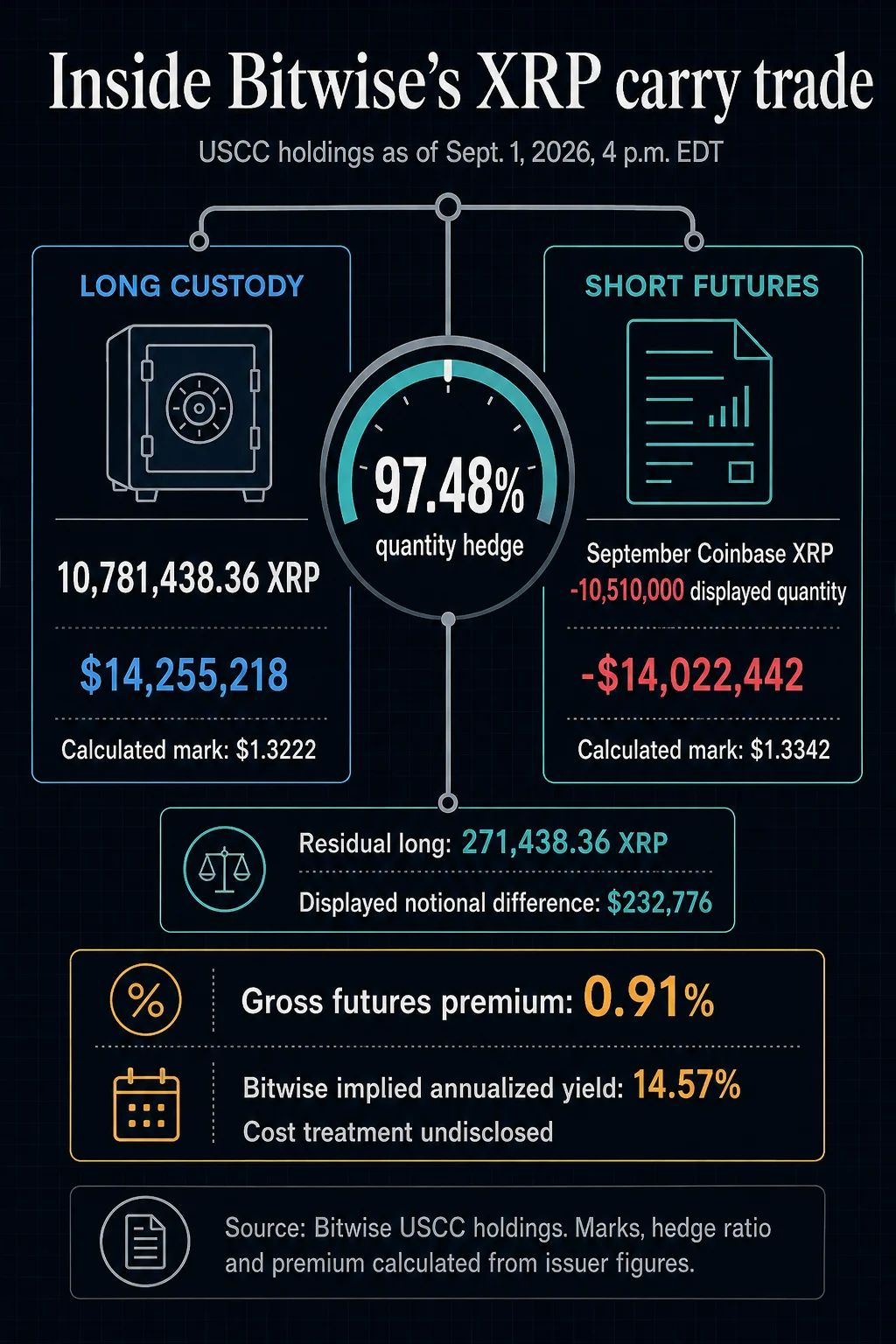
In a move that provides a valuable window into sophisticated institutional cryptocurrency investment, Bitwise has publicly disclosed the mechanics of a rare XRP carry trade executed by its Bitwise Crypto Carry Fund (USCC). This strategy, designed to capitalize on price differentials between spot markets and futures contracts, highlights a nuanced approach to generating yield within the volatile digital asset landscape. The fund’s positioning, as revealed through its holdings data, demonstrates a near-market-neutral stance, meticulously hedging its physical XRP holdings against a significant short position in Coinbase XRP futures. This careful calibration aims to isolate and profit from the premium embedded in the futures market, while minimizing exposure to the underlying asset’s price fluctuations.
The specific disclosure, made on September 1st at 4 p.m. EDT, revealed that the Bitwise Crypto Carry Fund held 10,781,438.36 XRP in custody. Simultaneously, the fund maintained a short position equivalent to 10,510,000 XRP in September Coinbase XRP futures. This precise matching, representing a 97.48% offset by quantity, underscores the fund’s objective: to lock in the premium offered by the futures contract without taking substantial directional risk on XRP itself. The futures contract in question was associated with an implied yield of 14.57%, a figure that warrants a deeper examination of how such a yield is derived and its implications for investors.
Deconstructing the Carry Trade: From Premium to Annualized Yield
The core of this strategy lies in exploiting the basis – the difference between the spot price of an asset and its futures price. In this instance, Bitwise has leveraged the observable spread between the spot XRP market and the September Coinbase XRP futures. Analyzing the data provided, the notional value of Bitwise’s XRP custody position stood at approximately $14,255,218, with an implied unit mark of $1.3222 per XRP. In contrast, the short futures position represented a notional value of -$14,022,442, with an implied unit mark of $1.3342 per XRP.
This calculation reveals a gross premium of approximately $0.012 per XRP, or a 0.91% difference between the futures and spot prices. It is this spread that the carry trade aims to monetize. The strategy involves buying the underlying asset (XRP in this case) and simultaneously selling a futures contract that is trading at a premium. At settlement, if the futures contract converges to the spot price, the premium is realized as profit, largely offsetting any gains or losses from the directional movement of XRP.
The impressive 14.57% annualized yield figure, as presented by Bitwise, is a product of annualizing this short-term premium. The fund’s methodology defines this implied yield as the annualized rate if the position were to be held until maturity. Therefore, the 0.91% premium, representing the difference observed on a specific date, is extrapolated over a 12-month period to provide an annualized projection. It is crucial for investors to understand that this 14.57% is an implied rate, reflecting the market’s expectation of the premium’s value over time, rather than a guaranteed return.
Navigating Residual Risks and Market Dynamics
While the 97.48% hedge ratio significantly mitigates directional risk, it does not entirely eliminate it. Several residual risks remain inherent in such a strategy. Firstly, the spot and futures prices are not guaranteed to move in lockstep prior to settlement. Discrepancies can arise due to market sentiment, liquidity conditions, or other factors, potentially impacting the realized profit. Secondly, the fund must maintain sufficient collateral for both its custody holdings and its margin requirements for the futures position. Fluctuations in XRP’s price could necessitate margin calls, impacting the fund’s capital efficiency. Thirdly, the cash-settlement benchmark for the futures contract might differ from the actual price at which the fund can liquidate its custody inventory, introducing a basis risk at the settlement stage. Finally, the remaining 2.52% of the position, equivalent to 271,438.36 XRP, carries direct price exposure to XRP’s movements.

The precise conversion of the displayed futures quantity into a number of contracts is also conditional, as Coinbase offers multiple XRP futures products with varying contract sizes. A standard monthly XRP future on Coinbase Derivatives is typically configured for 10,000 XRP. However, without a specific product code, determining the exact number of contracts Bitwise shorted remains unconfirmed, though it would be a substantial number given the notional value.
CFTC Data and Broader Institutional Landscape
Further context for the XRP futures market can be gleaned from the Commodity Futures Trading Commission’s (CFTC) "Traders in Financial Futures" report. As of August 25th, approximately two weeks prior to Bitwise’s disclosure, open interest in standard Coinbase XRP futures stood at 20,518 contracts. A significant portion of this open interest was held by dealer and intermediary accounts (17,853 long contracts) and asset manager and institutional accounts (1,800 long contracts), suggesting broad institutional participation.
Interestingly, leveraged funds were predominantly on the short side of the market, holding 13,822 outright short contracts. This positions leveraged funds as potential counterparties to the institutions buying futures, a dynamic that aligns with the direction of Bitwise’s short hedge. However, the CFTC data aggregates positions by broad categories and predates the Bitwise holdings by seven days, meaning it cannot definitively confirm the identity of Bitwise’s matched counterparties or their specific September futures positioning.
Divergent Strategies within Bitwise’s Product Suite
The disclosure of the USCC’s carry trade strategy also offers a point of contrast with another Bitwise product, the Bitwise XRP ETF. As of September 2nd, the Bitwise XRP ETF held a substantial 361,995,068.31 XRP in its trust, valued at approximately $531.3 million. The ETF’s objective, as outlined in its SEC filings, is to provide investors with exposure to the value of the XRP it holds, making XRP its sole asset. This structure is fundamentally different from the USCC, which actively seeks to hedge its XRP holdings to extract yield from futures premiums. While the ETF focuses on providing direct spot exposure, the USCC demonstrates an institutional appetite for yield-generating strategies that involve managing complex derivatives positions. The ETF’s documentation does not detail any specific hedging strategies for its investors.
Implications for Institutional Crypto Adoption
The Bitwise XRP carry trade disclosure is significant for several reasons. It offers concrete evidence of institutional investors employing sophisticated, yield-focused strategies in the digital asset space, moving beyond simple spot market exposure. The 14.57% annualized implied yield, while subject to market conditions and fund-specific costs, represents a potentially attractive return in a low-yield global economic environment. This demonstrates a growing maturity in the crypto market, where a wider array of financial instruments and strategies are being utilized.
The transparency provided by Bitwise, even within the context of a qualified purchaser fund, is noteworthy. While the identities of the futures buyers remain private, the detailed breakdown of the carry trade’s structure allows market observers to better understand the forces driving demand for XRP futures and the potential for arbitrage opportunities. This level of insight is invaluable for shaping broader market expectations and for other asset managers considering similar strategies.
Ultimately, Bitwise’s move highlights the evolving landscape of institutional cryptocurrency investment, showcasing a sophisticated approach to risk management and yield generation. The USCC’s near-market-neutral XRP position underscores the growing interest in basis trading within digital assets, suggesting that institutional capital is increasingly seeking to profit from market inefficiencies rather than solely relying on directional price appreciation. As the crypto market continues to mature, such transparent disclosures of advanced strategies will be crucial for fostering trust and encouraging wider institutional adoption. The precise interplay between directional demand and basis demand across the broader institutional market remains an area of ongoing observation, with this specific Bitwise fund providing a compelling case study of the latter.