admin
admin
A Solana-based cryptocurrency token, prominently promoted by a brand publicly endorsed by former US President Donald Trump, experienced a catastrophic collapse just hours after its launch. The swift downfall of the "Trump Digital GOLD" (GOLD) token has ignited a flurry of questions regarding its true origin, the identities of those behind its promotion, and a series of highly unusual trading activities that blockchain analytics firms swiftly flagged. The incident casts a renewed spotlight on the volatile intersection of political endorsements and the speculative world of digital assets, especially as the 2024 presidential election cycle intensifies.
The Rapid Rise and Catastrophic Fall of Trump Digital GOLD
The saga began early Saturday when the X (formerly Twitter) account for "Real Trump Coins," a brand that President Trump publicly promoted in September 2024 as the exclusive retailer for his silver medallions, announced the launch of the GOLD token. The post directed eager investors to RealTrumpCoins.com to acquire the new digital asset, promising a groundbreaking venture. The token, built on the high-speed Solana blockchain, immediately garnered attention due to its explicit association with the Trump brand, which had been previously leveraged for various digital collectibles and cryptocurrencies.
However, the initial fanfare quickly dissolved into alarm. Blockchain analytics platform Lookonchain wasted no time in flagging the nascent token for highly suspicious activity. Almost immediately after the launch, Lookonchain reported that the token’s developer held an astonishing 600 million GOLD tokens, representing a vast majority of the total supply. Further intensifying concerns, 15 newly created wallets collectively spent a modest $18,657 to acquire an additional 224.5 million tokens. This concentration of ownership immediately raised red flags, prompting Lookonchain to issue a stark warning: "The team currently controls 82.45% of the total supply," advising potential investors to exercise extreme caution. This level of concentrated ownership is a classic indicator of a potential "rug pull" or manipulative scheme, where a small group can dictate the token’s price and liquidity.
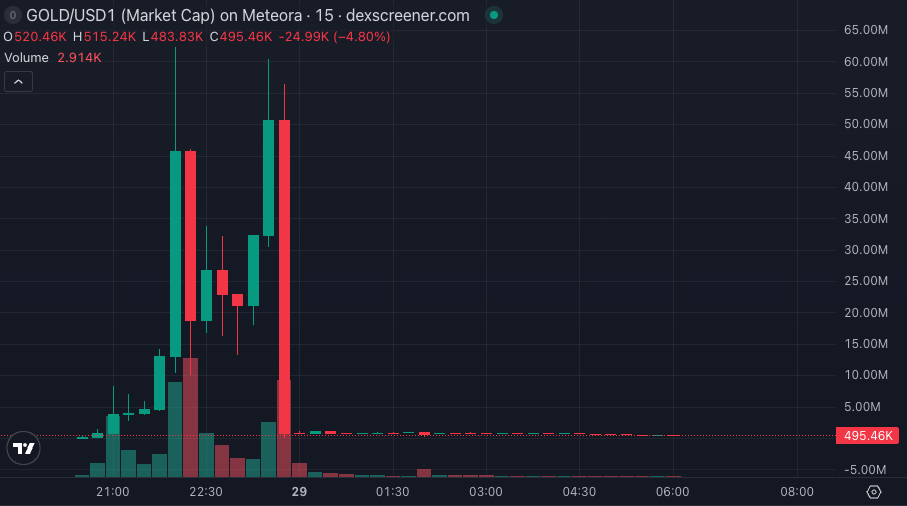
The fears materialized with brutal efficiency. Shortly after acquiring their substantial holdings, the 15 wallets, identified by Lookonchain as being linked to the development "team," proceeded to sell all 224.5 million GOLD tokens. This mass sell-off was executed for 3,178 Solana (SOL), an amount valued at approximately $330,000 at the time. The immediate consequence was a near-total annihilation of GOLD’s market value. According to data from DEX Screener, the token’s market capitalization plummeted from an estimated $50 million to a mere $500,000 within hours. Lookonchain unequivocally declared, "GOLD just rugged!" estimating that the perpetrators reaped an staggering profit of approximately $312,000, representing roughly 17 times their initial investment. The term "rug pull" refers to a malicious maneuver in the cryptocurrency industry where developers suddenly abandon a project and sell off their large holdings, draining liquidity and leaving investors with worthless tokens.
The Enigma of "Real Trump Coins" and Allegations of Compromise
The "Real Trump Coins" brand itself holds a curious position in the ecosystem of Trump-related ventures. Former President Trump publicly endorsed RealTrumpCoins.com in September 2024 when unveiling his silver medallions, explicitly designating the website as the sole platform for purchasing these physical collectibles. The website maintains a disclaimer stating that its products are not manufactured, distributed, or sold by the Trump Organization, suggesting a degree of separation. This endorsement, however, lends an aura of officiality and credibility to the brand, making its sudden foray into highly speculative digital tokens all the more perplexing.
The rapid promotion of the GOLD token on the Real Trump Coins X account, followed by the swift deletion of all related posts on Saturday, fueled widespread speculation within the crypto community that the account might have been compromised. Several prominent figures and analysts in the Solana community voiced their suspicions. Fabiano.sol, a known Solana community member, publicly claimed that the Real Trump Coins X account had been hacked. Similarly, on-chain analyst EmberCN unequivocally labeled GOLD as a scam. Adding another layer of intrigue, X user TITAN shared claims circulating that "Iranian hackers" were allegedly behind what was described as a "fake Trump launch." These allegations, while unverified by official sources, underscore the chaotic and often opaque nature of such incidents in the crypto space, where attribution can be difficult and misinformation can spread rapidly. The silence from Real Trump Coins or any official representative of the Trump campaign regarding these allegations only deepened the mystery surrounding the token’s true origins and the nature of the promotion.
Donald Trump’s Expanding Engagement with the Crypto Sphere
The GOLD token episode is not an isolated incident but rather the latest in a series of events highlighting former President Trump’s increasingly prominent, albeit often controversial, engagement with the cryptocurrency industry. His involvement has evolved from initial skepticism to a more embraceful stance, particularly as the 2024 election approaches.
Trump’s foray into digital assets began with the launch of his official NFT collections, which proved to be a significant commercial success. These digital collectibles, often featuring stylized images of the former president, quickly sold out, demonstrating the financial potential of leveraging his brand in the crypto market. Following this, the "Official Trump" (TRUMP) memecoin emerged, gaining considerable traction and market capitalization, though its direct affiliation with Trump’s official campaign has remained ambiguous. Additionally, entities like World Liberty Financial, also associated with the Trump brand, have ventured into digital finance, drawing further attention and scrutiny.
These ventures have consistently raised concerns about potential conflicts of interest, especially given Trump’s position as a former president and current presidential candidate. Critics argue that his involvement in highly speculative digital assets could be perceived as leveraging his public office for personal gain, potentially influencing investor behavior. The White House, during his previous term and subsequently, has generally denied any impropriety, asserting that these are private business endeavors.
More recently, Trump has adopted a distinctly pro-crypto stance, positioning himself as a champion for the industry in contrast to what he often characterizes as the Biden administration’s restrictive approach. On August 19, he publicly urged lawmakers to pass a "fair version" of the CLARITY Act. This proposed legislation aims to establish a comprehensive regulatory framework for crypto assets, crucially clarifying whether tokens should be classified as securities or commodities. Trump’s advocacy for clearer regulations and his criticism of what he perceives as hostile regulatory actions against crypto have endeared him to a segment of the crypto community, further intertwining his political brand with the future of digital finance. The collapse of the GOLD token, therefore, occurs at a particularly sensitive time, potentially complicating his narrative as a proponent of a robust and legitimate crypto ecosystem.
The Solana Ecosystem, Memecoin Mania, and Inherent Risks
The Solana blockchain has become a popular platform for the rapid launch and trading of memecoins, largely due to its high transaction speeds and low fees compared to other networks like Ethereum. This environment fosters a culture of speculative trading, where new tokens can emerge and gain significant value in a short period, often driven by social media hype and community engagement rather than underlying utility or fundamental value. However, this accessibility also makes Solana a fertile ground for illicit activities, including "rug pulls" and pump-and-dump schemes.
The ease with which new tokens can be deployed, often with minimal oversight, means that investors must exercise extreme diligence. The GOLD token incident serves as a stark reminder of the inherent risks associated with investing in such volatile assets, particularly those launched with anonymous or semi-anonymous development teams and highly concentrated ownership. The allure of quick profits often overshadows the crucial need for thorough due diligence, leaving many susceptible to predatory schemes. The prevalence of these types of scams highlights the ongoing challenge for regulators and blockchain platforms to protect investors without stifling innovation.
Broader Implications for Political Endorsements and Regulatory Scrutiny
The collapse of the Trump Digital GOLD token adds significant fuel to the ongoing debate surrounding cryptocurrency regulation and the ethical implications of political figures endorsing or being associated with speculative digital assets. For investors, particularly those drawn in by the "Trump" brand, the incident represents a substantial financial loss and a severe erosion of trust. It reinforces the perception among skeptics that the crypto market, especially its more speculative fringes, remains a wild west rife with scams.
For Donald Trump and his political brand, the incident presents a challenging narrative. While the direct link between Trump’s official campaign and the GOLD token remains tenuous and the "Real Trump Coins" account may indeed have been compromised, the public perception often conflates any "Trump-linked" venture with the former president himself. Such events can undermine his efforts to portray himself as a champion for a legitimate and innovation-driven crypto industry. Critics, such as the public interest group Public Citizen, have previously alleged that Trump’s various crypto ventures have cost investors billions, citing concerns over "schemes" and potential conflicts of interest. While the exact figures and direct causation are debated, incidents like the GOLD token collapse inevitably contribute to this critical discourse.
The episode also intensifies the calls for greater regulatory clarity and enforcement. As policymakers in Washington grapple with how to effectively oversee the rapidly evolving digital asset space, high-profile "rug pulls" linked, however indirectly, to prominent political figures underscore the urgent need for robust investor protection mechanisms. The incident highlights the challenges of differentiating legitimate projects from fraudulent ones, especially when the lines between political promotion, merchandise sales, and speculative crypto ventures become blurred.
Ultimately, the Trump Digital GOLD collapse serves as a potent cautionary tale. It illustrates the extreme volatility and inherent risks of the memecoin market, the critical importance of scrutinizing token distribution and developer holdings, and the complex ethical and regulatory dilemmas that arise when political brands intersect with the speculative frontier of cryptocurrency. As the crypto landscape continues to evolve, and political figures increasingly engage with it, the onus remains on both investors to exercise vigilance and on the industry to strive for greater transparency and accountability to prevent such devastating outcomes. The questions surrounding who was truly behind the GOLD token’s launch and the extent of the Real Trump Coins account’s compromise will likely persist, leaving a stain on the politically-charged digital asset space.