admin
admin
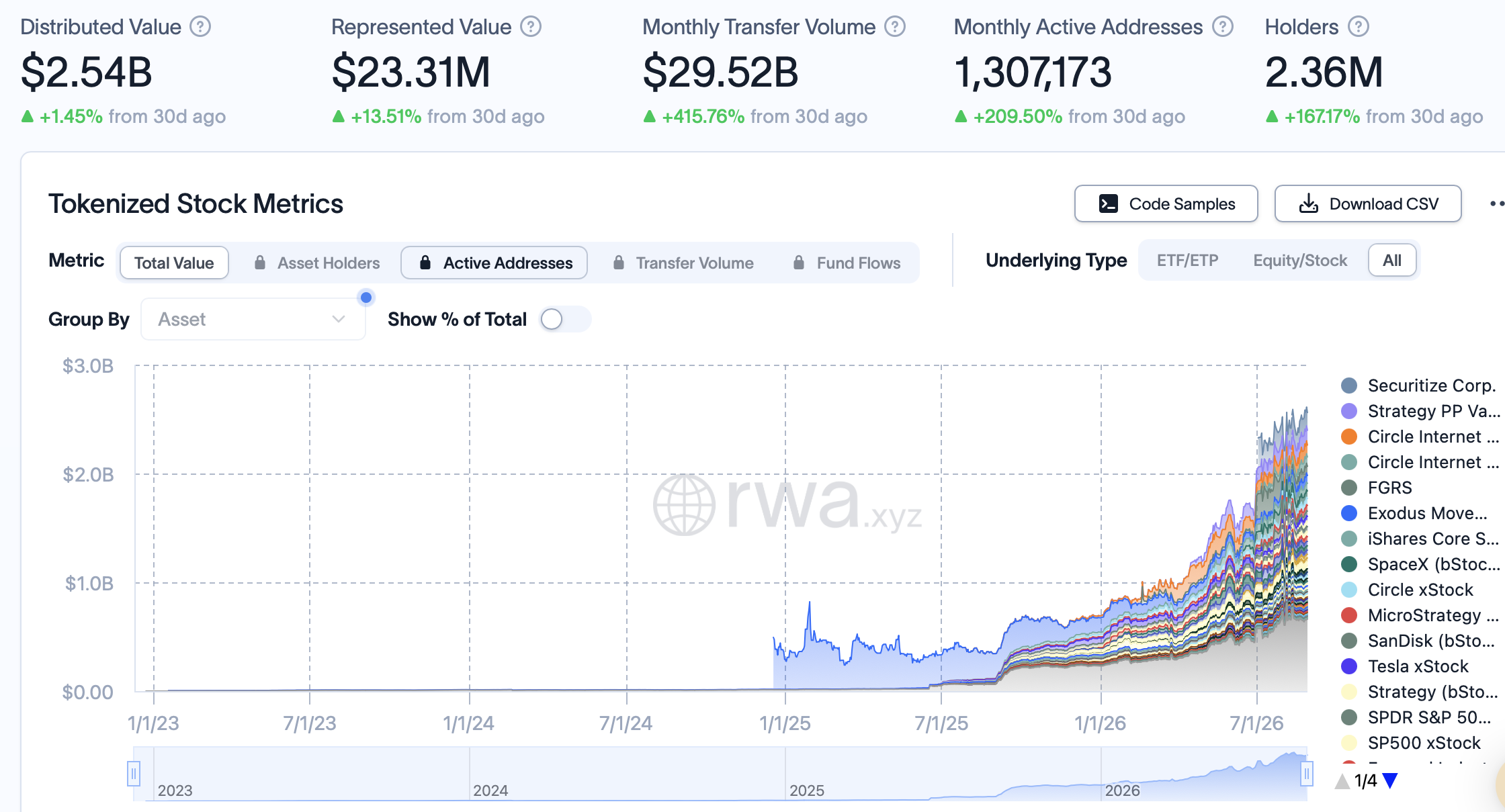
The nascent market for tokenized stocks has witnessed an unprecedented surge in activity over the past month, with transfer volumes rocketing by more than 415% to an astounding $29.5 billion. This dramatic acceleration, documented by blockchain data analytics firm RWA.xyz, underscores a pivotal moment in the convergence of traditional financial assets with decentralized blockchain technology. The exponential growth extends beyond mere transactional volume, reflecting a broader deepening of engagement and adoption within this innovative financial segment.
Unpacking the Exponential Growth: Key Metrics Revealed
The robust performance metrics reported by RWA.xyz paint a clear picture of an ecosystem experiencing rapid expansion. In addition to the colossal increase in monthly transfer volume, the number of active addresses participating in tokenized stock transactions soared by over 209%, reaching approximately 1.3 million unique users. This metric is crucial as it indicates a significant broadening of the user base, suggesting that the appeal of tokenized equities is resonating with a growing number of investors. Concurrently, the total number of tokenized stock holders climbed by 167% within the same 30-day period, now standing at an impressive 2.36 million. This sustained growth in both active participants and overall holders points to increasing confidence and long-term interest in these digital assets.
Furthermore, the total value of tokenized stocks distributed on-chain, often referred to as Total Value Distributed (TVD), registered a steady increase of 1.45% over the last month, reaching $2.54 billion. While this monthly percentage increase might appear modest compared to the other metrics, it builds upon a foundation of explosive year-over-year growth. A mere twelve months prior, the TVD stood at $344 million, meaning the current figure represents a staggering 637% increase over the past year. This long-term trend provides crucial context, illustrating that the recent monthly surge is not an isolated event but rather an acceleration of an already established trajectory of expansion. The combination of soaring transfer volumes, a rapidly expanding user base, and substantial year-over-year TVD growth collectively signals a maturing market segment poised for further innovation and integration into mainstream finance.
Leading the Charge: Dominant Tokenized Stocks and Platforms
Within this burgeoning market, certain individual tokenized stocks and platforms have emerged as frontrunners, demonstrating significant traction and market share. According to RWA.xyz, Securitize Corp. currently holds the distinction of being the largest individual tokenized stock tracked, with a distributed value of approximately $163 million. Securitize, a prominent player in the digital asset securities space, has been instrumental in bridging traditional finance with blockchain technology, making its leading position a testament to its established infrastructure and regulatory compliance efforts. Following closely is Strategy PP Variable xStock, commanding $136 million in distributed value, and an Ondo-tokenized version of Circle Internet Group, which accounts for $109 million. These top individual tokenized assets highlight a diverse range of underlying securities and issuers finding success in the on-chain environment.
On the platform front, Ondo has solidified its position as the dominant force, leading the market with $842.8 million in distributed value. Ondo Finance is known for its focus on bringing institutional-grade assets onto the blockchain, often specializing in tokenized treasuries and other real-world assets (RWAs). Its substantial lead indicates a strong demand for its offerings, particularly among investors seeking exposure to traditional financial instruments in a tokenized format. Kraken’s xStocks platform follows with $609.3 million, showcasing the crypto exchange’s strategic move into regulated digital securities. Binance’s bStocks platform rounds out the top three, contributing $599.9 million to the market’s distributed value. Collectively, these three platforms—Ondo, Kraken’s xStocks, and Binance’s bStocks—account for roughly 81% of the entire tokenized stock market by distributed value. This high concentration among a few key players suggests that economies of scale, robust technological infrastructure, and perhaps clearer regulatory pathways are critical factors for success in this rapidly evolving sector. Their dominance also implies that while the market is growing, it is still consolidating around established and trusted entities capable of handling the complexities of issuing and managing tokenized securities.
The Genesis of Growth: Tokenized Equities Embrace Crypto Platforms
The current explosion in tokenized stock activity is not an isolated phenomenon but rather the culmination of strategic initiatives by major cryptocurrency platforms to integrate traditional equities into their digital asset ecosystems. This broader trend sees crypto exchanges and decentralized finance (DeFi) protocols introducing novel mechanisms for investors to trade, hold, and leverage tokenized equities directly on-chain, thereby unlocking new avenues for liquidity and utility.
A significant catalyst for the recent surge occurred on August 24, when Coinbase, one of the world’s largest cryptocurrency exchanges, officially launched its tokenized US stocks on Base, its Ethereum Layer 2 blockchain. This landmark development specifically targets eligible non-US users, granting them unprecedented 24/7 access to trade these assets. Critically, these B20 tokens, representing shares in high-profile companies such as Nvidia, Apple, Meta, and Alphabet, can be held in self-custody wallets, offering investors greater control and autonomy over their assets compared to traditional brokerage accounts. Moreover, the integration on Base means these tokenized stocks can be seamlessly utilized across a myriad of decentralized finance applications, opening up possibilities for collateralization, lending, and yield generation within the DeFi landscape. This move by Coinbase, a regulated and publicly traded entity, lends significant credibility to the tokenized stock market and signals a strong institutional belief in its future.
Building on Coinbase’s initiative, Bitwise, a leading crypto asset manager, followed up just a day later with the launch of automated portfolios constructed from Coinbase’s tokenized stocks. These portfolios are designed for eligible non-US investors, allowing them to follow preset investment strategies while maintaining full self-custody of the underlying tokenized assets in their own wallets. The initial offerings from Bitwise strategically target high-demand sectors, including the "Magnificent Seven" (a term often used to describe the seven largest and most influential tech companies by market capitalization), as well as specialized portfolios focused on robotics and artificial intelligence sectors. This development by Bitwise underscores a growing sophistication in the tokenized stock market, moving beyond individual asset trading to offering structured, thematic investment products that appeal to a broader range of investors seeking diversified exposure.
Beyond these major announcements, other prominent platforms have also been actively expanding the utility and accessibility of tokenized stocks. In July, the Bybit exchange integrated tokenized shares of major US companies, including Nvidia, Apple, and Tesla, as acceptable collateral for margin loans. This move significantly enhances the liquidity and flexibility of these digital assets, allowing investors to unlock capital without selling their underlying positions. Simultaneously, Arcus, a decentralized exchange (DEX) backed by Robinhood, made a substantial push into the tokenized market by debuting over 95 stock tokens and establishing perpetual markets on the Robinhood Chain. This expansion by Arcus highlights the growing trend of integrating tokenized securities into more advanced trading instruments, such as perpetual swaps, which were previously exclusive to the cryptocurrency derivatives market. These concurrent developments across various platforms—from major exchanges to asset managers and DEXs—collectively contribute to the robust growth observed, creating a more interconnected and versatile ecosystem for tokenized equities.
The Broader Implications: Reshaping Global Finance
The remarkable surge in tokenized stock activity carries profound implications for the future of global finance, signaling a paradigm shift towards greater accessibility, efficiency, and innovation. This trend is not merely about digitizing existing assets; it represents a fundamental re-imagining of how securities are issued, traded, and owned.
One of the most significant implications is the democratization of finance. By enabling fractional ownership and lowering the minimum investment threshold, tokenized stocks make blue-chip companies and traditionally exclusive assets accessible to a far wider global audience. An investor in a developing nation, for instance, can now own a fraction of Nvidia or Apple through a tokenized asset, overcoming geographical barriers, prohibitive costs, and restrictive traditional brokerage requirements. This global accessibility also fosters a more inclusive financial system, potentially leveling the playing field for millions of investors previously excluded from international markets.
The inherent properties of blockchain technology also promise enhanced liquidity and operational efficiency. Unlike traditional markets with fixed trading hours, tokenized stocks can be traded 24/7, year-round, eliminating temporal restrictions and allowing investors to react instantly to global market events. The automation offered by smart contracts can streamline settlement processes, reducing transaction costs and settlement times from days to mere minutes or seconds. This increased efficiency and continuous trading environment could attract more capital, leading to deeper and more robust markets.
Furthermore, the deep integration of tokenized stocks into the decentralized finance (DeFi) ecosystem opens up a vast array of innovative use cases. As demonstrated by Bybit’s initiative, these tokens can serve as collateral for margin loans, unlocking capital without liquidating positions. They can also be pooled in liquidity protocols, used in yield farming strategies, or integrated into decentralized lending and borrowing platforms. This fusion of traditional assets with DeFi primitives creates hybrid financial products that combine the stability and recognition of established equities with the flexibility and composability of blockchain-native assets, potentially creating entirely new financial instruments and investment opportunities.
The growing involvement of major players like Coinbase, Kraken, Binance, and Bitwise underscores a significant trend of institutional interest and validation. These are not fringe projects but established entities with substantial user bases and regulatory considerations. Their commitment to offering tokenized stock products signals that the market is moving beyond early adopters and gaining acceptance within more mainstream financial circles. This institutional embrace provides crucial legitimacy, infrastructure, and capital, which are essential for the long-term sustainability and growth of the tokenized asset class.
Looking ahead, while the potential is immense, challenges remain. Regulatory frameworks across different jurisdictions are still evolving, and achieving global interoperability and legal clarity will be crucial for mass adoption. Scalability of underlying blockchain networks and robust security measures will also need to keep pace with increasing transaction volumes. However, the current trajectory suggests that these challenges are being actively addressed by innovators and regulators alike.
Expert Commentary and Forward Outlook
Industry analysts and proponents of asset tokenization largely view this recent surge as a clear indication of a maturing market and the growing recognition of blockchain’s transformative potential beyond cryptocurrencies. "The data from RWA.xyz unequivocally demonstrates that tokenization is moving past theoretical discussions and into tangible, high-value applications," stated a prominent blockchain economist who preferred to remain unnamed due to ongoing advisory roles. "The ability to trade fractional shares 24/7, coupled with the potential for self-custody and DeFi integration, represents a compelling value proposition that traditional markets struggle to match."
Advocates further highlight that this growth is driven by both retail and institutional demand. "Retail investors are drawn to the accessibility and lower entry barriers, while institutions are exploring the efficiency gains and new liquidity pools that tokenization offers," commented a senior analyst at a digital asset research firm. "The launches by Coinbase and Bitwise are particularly significant as they bring established brands and robust infrastructure to the table, significantly lowering the barrier to entry for a broader investor base, particularly those outside the traditional U.S. financial ecosystem."
The market for tokenized stocks is still in its nascent stages when compared to the trillions of dollars in global equities. However, its current growth rate suggests a powerful trajectory. As regulatory clarity improves, technological infrastructure becomes more robust, and more traditional financial institutions embrace blockchain, tokenized equities are poised to become an increasingly integral part of the global investment landscape. This ongoing evolution is set to redefine ownership, trading, and investment, making financial markets more accessible, efficient, and interconnected than ever before. The journey of tokenized stocks from a niche concept to a multi-billion dollar market within a year underscores a significant and potentially irreversible shift in how we perceive and interact with real-world assets in the digital age.