admin
admin
Solana validators have officially approved a pivotal proposal to double the network’s annual disinflation rate, a strategic move designed to significantly reduce future SOL issuance and accelerate the blockchain’s journey towards a more controlled long-term supply. This decision, formalized through a binding governance vote, marks a significant evolution in Solana’s economic policy, directly impacting token holders, validators, and the broader ecosystem’s sustainability.
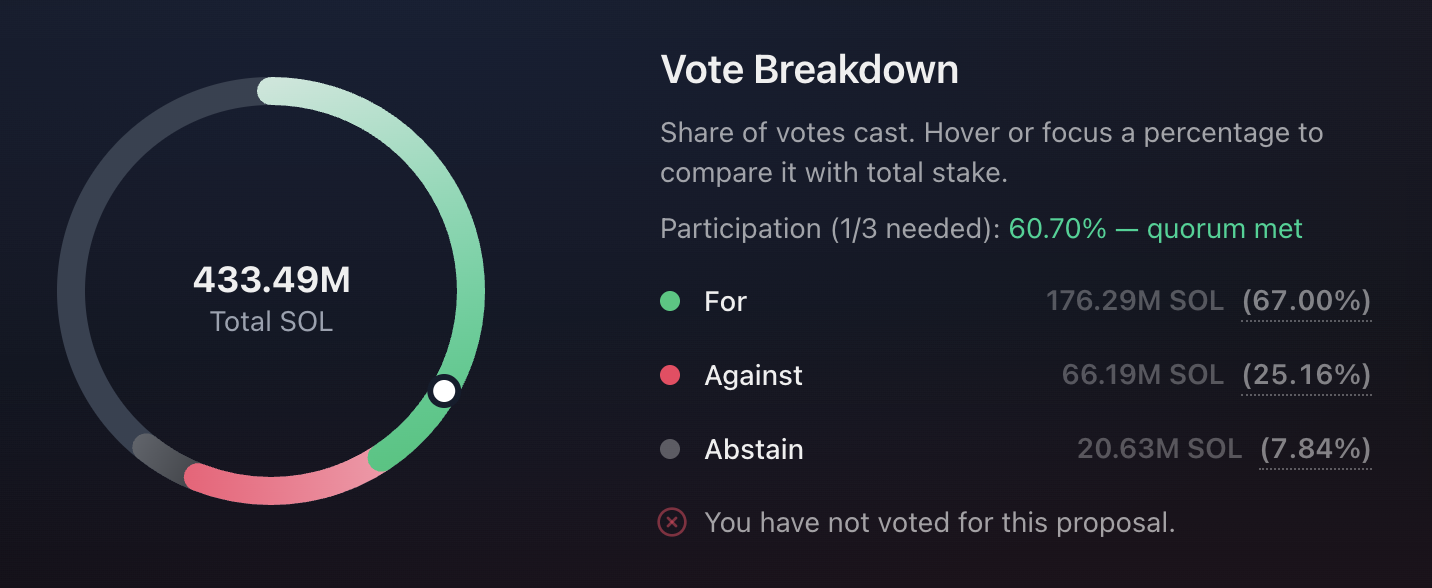
The proposal, officially designated as SGP-0002 and colloquially known as "Double Disinflation," received robust community backing. Finalized voting results indicate a substantial 67% support from participating validators, with 25.16% voting against and 7.84% abstaining. The overall engagement demonstrated a healthy democratic process, with 60.7% of eligible staked SOL participating in the crucial decision. This level of participation underscores the community’s vested interest in Solana’s economic future and its commitment to decentralized governance.
Accelerating Towards a Stable Inflation Target
At its core, SGP-0002 mandates an increase in Solana’s annual disinflation rate from its previous 15% to a new rate of 30%. Disinflation, distinct from deflation, refers to a slowdown in the rate of inflation. In the context of cryptocurrencies, it means the rate at which new tokens are introduced into circulation is decreasing, even if the total supply is still expanding, albeit at a slower pace. Crucially, this accelerated disinflationary schedule leaves the network’s long-term inflation target unchanged at 1.5%. This long-term target is designed to provide a sustainable incentive for network validators while ensuring the scarcity of the SOL token.
The immediate and most tangible effect of this change will be a significantly faster trajectory to reach this terminal inflation rate. Under the newly approved schedule, Solana is now projected to achieve its 1.5% terminal inflation rate in approximately 2.8 years. This represents a drastic acceleration compared to the roughly 5.7 years it would have taken under the previous 15% disinflation schedule, as reported by Solana Compass. This accelerated timeline is expected to have a profound impact on the supply dynamics of SOL. Estimates suggest that the change will result in approximately 18.9 million fewer SOL being issued over the next six years. This reduction in new supply is a direct benefit to existing SOL holders, as it mitigates dilution and potentially enhances the token’s scarcity value.
However, the decision also introduces a trade-off. While beneficial for token scarcity, the reduced issuance will inevitably lead to lower staking rewards for validators and delegators. Staking rewards are a fundamental incentive for network participants to secure the blockchain, and a reduction could influence their economic models. The community’s approval suggests a collective belief that the long-term benefits of increased scarcity and a more predictable supply outweigh the immediate impact of reduced rewards.
Solana’s Maturing Governance Framework

This landmark vote on SGP-0002 was not an isolated event but rather a central component of Solana’s inaugural binding governance process. This represents a significant milestone in Solana’s journey towards greater decentralization and community-led decision-making. Historically, many blockchain projects have evolved their governance structures, moving from more centralized initial setups to increasingly decentralized models where token holders or validators directly influence protocol parameters. Solana’s first binding vote indicates its progression in this critical aspect of blockchain development.
In addition to SGP-0002, the governance process also successfully approved a proposed Solana Constitution, laying foundational rules for the network’s future evolution. Conversely, a separate proposal concerning resource and inclusion fees was rejected, showcasing the nuanced and deliberative nature of the voting process. This demonstrates that not all proposals gain unanimous support, and the community actively scrutinizes changes, rejecting those deemed not to be in the network’s best interest.
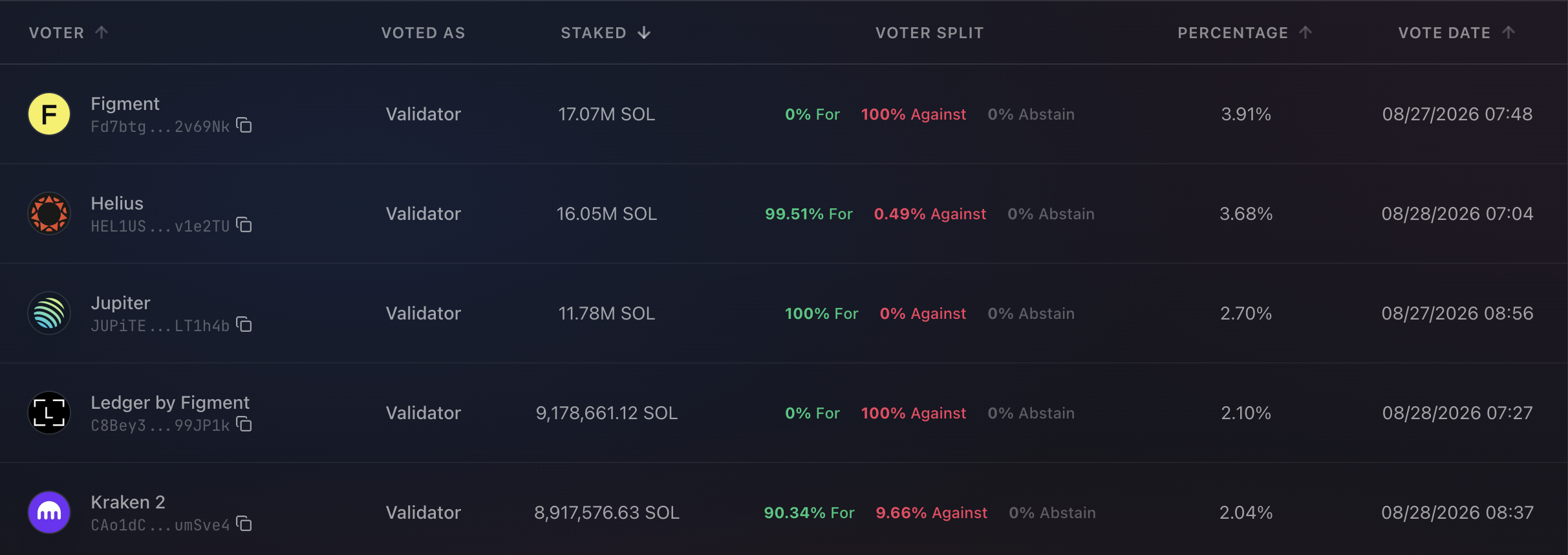
The voting dynamics for SGP-0002 highlighted a division among some of the network’s largest participants, underscoring the complexities and diverse interests within the validator ecosystem. Figment, which holds a significant stake, notably voted entirely against the measure, leveraging its 17.1 million staked SOL. This stance indicates that not all major players agreed on the optimal path for Solana’s economic model, likely weighing the benefits of reduced dilution against the potential impact on staking profitability or other long-term considerations.
Conversely, prominent entities like Helius and Jupiter overwhelmingly backed the proposal, signaling their conviction that a more aggressive disinflationary schedule aligns with Solana’s long-term health and value proposition. These differing perspectives are healthy in a decentralized system, fostering debate and ensuring that decisions are robustly vetted.
Perhaps one of the most intriguing aspects of the voting process was the shifting position of Kraken, a major US-based crypto exchange. Initially, Kraken voted against SGP-0002 at 12:33 UTC, a move that temporarily pushed the proposal’s support below the required threshold. Such shifts can create significant volatility and uncertainty during live governance votes. However, by the close of the voting period, Kraken reversed its position, with more than 90% of its approximately 8.9 million SOL voting stake ultimately backing the proposal. This shift was critical in securing the necessary support for SGP-0002 to pass, illustrating the fluidity and sometimes strategic nature of large-stake voting in decentralized autonomous organizations (DAOs). The reasons behind such a shift can be multifaceted, ranging from internal deliberation and stakeholder consultation to reactions to real-time voting trends and broader market sentiment.
Broader Economic Context: Solana’s Growing Institutional Appeal
The decision to double Solana’s disinflation rate arrives amidst a period of notable growth and increasing institutional interest in the Solana ecosystem. While the original article noted "weaker performance earlier this year," the current trajectory of Solana-based investment products paints a picture of sustained investor confidence and growing adoption. This suggests that while individual price movements can fluctuate, the underlying belief in Solana’s technology and long-term potential remains strong.
A significant indicator of this burgeoning institutional appeal is the performance of US-listed Solana Exchange Traded Funds (ETFs). Bitwise’s Solana ETF recently made headlines by surpassing $1 billion in assets under management (AUM), a monumental achievement that establishes it as the first Solana ETF to reach this significant milestone. This information, highlighted by Bloomberg ETF analyst Eric Balchunas, underscores the increasing mainstream acceptance of Solana as a legitimate investment vehicle.
Collectively, US Solana ETFs have attracted an impressive approximately $1.7 billion in cumulative net inflows. What is particularly noteworthy is the sustained nature of these inflows, with "little sustained outflow since their launch," as observed by Balchunas. This indicates not merely speculative interest but a more enduring commitment from institutional and retail investors who are choosing to gain exposure to SOL through regulated investment products. The consistent influx of capital into these ETFs, even potentially during periods of price consolidation, suggests a robust underlying demand for Solana exposure.
The success of Solana ETFs can be attributed to several factors. For traditional investors, ETFs offer a regulated, accessible, and often more palatable way to invest in cryptocurrencies without the complexities of direct token custody. Furthermore, Solana’s reputation for high transaction speeds, low fees, and a growing developer ecosystem makes it an attractive asset for diversification within the digital asset space. The increasing AUM in Solana ETFs can also be seen as a vote of confidence in the network’s long-term viability and its potential to compete with established blockchains. This institutional validation complements the network’s internal efforts to strengthen its economic model through governance decisions like SGP-0002, creating a synergistic effect that could bolster Solana’s position in the broader financial landscape.
Understanding Disinflation and Tokenomics
To fully appreciate the significance of SGP-0002, it is essential to understand the concept of disinflation within the context of cryptocurrency tokenomics. Unlike fiat currencies, which can be subject to monetary policy decisions by central banks, the supply of most cryptocurrencies is governed by pre-defined algorithms and, increasingly, by community governance.
Solana, like many proof-of-stake blockchains, has an initial inflation schedule designed primarily to incentivize network participants (validators and delegators) to secure the network. New SOL tokens are minted and distributed as staking rewards. Without these rewards, there would be less incentive for individuals and entities to dedicate resources to operate nodes and validate transactions, potentially compromising network security and decentralization.
However, an unchecked or excessively high inflation rate can dilute the value of existing tokens, leading to concerns about long-term scarcity and price stability. Disinflationary mechanisms, therefore, aim to strike a balance: provide sufficient incentives for network security in the short to medium term, while gradually reducing the rate of new supply creation to enhance long-term value.
By doubling its disinflation rate, Solana is signaling a stronger commitment to scarcity as a core tenet of its economic model. The move to reach the 1.5% terminal inflation rate faster means that the period of higher token issuance will be shortened. While the 1.5% long-term inflation rate will still result in a gradual increase in total supply, it is a rate considered sustainable and competitive compared to other major Layer 1 blockchains. For instance, Ethereum, post-Merge, has seen periods of deflation where its supply actually decreases, while Bitcoin’s supply schedule is strictly capped and reduced by halving events every four years. Solana’s approach, while not deflationary, aims for a controlled and low inflationary environment.
Implications and Future Outlook
The approval of SGP-0002 carries several key implications for Solana and its ecosystem:
-
Enhanced Scarcity and Investor Confidence: For existing SOL holders, the reduced issuance means less dilution, which could positively impact the token’s long-term value proposition. This move aligns Solana with a broader trend in the crypto space towards more supply-constrained assets, which are often favored by investors seeking store-of-value characteristics. This could further attract capital, especially from institutional investors who value predictable and transparent economic policies.
-
Validator Economics and Network Security: The most direct impact of lower staking rewards will be on validators and delegators. While the reduction might be marginal for individual stakers in the short term, over time, it could necessitate validators to optimize their operations or find alternative revenue streams. The Solana community will need to monitor if this reduction in rewards affects validator participation rates or the overall decentralization and security of the network. A healthy balance must be maintained to ensure robust network operation. However, a higher SOL price (due to scarcity) could offset some of the reduced reward percentages, making staking still attractive in absolute terms.
-
Maturity of Governance: The successful execution of Solana’s first binding governance vote, especially on a contentious economic proposal, highlights the network’s growing maturity in decentralized decision-making. This sets a precedent for future protocol upgrades and policy changes, fostering greater community involvement and ownership. The ability to collectively adapt and refine core economic parameters through a transparent voting mechanism is a strong indicator of a resilient and decentralized blockchain.
-
Competitive Positioning: In the highly competitive Layer 1 blockchain landscape, a well-defined and sustainable economic model is a critical differentiator. By proactively managing its token supply, Solana strengthens its position against rivals, demonstrating a commitment to long-term value for its ecosystem participants. This could reinforce its appeal to developers building decentralized applications (dApps) and users interacting with the network.
Looking ahead, the Solana ecosystem will undoubtedly continue to evolve its governance mechanisms. The successful passage of SGP-0002, alongside the approval of the Solana Constitution and the rejection of other proposals, demonstrates a dynamic and engaged community. The interplay between supply-side economics, validator incentives, and growing institutional interest through products like ETFs will collectively shape Solana’s trajectory in the coming years. This latest governance decision is a bold statement about Solana’s commitment to a robust and sustainable economic future, positioning it strategically within the ever-expanding digital asset economy.