admin
admin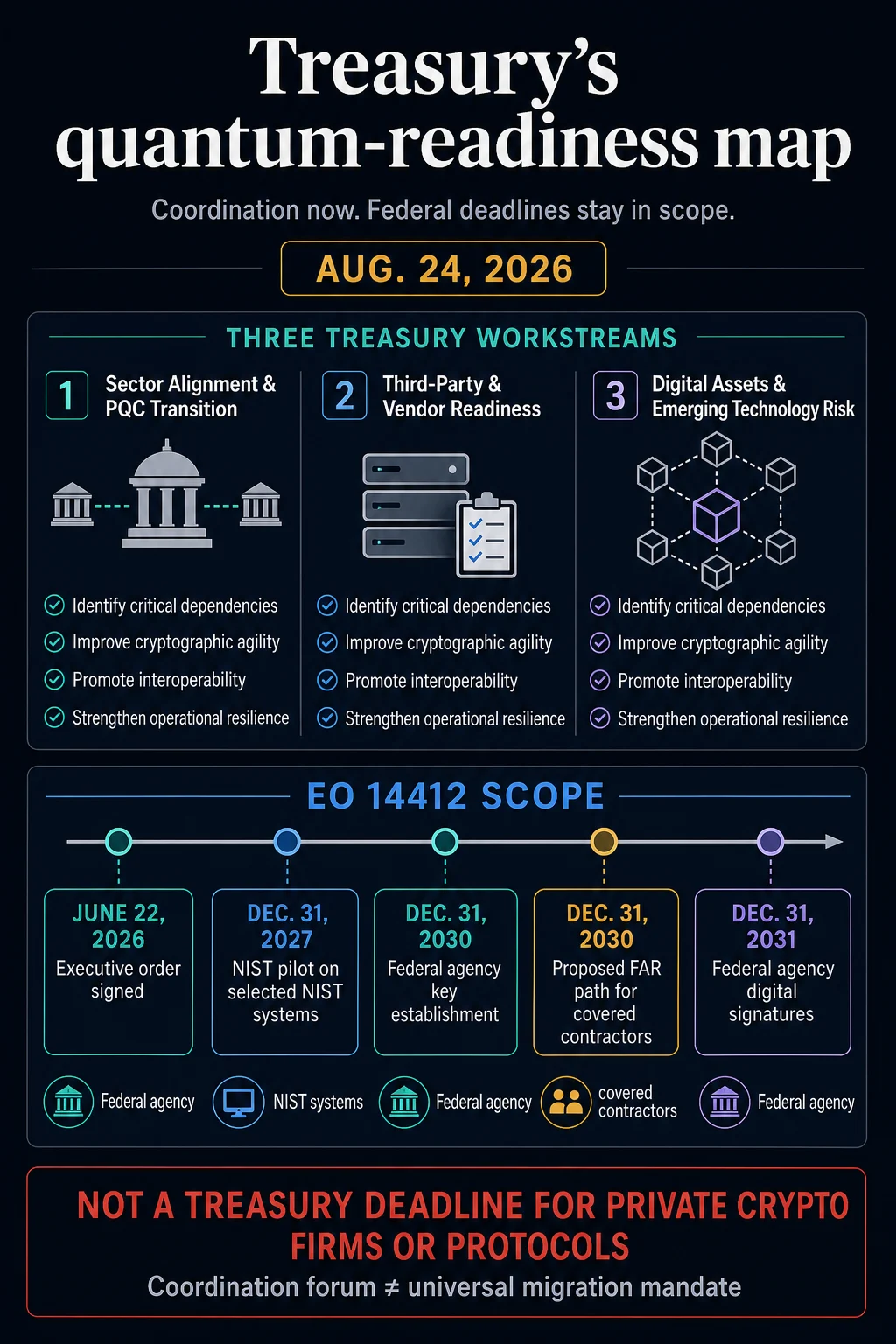
The US Treasury has formally brought digital assets into the financial sector’s preparations for quantum computing threats. On August 24, the US Treasury launched its Quantum-Readiness Task Force, establishing a dedicated workstream focused on digital assets and emerging technology risks, signaling a significant step in addressing the potential vulnerabilities that advanced computing power poses to current cryptographic security. This initiative aims to foster a collaborative environment between government agencies, financial institutions, and the burgeoning cryptocurrency industry to navigate the complex transition to quantum-safe technologies.
The Dawn of the Quantum Era and its Cryptographic Challenge
The advent of quantum computing represents a paradigm shift in computational power, promising to revolutionize fields from medicine and materials science to artificial intelligence. However, this progress also casts a long shadow over the digital security landscape. The cryptographic algorithms that underpin much of our modern digital infrastructure, including the security of financial transactions and the integrity of blockchain networks, rely on mathematical problems that are computationally infeasible for classical computers to solve. Quantum computers, with their ability to perform calculations in fundamentally different ways, could potentially break these widely used cryptographic systems with relative ease.
This impending threat is not a distant hypothetical. Experts predict that sufficiently powerful quantum computers capable of breaking current encryption standards could emerge within the next decade, potentially sooner. The implications are far-reaching, threatening not only sensitive government data and critical infrastructure but also the security of digital currencies that depend heavily on public-key cryptography for transaction authentication and ownership verification. The US Treasury’s proactive stance acknowledges the urgency of this challenge and seeks to orchestrate a coordinated response across the financial ecosystem.
Treasury’s Quantum-Readiness Task Force: A Multi-faceted Approach
The Quantum-Readiness Task Force, as announced by the US Treasury, is structured around three pivotal workstreams designed to comprehensively address the transition to post-quantum cryptography (PQC). While one stream is dedicated to the specific challenges posed by digital assets and emerging technologies, the other two focus on the broader adoption of PQC across federal systems and ensuring the readiness of third-party vendors. This holistic approach underscores the Treasury’s commitment to securing the entire financial ecosystem against future threats.
The workstream dedicated to digital assets and emerging technologies is particularly noteworthy. It is designed to serve as a crucial government-industry forum, bringing together key stakeholders from the cryptocurrency space, including custodians, infrastructure providers, and exchanges. The objective is to facilitate open dialogue, knowledge sharing, and coordinated planning for the eventual migration to quantum-safe cryptographic standards. This collaborative effort is essential for identifying critical dependencies within digital asset ecosystems, improving interoperability between legacy and future systems, and addressing the unique implementation challenges inherent in decentralized technologies.
The broader context for this task force is rooted in President Donald Trump’s Executive Order 14029, signed in June, which mandated an acceleration of the federal government’s own transition to PQC. This order set specific deadlines for federal systems, requiring high-value and high-impact systems to adopt post-quantum key establishment by December 31, 2030, and post-quantum digital signatures by December 31, 2031. While these deadlines apply directly to federal agencies, they have served as a catalyst for broader industry preparedness, including the financial sector.

The Quantum Threat to Bitcoin and Digital Assets
The unique architecture of cryptocurrencies, particularly Bitcoin, makes them a focal point in discussions about quantum computing’s impact. Bitcoin, the first and largest cryptocurrency, relies on cryptographic principles, including Elliptic Curve Digital Signature Algorithm (ECDSA), to secure transactions and ownership. While the private keys used to authorize transactions are kept secret, the corresponding public keys are often publicly visible on the blockchain, especially when an address has been previously used to send funds.
This exposure of public keys presents a potential vulnerability. A sufficiently powerful quantum computer, using algorithms like Shor’s algorithm, could theoretically derive a user’s private key from their public key. If this were to happen, an attacker could gain unauthorized access to and control over the associated Bitcoin holdings. The scale of this potential threat has been quantified by industry experts.
Coinbase’s independent quantum advisory council, in a report released in June, highlighted that an estimated 7 million Bitcoin are currently considered potentially vulnerable. This vulnerability arises primarily from older address formats or instances where addresses have been reused, leading to the public exposure of public keys. This figure underscores the immediate relevance of the Treasury’s initiative to the digital asset space.
Industry Prepares for the Quantum Shift
The US Treasury’s move is not occurring in a vacuum; significant segments of the crypto industry have already begun to acknowledge and address the quantum threat. The formation of the Bitcoin Security Consortium in July, just a month prior to the Treasury’s announcement, is a testament to this growing awareness. This consortium, comprising prominent institutions such as BlackRock, Coinbase, and Strategy, along with six other entities, has pledged a combined $15 million over three years to fund research specifically focused on enhancing Bitcoin’s security, with post-quantum cryptography as a key priority. While members direct their funding independently, the collective commitment signifies a serious engagement with the issue.
The work of the consortium and the advisory council highlights a critical realization within the industry: the transition to quantum-safe cryptography for blockchains will be a complex engineering and governance undertaking. Unlike centralized financial systems that can implement software updates across their infrastructure, decentralized blockchains require consensus among network participants to adopt new cryptographic standards. This can involve intricate technical upgrades to signature schemes, wallet software, and potentially even the underlying blockchain protocols.
The Treasury’s Quantum-Readiness Task Force aims to streamline this process by providing a structured platform for dialogue and coordination. By bringing together regulatory bodies, financial institutions, and technology providers, the task force can help identify best practices, foster interoperability, and potentially pre-empt regulatory hurdles that could arise during a rushed migration.

Implications and Future Outlook
The establishment of the Quantum-Readiness Task Force by the US Treasury represents a significant institutional recognition of the quantum computing threat to digital assets and the broader financial system. It signifies a shift from theoretical concern to proactive planning and collaboration.
For cryptocurrency custodians and infrastructure providers, this means engaging actively with the task force’s workstreams. They will be expected to contribute their expertise, identify their cryptographic dependencies, and participate in discussions about migration strategies. This engagement is crucial for ensuring that the transition to quantum-safe solutions is as seamless as possible, minimizing disruption to users and maintaining the integrity of digital asset markets.
However, it is important to note that the Treasury’s current action does not impose immediate, binding migration deadlines on private digital asset companies or public blockchains like Bitcoin and Ethereum. The task force is primarily a coordination and information-gathering body. Any mandatory migration requirements for the crypto industry would likely necessitate the development of specific regulations or other legal authorities that are directly applicable to these entities.
The long-term implications of this initiative are substantial. It sets a precedent for how governments and industries can collaborate to address systemic technological risks. As quantum computing capabilities advance, the Treasury’s proactive approach could serve as a model for other nations and sectors grappling with similar challenges. The ongoing dialogue between public and private sectors is essential for building a resilient and secure digital financial future, one that can withstand the transformative power of quantum computation. The journey to quantum-readiness is complex and will require sustained effort, innovation, and collaboration from all stakeholders involved. The US Treasury’s initiative marks a critical step forward in this vital endeavor.