admin
admin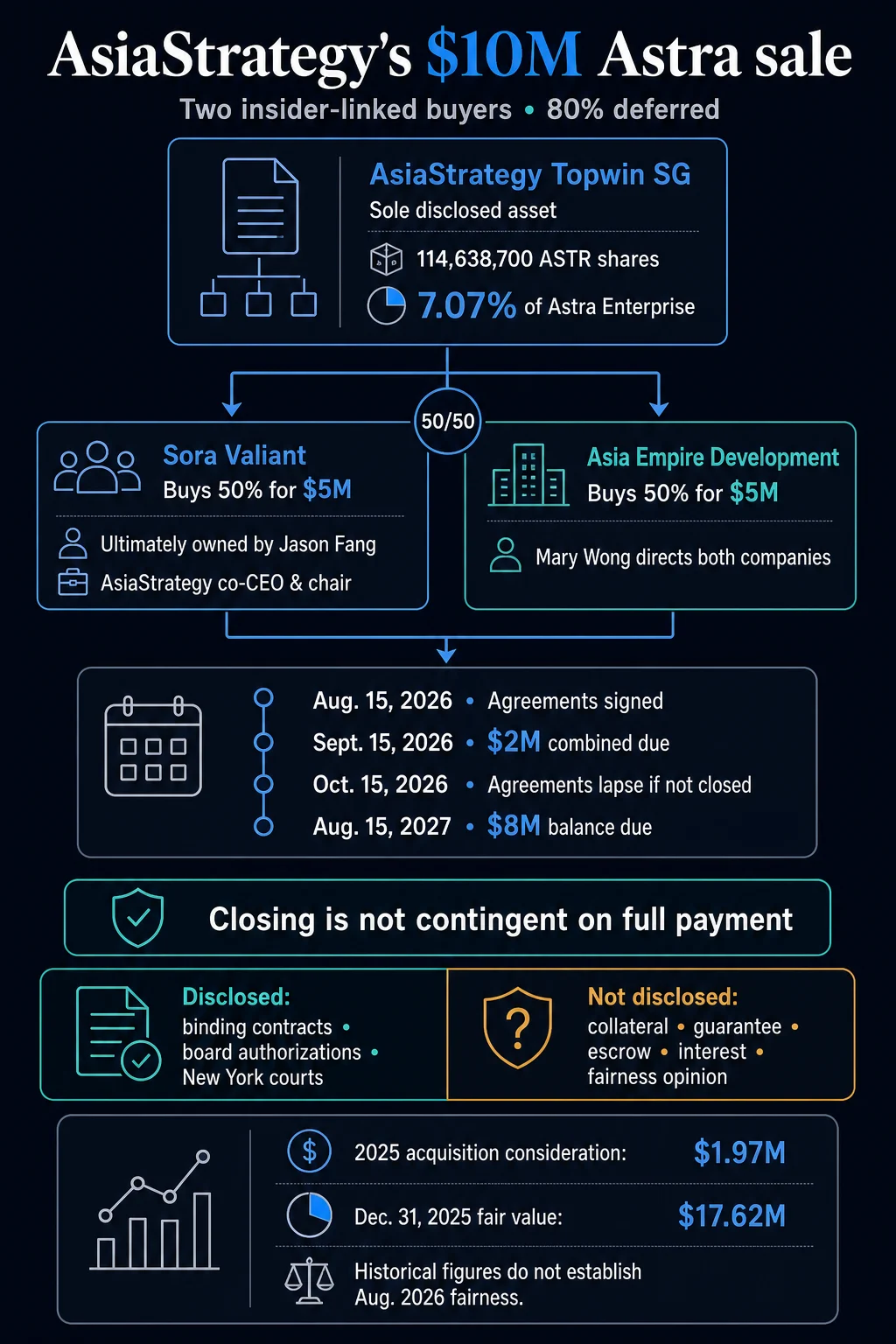
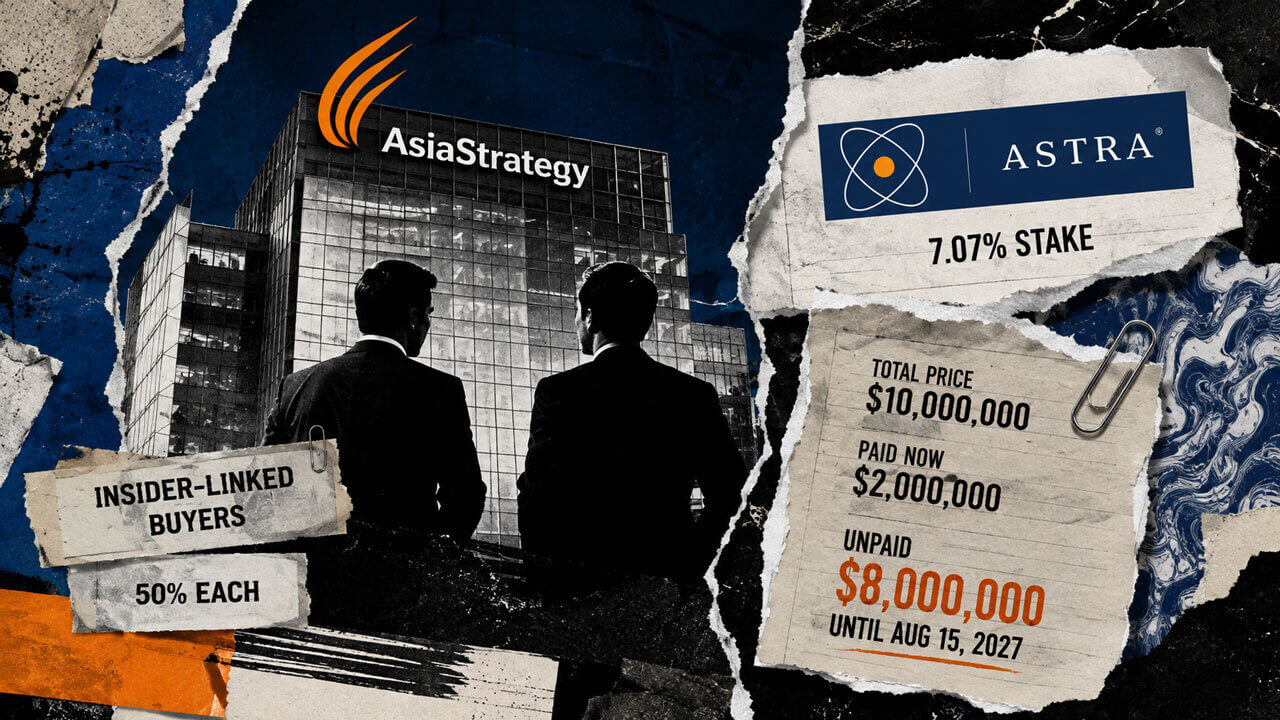
AsiaStrategy has entered into agreements to divest its entire holding in a Singapore-based subsidiary, which exclusively owns a 7.07% stake in the publicly traded Astra Enterprise in Thailand. The transaction, valued at $10 million, involves two buyers with direct ties to AsiaStrategy’s leadership. A significant portion of the purchase price, $8 million, is deferred, raising questions about the immediate financial security for AsiaStrategy and its shareholders. The sale structure, particularly the substantial deferred payment and the immediate transfer of ownership before full payment, warrants a closer examination of the protections in place for all parties involved.
Deal Structure and Key Terms
On August 15, 2026, AsiaStrategy, a Nasdaq-listed entity, executed two separate share purchase agreements for its subsidiary, AsiaStrategy Topwin SG. This subsidiary’s sole asset is its substantial 7.07% ownership in Astra Enterprise, a company listed on the Stock Exchange of Thailand. Each of the two agreements outlines a purchase price of $5 million, totaling the $10 million sale value.
The structure of the payment is a critical aspect of this deal. Each buyer is required to pay 20% of their respective purchase price, amounting to $1 million per buyer or $2 million in total, within one month of the August 15, 2026 effective date. This initial payment is due by September 15, 2026. The remaining 80% of the purchase price, totaling $8 million ($4 million per buyer), is deferred and payable within one year of the effective date, with a final deadline of August 15, 2027.
The agreements offer flexibility in the form of payment, allowing for US dollars, USDT at a 1:1 exchange rate, or Hong Kong dollars at a fixed rate of HK$7.80 per US dollar. This provision for USDT payment suggests an acknowledgment of the growing role of digital assets in financial transactions.
Insider Connections and Potential Conflicts of Interest
The identities of the two buyers, Sora Valiant and Asia Empire Development, raise significant questions regarding potential conflicts of interest. Sora Valiant is ultimately owned by Jason Kin Hoi Fang, who holds multiple key positions within AsiaStrategy: co-CEO, director, and board chairman. The second buyer, Asia Empire Development, shares Wong Fung Yee Mary as a director with AsiaStrategy. Both Fang and Wong Fung Yee Mary signed their respective buyer agreements in their capacities as directors, underscoring the direct involvement of individuals with existing ties to AsiaStrategy.
This insider-linked nature of the transaction necessitates a thorough review of the corporate governance practices and the due diligence undertaken by AsiaStrategy’s board to ensure that the deal is indeed in the best interests of all shareholders, not just those with insider connections.
Ownership Transfer and Deferred Payment Concerns
A particularly noteworthy aspect of the agreements is the stipulation that legal ownership of the respective 50% stakes in AsiaStrategy Topwin SG can pass to the buyers at closing, independent of the full payment of the purchase price. The agreements explicitly state that closing is not contingent upon the complete remittance of the $10 million. This means that the buyers could gain full legal and beneficial ownership of their stakes before the substantial $8 million deferred payment is realized by AsiaStrategy.
As of AsiaStrategy’s filing on August 17, 2026, there was no public confirmation that either transaction had officially closed or that any initial payments had been received. This leaves a period of uncertainty regarding the immediate financial implications for AsiaStrategy.
Shareholder Protections: A Limited Safety Net
In its filings, AsiaStrategy stated that its management and board had thoroughly reviewed the terms of the sale and concluded that it was in the best interests of the company and its shareholders. The company cited regulatory burdens under the U.S. Investment Company Act, particularly for entities holding significant "investment securities," as a primary driver for the divestment. Additionally, a mandatory holding-period restriction imposed by a commercial contract was also mentioned as a contributing factor.
However, the publicly disclosed agreements reveal a limited safety net for the deferred $8 million. The contracts contain standard contractual provisions, such as buyer representations of binding agreements and the inclusion of corporate board authorizations as closing deliverables. Written non-waiver provisions are in place to preserve contractual rights, and disputes are subject to New York court jurisdiction.
Crucially, the agreements do not disclose any collateral, guarantees, or escrow arrangements to secure the deferred $8 million. There is also no mention of interest accrual on the unpaid balance, nor are there provisions for acceleration of payments in the event of default or specific remedies tailored to payment defaults. Notably, the agreement with Sora Valiant includes a specific carve-out that absolves the buyer from liability for payment delays caused by banking or blockchain processing issues beyond their reasonable control. This clause could potentially provide Sora Valiant with additional leeway in meeting its payment obligations.
Valuation and Fair Consideration: A Historical Perspective
AsiaStrategy’s 2025 annual report provided some context for the valuation of its Astra Enterprise stake. The company stated that it acquired the stake for approximately $1.97 million. As of December 31, 2025, the reported fair value of this stake was $17.62 million. It is important to note that these figures are based on different valuation methodologies and reporting periods, and therefore, they cannot definitively establish the fairness of the $10 million sale price agreed upon in August 2026.

The current disclosure package for the sale omits several key elements that would typically support the fairness of such a transaction. There is no mention of a current independent valuation of the Astra stake, a fairness opinion from an external financial advisor, the formation of a special committee to oversee the transaction, director abstentions from voting due to potential conflicts of interest, or a shareholder vote to approve the deal. The absence of these standard corporate governance mechanisms raises further questions about the rigor of the approval process.
Timeline and Immediate Milestones
The immediate future of this transaction hinges on several key dates. The agreements have a lapse deadline, which, if not met by the parties, could render the deals void. More critically, the initial $2 million in payments are due by September 15, 2026. The successful collection of this initial amount will be a significant indicator of the buyers’ commitment and financial capacity.
Following this, the substantial $8 million deferred payment is scheduled to be settled by August 15, 2027. The lack of robust security for this deferred amount places a considerable degree of reliance on the buyers’ future financial performance and their willingness to fulfill their contractual obligations.
Broader Implications for AsiaStrategy and its Shareholders
The sale of such a significant asset, particularly one that has appreciated considerably since its acquisition, carries substantial implications for AsiaStrategy. The company’s stated rationale for divesting, citing regulatory complexities and contractual restrictions, suggests a strategic decision to streamline its portfolio and potentially reduce its compliance burden. However, the structure of the deal, with its substantial deferred payment and insider involvement, introduces a layer of risk that shareholders will be closely monitoring.
For shareholders, the primary concerns revolve around the certainty of receiving the full $10 million purchase price and the timing of those payments. The immediate transfer of ownership prior to full payment creates a scenario where AsiaStrategy’s recourse in the event of a future default by the buyers might be limited. This could potentially impact the company’s financial stability and its ability to pursue future strategic initiatives.
The market reaction to this news will likely be influenced by how investors perceive the risks associated with the deferred payment structure and the potential for conflicts of interest. Transparency regarding any further developments, including the confirmation of closing and payment receipts, will be crucial in shaping investor sentiment. The company’s ability to effectively manage the collection of the deferred payment will be a key determinant of the ultimate success of this divestiture from a financial perspective. The market will be watching closely to see if AsiaStrategy has adequately protected its interests and those of its shareholders in this complex transaction.