Dwi Wanna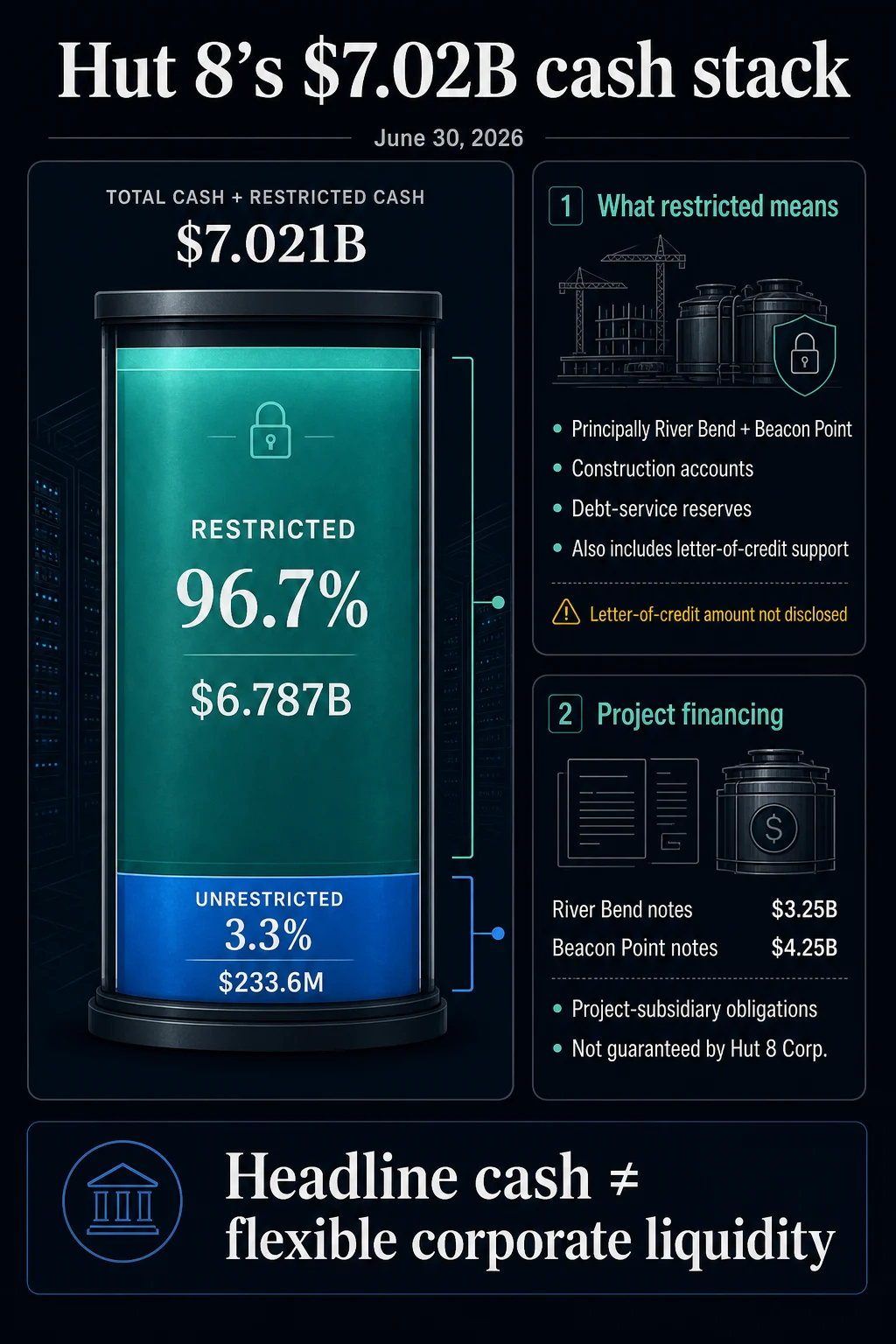
The distinction between headline cash and unrestricted liquidity is more than an accounting nuance; it is a vital metric for assessing Hut 8’s ability to withstand potential delays or cost overruns in its ambitious infrastructure build-out. While the multi-billion-dollar balance suggests a fortress-like treasury, the vast majority of those funds are locked within construction and debt-service reserve accounts required by the indentures of its recent note issuances. If the company’s AI projects, specifically the River Bend and Beacon Point developments, encounter unforeseen hurdles, the $233.6 million "dry powder" may prove to be a thin margin for a company of this scale.
The Strategic Pivot to AI Infrastructure
Hut 8’s financial structure reflects a broader industry trend where traditional Bitcoin miners are diversifying into High-Performance Computing (HPC) and AI hosting to mitigate the volatility of mining rewards. This transition requires significant capital expenditure and a complete overhaul of energy infrastructure. The company has staked its future on two primary developments: the River Bend and Beacon Point AI data centers.
To fund these projects, Hut 8 utilized a subsidiary-level financing model designed to isolate risk. River Bend was funded through $3.25 billion of notes carrying a 6.19% interest rate, issued by Hut 8 DC LLC. Similarly, Beacon Point was financed via $4.25 billion of notes at a 6.13% interest rate, issued by Beacon Point DC LLC. By structuring the debt this way, Hut 8 Corp—the parent entity—remains outside the guarantee structure, limiting its direct exposure to the project debt. However, this "ring-fencing" also means that the $6.8 billion in restricted cash is legally tethered to those projects and cannot be redirected to cover parent-level expenses or other corporate needs.
Financial Performance and the Interest Burden
The second quarter of 2026 was marked by significant financial turbulence for Hut 8. The company reported a net loss of $177.1 million, a figure heavily impacted by a $138.6 million loss on digital assets. Management characterized this loss as primarily unrealized, stemming from the mark-to-market valuation of its Bitcoin holdings during a period of market contraction.
To provide a clearer picture of operational health, the company utilized revised non-GAAP definitions. When excluding the digital-asset mark-to-market changes, Hut 8 reported a positive adjusted EBITDA of $10.4 million. Conversely, when those changes were included, the adjusted EBITDA plummeted to a negative $94.6 million.
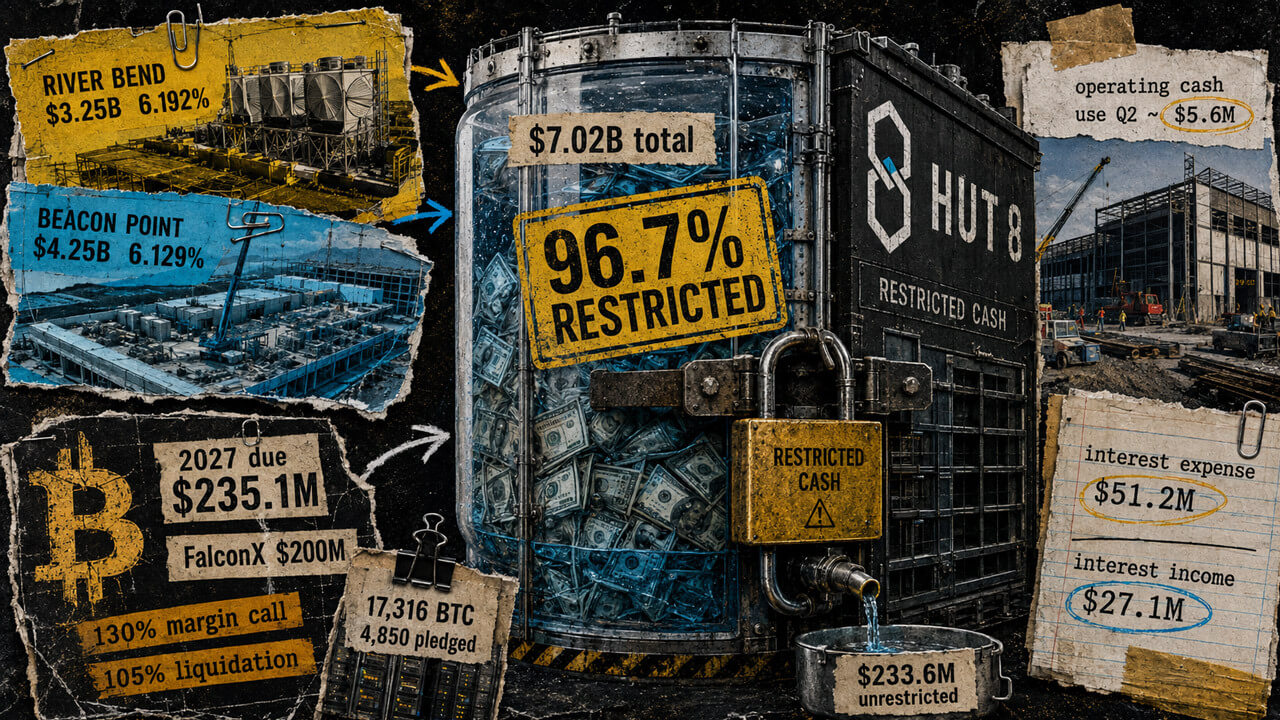
The company’s interest obligations are also becoming a central feature of its balance sheet. During the quarter, Hut 8 recorded $51.2 million in interest expense. This was partially mitigated by $27.1 million in interest income, generated largely from the unused portions of the River Bend and Beacon Point proceeds sitting in reserve accounts. As construction progresses and these funds are deployed, the interest income is expected to decrease, increasing the net interest burden on the company.
Chronology of Obligations and Project Milestones
The timeline for Hut 8’s financial commitments is structured around the completion and operationalization of its AI data centers. The following chronology outlines the critical milestones facing the company over the next four years:
- June 30, 2026: Hut 8 reports a $7.021 billion total cash stack, with 96.7% restricted.
- August 4, 2026: Quarterly filing reveals the limited $233.6 million in unrestricted cash.
- November 2026: Both River Bend and Beacon Point projects are scheduled to begin making interest payments on their respective note packages.
- April 30, 2027: A $200 million loan from FalconX, carrying a 7% interest rate, reaches maturity. This facility is backed by Bitcoin and includes strict margin-call and liquidation thresholds.
- Late 2027: Hut 8 faces a total of $235.1 million in long-term debt principal due throughout the year.
- May 2028: Principal payments are scheduled to begin for the River Bend AI data-center notes.
- May 2030: Principal payments are scheduled to begin for the Beacon Point AI data-center notes.
This timeline suggests that while the company has successfully deferred principal payments on its largest debts until 2028 and beyond, the next 18 months will test its liquidity through interest payments and the 2027 maturity of the FalconX facility.
Bitcoin Holdings and the FalconX Maturity
A critical component of Hut 8’s balance sheet remains its substantial Bitcoin treasury. As of the end of the second quarter, the consolidated group held 17,316 Bitcoin. This stash is divided between Hut 8 (9,314 BTC) and American Bitcoin (8,002 BTC).
The management of these assets is complex. The company reported that 9,376 Bitcoin are held in custody, while 3,090 are pledged for miner purchases and 4,850 are pledged as collateral. A significant portion of this collateral is likely tied to the $200 million FalconX loan due in April 2027. This facility represents a "near-term test" for the company because of its margin-call structure. The loan has a 130% margin-call threshold and a 105% liquidation threshold. If the price of Bitcoin drops significantly, Hut 8 could be forced to pledge more of its unrestricted Bitcoin or face liquidation of the collateral, further straining its liquid reserves.
The company has not disclosed the exact allocation of Bitcoin backing the FalconX facility, leaving a degree of uncertainty regarding how much of its 17,316 BTC remains unencumbered and available to support the parent company’s $233.6 million cash position.

Cash Flow Analysis: Operations vs. Construction
While the net loss figures are dramatic, Hut 8’s actual cash usage provides a more nuanced view of its day-to-day operations. In the first half of 2026, the company used $32.8 million of operating cash. Given that $27.2 million was used in the first quarter, the implied operating cash use for the second quarter was approximately $5.6 million.
This suggests that the core business—excluding the massive capital infusions for AI projects and the non-cash fluctuations of Bitcoin value—is operating relatively close to a break-even cash flow state. However, "operating cash" does not include the massive interest payments looming on the horizon. The ability to transition from a Bitcoin miner to an AI infrastructure provider depends entirely on whether the revenue generated by River Bend and Beacon Point can exceed the $51.2 million (and growing) quarterly interest expense before the unrestricted cash reserves are exhausted.
Broader Implications for the Mining Industry
Hut 8’s financial positioning is a case study in the high-stakes evolution of the digital asset mining sector. Following the most recent Bitcoin halving events, the industry has bifurcated into companies that are doubling down on mining efficiency and those, like Hut 8, Core Scientific, and IREN, that are pivoting toward AI.
The challenge for Hut 8 is the sheer scale of the debt required to compete in the AI space. AI data centers require specialized GPU clusters (such as NVIDIA H100s or B200s), advanced cooling systems, and massive power draws that far exceed standard mining setups. By securing $7.5 billion in project-specific financing, Hut 8 has ensured it has the capital to build, but the "restricted" nature of that cash means the parent company is essentially walking a tightrope.
Industry analysts note that if the AI projects are delivered on time and meet the projected demand from enterprise clients, the restricted cash will have served its purpose, and the resulting revenue will dwarf the current interest obligations. However, the data center construction industry is currently plagued by supply chain bottlenecks for transformers and high-density cooling equipment. Any delay that pushes the operational date past the start of principal repayments in 2028 could force Hut 8 to seek additional parent-level equity or sell down its Bitcoin treasury at inopportune times.
Conclusion
Hut 8’s current financial status is a paradox of massive scale and tight liquidity. With over $7 billion on the balance sheet, it is one of the most well-capitalized players in the crypto-infrastructure space. Yet, with 96.7% of that capital restricted and a $200 million Bitcoin-backed loan maturing in 2027, the company’s margin for error is narrower than the headline figures suggest. The success of the River Bend and Beacon Point projects is no longer just a growth strategy; it is a fundamental requirement for the company’s long-term solvency. Investors and stakeholders will likely keep a close watch on the November 2026 interest payment commencement as the first real indicator of Hut 8’s ability to service its new AI-driven debt profile.