Dwi Wanna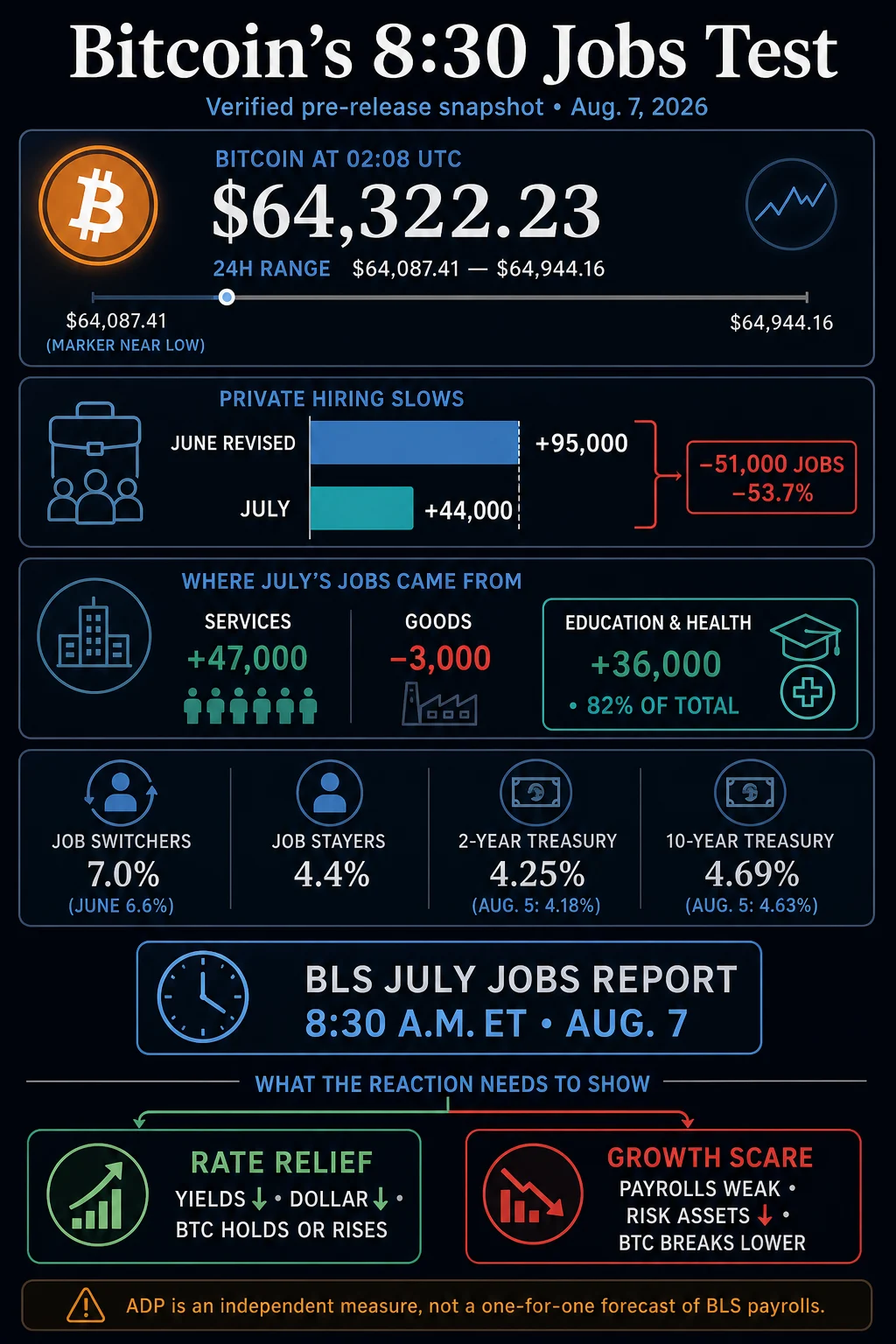
As of approximately 2:08 a.m. UTC, Bitcoin was trading at $64,322.23 on the Coinbase exchange. This price point represented a marginal 0.37% cushion above its 24-hour low of $64,087.41, illustrating the fragile nature of current support levels. Market participants are now looking toward the Bureau of Labor Statistics (BLS) and its impending July Employment Situation report, scheduled for release at 8:30 a.m. ET, as the ultimate arbiter of near-term price action.
The ADP Private Hiring Slowdown: A Granular Analysis
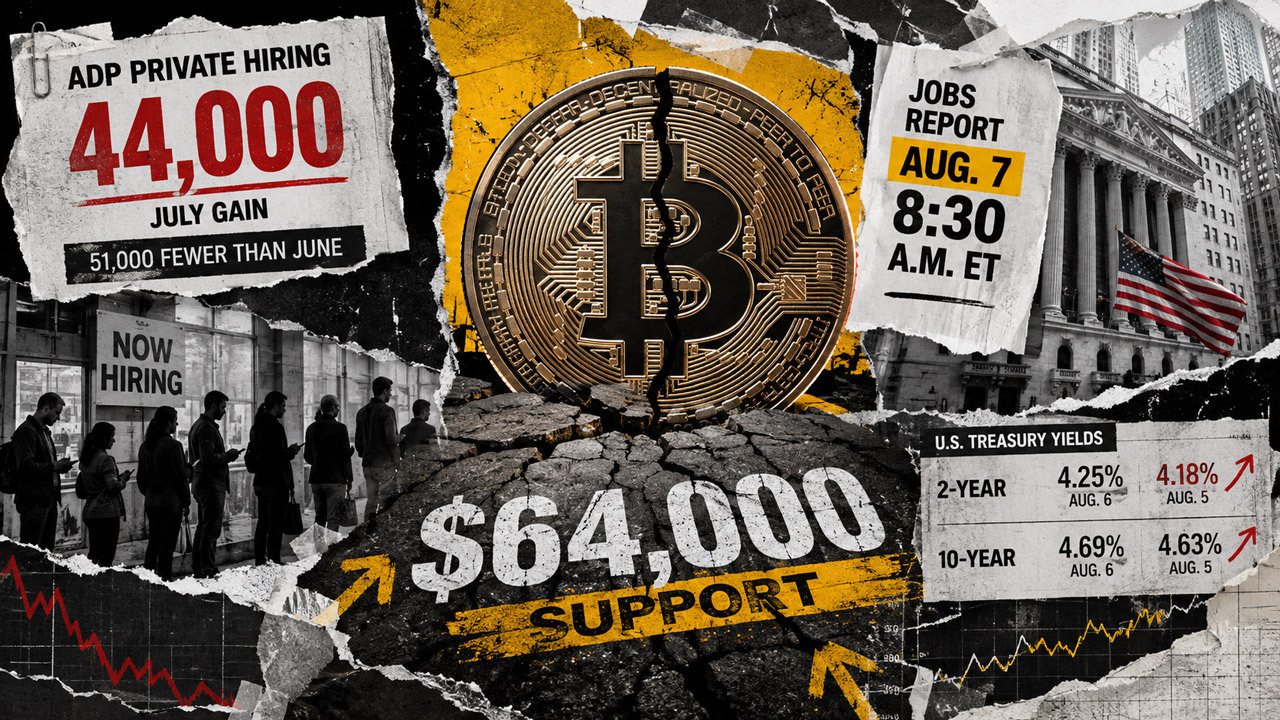
The primary catalyst for the current market caution was the release of the ADP National Employment Report earlier this week. The data revealed that private employers in the United States added only 44,000 jobs in July 2026. This figure represents a staggering 53% decline from the revised June gain of 95,000 jobs. While the ADP report is often viewed as an independent metric and not an exact precursor to the government’s official payroll count, the magnitude of the drop has sent ripples through the investment community.
The internal composition of the ADP data suggests an economy that is growing increasingly bifurcated. The vast majority of the job gains—approximately 82%—were concentrated within the education and health services sector, which added 36,000 positions. In contrast, the broader service-providing sector added 47,000 jobs, while goods producers saw a net loss of 3,000 positions.
Specific industries that typically serve as bellwethers for consumer discretionary spending and industrial health showed notable weakness. The leisure and hospitality sector shed 11,000 jobs, while trade, transportation, and utilities lost 8,000. Natural resources and mining also saw a contraction of 6,000 jobs. This sectoral distribution indicates that while essential services remain resilient, the cyclical parts of the economy are beginning to feel the weight of sustained high interest rates.
The Wage Growth Paradox and Inflationary Pressures
While the headline hiring number suggested a cooling labor market, the accompanying wage data provided a more complex narrative for the Federal Reserve. ADP reported that annual pay growth for workers who changed jobs accelerated to 7.0% in July, up from 6.6% in June. For those who remained in their current roles, wage growth held steady at 4.4%.
This acceleration in "job-switcher" wages is particularly concerning for central bankers. Persistent wage pressure can lead to a "wage-price spiral," where higher labor costs are passed on to consumers, thereby embedding inflation deeper into the economy. This dynamic complicates the "rate-relief" trade that many Bitcoin investors have been anticipating. If wages remain high despite slowing hiring, the Federal Reserve may be forced to maintain a restrictive monetary policy for longer than the market currently expects, even if the unemployment rate begins to tick upward.
Treasury Yields and the Fixed Income Reaction
The bond market’s reaction to the labor data has been equally telling. Rather than yields falling on the news of a hiring slowdown—which would typically signal expectations of future rate cuts—U.S. Treasury yields moved higher. On August 6, the two-year Treasury yield, which is highly sensitive to Federal Reserve policy expectations, rose to 4.25% from 4.18% the previous day. Simultaneously, the 10-year Treasury yield climbed to 4.69% from 4.63%.
This upward movement in yields suggests that the market is prioritizing the inflationary signals found in the wage data over the recessionary signals found in the hiring slowdown. For Bitcoin, rising yields are generally a headwind. As the "risk-free" rate of return on government bonds increases, the relative attractiveness of non-yielding assets like Bitcoin tends to diminish. The fact that Bitcoin has managed to hold the $64,000 level despite these rising yields indicates a degree of underlying demand, but also highlights the precariousness of the current price floor.
Chronology of Market-Moving Events: July to August 2026
To understand the significance of today’s macro test, it is essential to review the timeline of events that led to this juncture:
- Early July 2026: Markets reacted positively to a weak June jobs report, which saw a Bitcoin rebound and $223 million in spot ETF inflows as investors bet on a "rate-relief" scenario.
- August 5, 2026: ADP releases its July private hiring data, showing a sharp drop to 44,000 jobs. Initial market reaction is mixed as participants digest the high wage growth figures.
- August 6, 2026: U.S. Treasury yields rise across the curve. Bitcoin experiences a slight pullback, testing the $64,000 support level. Spot Bitcoin ETF flows show a modest provisional inflow of $9.3 million, a sharp decrease from the $244.4 million recorded on August 5.
- August 7, 2026 (2:00 a.m. UTC): Bitcoin stabilizes near $64,300. The global market enters a "wait-and-see" mode ahead of the BLS report.
- August 7, 2026 (8:30 a.m. ET): The Bureau of Labor Statistics is scheduled to release the official July Employment Situation report, including non-farm payrolls, the unemployment rate, and average hourly earnings.
Bitcoin ETF Dynamics and Institutional Sentiment
The role of institutional capital, specifically through spot Bitcoin Exchange-Traded Funds (ETFs), remains a critical component of Bitcoin’s price discovery. Data from Farside Investors indicated a significant drop in net inflows on August 6. The provisional total of $9.3 million suggests that institutional appetite may be pausing ahead of the high-stakes economic data.
Notably, data for BlackRock’s iShares Bitcoin Trust (IBIT), often the leader in ETF volume, remained unreported at the time of the latest market update. On the previous day, August 5, the market saw a robust $244.4 million inflow, which helped propel Bitcoin toward the upper end of its recent range. The drop-off in inflows suggests that "smart money" is currently sidelined, waiting to see if the BLS report confirms the ADP’s weakness or provides a surprise that could shift the Federal Reserve’s trajectory.

The Two Paths: Rate Relief vs. Growth Scare
As the market approaches the 8:30 a.m. ET deadline, analysts are focused on two primary interpretive frameworks for the upcoming data:
The Rate-Relief Interpretation
In this scenario, a weak BLS payroll number, combined with cooling wage growth and a slight rise in the unemployment rate, would lead to a decline in Treasury yields and a weakening of the U.S. Dollar. This would likely be viewed as a "goldilocks" scenario for Bitcoin. It would provide the Federal Reserve with the necessary cover to signal an upcoming rate cut, providing a liquidity injection that could push Bitcoin toward the $70,000 resistance level.
The Growth-Scare Interpretation
Conversely, if the payroll numbers are significantly lower than expected while inflation (wages) remains high, the market may shift from "bad news is good news" to "bad news is bad news." In this "growth-scare" scenario, investors fear that the Federal Reserve has waited too long to pivot and that the economy is heading for a hard landing. This could lead to a broad sell-off in risk assets, including stocks and cryptocurrencies, potentially breaking the $64,000 support level for Bitcoin and testing lower liquidity zones.
Broader Economic Implications and Market Dominance
The current macro environment has solidified Bitcoin’s position as a primary indicator of global liquidity. With Bitcoin dominance currently sitting at 58.90%, the asset continues to capture the lion’s share of interest within the digital asset space. The global crypto market cap stands at $2.21 trillion, with 24-hour volumes hovering around $47.41 billion.
The outcome of today’s jobs report will likely dictate the trend for the remainder of the month. If the data suggests a resilient but cooling economy, the "soft landing" narrative may regain traction, benefiting both traditional equities and digital assets. However, if the data reveals a labor market in freefall, the flight to safety could favor the U.S. Dollar and short-term Treasuries at the expense of Bitcoin.
As the countdown to the BLS release continues, the $64,000 level remains the line in the sand for Bitcoin bulls. A successful defense of this level post-report would confirm the resilience of the current uptrend, while a failure could signal a deeper correction as the market recalibrates for a more challenging economic reality in the second half of 2026. Professional traders are advised to monitor the immediate reaction in the two-year Treasury yield and the U.S. Dollar Index (DXY) as the most reliable leading indicators for Bitcoin’s next move.