Dwi Wanna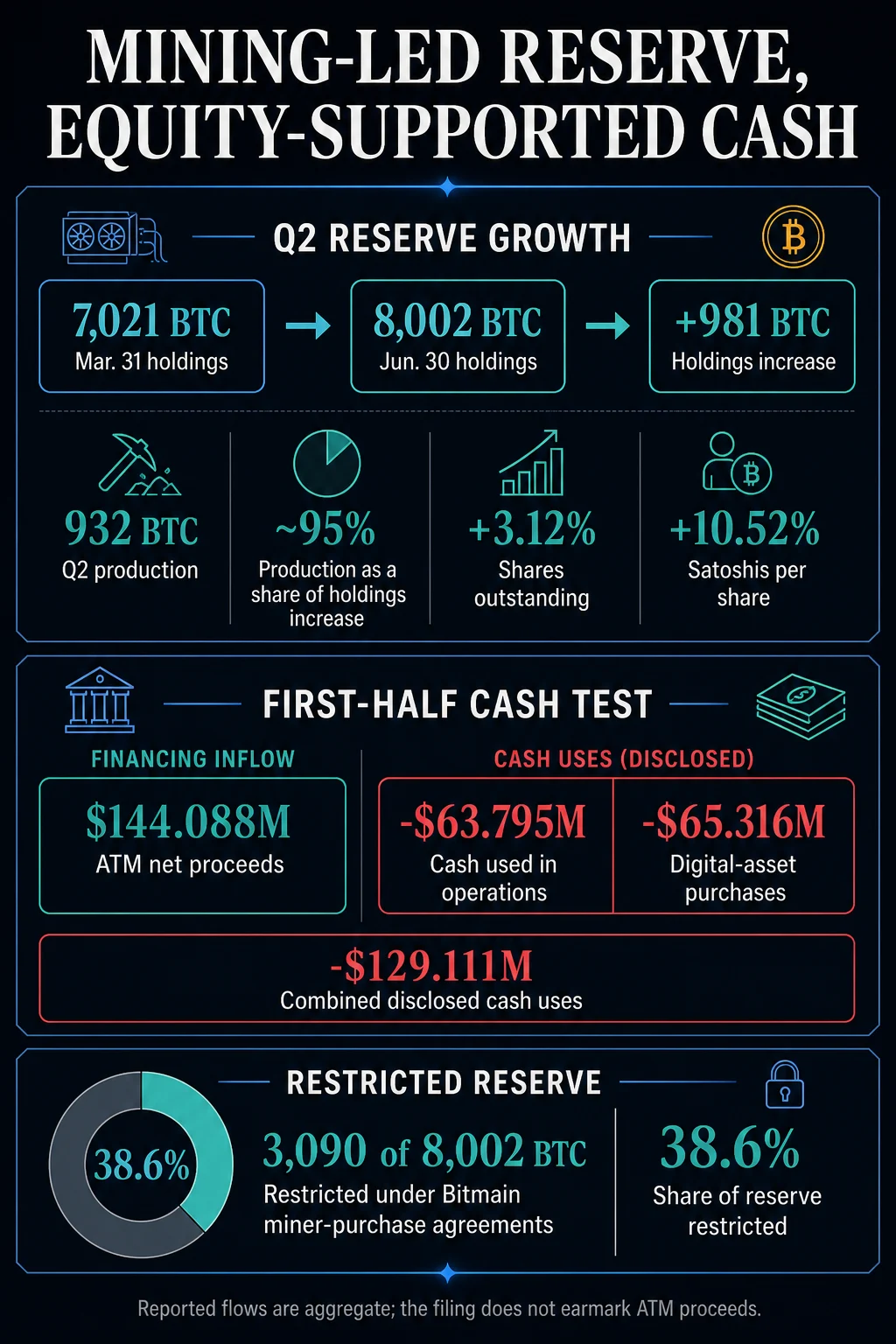
The company’s second-quarter financial disclosures for 2026 reveal a complex balancing act between aggressive balance sheet expansion and the heavy reliance on equity markets to sustain operations. While American Bitcoin successfully increased its total Bitcoin holdings to 8,002 BTC by the end of June, a deeper dive into the company’s Securities and Exchange Commission (SEC) filings shows that 3,090 of those coins—representing approximately 38.6% of the total reserve—are restricted under purchase agreements with the hardware manufacturing giant Bitmain. This restriction, coupled with a significant net loss and a reliance on "at-the-market" (ATM) share sales, paints a picture of a mining firm that is growing its assets while facing substantial liquidity and structural challenges.
Operational Performance and Mined Revenue
During the second quarter of 2026, American Bitcoin’s mining operations remained productive, yielding approximately 932 BTC. This production accounted for roughly 95% of the growth in the company’s total holdings between March 31 and June 30, which rose by 981 BTC in total. The company reported $67.015 million in revenue for the quarter, largely driven by these mining activities. On the surface, the unit economics of the operation appeared favorable: American Bitcoin reported revenue of approximately $71,900 per mined BTC against a stated production cost of $36,500 per BTC.
However, these figures require careful scrutiny. The $34.009 million "cost of revenue" cited by the company excludes several significant expenses. Specifically, the company’s quarterly results and 10-Q filing reveal an additional $28.237 million depreciation-and-amortization charge that is not included in the "cost-per-BTC" metric. When accounting for the wear and tear on high-performance ASIC (Application-Specific Integrated Circuit) miners and the amortization of infrastructure costs, the "fully loaded" cost of production is significantly higher than the headline figure suggests. This accounting treatment is common in the capital-intensive mining industry but can obscure the true break-even point for investors evaluating operational efficiency.
The Bitmain Encumbrance: A Strategic Tether
The most striking revelation in the recent filings is the status of a large portion of American Bitcoin’s treasury. Of the 8,002 BTC held as of June 30, 3,090 BTC are classified as restricted. These assets are tied to miner-purchase agreements with Bitmain, the world’s leading manufacturer of Bitcoin mining hardware.
This restriction is linked to a $371.687 million liability recorded on the company’s balance sheet. Under the terms of the agreement, American Bitcoin retains the economic exposure to these coins—meaning they benefit if the price of Bitcoin rises—but the coins cannot be sold or moved freely. They serve effectively as collateral or are held in a structure where Bitmain maintains a claim until specific financial obligations are met. While the company has not forfeited these coins and retains redemption or repurchase rights, the lack of immediate liquidity for nearly 40% of its reserve limits the firm’s ability to use its "HODL" strategy as a safety net for cash flow needs.
Cash Flow Realities and Equity Financing
Despite the growth in digital assets, American Bitcoin’s cash flow statement for the first half of 2026 indicates that the company’s broader reserve strategy is not currently self-funding. In the first six months of the year, operations consumed $63.795 million in cash. Simultaneously, the company spent $65.316 million on direct digital-asset purchases to bolster its reserves beyond what was produced through mining.

To cover these outflows, which totaled $129.111 million, American Bitcoin turned to the equity markets. The company’s principal financing inflow came from the sale of Class A shares through an at-the-market (ATM) offering. During the first half of 2026, the firm sold 7,755,671 shares, generating $144.088 million in net proceeds. A significant portion of this activity occurred in the second quarter, where the sale of 2,151,127 shares produced $33.585 million in net proceeds.
While the company did not explicitly state that these funds were earmarked for Bitcoin purchases, the correlation between the cash raised through dilution and the cash used for operations and asset acquisition is clear. Equity issuance has become the primary engine for liquidity, allowing the company to maintain its Bitcoin treasury even as its operational costs exceed its cash revenue.
GAAP Net Loss vs. Operational Reality
For the second quarter, American Bitcoin reported a GAAP (Generally Accepted Accounting Principles) net loss of $57.151 million. This loss was not primarily a result of cash spending but was driven by accounting adjustments related to the volatility of digital assets. A $71.178 million fair-value loss on digital assets was the primary driver of a $74.081 million operating loss.
Under current accounting standards, public companies must often mark their digital asset holdings to market values, which can create massive swings in reported net income that do not necessarily reflect the "cash burn" of the business. To offset some of these losses, the company recorded an $18.315 million gain from derivatives and a small $22,000 gain from warrant liabilities. Because the digital-asset fair-value loss and derivative gains are treated as non-cash adjustments in the cash-flow reconciliation, the $57 million net loss is an indicator of balance sheet valuation changes rather than a depletion of the company’s actual bank accounts.
Chronology of Structural Changes: The July Reverse Split
The financial pressure on American Bitcoin’s stock price led to a significant structural change shortly after the close of the second quarter. In July 2026, the company executed a 1-for-15 reverse stock split. This move was necessitated by Nasdaq listing requirements, which typically mandate a minimum bid price of $1.00 per share. Prior to the split, the dilution caused by the ATM share sales, combined with market sentiment, had pushed the share price into a range that risked delisting.
The reverse split successfully elevated the share price to maintain regulatory compliance, but it also highlighted the cost of the company’s "growth at all costs" strategy. Interestingly, the dilution did not immediately erase the value for shareholders on a "per-share" basis regarding Bitcoin holdings. Even after adjusting for the reverse split, common shares rose by 3.12%, while the total Bitcoin holdings rose by 13.97%. This resulted in a 10.52% increase in the "implied satoshis per share," a metric often used by Bitcoin-adjacent companies to prove they are creating value for investors despite increasing the total share count.
Market Context and Industry Implications
The strategy employed by American Bitcoin—using equity to fund Bitcoin accumulation—is a model popularized by firms like MicroStrategy, though applied here within the context of an active mining operation. In the 2026 market environment, mining difficulty has remained high, and the rewards for securing the network have become increasingly dependent on operational scale and energy efficiency.

By tying nearly 40% of its reserve to Bitmain, American Bitcoin has secured a pipeline for hardware that is essential for staying competitive. However, the $371 million liability associated with these coins suggests that the company is heavily leveraged against its own production. If the price of Bitcoin were to experience a prolonged downturn, the "economic exposure" the company retains could turn into a liability, especially if the value of the restricted coins falls below the threshold required to satisfy the Bitmain agreements.
Industry analysts suggest that American Bitcoin’s reliance on ATM offerings is a double-edged sword. While it provides the necessary capital to avoid selling Bitcoin during market dips, it places a ceiling on stock price appreciation by constantly adding new supply to the market. For investors, the primary draw remains the "Bitcoin per share" growth, but the underlying health of the company depends on its ability to eventually bring its "fully loaded" mining costs below the market price of Bitcoin without the need for constant capital injections.
Analysis of Future Outlook
As American Bitcoin moves into the second half of 2026, the focus will likely shift to how it manages the Bitmain liability and whether it can transition toward a self-sustaining cash flow model. The availability of the ATM offering post-reverse split suggests that the company will continue to use equity as a strategic tool.
The core tension for American Bitcoin remains its dual identity: it is a high-tech industrial miner with significant physical overhead and a digital asset treasury that functions like a closed-end fund. The restricted status of 3,090 BTC serves as a reminder that in the world of institutional mining, "Not your keys, not your coins" can apply even to multi-million dollar corporations when high-stakes financing is involved.
The company’s ability to navigate these encumbrances while continuing to outpace share dilution with asset growth will determine its long-term viability on the Nasdaq. For now, American Bitcoin remains a massive, albeit leveraged, player in the North American mining landscape, holding a significant portion of the world’s circulating Bitcoin supply while navigating the complex financial waters of the public markets.