admin
admin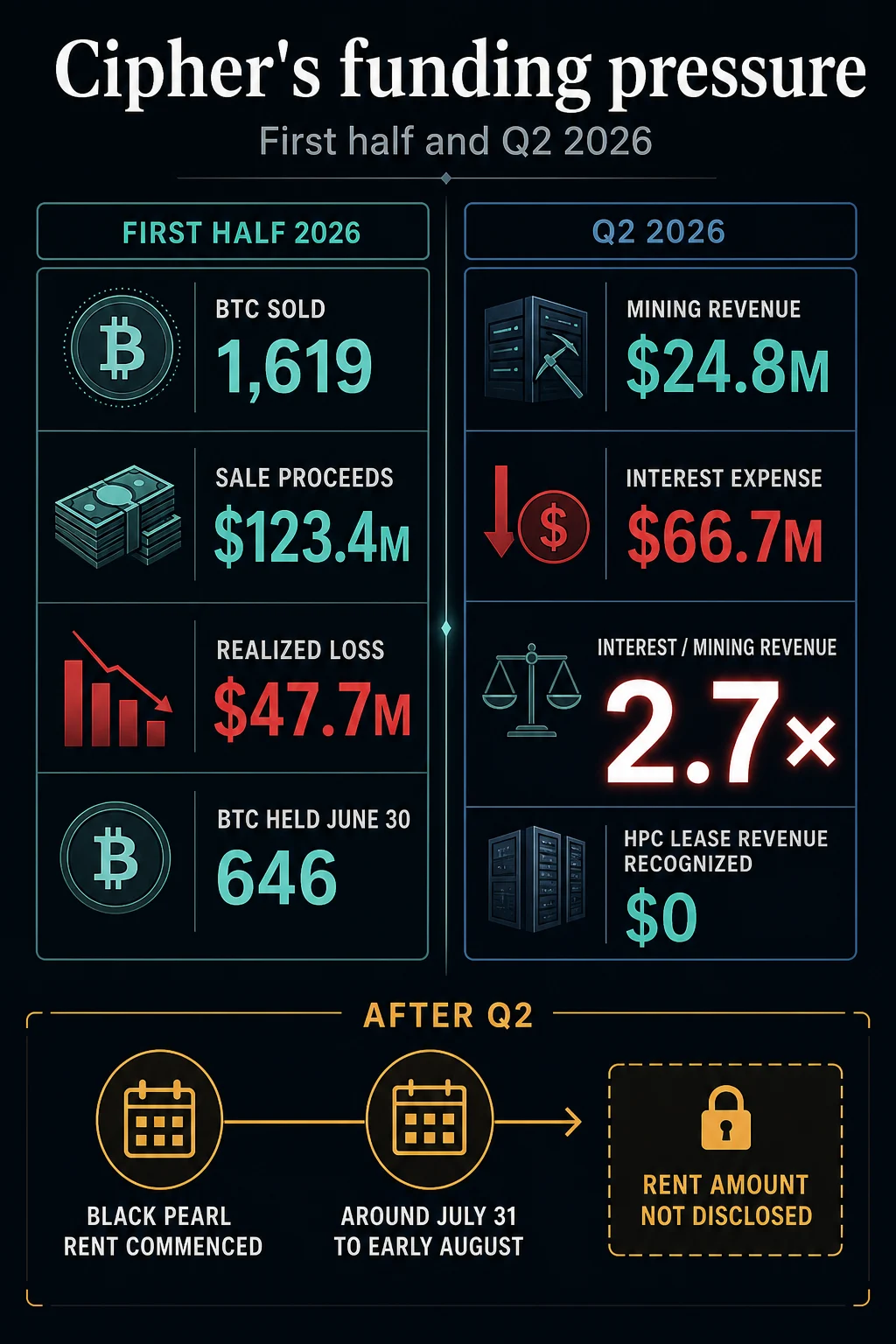
Cipher Digital, a prominent player in the Bitcoin mining sector, has disclosed the sale of 1,619 Bitcoin during the first half of the year, resulting in a realized loss of $47.7 million. This significant divestment occurred as the company navigates substantial interest expenses and prepares for the operational launch of its ambitious AI data center, Black Pearl. The details of the Black Pearl’s rental income ramp-up remain undisclosed, leaving a crucial aspect of Cipher’s future revenue streams opaque.
Financial Strain and Strategic Divestment
In the first six months of the year, Cipher Digital’s financial disclosures reveal a stark picture of operational costs and revenue generation. The company reported interest expenses totaling $66.7 million, a figure that dwarfs its mining revenue of $24.8 million during the same period. This ratio of approximately 2.7-to-1 underscores the significant financial pressure Cipher is under, necessitating strategic decisions like the substantial sale of its Bitcoin holdings.
The second quarter, in particular, bore the brunt of these financial challenges. Cipher’s mining revenue for this period fell from $43.6 million in the prior year to a substantially lower figure. Compounding this decline, the second quarter accounted for $23.5 million of the total $47.7 million realized loss from Bitcoin sales. This indicates a strategic pivot or necessity to liquidate assets to meet financial obligations. The entirety of Cipher’s reported second-quarter revenue was generated from its Bitcoin mining operations in Odessa, Texas.
The Black Pearl Project: A New Frontier
The launch of the Black Pearl data center represents a significant diversification strategy for Cipher Digital, moving beyond its core Bitcoin mining operations. While the project’s rental income is anticipated to bolster the company’s financial standing, the precise details of its revenue generation are currently limited. Cipher stated that the "Black Pearl rent clock started after June 30," indicating the commencement of financial obligations related to the facility.

In a notable acceleration of its development timeline, Cipher announced that initial Black Pearl data center capacity began delivery at the beginning of August, two months ahead of its original schedule. This early operational readiness means that rental income commenced by the time the company released its August 4th business update. However, the update provided no specific figures regarding the amount collected from Black Pearl rentals, nor did it detail a quarter-by-quarter ramp-up in revenue. This lack of transparency makes it challenging to assess the immediate impact of the AI data center on Cipher’s overall financial health and its ability to offset the substantial Bitcoin sales and external financing requirements.
Financing Avenues: Bitcoin, Stock, and Debt
Cipher Digital has employed a multi-pronged approach to secure the necessary capital for its operations and expansion initiatives. During the first half of the year, its operations consumed $152 million in cash. Furthermore, the company made substantial investments in its infrastructure, spending $964.3 million on property and equipment, likely in preparation for the Black Pearl facility and other operational enhancements.
The sale of Bitcoin, bringing in $123.4 million, played a role in meeting these capital demands. However, the bulk of Cipher’s financing came from external sources. Financing activities collectively supplied a net $2.84 billion. This figure includes $129.2 million raised through at-the-market (ATM) stock sales, indicating a reliance on equity markets to supplement its funding.
It is important to note that the company’s filings present consolidated cash flows, meaning the proceeds from Bitcoin sales are not explicitly earmarked for a single project. This makes it difficult to precisely link the Bitcoin divestment to the funding of the Black Pearl or other specific capital expenditures.
Balance Sheet Strength and Debt Obligations
As of June 30, Cipher Digital maintained a robust cash position, reporting $831.8 million in cash and cash equivalents. However, a significant portion of its assets, $3.73 billion, was held as restricted cash, unavailable for general corporate purposes. This restricted cash is likely tied to project financing or other contractual obligations.

The Black Pearl project itself involves substantial debt financing, with $2 billion in notes held by project entities. These notes are secured, indicating that the revenue generated by the Black Pearl facility serves as collateral. Cipher’s parent company retains limited exposure to construction-completion risks, with customary recourse carve-outs in place.
Non-Cash Charges and Net Loss
Beyond operational and financing activities, Cipher Digital’s financial statements were also impacted by non-cash charges. A $150.5 million non-cash warrant charge significantly swelled the company’s quarterly net loss, pushing it to $267.5 million. This charge is attributed to warrants issued to Google for its backing of the separate Barber Lake lease. Therefore, this particular charge is associated with the Barber Lake deal and is distinct from the cash debt service and operational costs related to the Black Pearl.
Looking Ahead: The Impact of Black Pearl
The third quarter of 2026 will mark the first period where Cipher Digital’s financial results will fully incorporate the rental income from the Black Pearl facility. Investors and analysts will be closely scrutinizing these upcoming reports to understand the true financial contribution of the AI data center. The extent of its revenue generation, beyond covering its own operational costs and debt service, will be a critical determinant of Cipher’s ability to alleviate its current funding pressures and reduce its reliance on further Bitcoin sales or external financing.
The interplay between Bitcoin market volatility, the operational efficiency of its mining fleet, and the success of the Black Pearl venture will shape Cipher Digital’s trajectory in the coming quarters. The company’s ability to manage its substantial debt obligations while demonstrating sustainable revenue growth from its diversified operations will be key to its long-term viability and investor confidence. The market will be particularly keen to see how the Black Pearl’s revenue stream integrates with and potentially offsets the significant interest expenses Cipher is currently shouldering. The early delivery of capacity for the Black Pearl, while a positive operational development, does not yet provide the financial clarity needed to fully assess its impact on the company’s bottom line.
The financial strategy employed by Cipher Digital, characterized by significant Bitcoin sales, reliance on external financing, and a bold diversification into AI infrastructure, highlights the complex challenges and opportunities facing Bitcoin miners in the current economic landscape. The success of the Black Pearl project is not merely a matter of technological deployment but a critical financial lifeline for the company, with its revenue ramp-up being a closely watched indicator for the foreseeable future.