admin
admin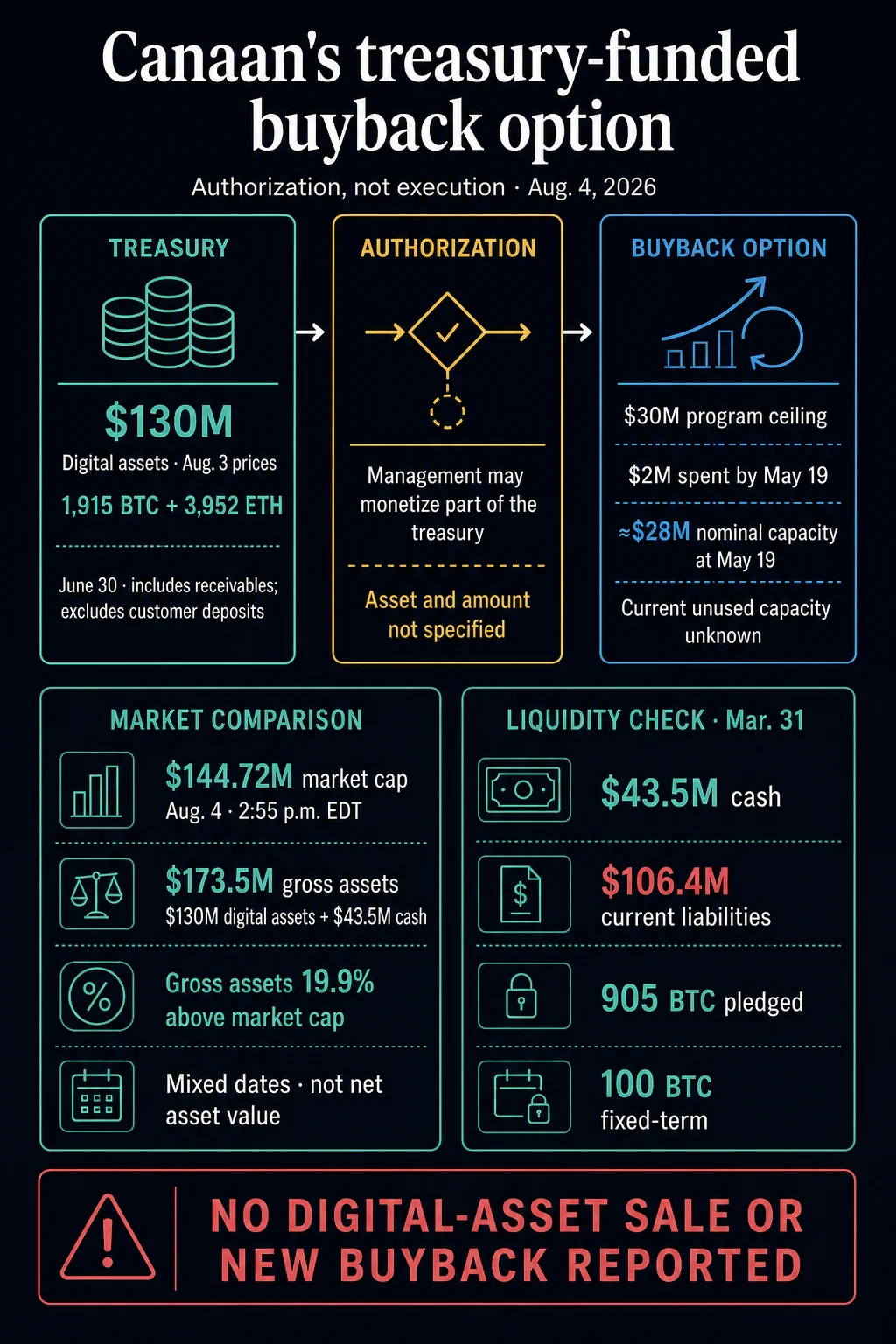
Bitcoin mining machine manufacturer Canaan has opened a new funding channel for share buybacks, allowing management to sell part of its roughly $130 million digital asset treasury. This strategic move, detailed in a recent SEC filing, presents a potential avenue for bolstering per-share value. However, it also introduces a critical trade-off: any liquidation of these digital assets would directly reduce the reserves available to a Bitcoin mining and hardware business that has been operating at a loss.
The announcement, filed with the Securities and Exchange Commission (SEC) on August 4, 2026, explicitly permits Canaan’s management to leverage its cryptocurrency holdings to fund an existing share repurchase program. While the authorization is clear, the practical execution remains undisclosed. As of the latest reports, there have been no public announcements detailing any transactions from the company’s digital asset treasury, nor any subsequent repurchases of its American Depositary Shares (ADS) or Class A ordinary shares. This lack of transparency leaves the exact current capacity for buybacks and the company’s available liquidity in an unresolved state.
A History of Share Repurchases and Evolving Strategy
Canaan’s share buyback initiative officially commenced on December 12, 2025, with an initial authorized ceiling of $30 million for ADS or Class A ordinary share repurchases over a 12-month period. Financial disclosures provided in the company’s first-quarter results, dated May 19, 2026, indicated that Canaan had utilized approximately $2 million of this authorization by that date. During this period, the company had successfully bought back approximately 2.8 million ADSs.
Based on these figures, a simple calculation suggests that as of May 19, Canaan retained a nominal repurchase capacity of around $28 million. However, the subsequent announcement on August 4 did not provide an updated total for repurchases made between May 19 and the filing date. This omission means that the precise, current unused authorization for share buybacks remains unknown to the public. This uncertainty complicates assessments of the company’s immediate financial flexibility and its commitment to its buyback strategy.
Valuation and Treasury Assets: A Complex Picture
To understand the potential impact of these buybacks, it’s crucial to examine Canaan’s market valuation and its asset holdings. At 2:55 p.m. EDT on August 4, 2026, Canaan’s market capitalization was valued at approximately $144.7 million, according to data sourced from StockAnalysis and S&P Global Market Intelligence.
On August 3, 2026, the company’s digital asset treasury was estimated to be worth around $130 million. This figure, when combined with Canaan’s reported cash balance of $43.5 million as of March 31, 2026, yields a gross sum of $173.5 million. This total is approximately $28.8 million, or 19.9%, higher than the intraday market capitalization recorded on August 4. This substantial difference suggests that, at least on paper, the company holds assets that significantly exceed its current market valuation, creating a potential discount that buybacks could aim to address.

It is important to note that these figures are derived from data points at different reporting dates. The $130 million digital asset estimate is based on August 3 prices, while the cash balance of $43.5 million is from March 31. A more precise calculation of net asset value would require a comprehensive balance sheet reflecting all liabilities and asset restrictions as of a single, consistent date. Furthermore, the calculation omits potential liabilities and any restrictions on the company’s digital assets, which could impact their immediate liquidity.
Deep Dive into Canaan’s Financial Health and Asset Management
Canaan’s financial disclosures offer a deeper insight into the company’s operational challenges and its strategic reliance on its digital asset treasury. In its first-quarter report for 2026, the company recorded a significant gross loss of $22.9 million and an operating loss of $54.3 million. The net loss for the quarter reached a substantial $88.7 million. While the company projected second-quarter revenue between $35 million and $45 million, which was in line with analyst expectations, the underlying profitability concerns persist.
The company’s operating update from June 2026 provided specific details on its digital asset holdings. As of June 30, 2026, Canaan’s balance sheet included 1,915 Bitcoin (BTC) and 3,952 Ethereum (ETH). These figures represent direct holdings and exclude customer deposits. However, it is crucial to consider that not all of these assets may be immediately available for liquidation.
Liquidity Constraints and Strategic Trade-offs
Canaan’s liquidity situation, as detailed in its March 31, 2026, financial statements, reveals a challenging landscape. The company held $43.5 million in cash against current liabilities totaling $106.4 million. This represents a notable decrease from the $80.8 million in cash reported at the end of the previous fiscal year.
Furthermore, the company has strategically utilized a portion of its Bitcoin holdings to secure financing. As of March 31, 2026, 905 BTC were pledged as collateral for secured term loans. An additional 100 BTC were placed in a fixed-term product, indicating that these assets are not readily available for immediate sale or use. These existing encumbrances and restrictions mean that the headline figure of its digital asset treasury does not equate to fully liquid capital.
The collections from customer receivables in April 2026 provided a temporary influx of approximately $42 million. However, this inflow does not negate the underlying operational losses and the strategic decisions required to manage the company’s financial health. The weaker hardware cycle in the Bitcoin mining industry has amplified the importance of Canaan’s expanding digital asset treasury, making it a more central factor in the company’s overall valuation.

The Buyback Dilemma: Value Enhancement vs. Operational Needs
The authorization to use cryptocurrency for share buybacks presents Canaan’s management with a delicate balancing act. On one hand, a well-executed share repurchase program can significantly enhance per-share value, potentially signaling confidence in the company’s future prospects and providing a return to shareholders. In a market environment where the company’s stock may be trading at a discount to its underlying assets, buybacks can be a logical strategy to bridge that gap.
However, each dollar directed towards repurchasing shares directly reduces the pool of capital available for the company’s core operations. Canaan’s mining and hardware business has been grappling with significant losses. The capital required for research and development, manufacturing, sales, and operational expenses is substantial. Diverting funds from these essential areas to buybacks, while potentially beneficial for stock price performance in the short term, could impair the company’s ability to recover and achieve long-term profitability.
The ultimate decision on how much of the digital asset treasury to liquidate for buybacks will likely be influenced by several factors, including Canaan’s working-capital needs, its projected operational performance, and the oversight of its board of directors. The company must carefully weigh the immediate benefits of share buybacks against the long-term imperative of strengthening its core business operations.
Broader Industry Context and Future Outlook
Canaan operates within the highly dynamic and cyclical Bitcoin mining equipment manufacturing industry. The profitability of such companies is intrinsically linked to the price of Bitcoin, the cost of electricity, and the rate of technological innovation in mining hardware. Periods of low Bitcoin prices or increased competition can lead to reduced demand for new mining rigs and place significant financial pressure on manufacturers.
The company’s substantial digital asset holdings, accumulated through various means including potentially from previous operational profits or strategic acquisitions, have become an increasingly significant component of its financial structure. The decision to allow these assets to be used for buybacks suggests a strategic shift, or at least an expanded set of options, for how the company manages its capital and attempts to create shareholder value.
The lack of transparency regarding the execution of these buyback transactions raises questions for investors and market observers. Understanding the timing, volume, and pricing of any future asset sales and share repurchases will be critical for assessing the true impact of this new strategy on Canaan’s financial stability and its future growth prospects. As the company navigates these complex financial decisions, its ability to balance the immediate goal of enhancing shareholder value with the fundamental need to support its loss-making core business will be closely scrutinized by the market. The coming quarters will be crucial in determining whether this new funding channel proves to be a strategic advantage or a risky gambit for Canaan.