admin
admin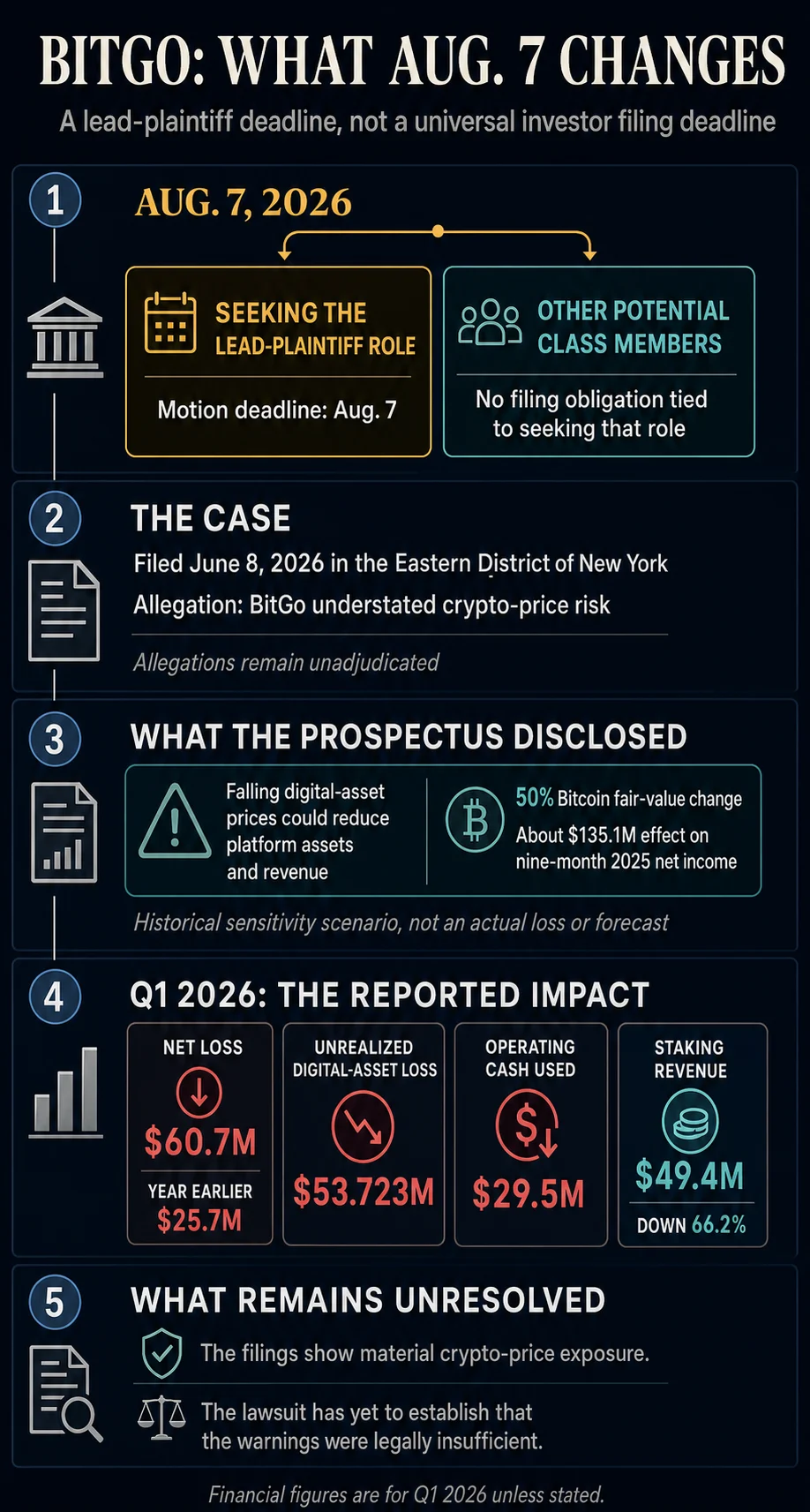
A significant wave of legal notifications has been disseminated to investors of BitGo, a prominent cryptocurrency custodian, concerning an August 7th deadline. This critical date, however, pertains specifically to those shareholders who wish to step forward and assume the role of lead plaintiff in a proposed securities class action lawsuit filed against the company. While several law firms, including DJS Law Group, Faruqi & Faruqi, and Schall Brown & Schwartz, have issued alerts urging BitGo shareholders to take action, it is crucial for the investment community to understand that participation in any potential future financial recovery does not hinge on securing the lead plaintiff position by this specific deadline.
The August 7th cutoff is a procedural requirement stemming from the Private Securities Litigation Reform Act of 1995. This federal law establishes a 60-day window from the date of the lawsuit’s filing for interested parties to petition the court to oversee the litigation and select legal counsel. The Act generally favors a candidate who can demonstrate the largest financial stake in the matter and who meets other applicable class-action requirements. Consequently, investors who are not seeking to be appointed lead plaintiff are not obligated to act by August 7th. Separate deadlines for opting out of the class or submitting proof of claim may be established at a later stage of the legal proceedings, should the litigation progress.
The Genesis of the Lawsuit: Allegations of Misrepresentation
The legal action, formally titled Arsenault v. BitGo Holdings, was initiated on June 8th in the U.S. District Court for the Eastern District of New York. The core of the complaint centers on allegations that BitGo and its executive leadership deliberately understated the company’s vulnerability to declining digital asset prices within its initial public offering (IPO) prospectus. The lawsuit contends that these offering documents, in fact, presented a misleadingly resilient picture of the firm’s underlying business fundamentals.
According to the plaintiffs’ filing, "The Offering Documents were negligently prepared and, as a result, contained untrue statements of material fact or omitted to state other facts necessary to make the statements made not misleading and were not prepared in accordance with the rules and regulations governing their preparation." This assertion suggests a fundamental flaw in the disclosures made to potential investors during the IPO process, which is alleged to have deceived shareholders about the true risks associated with BitGo’s business model.
Furthermore, the lawsuit posits that BitGo downplayed the severity with which cryptocurrency market volatility could impact its financial performance. This alleged underestimation, the plaintiffs argue, directly contributed to the volatility experienced by the company’s stock, identified by the ticker symbol BTGO.

Scrutiny of BitGo’s IPO Prospectus and Financial Disclosures
A detailed examination of BitGo’s IPO prospectus, however, reveals that the company did, in fact, include warnings regarding its exposure to fluctuations in digital asset prices. For instance, the prospectus explicitly stated that a hypothetical 50% change in the fair value of Bitcoin could have significantly impacted its net income for the first nine months of 2025. The estimated alteration was approximately $135.1 million, indicating a substantial, albeit qualified, disclosure of risk.
Despite these disclosures, the plaintiffs maintain that the warnings were insufficient and that the overall portrayal of the company’s resilience masked the true extent of its exposure. This divergence between the plaintiffs’ claims and the prospectus’s contents forms a central point of contention in the ongoing legal battle.
The impact of cryptocurrency market volatility on BitGo’s financial performance became evident in its subsequent financial reports. The company disclosed a net loss of $60.7 million during the first quarter of its fiscal year. A significant portion of this loss, amounting to $53.7 million, was attributed to unrealized digital asset losses. Concurrently, its staking revenue experienced a substantial decline of 66.2%, directly correlated with the downturn in cryptocurrency prices. This financial performance subsequent to the IPO appears to lend credence to some of the plaintiffs’ concerns regarding the company’s sensitivity to market fluctuations.
BitGo’s Market Position and the Broader IPO Landscape
BitGo, recognized as a major player in the cryptocurrency custody space with assets under custody exceeding $100 billion, embarked on its IPO journey earlier this year. This move was part of a broader trend that saw several prominent crypto-centric companies, including Circle, also seeking to go public. The initial enthusiasm for these offerings was fueled by the burgeoning digital asset market and the increasing institutional adoption of cryptocurrencies.
However, the landscape for crypto IPOs has shifted dramatically. A confluence of factors, including a broader market downturn, increased regulatory scrutiny, and disappointing post-listing performances of some early crypto public offerings, has led to a significant reversal in investor sentiment. This challenging market environment may have exacerbated the impact of BitGo’s financial results and contributed to the current legal challenges.
The Role of Lead Plaintiff and Class Action Mechanics
The designation of a lead plaintiff is a crucial step in securities class action litigation. This individual or entity is tasked with representing the interests of the entire class of affected investors. The court’s decision on who will serve as lead plaintiff is typically based on their ability to demonstrate the largest financial interest in the relief sought and their adequacy in representing the class. Once a lead plaintiff is appointed, they work with legal counsel to prosecute the case on behalf of all class members.

It is imperative for investors to differentiate between the deadline for seeking lead plaintiff status and the broader participation in any potential settlement or judgment. The August 7th deadline is exclusive to the lead plaintiff role. Investors who do not wish to assume this leadership responsibility can still benefit from the litigation if it is successful. They will have future opportunities to formally join the class or pursue individual claims, depending on the specific directions provided by the court as the case progresses.
Analysis of Implications for BitGo and the Crypto Custody Sector
The lawsuit against BitGo highlights the inherent risks and challenges associated with operating within the volatile cryptocurrency market. As a custodian holding significant digital assets, BitGo’s financial health is intrinsically linked to the price movements and stability of the cryptocurrencies it safeguards. The allegations suggest a failure to adequately communicate these risks to investors, particularly during the crucial IPO phase when public trust and capital are being sought.
The outcome of this litigation could have several implications. Firstly, it could lead to significant financial penalties for BitGo if found liable, impacting its profitability and future growth prospects. Secondly, it may prompt increased scrutiny from regulatory bodies regarding the disclosures and risk management practices of cryptocurrency custodians. This could lead to stricter compliance requirements for the sector as a whole.
Furthermore, this case serves as a stark reminder for investors in the digital asset space to conduct thorough due diligence, understand the specific risks associated with each investment, and critically evaluate the information provided in prospectuses and other corporate disclosures. The volatility of the crypto market, while offering potential for high returns, also carries substantial risks that must be fully understood and accounted for.
The legal proceedings will likely unfold over several months, if not years. The court will need to certify the class, allowing for a formal definition of the group of investors who are part of the lawsuit. Following this, discovery will take place, where both sides will exchange evidence. Ultimately, the case could be resolved through a settlement or proceed to trial. Investors are advised to stay informed about the developments in Arsenault v. BitGo Holdings and consult with legal counsel if they believe they have been financially harmed by the company’s alleged misrepresentations. The focus for the majority of BitGo investors should remain on understanding the claims and their potential future rights to recovery, rather than solely on the immediate deadline for the lead plaintiff role.