admin
admin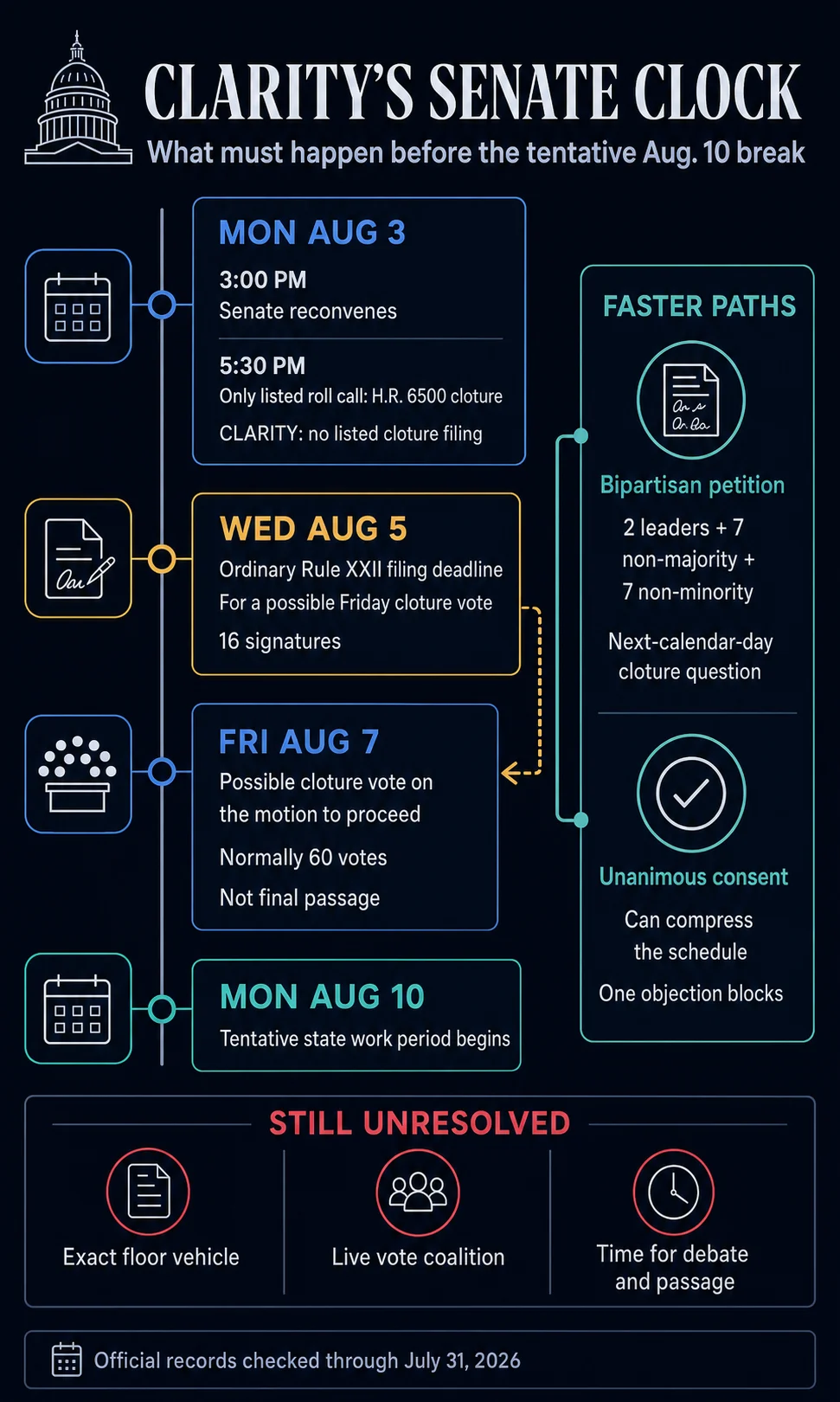
The legislative journey of the Digital Asset Market Clarity Act (CLARITY Act), a landmark bill aimed at providing a comprehensive regulatory framework for the digital asset industry, has hit a significant procedural hurdle. The Senate’s published floor plan for Monday, August 3, 2026, conspicuously omits any mention of the CLARITY Act, casting uncertainty over its immediate future. Senators are scheduled to convene at 3 p.m., with the sole listed roll-call vote slated for approximately 5:30 p.m. This vote will focus on cloture for the motion to proceed to H.R. 6500, a continuing resolution vehicle, underscoring the immediate legislative priorities occupying the chamber.
The Senate’s official cloture ledger, updated through July 31, further reinforces the absence of the CLARITY Act from Monday’s agenda. While it meticulously details the July 30 filing concerning H.R. 6500, there is no corresponding entry for H.R. 3633, the House-passed version of the CLARITY Act, or the broader Digital Asset Market Clarity Act itself. This omission does not definitively end the bill’s prospects, but it significantly complicates its path forward, particularly as the Senate’s tentative calendar approaches a state work period beginning August 10. The current procedural landscape suggests a race against time for proponents of the CLARITY Act to secure its consideration before lawmakers depart for recess.
Understanding Senate Procedural Timelines
The Senate operates under a strict set of rules that govern the progression of legislation. Under the chamber’s ordinary Rule XXII, initiating a debate on a measure typically requires a cloture petition signed by 16 senators. Following such a filing, the cloture question—a vote to end debate and move forward—is usually considered one hour after the Senate convenes on the calendar day immediately following the filing. A cloture vote on a motion to proceed to a bill, as is the case with the CLARITY Act, generally necessitates the support of three-fifths of senators duly chosen and sworn, which translates to 60 votes when all 100 seats are filled.
Given these procedural timelines, an "ordinary" filing on Wednesday, August 5, could potentially lead to a cloture vote on Friday, August 7, assuming the Senate is in session on both Wednesday for the filing and Friday for the vote. It is crucial to note that this potential Friday vote would not be on the final passage of the CLARITY Act, but rather on ending debate on the motion to proceed to the bill. If cloture is successfully invoked, Rule XXII allows for up to 30 hours of debate on the motion itself before a vote to proceed can occur. Subsequently, the bill would still require consideration and a separate vote on its passage, which could itself face another cloture hurdle, thereby extending the legislative process considerably.
Accelerated Pathways: Bipartisan Petitions and Unanimous Consent
While the standard procedural route presents a lengthy timeline, Senate leadership possesses mechanisms to expedite legislative action. A special bipartisan petition, for instance, can accelerate the process. Such a petition requires the signatures of the two party leaders, seven additional senators not affiliated with the majority party, and seven additional senators not affiliated with the minority party, totaling the requisite 16 signatories. Under this expedited procedure, the cloture question would be considered one hour after the chamber convenes on the next calendar day. If cloture is invoked via a bipartisan petition, the Senate proceeds to a vote on the motion to proceed without further debate.
Alternatively, a unanimous-consent agreement could be sought to compress the legislative schedule. This requires the agreement of all senators present and voting. However, this pathway is inherently fragile, as any single senator can object to a unanimous-consent request, thereby blocking the proposed acceleration of legislative action. The effectiveness of these expedited routes hinges on the willingness of Senate leadership and individual senators to prioritize the CLARITY Act and find common ground.
The Evolving CLARITY Act Vehicle
The precise legislative vehicle through which the CLARITY Act might advance remains somewhat fluid. H.R. 3633, the version passed by the House of Representatives, is a primary contender. Senator Cynthia Lummis, a key proponent of digital asset regulation, recently released updated text for a merged Banking-Agriculture proposal, which she has referred to as "updated H.R. 3633 text." The current Senate floor notice and cloture ledger do not clarify whether this revised text would be presented as H.R. 3633, offered as an amendment to another bill, or incorporated into an entirely different legislative vehicle. This ambiguity adds another layer of complexity to the bill’s procedural navigation.

Uncertain Vote Counts and Political Dynamics
The prospect of securing the necessary 60 votes for cloture remains a significant question mark, heavily influenced by the current political dynamics within the Senate. While several Democratic negotiators, including Senators Catherine Cortez Masto, Angela Alsobrooks, Cory Booker, Ruben Gallego, John Hickenlooper, Mark Warner, and Raphael Warnock, have acknowledged that the draft legislation falls short of their ideal outcomes, they have also expressed a commitment to continued negotiations. This suggests a willingness to engage and potentially support the bill if amendments or further discussions yield satisfactory progress.
Conversely, Senator Elizabeth Warren has publicly expressed opposition to the revised text of the CLARITY Act, signaling a potential point of contention. Reports from Axios indicate that Senate Majority Leader John Thune anticipated a procedural vote before the upcoming recess only if sufficient Democratic support could be garnered for moving the bill forward. This suggests that the onus is, in part, on Democratic leadership and members to signal their willingness to advance the legislation, thereby influencing the Republican leadership’s decision on scheduling. The current vote count is therefore unsettled, and dependent on ongoing bipartisan discussions and the evolving political calculus.
The Imminent Decision Point
The immediate future of the CLARITY Act hinges on procedural developments in the coming days. Senate leaders must now formally identify the legislative vehicle through which the bill will be considered. Following this identification, they have a critical window to either file for ordinary cloture by Wednesday, August 5, which could lead to a procedural vote by Friday, August 7; assemble the necessary signatures for a bipartisan petition; or secure a unanimous-consent agreement to expedite consideration. Any new filing or explicit notice from Senate leadership regarding the CLARITY Act would significantly alter the current landscape and provide a clearer indication of its immediate prospects. The clock is ticking, and the next 72 hours will be crucial in determining whether this pivotal piece of digital asset legislation can navigate the Senate’s procedural maze before lawmakers adjourn for their state work period. The stakes are high, as the digital asset industry awaits a clear and consistent regulatory framework that has been years in the making. The absence of the CLARITY Act from Monday’s schedule underscores the intricate and often challenging nature of legislative progress in the U.S. Senate, where procedural maneuvers can have as much impact as substantive policy debates.