admin
admin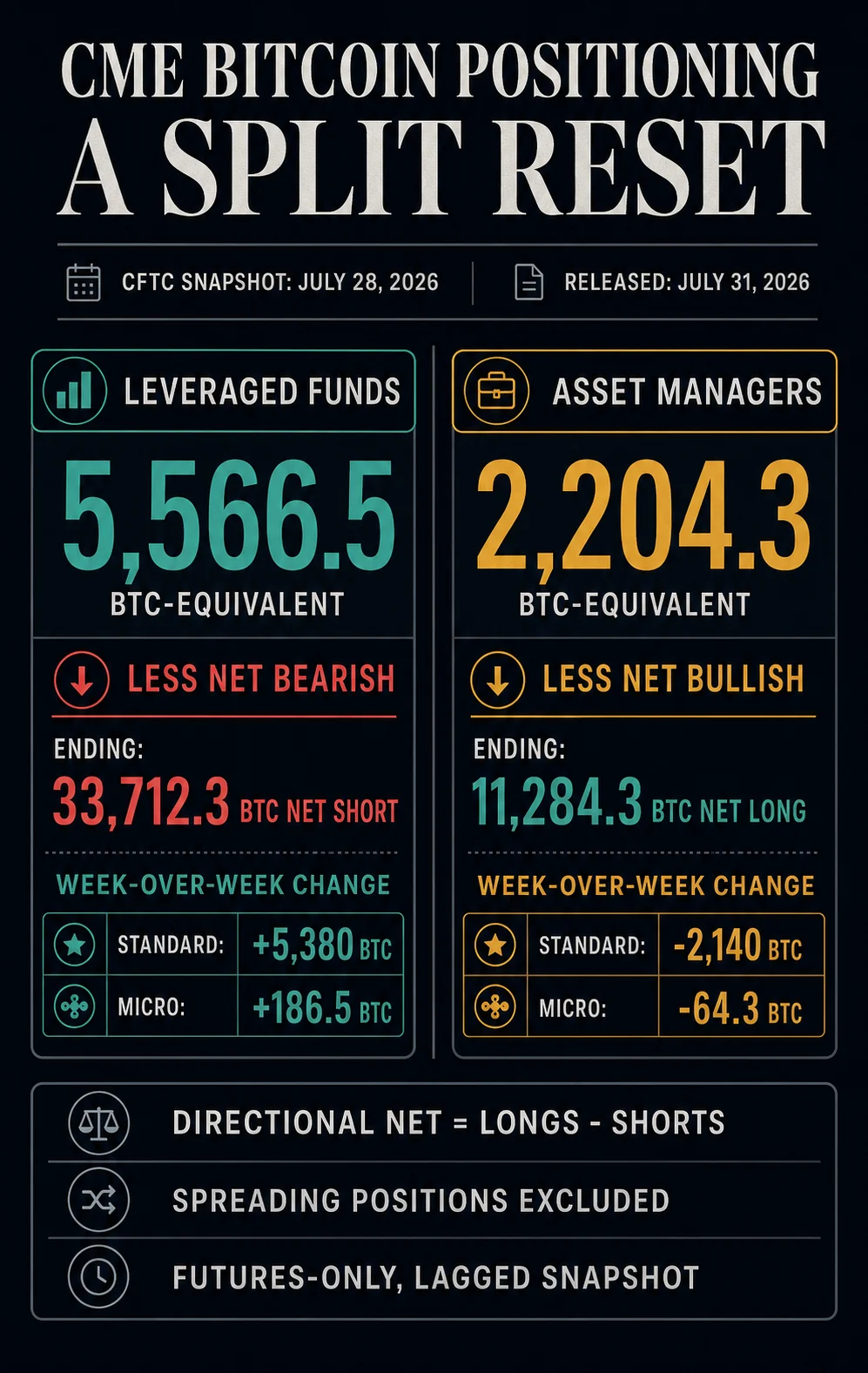
The latest snapshot of CME Bitcoin futures positioning, as of Tuesday, July 28, reveals a complex interplay of market forces that has left many traders seeking clearer signals of sustained bullish momentum. While leveraged funds significantly reduced their net bearish exposure, a concurrent pullback by asset managers has cast a shadow of uncertainty over the broader market sentiment. This divergence in positioning, documented by the Commodity Futures Trading Commission’s (CFTC) report released on Friday, July 31, underscores the ongoing debate about the true drivers of Bitcoin’s price action.
Key Developments in Futures Markets
The CFTC’s Commitment of Traders (COT) report, a crucial gauge of institutional and large-scale trading activity, indicated that leveraged funds collectively decreased their net short positions by an equivalent of 5,566.5 Bitcoin (BTC) between July 21 and July 28. This reduction represents a notable shift away from bearish bets, a move that often precedes or accompanies a price rally.
Simultaneously, however, asset managers, another significant category of market participants, saw their combined directional net exposure weaken by 2,204.3 BTC-equivalent over the same period. This weakening of net bullish sentiment among asset managers suggests a degree of caution or a scaling back of long positions, counterbalancing the reduction in shorts by leveraged funds.
The Divergent Paths of Trader Groups
The data clearly illustrates a market divided. As of July 28, leveraged funds maintained a net short position of 33,712.3 BTC. This indicates that, despite the reduction in their bearish stance, they still held more short contracts than long contracts. In contrast, asset managers held a net long position of 11,284.3 BTC, signifying a predominantly bullish outlook, though this position had also seen a reduction in its bullish conviction.
Delving deeper into the specifics, the improvement in leveraged funds’ net bearish position was driven by a net increase of 1,076 contracts in standard Bitcoin futures, equivalent to 5,380 BTC. An additional 186.5 BTC in net short reduction came from Micro Bitcoin futures, with a net improvement of 1,865 contracts. The size of these contracts is standardized, with CME’s contract guide specifying that a standard Bitcoin futures contract represents 5 BTC, while a micro contract represents 0.1 BTC.

On the other side of the ledger, the weakening of asset managers’ net bullish exposure was characterized by a decrease of 428 contracts in standard contracts, translating to 2,140 BTC. The micro Bitcoin futures segment saw a fall of 643 contracts, equating to 64.3 BTC. These figures are crucial as they measure directional net exposure, calculated by subtracting short positions from long positions, and importantly, they exclude any spreading strategies that traders might employ for hedging purposes.
Understanding the CFTC Methodology and Data Limitations
It is imperative to understand the nuances of the CFTC’s reporting. The agency classifies traders based on their primary business purpose as declared on Form 40. This categorization is broad, and the CFTC explicitly states that it does not possess information regarding the specific motivations behind each reported position. Therefore, a leveraged fund classified as a short seller might not necessarily be initiating an outright bearish trade. Their short position could be part of a more complex strategy, such as a cash-and-carry trade, which involves simultaneously holding a spot asset and a futures contract to profit from the price difference, or it could be a hedge against other market exposures.
The CFTC report, by its very nature, cannot differentiate between positions taken for directional speculation, hedging against price fluctuations, managing basis risk (the difference between spot and futures prices), or preparing for contract expirations. This inherent limitation means that while the data reveals significant shifts in net positioning, the precise strategic intent behind these moves remains open to interpretation.
Market Context and External Factors
The futures market activity occurred against a backdrop of mixed signals from other segments of the cryptocurrency ecosystem. CME’s July 30 bulletin provided insights into the pricing and open interest of Bitcoin futures contracts. Standard Bitcoin futures for July settled at $64,775, August at $65,085, and September at $65,335. The daily open interest changes offered a further layer of complexity: July contracts saw a decrease of 1,942, while August gained 1,838 and September added 507. This pattern could suggest traders rolling their positions forward from the expiring July contracts to later months, a common practice around expiration dates, or it might reflect adjustments related to basis trading. However, this data, released after the CFTC snapshot, cannot fully explain the shifts in trader class positioning observed in the COT report.
Adding to the picture of a hesitant market, a CryptoSlate analysis from July 29, referencing data from Glassnode, pointed to softening demand signals. Perpetual futures funding rates, which indicate the cost of holding long positions in perpetual futures contracts, were reported as softer. Furthermore, over the four trading sessions leading up to July 28, spot Bitcoin Exchange-Traded Funds (ETFs) experienced outflows totaling $526.5 million. This outflow trend suggested a potential cooling of institutional interest in spot Bitcoin products. However, a subsequent flow report indicated a partial reversal, with a $32.1 million ETF inflow recorded on July 29, introducing a brief flicker of renewed buying interest.

Implications and the Path Forward
The reduction in leveraged funds’ net bearish exposure is a statistically significant development in the Bitcoin futures market. It implies that a portion of the market that was betting against Bitcoin has reduced its risk. This action, in isolation, is typically viewed as a bullish indicator, as it removes selling pressure and can pave the way for price appreciation.
However, the simultaneous reduction in the net bullish stance of asset managers complicates this interpretation. If asset managers, often considered more conservative and strategic investors, are scaling back their long positions, it could signal a lack of conviction in an imminent or sustained rally. This could be due to various factors, including macroeconomic uncertainties, regulatory concerns, or simply a desire to lock in profits after recent price movements.
The divergence in behavior between these two key trader groups means that the CFTC figures, while documenting a meaningful reduction in bearish bets by leveraged funds, do not provide definitive proof of a broad-based, institutional shift towards a bullish outlook for Bitcoin. The market appears to be at a crossroads, with opposing forces at play.
Looking Ahead: What to Watch
For traders and analysts, the next steps will involve closely monitoring several key indicators. The ongoing flow data from spot Bitcoin ETFs will be crucial in determining whether the recent inflow on July 29 represents a sustained trend or a temporary anomaly. Developments in the broader macroeconomic landscape, including inflation data, interest rate decisions, and geopolitical events, will continue to influence investor sentiment towards risk assets like Bitcoin.
Furthermore, the upcoming CFTC reports will be vital in tracking whether leveraged funds continue to reduce their net short positions and, critically, whether asset managers begin to rebuild their net bullish exposure. A sustained increase in long positions from asset managers would provide a much stronger signal of institutional confidence and could indeed confirm a broader bullish turn for Bitcoin. Until then, the market remains in a state of flux, with traders weighing the reduction of bearish bets against a more cautious approach from other significant market players. The July 28 snapshot serves as a reminder that in the complex world of financial markets, a single data point, however significant, rarely tells the whole story.