admin
admin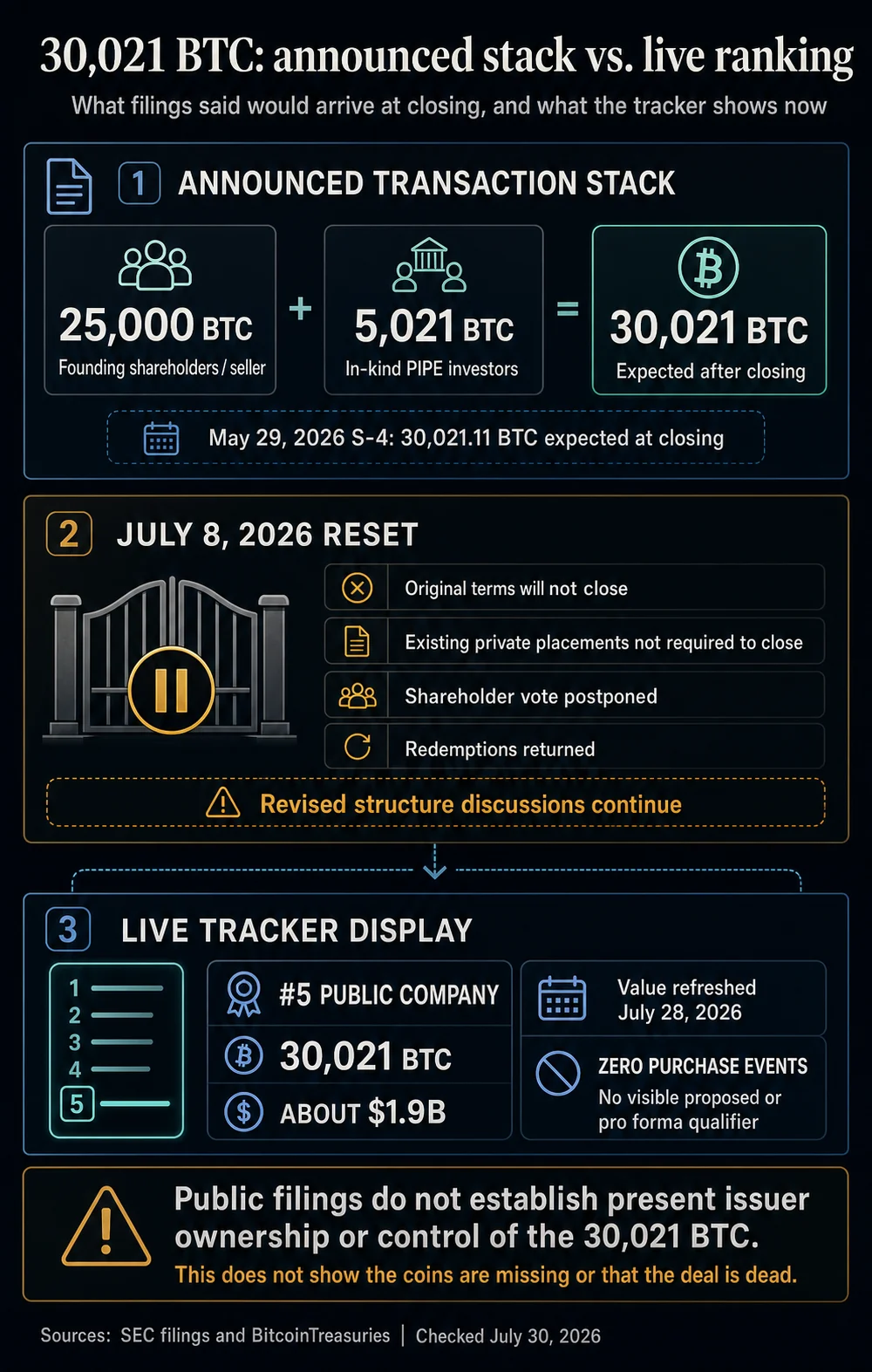
The tracker refreshed a roughly $1.9 billion valuation even though filings still describe the stack as closing-dependent. As of July 30, BitcoinTreasuries ranked Bitcoin Standard Treasury Company fifth among public companies, displaying 30,021 BTC worth about $1.9 billion. Its live profile labels the amount “BTC Holdings” and “Bitcoin Reserve,” although the transaction documents describe the coins as contributions intended for a corporate treasury that has not closed on its announced terms. The picture changed on July 8. Cantor Equity Partners I (CEPO), a publicly traded SPAC, and BSTR scrapped the deal’s original terms and began discussing a new structure. The private placements fell away, CEPO postponed its shareholder meeting indefinitely, and investors got their redemption shares back. BSTR and CEPO are still talking, though the financing behind the 30,021-BTC figure has unraveled.
The Curious Case of Bitcoin Standard Treasury Company’s Valuation
A significant discrepancy has emerged in the public perception of Bitcoin Standard Treasury Company (BSTR), with a prominent cryptocurrency tracker, BitcoinTreasuries, currently listing the company as holding a substantial Bitcoin reserve valued at approximately $1.9 billion. This valuation, placing BSTR fifth among public companies by Bitcoin holdings as of July 30, 2026, presents a striking contrast to the company’s official filings. These documents, according to the report, consistently describe the Bitcoin stack as contingent upon the successful closure of a proposed transaction, a crucial detail that appears to be overlooked by the tracker’s live profile.
The discrepancy highlights a complex situation involving a Special Purpose Acquisition Company (SPAC), Cantor Equity Partners I (CEPO), and BSTR. While BitcoinTreasuries displays the 30,021 Bitcoin (BTC) under headings like "BTC Holdings" and "Bitcoin Reserve," the underlying transaction documents indicate these assets are intended contributions for a corporate treasury that has yet to finalize its terms. This situation has become particularly noteworthy following a significant shift in the deal’s dynamics on July 8, when CEPO and BSTR mutually agreed to revise the original terms of their merger.
A Shifting Deal Landscape: From Merger to Restructuring
The initial announcement of the proposed merger between BSTR and CEPO, made in July 2025, outlined a clear path for BSTR to become a publicly traded entity. The plan was for BSTR to hold a significant Bitcoin reserve upon the transaction’s completion. Specifically, the original announcement detailed that 25,000 BTC would be contributed by founding shareholders, with an additional 5,021 BTC coming from an in-kind private investment. The combined entity was intended to trade under the ticker symbol BSTR.
This structure was further solidified in a registration statement filed on May 29, 2026. This filing reiterated the expectation that the public company would possess at least 30,021.11 BTC at closing. The breakdown remained consistent: 25,000 BTC from the seller and 5,021.11 BTC from private placement investors. The intended contributors were identified as BSTR Holdings (Cayman) and these private investors, with the public issuer slated to receive these assets through the closing mechanisms of the merger.
However, the landscape of this proposed merger underwent a dramatic alteration on July 8, 2026. On this date, CEPO and BSTR announced a significant departure from their original agreement. The two entities decided to scrap the initial terms and commenced discussions for an entirely new transaction structure. This pivotal decision led to a cascade of consequential events. The private placements, which were intended to provide a portion of the Bitcoin reserves, were effectively dissolved. Consequently, CEPO was compelled to postpone its shareholder meeting indefinitely. In a move that directly impacted investors, CEPO allowed shareholders to redeem their shares, signaling a pause or a fundamental change in the planned acquisition.

Despite these setbacks and the unraveling of the initial financing structure for the 30,021 BTC, BSTR and CEPO reportedly remained engaged in discussions. The exact nature and progress of these ongoing talks, however, have not been publicly disclosed in detail. The core issue remains that the financing and the contribution of the Bitcoin reserves, as originally conceived, have been significantly disrupted.
BitcoinTreasuries’ Methodology and the "Closing-Dependent" Clause
The BitcoinTreasuries platform, which tracks Bitcoin holdings of public companies, dates its reported 30,021-BTC figure for BSTR to July 22, 2025. The platform updates the dollar valuation based on current market prices, with the latest refresh on July 30, 2026, reflecting the approximate $1.9 billion valuation. Notably, the tracker records "zero purchase events" for this amount. This implies that the platform is classifying these Bitcoins as part of the company’s holdings based on its stated policy, rather than through direct market purchases by the company.
The platform’s editorial policy, as outlined on its website, states that its data is derived from a combination of sources, including regulatory filings, audited financial statements, company disclosures, on-chain heuristics, and third-party providers. A critical point of contention is how the policy interprets "closing-dependent contributions" in the context of present holdings. The current reporting by BitcoinTreasuries appears to treat these future, contingent contributions as current assets, thereby elevating BSTR’s ranking among Bitcoin-holding companies.
The SEC disclosures, however, provide a more cautious perspective. These filings do not definitively establish that BSTR Holdings, CEPO, BSTR Newco, or the prospective combined issuer currently owns or controls the 30,021-BTC stack. The absence of a completed transaction means that legal ownership and control over these Bitcoins remain ambiguous from a regulatory standpoint. A prospectus supplement filed on July 9, 2026, further underscored this uncertainty by not disclosing any agreed-upon replacement terms for the deal or any completed Bitcoin contributions. This indicates that, as of that date, the path forward was still under negotiation and the transfer of assets had not occurred.
Implications of the Discrepancy
The situation raises important questions about transparency and the methodologies used by financial trackers. While BitcoinTreasuries aims to provide an accurate overview of Bitcoin holdings in the corporate sector, its inclusion of "closing-dependent" assets as current holdings can lead to a potentially misleading representation of a company’s financial position.
For investors and market observers, this discrepancy underscores the importance of cross-referencing data from multiple sources and paying close attention to the nuances of official regulatory filings. The valuation presented by BitcoinTreasuries, while impressive on its face, does not yet reflect a realized asset on BSTR’s balance sheet. Instead, it appears to represent a future promise, contingent on the successful renegotiation and completion of a corporate transaction.

The ongoing discussions between BSTR and CEPO are crucial. The outcome of these negotiations will determine whether the 30,021 BTC will indeed become a part of a publicly traded corporate treasury, or if the current valuation will be re-evaluated based on a different deal structure or if the entire plan is shelved. Until such a time as the transaction closes and the Bitcoin is demonstrably under the control of the combined entity, its presence in top corporate rankings remains a matter of projection rather than confirmed ownership.
Broader Market Context and Bitcoin’s Corporate Adoption
The interest in companies holding significant Bitcoin reserves stems from the broader trend of corporate adoption of Bitcoin as a treasury asset. Companies like MicroStrategy have famously added substantial amounts of Bitcoin to their balance sheets, influencing investor sentiment and prompting other corporations to consider similar strategies. BitcoinTreasuries aims to provide a comprehensive view of this trend, enabling investors to track which public companies are most exposed to Bitcoin’s price movements.
The inclusion of BSTR, even with the caveat of its "closing-dependent" status, highlights the dynamic nature of corporate treasury strategies in the digital asset space. It also points to the potential for new entities, particularly those emerging through SPACs, to aim for significant Bitcoin holdings from their inception.
However, the case of BSTR also serves as a reminder of the inherent risks and complexities involved in such transactions. SPAC mergers, in particular, can be subject to market volatility, regulatory scrutiny, and the need for renegotiation if initial terms become unfeasible. The successful integration of digital assets into traditional corporate finance requires robust legal frameworks, transparent reporting, and a clear understanding of asset ownership and control.
The Future Outlook for Bitcoin Standard Treasury Company
As BSTR and CEPO continue their discussions, the market will be watching closely for any updates on the revised transaction terms. The ability of these entities to secure a new agreement that satisfies both parties and regulatory requirements will be paramount. If a new deal is struck, the nature of the Bitcoin contribution, its timing, and its legal standing will be critical factors.
The current situation, where a substantial Bitcoin valuation is displayed without a confirmed purchase or finalized transaction, illustrates the challenges in accurately representing the financial status of companies involved in complex, evolving mergers and acquisitions, especially when digital assets are at the core of the proposed treasury. For now, BSTR’s prominent position on BitcoinTreasuries appears to be more indicative of a future aspiration than a present reality, a deal awaiting its final shape rather than a completed corporate treasury. The ultimate success of BSTR in establishing its claimed Bitcoin reserve will depend on the successful navigation of these ongoing corporate and regulatory discussions.