admin
admin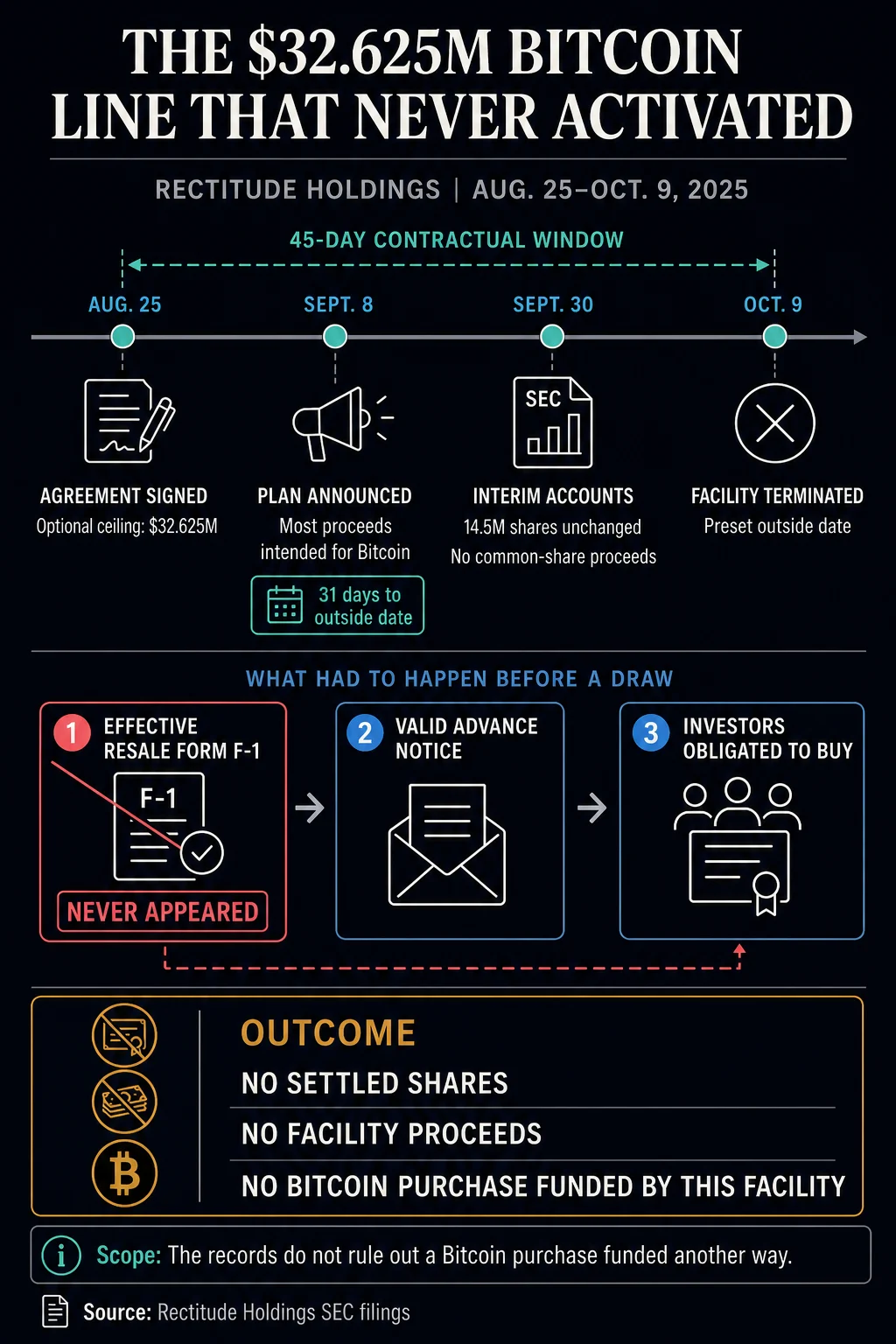
A highly publicized financing facility, designed to bolster Rectitude Holdings’ treasury with a significant allocation for Bitcoin purchases, has officially concluded without any assets being exchanged, according to the Singapore-based safety equipment supplier’s latest annual report. The $32.625 million agreement, which was intended to provide a pathway for the company to acquire cryptocurrency, expired on its predetermined date of October 9, 2025, leaving no settled shares, no incoming cash, and crucially, no Bitcoin in its portfolio. This development marks a quiet, anticlimactic end to a strategy that had generated considerable attention upon its announcement.
The Genesis of the Bitcoin Facility
Rectitude Holdings initially revealed its ambitious plan to leverage a standby equity facility for Bitcoin acquisitions on August 26, 2025. The announcement signaled a notable embrace of digital assets by a company primarily operating in the personal protective equipment (PPE) sector. The facility, structured as a forward purchase agreement, granted Rectitude the option to sell shares to designated investors, Constantinople Limited and Chen Zhiqiang, at a discount. The primary objective, as stated by the company, was to use the majority of the proceeds from these potential share sales to acquire Bitcoin, with any residual funds earmarked for general corporate purposes. The total facility had an upper limit of $32.625 million, with the company retaining full discretion over when and how much capital to draw, a mechanism that rendered the unused facility cost-free.
A Tight Chronology of Unfulfilled Intentions
The timeline surrounding the financing facility is critical to understanding its ultimate expiration without consequence. The agreement was officially signed on August 25, 2025. Following the public announcement on August 26, the facility was subject to a 45-day commitment period. This period was slated to conclude on October 9, 2025, a date that was explicitly defined as the "preset outside date" in the original Form 6-K filing.
However, the crucial element that prevented any transaction from occurring was the prerequisite of an effective resale registration statement on Form F-1 being filed with the U.S. Securities and Exchange Commission (SEC). This was not a mere formality; the contract explicitly stipulated that investors would only have a purchase obligation after Rectitude had secured an effective F-1 registration statement and subsequently submitted a valid advance notice.
A thorough review of Rectitude Holdings’ SEC filing history reveals a conspicuous absence of any Form F-1 filing, amended F-1, or any effectiveness notice during the entire 45-day commitment window. This fundamental condition, essential for activating the investors’ obligation to purchase shares, was never met. Consequently, the investors’ commitment was never triggered, and no purchase obligation arose.

Financial Records Corroborate the Absence of Activity
The company’s financial statements provide a secondary, yet equally definitive, layer of evidence confirming the non-commencement of the facility. Interim financial statements, covering the period up to September 30, 2025, which encompassed the majority of the 45-day commitment window, showed no change in the company’s issued shares. The number of shares remained at 14.5 million, and the additional paid-in capital was unchanged from March 31, 2025. Crucially, these statements reported no proceeds derived from the sale of common shares.
These interim figures were further corroborated by the audited annual financial statements, which extended through the entire commitment period and an additional five months. These comprehensive statements maintained the same equity figures and continued to report no revenue from common share sales. The immutability of these equity figures, coupled with the explicit lack of reported proceeds, strongly indicates that no new shares were issued to facilitate the financing, which would have been a direct consequence of a settled advance.
Furthermore, the audited annual statements included a detailed accounting of the company’s assets. Notably, these reports did not list any holdings of Bitcoin or other digital assets. Similarly, there was no indication of any cash flow dedicated to the purchase of such assets. This absence of any digital asset balance or related transactional activity serves as the final piece of evidence that the intended Bitcoin purchases were never realized.
The Mechanics of the Facility and Investor Obligations
The standby equity purchase agreement was designed to offer flexibility to Rectitude Holdings. The company had the discretion to initiate draws on the facility, thereby triggering the issuance of shares and the subsequent receipt of funds. The agreement stipulated that the investors, Constantinople Limited and Chen Zhiqiang, would purchase Rectitude’s shares at a price determined by a three-day pricing benchmark, with a 2.5% discount applied.
However, the structure of the agreement placed a significant onus on Rectitude to fulfill specific regulatory and procedural requirements before any investor obligation could materialize. The requirement for an effective Form F-1 registration statement was paramount. This form is a critical document for companies seeking to register securities for resale by non-affiliates. Its effectiveness by the SEC signifies that the commission has reviewed and approved the filing, deeming it compliant with disclosure requirements.
Without this SEC approval, the shares intended for sale under the facility could not be legally resold in the public market by the investors. This regulatory hurdle, therefore, acted as an insurmountable barrier to the transaction’s execution.

Broader Implications and Market Context
The expiration of Rectitude Holdings’ Bitcoin facility, while specific to the company’s strategic decisions and regulatory compliance, occurs within a broader context of corporate interest in digital assets. Many companies, particularly in the technology and finance sectors, have explored or implemented strategies involving Bitcoin as a treasury reserve asset, seeking potential diversification and inflation hedging benefits.
However, the regulatory landscape surrounding such initiatives remains complex and evolving. The need for meticulous adherence to securities laws, including registration requirements, is a critical factor for any company looking to engage in cryptocurrency-related financing. Rectitude’s situation underscores the importance of these prerequisites, highlighting that a well-intentioned strategy can be rendered ineffective if the foundational regulatory steps are not completed.
The quiet dissolution of this facility also raises questions about the initial rationale and subsequent reassessment of the strategy by Rectitude Holdings. While the company has not issued any public statements beyond its SEC filings regarding the expiration, the lack of any drawdowns suggests that either the market conditions for share sales became unfavorable, the company’s strategic priorities shifted, or the complexities of regulatory compliance ultimately proved too challenging within the given timeframe.
For investors and market observers, the Rectitude Holdings case serves as a case study in the practicalities of corporate digital asset acquisition strategies. It emphasizes that the intention to purchase Bitcoin, however strong, is contingent upon a robust legal and regulatory framework, as well as the successful execution of financial and procedural requirements. The absence of any financial impact on Rectitude Holdings’ balance sheet, due to the facility’s unused nature, means that this particular foray into Bitcoin financing has left no discernible trace on the company’s financial standing, other than the cost of the initial planning and announcement. The facility’s conclusion, therefore, is notable more for its lack of action than for any definitive outcome.