admin
admin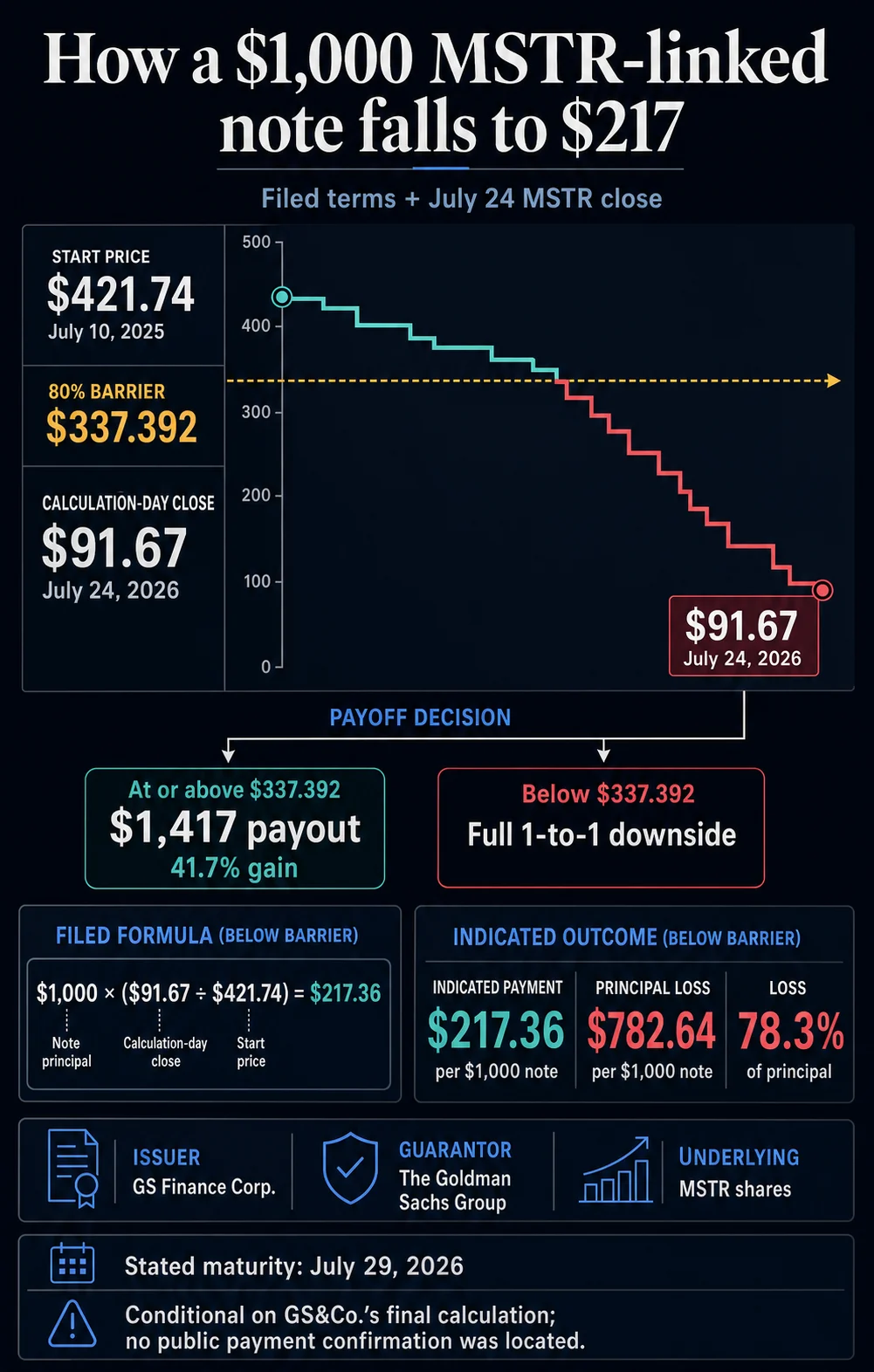
Investors who allocated $1,000 to a GS Finance note intricately linked to the performance of MicroStrategy Inc. (MSTR) shares are facing a significant return of approximately $217.36 at the note’s scheduled maturity on July 29, 2026. This projected payout, pending final calculations by Goldman Sachs & Co. LLC, represents a substantial loss of roughly 78.3% of the initial principal investment, underscoring the high-risk nature of structured financial products tied to volatile underlying assets. The stark outcome stems from the dramatic decline in MicroStrategy’s stock price, which has fallen far below the predetermined threshold set forth in the note’s prospectus.
The Anatomy of a Structured Note: How Payments Are Determined
The GS Finance note in question was designed with a specific payoff structure dependent on the closing price of MicroStrategy’s common stock (MSTR) on a designated calculation day, which was July 24, 2026, for the purpose of this analysis. According to the SEC-filed pricing supplement, the initial price of MSTR was established at $421.74. A critical component of the note’s structure was a "barrier level," set at 80% of the initial price, equating to $337.392.
The note’s terms created a distinct bifurcation in investor returns:
-
Above the Barrier: Had the MSTR closing price on the calculation day remained at or above the $337.392 barrier, investors would have received their full principal back, plus a predetermined contingent gain. In this specific offering, the contingent gain was set at 41.7%, meaning a $1,000 investment could have yielded $1,417. This feature offered investors a potential upside participation in MicroStrategy’s stock performance, capped by the barrier.
-
Below the Barrier: Conversely, if the MSTR closing price fell below the $337.392 barrier, the investment would then be subject to the downside performance of the underlying stock. Crucially, the note’s structure did not include a loss cap in this scenario. This "cliff" effect meant that any price movement below the barrier would directly translate into a proportional loss for the investor, calculated from the initial $421.74 starting price.
The pricing supplement clearly delineated this "cliff" mechanism. A closing price precisely at the barrier would have still triggered the more favorable outcome of $1,417 per $1,000 invested. However, a closing price even marginally below the barrier would instantly shift the payout calculation to the disadvantageous downside formula. The barrier, therefore, served as a critical trigger point, with no buffer or partial protection offered once breached.
MicroStrategy’s Steep Descent: The Catalyst for Investor Losses
The dramatic underperformance of MicroStrategy’s stock price has been the direct driver of the severe losses anticipated by holders of these GS Finance notes. On July 24, 2026, the closing price of MSTR was recorded at $91.67. This figure, according to historical data compiled from financial data providers like Investing.com and Twelve Data, placed the stock significantly below both its initial price of $421.74 and the crucial $337.392 barrier level. The stock had traded within a range of $89.76 to $93.68 on that day, firmly cementing its position deep within the downside territory.

This substantial drop from the initial price directly activated the downside formula outlined in the note’s terms. The calculation for the maturity payment is based on the principal amount ($1,000 for each note) adjusted by the percentage change in MSTR’s stock price from its starting level. The formula can be expressed as:
Maturity Payment = Principal + (Principal * (MSTR Closing Price – MSTR Starting Price) / MSTR Starting Price)
Applying the figures from July 24, 2026:
Maturity Payment = $1,000 + ($1,000 * ($91.67 – $421.74) / $421.74)
Maturity Payment = $1,000 + ($1,000 * (-$330.07) / $421.74)
Maturity Payment = $1,000 + ($1,000 * -0.7826)
Maturity Payment = $1,000 – $782.64
Maturity Payment = $217.36
This calculation confirms the projected return of approximately $217.36 for every $1,000 initially invested, translating to a loss of $782.64, or 78.3%, per note. The outcome can also be viewed as the principal amount multiplied by the ratio of the closing price to the starting price: ($1,000 * $91.67) / $421.74 = $217.36.
The Role of Goldman Sachs and Distribution Channels
GS Finance, a subsidiary of The Goldman Sachs Group, Inc., issued these notes. The ultimate responsibility for the payout rests with GS Finance, with The Goldman Sachs Group, Inc. providing the backing for these financial instruments. This structure highlights the role of investment banks in creating and distributing complex financial products tailored to specific market views or risk appetites.
Wells Fargo Securities acted as the distributor for these notes, facilitating their sale to investors. Wells Fargo Advisors was also identified as a potential resale channel, indicating the broader network involved in bringing such structured products to the market. The involvement of multiple financial institutions underscores the intricate web of services and intermediaries that support the structured finance industry.
The SEC filing for the pricing supplement, dated July 14, 2025, serves as the foundational document outlining the terms and conditions of the notes. It is through this filing that investors are meant to understand the potential risks and rewards associated with their investment.

Examining the Timeline and Potential Adjustments
The pricing supplement established July 24, 2026, as the calculation day, with the note’s maturity date set for July 29, 2026. Publicly available information, including Nasdaq Trader’s halt log for July 24, 2026, did not indicate any trading halts or unusual market events specifically affecting MSTR that would have directly altered the calculation day’s outcome.
Goldman Sachs & Co. LLC, as the issuer and calculation agent, retains the contractual authority to make final determinations regarding the payout. This includes the possibility of postponing the maturity date or adjusting the terms under specific circumstances outlined in the note’s documentation. However, as of the time of this report, no such adjustments or postponements were publicly announced or noted in reviewed public sources, such as CUSIP-specific postponement notices or corporate action adjustments. Therefore, the projected payout of approximately 22 cents on the dollar remains the most evident outcome based on the filed terms and the closing price on the calculation day.
Broader Implications for Investors and the Structured Products Market
The outcome for holders of these GS Finance notes serves as a stark reminder of the inherent risks associated with structured financial products, particularly those tied to highly volatile underlying assets like technology stocks or cryptocurrencies. MicroStrategy, a company known for its significant Bitcoin holdings, has experienced considerable stock price fluctuations, reflecting both the performance of its software business and the market sentiment surrounding digital assets.
The "cliff" feature of these notes, while offering potential for enhanced returns above a certain threshold, exposes investors to amplified losses when that threshold is breached. This design necessitates a thorough understanding of the downside scenario and the potential for total loss of principal. Financial advisors and investors alike must exercise due diligence in evaluating the risk-reward profile of such instruments, considering their individual risk tolerance and investment objectives.
While the SEC filing indicates an original aggregate face amount of $660,000 for the offering, the exact amount of principal outstanding at maturity has not been publicly disclosed. This figure would be necessary to ascertain the total aggregate losses incurred by all investors in this particular offering. However, the per-note calculation provides a clear indication of the significant financial impact on individual investors.
The case of these MSTR-linked notes from Goldman Sachs underscores the critical importance of transparency and investor education in the structured products market. As investors navigate increasingly complex financial instruments, a deep understanding of the underlying mechanics, potential risks, and the role of the issuer and calculation agent is paramount to making informed investment decisions. The projected 78.3% loss serves as a potent case study in the consequences of market downturns on highly leveraged or path-dependent investment strategies.