admin
admin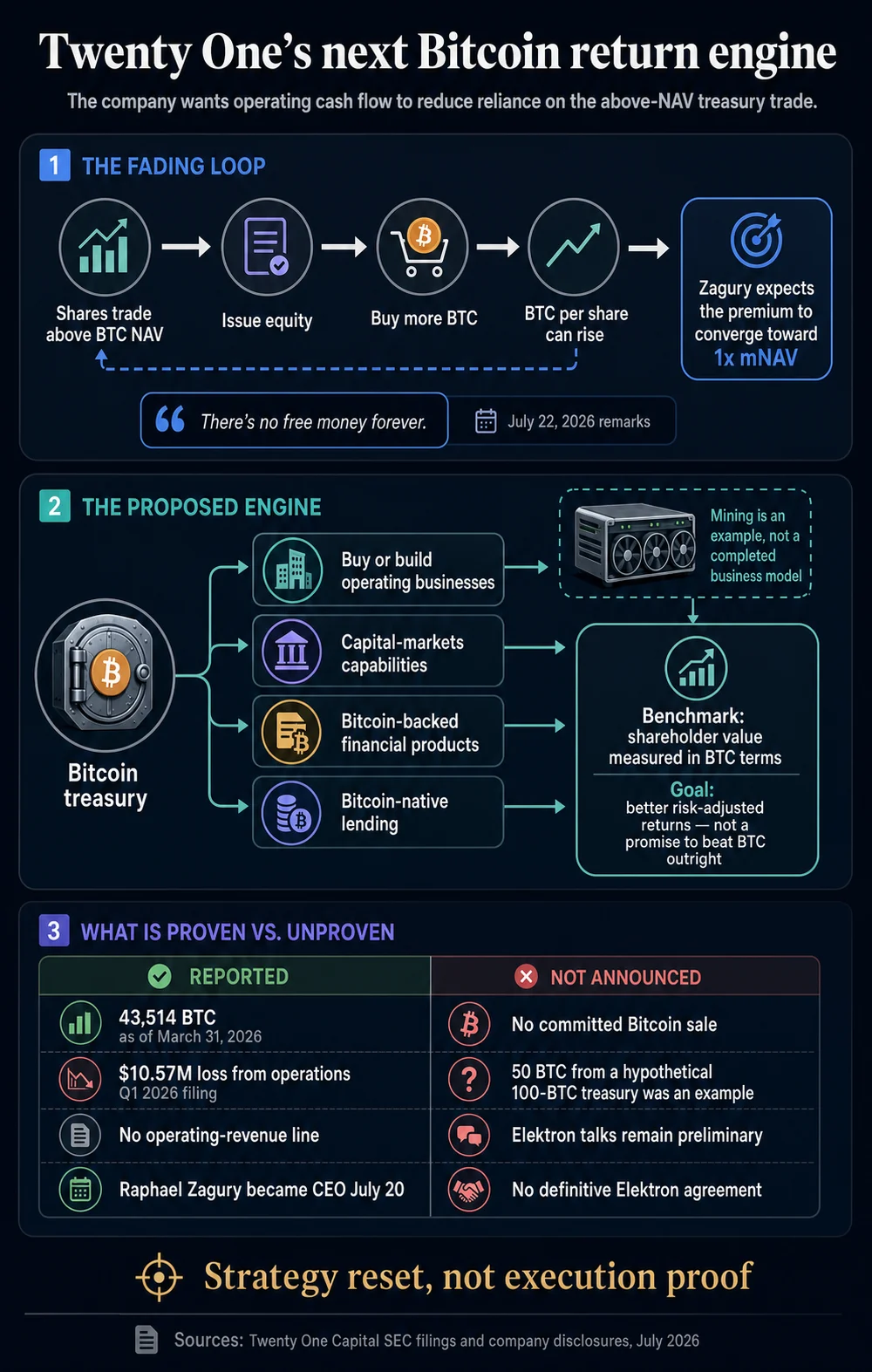
Raphael Zagury, the newly appointed Chief Executive Officer of Bitcoin-focused public company Twenty One Capital, has issued a stark warning regarding the sustainability of the premium-funded model that has characterized many Bitcoin treasury firms. He asserts that this approach, which relies on issuing shares at a valuation exceeding the net asset value of a company’s Bitcoin holdings, is a temporary market dislocation and cannot serve as an indefinite engine for easy returns. Instead, Zagury is advocating for a strategic pivot towards building robust, cash-generating businesses that can operate synergistically with the company’s existing Bitcoin balance sheet.
The core of Zagury’s argument, as detailed in a fireside chat furnished to the Securities and Exchange Commission (SEC) on July 22, is that the current strategy of leveraging market premiums to acquire more Bitcoin is inherently unsustainable. As more companies adopt this playbook, Zagury predicts that their market valuations will inevitably converge closer to their underlying Bitcoin asset value, thus diminishing the premium available for further capital deployment. "There’s no free money forever," he stated, emphasizing that while premiums might resurface, they should not be the sole or primary driver of shareholder returns.
Strategic Pivot: From Premium Playbook to Operating Businesses
Twenty One Capital had already begun signaling a shift in its operational philosophy in May, outlining a new strategic direction focused on becoming an operating company. Zagury’s refreshed priorities now encompass the acquisition or development of tangible businesses, a significant expansion of capital markets capabilities, the creation of innovative Bitcoin-backed financial products, and the establishment of a Bitcoin-native lending platform. A critical new criterion for prospective acquisitions is that they must demonstrate accretive value when measured against the company’s Bitcoin holdings. This marks a significant departure from a strategy that primarily focused on accumulating Bitcoin through capital markets.
This strategic realignment coincides with a recent leadership transition at Twenty One Capital. Raphael Zagury officially assumed the role of CEO on July 20, succeeding Jack Mallers, who resigned as both chief executive and a director. The company has stated that Mallers’ departure was amicable and unrelated to any internal disagreements, with Mallers intending to concentrate his efforts on his other venture, Strike. Notably, Twenty One Capital has also ceased its pursuit of a potential combination with Strike, further underscoring the company’s independent strategic path.
Illustrative Examples and Risk-Adjusted Returns
To illustrate the proposed new return engine, Zagury drew parallels with established capital allocation models, specifically referencing Berkshire Hathaway’s strategic use of its insurance operations. He posited that businesses like mining could potentially generate significant cash flows, akin to how insurance provided capital for Berkshire Hathaway to reinvest across its diversified portfolio. This capital, he suggested, could then be strategically deployed to enhance returns on the company’s Bitcoin assets. However, Zagury was candid about the challenges ahead, acknowledging that Twenty One Capital has yet to fully develop such a model and that its successful execution would be a formidable undertaking.
When questioned about whether Twenty One Capital’s objective was to outperform Bitcoin, Zagury’s initial agreement was quickly nuanced. He clarified that achieving a similar or even slightly lower level of volatility while matching Bitcoin’s value could still represent a significant success. Outperforming Bitcoin over the long term, he cautioned, would demand exceptional opportunities or a willingness to embrace potentially irresponsible leverage. Therefore, Zagury frames mining and other operating businesses not as a direct competition to Bitcoin’s performance, but as a strategic pathway to achieving superior risk-adjusted returns, with the ultimate benchmark for shareholder value being measured in Bitcoin terms.

Financial Footprint and Future Endeavors
As of March 31, Twenty One Capital reported holdings of 43,514 BTC, as detailed in its first-quarter SEC filing. The same filing, however, highlighted the absence of an operating revenue line and disclosed a $10.57 million loss from operations. This financial snapshot indicates that the envisioned cash-flow generation mechanisms have not yet materialized in the company’s reported financial results.
Zagury’s discussion concerning the strategic deployment of treasury assets did not signal an immediate sale of Bitcoin. His hypothetical scenario of exchanging 50 BTC from a 100-BTC treasury for a cash-generating company was explicitly presented as illustrative. Furthermore, a potential combination with Elektron Energy, a mining business with which Zagury has leadership ties, remains in preliminary stages. No definitive agreement has been reached, and there is no assurance that such a deal will ultimately be approved by the relevant parties.
Twenty One Capital has thus set a more ambitious benchmark than simply accumulating Bitcoin through share issuance. The company now aims to build businesses capable of generating returns that enhance the value of its Bitcoin holdings on a Bitcoin basis. Whether these nascent operating businesses can indeed deliver superior risk-adjusted returns is a strategic objective that is still to be proven through operational execution rather than documented financial performance. The transition signifies a move from a capital-arbitrage model to a more fundamentally driven approach, where the creation of tangible business value will be paramount to the company’s long-term success in the evolving Bitcoin ecosystem.
The Broader Implications for Bitcoin Treasury Models
The pronouncements from Twenty One Capital’s new CEO signal a potential inflection point for the broader Bitcoin treasury sector. For several years, a prominent strategy involved companies issuing equity at a premium to their Bitcoin holdings, effectively using market enthusiasm to acquire more Bitcoin at a discounted rate relative to the perceived value of their shares. This model proved highly effective during periods of significant market appreciation and investor optimism, allowing companies to rapidly expand their Bitcoin reserves without diluting their existing holdings significantly in terms of Bitcoin quantity.
However, as Zagury points out, this strategy is inherently dependent on sustained market premiums. When investor sentiment shifts, or when a larger number of companies adopt the same strategy, these premiums tend to compress. This compression reduces the efficiency of the capital allocation, making it harder to acquire Bitcoin at a favorable rate. The risk is that companies become overly reliant on this capital markets arbitrage, leaving them vulnerable to market downturns and a loss of their competitive edge.
The shift advocated by Zagury represents a maturation of the Bitcoin treasury model. It suggests a move from a pure Bitcoin accumulation play, driven by financial engineering, to a more diversified and operationally focused approach. By building businesses that generate their own cash flows, these companies can create value independent of Bitcoin’s price movements and market sentiment. This diversification can provide a more stable and predictable revenue stream, which can then be used to support Bitcoin accumulation, fund operations, or return value to shareholders through other means.

The Role of Bitcoin as a Treasury Reserve Asset
The underlying principle of holding Bitcoin as a primary treasury reserve asset remains a core tenet for companies like Twenty One Capital. However, the method of increasing that reserve is what is undergoing re-evaluation. Zagury’s vision suggests that the most sustainable way to grow a Bitcoin treasury is not solely through market premiums but through the profits generated by productive enterprises. This approach aligns more closely with traditional corporate finance, where profits from operations are reinvested or distributed.
The comparison to Berkshire Hathaway is particularly insightful. Warren Buffett’s conglomerate has historically used the cash flows from its diverse insurance and operating businesses to fund its investments. While Twenty One Capital’s Bitcoin holdings are distinct from traditional fiat assets, the principle of using operational cash flow to enhance overall shareholder value remains relevant.
Challenges and Opportunities Ahead
The path forward for Twenty One Capital, as outlined by Zagury, is not without its challenges. Identifying and successfully integrating cash-generating businesses requires expertise in diverse industries, effective management, and a keen understanding of market dynamics. The risk of operational missteps, market downturns affecting these businesses, or failure to achieve synergy with the Bitcoin holdings are all factors that will need to be carefully managed.
However, the potential upside is significant. If Twenty One Capital can successfully build a portfolio of accretive operating businesses that generate strong cash flows, it could provide a compelling alternative to the premium-funded Bitcoin accumulation model. Such a strategy could lead to more resilient and sustainable growth, offering investors a way to gain exposure to Bitcoin while also participating in the value creation of tangible businesses. This could set a new standard for Bitcoin-focused public companies, demonstrating a more robust and diversified approach to capital allocation in the digital asset space. The success of this new strategy will be closely watched by the broader investment community as it navigates the evolving landscape of Bitcoin finance.