admin
admin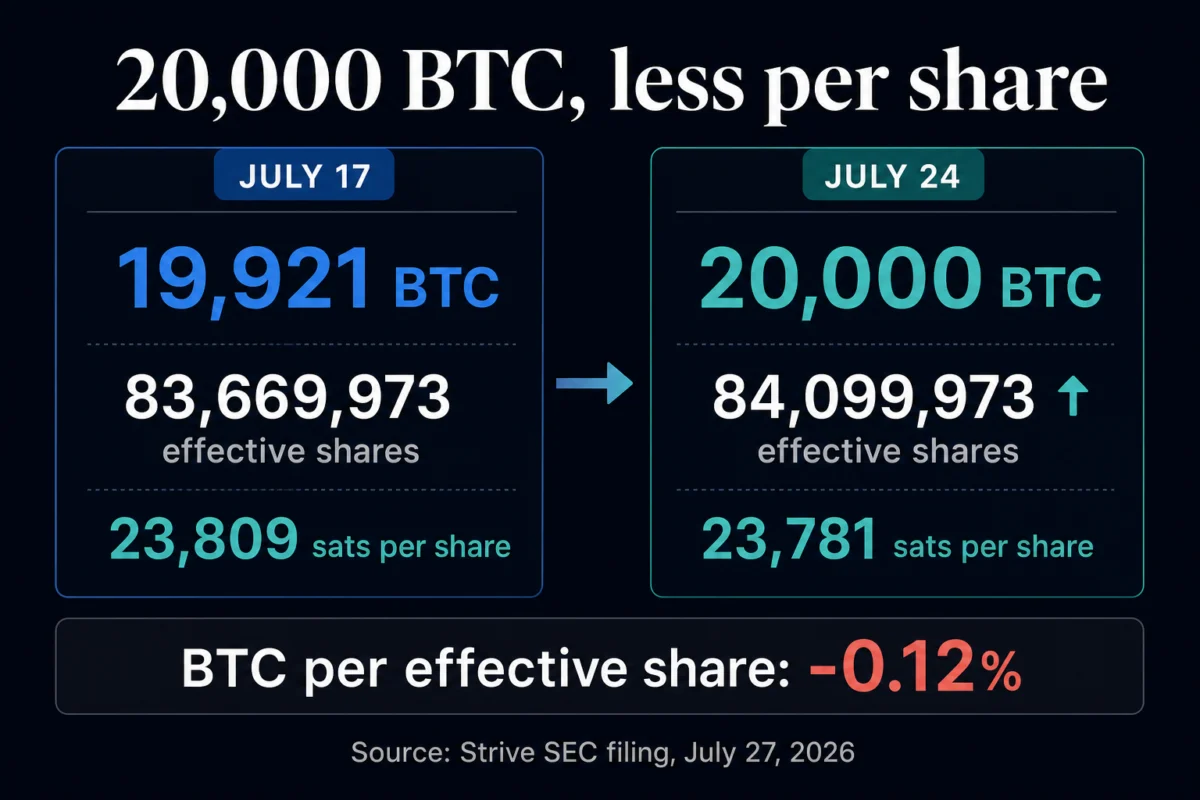
Strive, a prominent Bitcoin treasury company, recently achieved a significant milestone by surpassing 20,000 Bitcoin (BTC) in its holdings. However, this quantitative expansion of its digital asset reserves was accompanied by a concurrent increase in its outstanding common shares, resulting in a decrease in the amount of Bitcoin held per effective common share. This nuanced development, revealed in a recent SEC filing, highlights the intricate relationship between asset accumulation and equity dilution in the rapidly evolving cryptocurrency investment landscape.
The company’s latest filing with the Securities and Exchange Commission (SEC) on July 27, 2026, detailed its asset and share activity for the week of July 20 through July 24. During this period, Strive successfully acquired an additional 79 BTC, bringing its total holdings to precisely 20,000 BTC. This strategic purchase was executed at an average price of approximately $65,723 per Bitcoin, inclusive of all associated fees and expenses. This acquisition represented a modest but deliberate increase from its previous holdings of 19,921 BTC.
However, the narrative of growth at Strive is not solely defined by its Bitcoin accumulation. In parallel with the BTC acquisition, Strive’s "Effective Common Shares Outstanding" saw a notable increase of 430,000. The total number of these shares climbed from 83,669,973 to 84,099,973. This metric, as defined by the company, aggregates its Class A and Class B common shares. Specifically, Class A shares experienced a rise of 437,477, while Class B shares saw a slight decrease of 7,477.
Dilution Outpaces Asset Growth
The core of the story lies in the diverging trajectories of Strive’s Bitcoin holdings and its share count. When analyzed on a per-share basis, the impact of the increased share issuance becomes evident. Between July 17 and July 24, Strive’s Bitcoin held per effective common share experienced a fractional decline. On July 17, the company held approximately 23,809 satoshis (the smallest unit of Bitcoin) per effective common share. By July 24, this figure had receded to approximately 23,781 satoshis, marking a decrease of roughly 0.12%.
This calculation underscores a fundamental principle in corporate finance: simply increasing an asset base does not automatically translate to an improved ownership stake for existing shareholders if the number of outstanding shares also rises significantly. The growth in Strive’s Bitcoin treasury, while quantitatively impressive in absolute terms, was effectively diluted by the corresponding increase in its share capital.

Strive also provides a metric for "Assumed Fully Diluted Shares Outstanding." Utilizing the figures reported for this denominator, the amount of Bitcoin per assumed fully diluted share also saw a decline, albeit a slightly smaller one, of approximately 0.10% over the same period.
Inconsistencies and Unanswered Questions
Further scrutiny of Strive’s reporting reveals certain arithmetical inconsistencies and a lack of transparency regarding the financing of its Bitcoin acquisition. The company defines its "Assumed Fully Diluted Shares Outstanding" as a sum that includes effective common shares, stock options, and unvested restricted stock units, while specifically excluding shares underlying traditional warrants. However, the reported total for July 17 was 16,163 shares short of the sum of the individual components listed for that date, a discrepancy that Strive has yet to clarify. This adds a layer of complexity to the company’s financial disclosures and may raise concerns among investors seeking absolute clarity.
Moreover, Strive has not publicly disclosed the specific reasons behind the net increase of 430,000 in its Effective Common Shares Outstanding. Crucially, there has been no explicit connection drawn between the proceeds generated from the issuance of these additional shares and the recent 79 BTC purchase.
The company’s reported cash flow movements further complicate the understanding of how the Bitcoin acquisition was financed. The average purchase price of the 79 BTC suggests an expenditure of approximately $5.192 million. However, Strive’s filings indicate that its cash and cash equivalents decreased by $3.4 million during the week in question. This apparent shortfall between the cost of the Bitcoin acquisition and the reported change in cash reserves raises significant questions about the funding sources. Without a clear explanation, investors are left to speculate on whether internal cash reserves, other asset sales, or external financing mechanisms were employed to complete the purchase.
Broader Implications for Bitcoin Treasury Companies
The developments at Strive offer a valuable case study for the broader Bitcoin treasury and investment company sector. As more entities aim to provide investors with direct exposure to Bitcoin through traditional corporate structures, the interplay between asset management, share issuance, and investor returns becomes paramount.
For shareholders, the ultimate value proposition of such companies lies not only in the absolute growth of their Bitcoin holdings but also in the per-share ownership of those assets. When share dilution outpaces asset appreciation on a per-share basis, the benefit to existing shareholders can be diminished. This scenario highlights the importance of transparent communication from these companies regarding their strategies for share issuance, the reasons behind any dilution, and how newly issued capital is deployed to generate returns for all stakeholders.

The precise nature of the funding for the 79 BTC purchase remains a key point of interest. The lack of a clear link between the increase in shares and the Bitcoin acquisition, coupled with the apparent discrepancy in cash flow, suggests that Strive may be employing complex financial strategies or that its reporting requires further elaboration. Investors are likely to be closely monitoring future filings for clarification on these matters.
The Bitcoin Market Context
This period of activity for Strive occurred against a backdrop of a dynamic Bitcoin market. While the specific price of Bitcoin fluctuated during the acquisition week, the broader market sentiment and price action are critical to understanding the strategic decisions of treasury companies. Bitcoin’s market capitalization remained substantial, reflecting its position as the leading cryptocurrency. However, periods of price volatility can influence both the cost of acquiring BTC and the perceived value of Bitcoin-denominated assets.
The sustained interest in Bitcoin as an investment asset, evidenced by the growth of companies like Strive, points to a continued belief in its long-term potential. Yet, the challenges highlighted by Strive’s recent filing underscore the need for robust financial reporting and clear communication to maintain investor confidence. As the cryptocurrency market matures, regulatory scrutiny and investor expectations for transparency are likely to intensify, placing a premium on companies that can effectively navigate these complexities.
The ongoing evolution of Bitcoin treasury models will undoubtedly be shaped by such events. Companies that can demonstrate a clear strategy for increasing Bitcoin holdings per share, alongside transparent and well-articulated financing mechanisms, will likely gain a competitive edge in attracting and retaining investor capital. Strive’s achievement of the 20,000 BTC mark is a notable quantitative success, but the accompanying share dilution and unanswered funding questions serve as a critical reminder of the qualitative aspects of investor relations and financial stewardship in this innovative sector. The company’s ability to address these concerns will be pivotal in shaping its future trajectory and its standing within the investor community.