admin
admin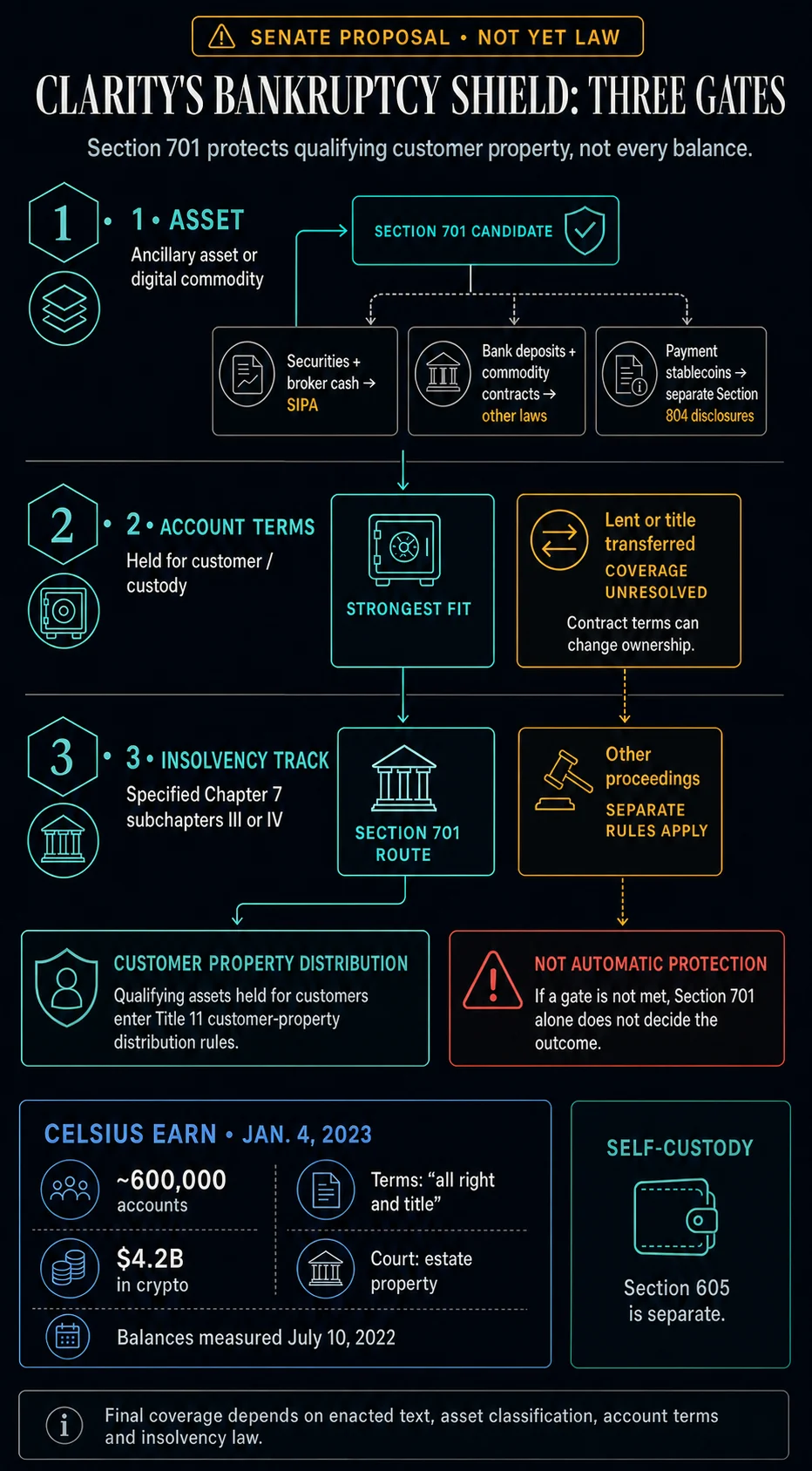
The collapse of cryptocurrency platforms like Celsius has left a stark reminder for millions of users: the digital assets held in their "Earn" accounts were not considered their personal property but rather part of the bankrupt estate. This crucial distinction, which led to significant losses for customers, is precisely what Senator Cynthia Lummis aims to rectify with the proposed CLARITY Act. On July 20th, she distilled the bill’s core promise into a simple, powerful message: "Your crypto stays yours." This sentiment, amplified on her X (formerly Twitter) platform, has garnered considerable attention, signaling a potential shift in how digital assets are treated when a crypto firm falters.
The failures of Celsius and Voyager served as a harsh legal education for the cryptocurrency community. In the case of Celsius, a federal court’s ruling directly addressed the ownership of its Earn balances, providing a concrete legal precedent. The Senate Banking Committee’s manager’s substitute bill, released on May 12th, appears to align with Lummis’s objective, proposing to incorporate qualifying ancillary assets and digital commodities into federal customer-property rules within specific Chapter 7 liquidations. However, this protection is not a blanket guarantee and comes with several stipulated conditions. The bill’s efficacy hinges on the precise nature of the asset, the terms of the account agreement, and the bankruptcy process itself, creating intricate boundaries for its application.
Section 701: Rewriting Bankruptcy Rules for Digital Assets
At the heart of the proposed changes lies Section 701 of the CLARITY Act. This section is designed to overhaul the bankruptcy rules governing the liquidation of failed stockbrokers, explicitly including ancillary assets and digital commodities within the definitions of customers, customer claims, and customer property. Under this provision, digital assets held "for customers" in specified Chapter 7 liquidations would be treated as customer property and distributed accordingly under Title 11 of the U.S. Bankruptcy Code.
The official section-by-section summary of the bill clarifies that ancillary assets and digital commodities will be defined as customer property under Chapter 7. However, the operative text of the legislation provides the crucial nuances and limitations. The bill’s protections are not universal and depend heavily on how a specific asset is classified. Section 701 specifically names ancillary assets and digital commodities. Existing protections for securities and cash held by broker-dealers, for instance, would continue to be governed by the Securities Investor Protection Act (SIPA). Similarly, bank deposits and commodity contracts would remain under their respective legal frameworks.
The treatment of payment stablecoins, a critical category in the digital asset ecosystem, is addressed separately in Section 804. This section mandates disclosures by broker-dealers regarding the insolvency treatment of payment stablecoins, digital commodities, and securities involving units of digital commodities. This segregated approach suggests that Section 701, on its own, may not establish a singular rule for all types of stablecoin balances.
The Criticality of Account Terms and Ownership Transfer
Beyond asset classification, the terms of an account agreement play a pivotal role in determining customer protection. The phrase "held for customers" strongly implies a custodial relationship where the customer retains ownership. Lending and yield-generating products, however, operate on a different principle. If an account agreement stipulates that ownership of the asset is transferred to the platform, the customer may be relegated to the status of an unsecured creditor, with their recovery contingent on the overall bankruptcy distribution.
The Celsius case serves as a potent illustration of the consequences of this distinction. In a January 4, 2023, order, the U.S. Bankruptcy Court for the Southern District of New York detailed that Celsius held approximately 600,000 Earn accounts with an estimated $4.2 billion in cryptocurrency as of July 10, 2022. For the court, the crux of the ownership question rested on the contract. Celsius’s terms of service granted the company "all right and title" to the cryptocurrency deposited into its Earn accounts. Consequently, the court ruled that the crypto remaining in these accounts was part of the bankruptcy estate, leaving Earn users as unsecured creditors. Users might have seen familiar balances in the Celsius app, unaware that they had effectively traded ownership of their crypto for a mere IOU from the company.

While the Celsius case involved title-transferring Earn terms, Section 701 is specifically designed to address qualifying customer property within specified Chapter 7 proceedings. The Celsius situation, therefore, highlights the core ownership debate at stake but does not definitively establish how Section 701 would apply to similar yield-generating products in the future.
Mapping the Proposed Protections: A Multifaceted Approach
The proposed categories under Section 701 create distinct risk profiles for different types of crypto holdings. A table outlining these relationships and their relevance to Section 701 provides clarity:
| Account Relationship | Section 701 Relevance | Main Limitation |
|---|---|---|
| Qualifying Intermediary Custody | The clearest fit when an ancillary asset or digital commodity is held for the customer in a covered Chapter 7 liquidation. | The asset, intermediary, and liquidation must fall within the provision’s definitions and scope. |
| Lending, Earn, or Yield Account | Coverage remains unresolved when the agreement transfers title or makes the platform a borrower. | Contract language can turn the customer’s balance into an unsecured claim, as demonstrated by Celsius. |
| Independently Controlled Self-Custody | Section 605 governs this relationship separately by protecting lawful self-custody for a defined covered user. | The provision preserves illicit-finance, anti-money-laundering, terrorism-financing, and sanctions enforcement. |
| Broker-Dealer Securities or Cash, Bank Deposits, and Commodity Contracts | Section 701 assigns these categories to other legal regimes. | Protection follows SIPA, banking law, commodities law, or another applicable framework. |
This framework underscores a crucial point: if a platform is acting purely as a custodian, holding qualifying crypto assets on behalf of a customer, Section 701 aims to place those assets within the customer-property pool during bankruptcy proceedings. However, the landscape becomes more complex with lending arrangements. Once a contract effectively transfers ownership to the platform, a court might be required to adjudicate whether the customer retains ownership of the underlying crypto or merely possesses a claim for repayment.
Independently controlled self-custody, where users manage their assets in self-hosted wallets, is addressed by a separate provision, Section 605. This section specifically protects lawful self-custody for defined covered users, while still acknowledging and preserving existing enforcement authorities related to illicit finance, anti-money laundering, terrorism financing, and sanctions. The inclusion of Section 605 reinforces a fundamental distinction within the bill: the difference between assets directly controlled by their owner and those entrusted to a financial intermediary.
The Path Forward: A Proposal Under Scrutiny
The CLARITY Act, embodied in H.R. 3633, has made progress, with the Senate Banking Committee advancing the bill by a 15-9 vote on May 14th. This committee passage represents a significant step, but it is by no means the final hurdle. The bill still requires approval from the full Senate and must navigate subsequent legislative processes. As of July 14th, the broader legislative package containing the CLARITY Act remains incomplete, with no floor vote yet scheduled for the full Senate.
The customer-property provision, Section 701, is just one component of a larger legislative effort to establish a market structure for digital assets. The bill’s text, released on May 12th, also encompasses crucial areas such as token classification, stablecoin remuneration, decentralized finance (DeFi), and banking powers.
The immediate legislative test for Section 701 will be whether its current wording remains intact as the broader package progresses through the legislative pipeline. The subsequent, and perhaps more practical, test will manifest in the contractual language employed by cryptocurrency platforms. It will be essential to observe whether exchanges begin to clearly delineate balances as being held in custody, offered as loans, or categorized under another distinct relationship, and critically, whether these terms explicitly state whether the platform holds the asset for the customer or claims ownership of it.
Senator Lummis’s concise promise, "Your crypto stays yours," effectively captures the core intent of Section 701 and distills its complex conditions into a memorable slogan. If enacted as proposed, qualifying ancillary assets and digital commodities held as customer property would indeed be integrated into the customer-property distribution rules during bankruptcy. However, for balances generated through title-transferring loans, the ultimate legal outcome of "your crypto stays yours" will still depend on the intricate interplay of asset classification, contract stipulations, and the applicable insolvency regime. The journey from proposal to definitive legal protection for crypto users is ongoing, with significant implications for the future of digital asset ownership and consumer trust in the burgeoning crypto economy.