admin
admin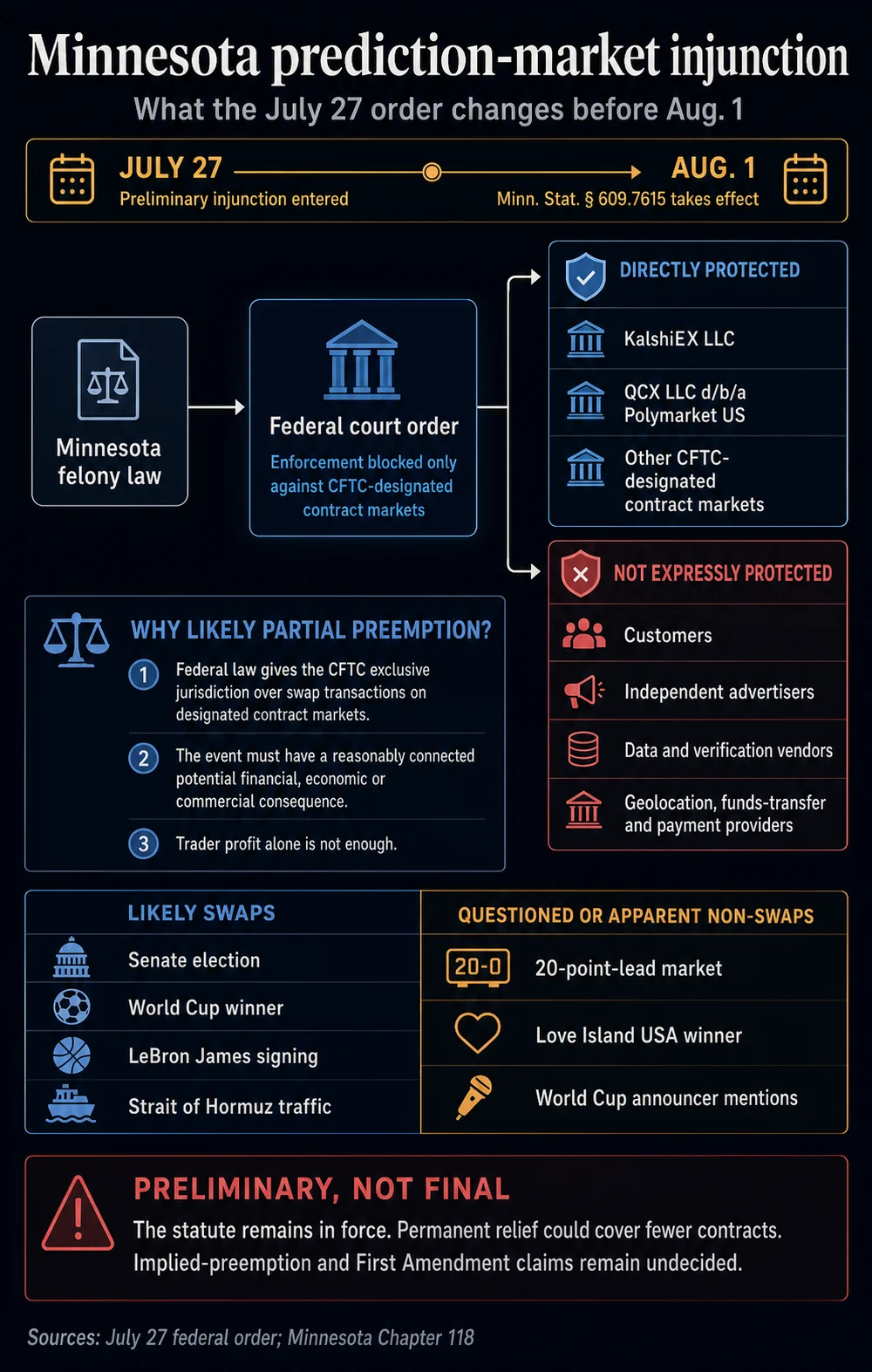
A federal judge has temporarily barred Minnesota from enforcing its new prediction-market felony law against federally regulated exchanges designated by the Commodity Futures Trading Commission (CFTC) as contract markets, a ruling that allows platforms like KalshiEX and Polymarket US to continue serving Minnesota users while legal challenges unfold. The decision, issued by Judge Katherine Menendez on July 27, grants preliminary injunctions against the enforcement of Minn. Stat. § 609.7615, specifically shielding entities recognized by the CFTC as contract markets from the state’s stringent new penalties. This development comes just days before the statute was slated to take effect on August 1, averting an immediate criminalization of operations for these platforms within the state.
The legal battle hinges on the principle of federal preemption, an area where the Commodity Exchange Act (CEA) grants the CFTC exclusive jurisdiction over swap transactions conducted on designated contract markets. The court found a strong likelihood that federal law expressly preempts significant portions of Minnesota’s prediction market statute. The CEA’s definition of a "swap" can encompass event contracts, provided their outcomes possess a reasonably connected potential financial, economic, or commercial consequence. Crucially, the court emphasized that a trader’s potential profit alone is insufficient to categorize a contract as a swap under federal law.
Judge Menendez’s order meticulously distinguished between various types of prediction markets, indicating that not all event contracts would automatically be classified as swaps. She identified specific markets as likely swaps, citing examples such as those tied to a Senate election outcome, the winner of the World Cup, a LeBron James contract signing, and traffic flow in the Strait of Hormuz. In contrast, she expressed skepticism about markets based on a 20-point lead in a game and suggested that contracts predicting the winning couple on "Love Island USA" or the specific words used by World Cup announcers appeared unlikely to meet the criteria for federal swap classification. This nuanced approach suggests that any future permanent injunction could potentially apply to a narrower range of contracts than initially feared by the state.
The Minnesota legislation, Chapter 118 of the Laws of 2026, which replaced earlier prediction market provisions in Chapter 97, aims to criminalize the operation of "covered prediction markets" as a felony when conducted for consideration and as part of a business. This includes activities such as listing, facilitating trades, managing funds, settling contracts, or determining pricing. Furthermore, the law targets individuals and entities that knowingly supply data, geolocation services, funds-transfer, or payment services to such markets, or those who advertise or market financial or technological products that promote these prohibited transactions. The August 1 effective date for crimes committed on or after that date means that without the injunction, KalshiEX and Polymarket US could have faced severe legal repercussions for their continued operation in Minnesota.
Background of the Legal Challenge
The genesis of this legal confrontation lies in Minnesota’s proactive legislative stance against what it terms "illegal gambling" facilitated by prediction markets. In an effort to curb the growth of these platforms, which allow individuals to wager on the outcomes of future events, the state enacted legislation that would have effectively outlawed their operation. The swift passage and impending implementation of this law triggered an immediate response from the platforms themselves and their federal regulator, the CFTC.
The CFTC, a federal agency tasked with overseeing the derivatives markets in the United States, views certain prediction market contracts as falling under its regulatory purview as swaps. This classification is central to the preemption argument, as federal law generally supersedes state law in areas where federal agencies have been granted exclusive regulatory authority. The CFTC, along with KalshiEX and Polymarket US (operating as QCX), jointly filed motions for preliminary injunctions, arguing that Minnesota’s law directly conflicted with the CEA and infringed upon the CFTC’s exclusive jurisdiction.

The preliminary injunction granted by Judge Menendez is a critical, albeit temporary, reprieve. It signifies that the court has found the plaintiffs likely to succeed on the merits of their preemption claim. This means that for now, the federal regulatory framework governing swaps on CFTC-designated contract markets takes precedence over Minnesota’s felony law. The injunction is in effect until a final decision is reached in the case, which will involve a more thorough examination of the merits of the plaintiffs’ claims, including arguments related to implied preemption and First Amendment rights, which were not fully addressed in the preliminary ruling.
Chronology of Events
The legal and legislative timeline leading to this injunction is marked by rapid developments:
- Early 2026: Minnesota lawmakers, citing concerns over unregulated gambling and market manipulation, begin drafting legislation to criminalize prediction markets.
- Spring 2026: The Minnesota legislature passes Chapter 118, which updates and strengthens existing laws regarding prediction markets, setting an August 1, 2026, effective date for the felony provisions.
- Late Spring/Early Summer 2026: KalshiEX, Polymarket US, and the CFTC assess the implications of Minnesota’s new law, recognizing the potential for significant legal and operational disruption.
- Early July 2026: KalshiEX faces a separate legal challenge in New York, where a state court denies its request for interim protection from existing state gambling enforcement, highlighting the fragmented legal landscape for prediction markets.
- Mid-July 2026: The CFTC, KalshiEX, and QCX (Polymarket US) file motions for preliminary injunctions in federal court in Minnesota, seeking to block the enforcement of Minn. Stat. § 609.7615.
- July 27, 2026: Judge Katherine Menendez issues an order granting the preliminary injunctions, temporarily shielding CFTC-designated contract markets from the Minnesota law.
- August 1, 2026: The Minnesota felony law is scheduled to take effect for crimes committed on or after this date, but the injunction prevents its enforcement against the protected entities.
Supporting Data and Analysis
The classification of prediction market contracts as swaps under the CEA is a pivotal point of contention. The CEA defines a swap as "a individually negotiated contract, agreement, or instrument of the character specified in section 2(a)(1) of the Commodity Exchange Act." The key here is the "character specified." Section 2(a)(1) of the CEA grants the CFTC exclusive jurisdiction over "swap[s] for a commodity, or a security-based swap, or on a security-based swap agreement." The definition of "commodity" under the CEA is broad and can encompass anything that forms the subject matter of a future or present exchange, including events whose outcomes have financial implications.
Federal court decisions have, at times, interpreted event contracts with discernible economic consequences as falling within the scope of commodities regulated by the CFTC. For instance, contracts whose payouts are tied to macroeconomic indicators, political election results, or significant market events have been argued to possess the characteristics of derivatives that the CFTC is empowered to regulate. The value derived from such contracts stems not just from the prediction itself, but from the potential for financial gain or loss based on the realization of that predicted event, thus creating a "financial, economic or commercial consequence."
The Minnesota law, conversely, casts a wider net, criminalizing a broad spectrum of activities related to prediction markets without necessarily distinguishing between contracts that might qualify as federal swaps and those that might not. This broad stroke is what the plaintiffs argue creates a direct conflict with federal authority. The court’s preliminary finding of likely partial preemption suggests that it agrees with the argument that Minnesota is attempting to regulate activities that are already under the exclusive jurisdiction of the CFTC.
Official Responses and Reactions
The ruling has elicited swift responses from the involved parties. Polymarket US, through its representatives, expressed satisfaction with the court’s decision. A spokesperson for the platform stated, "We are pleased that the court has recognized the federal preemption issue and granted us the preliminary relief we sought. We expect to continue serving our Minnesota users without interruption." This statement underscores the platform’s commitment to maintaining its operations in the state, pending further legal developments.
Conversely, Minnesota Attorney General Keith Ellison indicated that the state would continue to defend its law. "We respectfully disagree with the court’s preliminary ruling and remain confident in our ability to defend the statute," a statement from his office read. "The state’s law is designed to protect its citizens from the harms associated with unregulated gambling, and we will continue to present our case vigorously as the litigation proceeds." This signals an intent to appeal or to vigorously contest any further legal challenges, indicating that the dispute is far from over.

The CFTC, while not directly quoted in the initial reports, has consistently maintained its position that it has exclusive jurisdiction over swaps traded on designated contract markets. The agency’s involvement in the lawsuit demonstrates its commitment to upholding the integrity of federal regulation and preventing state laws from undermining its authority. The preliminary injunction aligns with the CFTC’s broader efforts to clarify the regulatory landscape for event contracts and prediction markets.
Broader Impact and Implications
The preliminary injunction in Minnesota carries significant implications for the prediction market industry and the broader regulatory environment. Firstly, it provides a crucial breathing room for platforms like KalshiEX and Polymarket US, allowing them to continue operating in a key market without the immediate threat of felony charges. This temporary shield is vital for business continuity and for their ability to serve their user base.
Secondly, the ruling highlights the complex interplay between federal and state regulatory authority in the evolving digital asset and derivatives space. It underscores the potential for federal law, particularly through the CFTC’s expansive jurisdiction over swaps, to preempt state-level attempts to regulate activities that fall under federal purview. This case serves as a significant precedent that other states considering similar legislation may need to carefully consider.
However, it is crucial to note the limitations of the preliminary injunction. The court has not yet ruled on the ultimate merits of the case, nor has it definitively settled the question of whether all prediction market contracts are federal swaps. The analysis of implied preemption and First Amendment claims remains outstanding. Furthermore, the injunction only protects CFTC-designated contract markets; it does not extend to individual users, independent advertisers, or third-party service providers who might still be subject to Minnesota’s law. This means that while the platforms may be shielded, their customers or partners could still face legal scrutiny.
The contrasting outcomes in the New York and Minnesota cases further illustrate the fragmented legal landscape. While Minnesota’s federal court has offered a protective injunction, a New York state court has previously denied similar interim relief. This divergence underscores that the resolution of how federal registration intersects with state gambling laws is far from uniform across the nation. The ongoing litigation in both jurisdictions, and potentially others, will be critical in shaping the future regulatory framework for prediction markets in the United States. The ultimate decision could redefine the boundaries of permissible activities for these platforms and set a national standard for their operation.