Dwi Wanna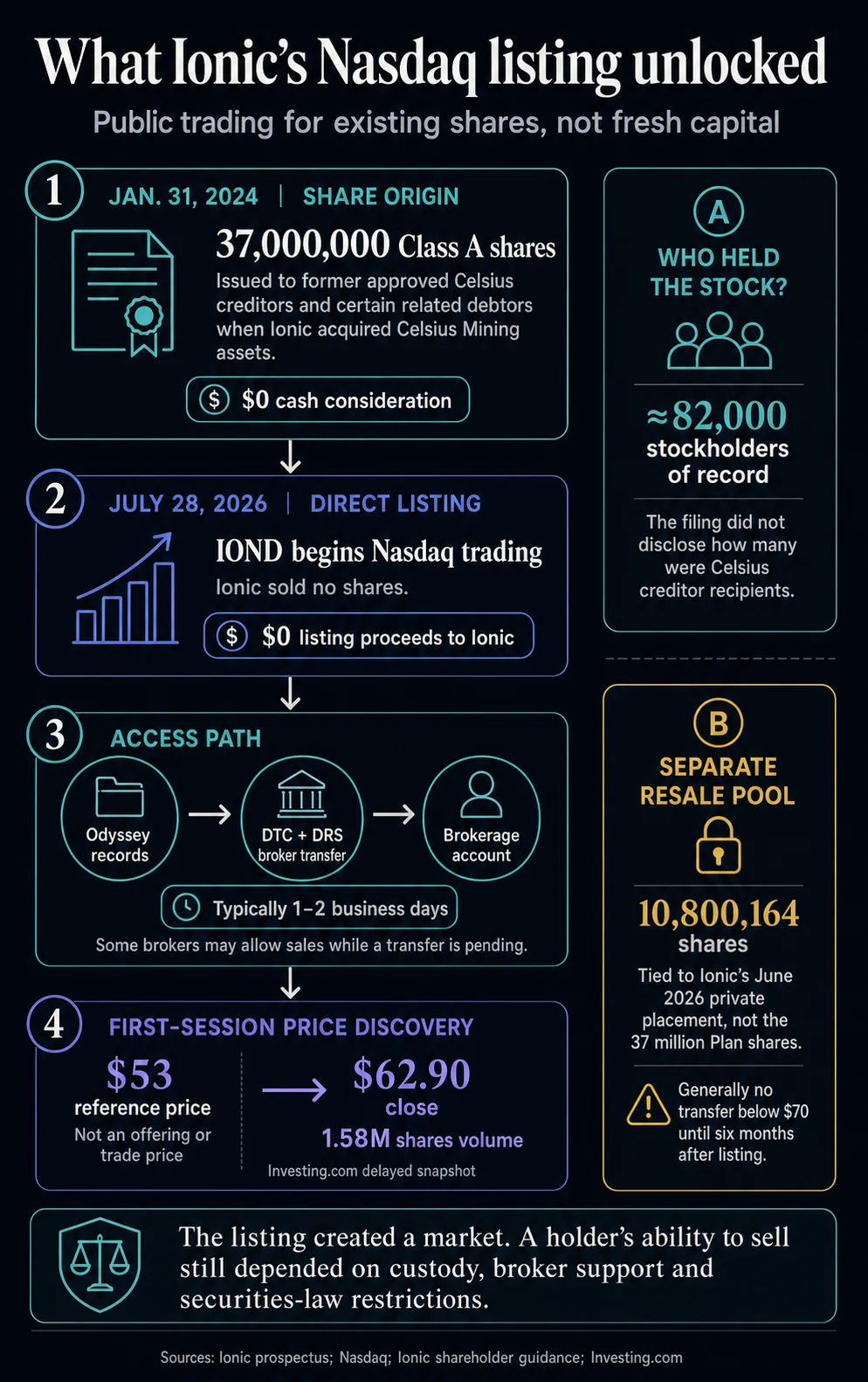
The public market debut of Ionic Digital on the Nasdaq Global Select Market under the ticker symbol IOND marked a significant milestone in the long-running restructuring of the defunct cryptocurrency lender Celsius Network. On July 28, 2026, the company successfully executed a direct listing, with its shares closing their inaugural session at $62.90. However, for the tens of thousands of former Celsius creditors who were issued equity as part of a court-approved bankruptcy recovery plan, the transition from "paper wealth" to liquid cash remains fraught with technical hurdles, regulatory restrictions, and brokerage delays. While the listing established a clear market price and a venue for discovery, the reality for approximately 37 million creditor-linked shares is a complex web of "locked" liquidity that prevents a universal, immediate exit.
The Genesis of Ionic Digital and the Celsius Legacy
To understand the current liquidity constraints, it is necessary to examine the origin of Ionic Digital. The company was born from the wreckage of Celsius Network, which filed for Chapter 11 bankruptcy protection in July 2022 following a catastrophic liquidity crisis that froze billions of dollars in user funds. As part of the reorganization plan confirmed by the United States Bankruptcy Court for the Southern District of New York, Celsius’s massive bitcoin mining operations were spun off into a standalone entity: Ionic Digital.
On January 31, 2024, Ionic officially acquired the mining assets. Unlike a traditional corporate formation, Ionic Digital did not pay cash for these assets. Instead, it issued 37 million Class A shares to the Celsius bankruptcy estate for distribution to "eligible" creditors. This equity was intended to provide creditors with a stake in the future upside of a regulated, publicly traded mining firm, offsetting some of the losses incurred during the Celsius collapse. For many creditors, these shares represent a significant portion of their remaining recovery, making the ability to sell them on the Nasdaq a high-stakes issue.
The Mechanics of the Direct Listing
Ionic Digital’s entry into the public markets was achieved via a direct listing rather than a traditional Initial Public Offering (IPO). In an IPO, a company creates new shares and sells them to institutional investors to raise capital. In contrast, a direct listing allows existing shareholders—in this case, former Celsius creditors and private placement investors—to sell their shares directly to the public on an exchange.
Because no new shares were created or sold by the company itself, Ionic Digital received no proceeds from the July 28 debut. The primary purpose of the listing was to provide a "liquidity event" for existing holders. However, the nature of a direct listing means that the opening price is not set by underwriters but by the balance of buy and sell orders in the Nasdaq’s opening auction. While Nasdaq provided a reference price of $53.00, the market’s appetite pushed the opening and closing prices significantly higher, with the stock ending its first day at $62.90 on a volume of approximately 1.58 million shares.

Why 37 Million Shares Remain "Blocked"
Despite the successful listing, the vast majority of the 37 million shares issued to creditors did not hit the market on day one. Several factors contributed to this lack of immediate liquidity:
1. The Transfer Agent Bottleneck
The shares issued to Celsius creditors are initially held in "book-entry" form with Ionic’s transfer agent, Odyssey Transfer and Trust Company. Unlike shares held in a standard brokerage account like Robinhood, Fidelity, or Charles Schwab, shares held with a transfer agent cannot be sold directly on an exchange. To sell, a shareholder must move their shares from Odyssey to a brokerage account through the Direct Registration System (DRS).
According to shareholder guidance issued by Ionic Digital, this transfer process requires the shareholder’s broker to initiate a "DRS Profile" request. This procedure typically takes one to two business days but can be delayed significantly if there are discrepancies in the shareholder’s name, address, or tax identification number between the bankruptcy records and the brokerage account. For many international creditors, the process is even more arduous, as many non-U.S. brokers do not support DRS transfers for U.S.-listed equities.
2. Regulatory and Underwriter Restrictions
Under U.S. securities laws, not all shares are immediately "freely tradeable." The SEC’s Rule 144 governs the resale of restricted and affiliate securities. While the 37 million shares were issued pursuant to an exemption in the Bankruptcy Code (Section 1145), which generally allows for the resale of securities without registration, certain holders are still restricted.
Specifically, any creditor deemed an "affiliate" of the company or anyone acting as an "underwriter" under the Bankruptcy Code’s definition may face volume limitations and holding periods. Furthermore, the company’s final prospectus filed with the SEC noted that certain large holders might be subject to specific lock-up agreements or restricted from selling if they possess material non-public information.
3. The $70 Threshold for Private Investors
While the focus remains on the 37 million creditor shares, Ionic Digital also has another 10.8 million shares tied to a June 2026 private placement. These investors are under even stricter constraints. The terms of their investment generally prohibit the transfer or sale of these securities at a price below $70 per share for a period of six months following the listing. With the stock currently trading in the low $60s, this entire block of shares is effectively sidelined, preventing a massive influx of sell-side pressure but also limiting the overall "float" or tradable supply of the stock.

Market Performance and Price Discovery
The first session’s trading volume of 1.58 million shares represents only about 4% of the total 37 million creditor-linked shares. This low turnover suggests that the technical hurdles mentioned above are successfully acting as a temporary "dam," preventing a potential "dump" of shares by thousands of creditors eager to exit their positions.
The $62.90 closing price is a significant premium over the $53 reference price, indicating strong initial demand for exposure to bitcoin mining assets. Ionic Digital operates a massive fleet of ASIC miners, and its valuation is closely tied to the price of Bitcoin and the "hashprice" (the revenue miners earn per unit of computing power). Analysts suggest that the initial price strength may be due to institutional investors looking to gain a foothold in the company while the "retail" selling pressure from creditors is still bottlenecked by the transfer process.
Chronology of the Ionic Digital Listing
- July 13, 2022: Celsius Network files for Chapter 11 bankruptcy.
- November 2023: The Celsius restructuring plan is approved, designating the creation of a "NewCo" (later named Ionic Digital) to manage mining assets.
- January 31, 2024: Ionic Digital officially begins operations and issues 37 million shares to the bankruptcy estate.
- June 2026: Ionic completes a private placement of over 10 million shares to institutional backers.
- July 20, 2026: Ionic Digital announces that its registration statement with the SEC has become effective.
- July 28, 2026: IOND begins trading on Nasdaq; shares close at $62.90.
Broader Implications for the Crypto Industry
The Ionic Digital listing is a landmark case for the "crypto-bankruptcy" era. It serves as a blueprint for how other distressed crypto firms—such as FTX, BlockFi, or Genesis—might eventually return value to creditors through equity in restructured entities rather than simple cash distributions.
However, the "blocked" liquidity of IOND shares highlights a recurring theme in the intersection of decentralized finance (DeFi) and traditional finance (TradFi): the "plumbing" of the legacy financial system is often slower than the expectations of crypto-native users. Creditors who are used to the 24/7, near-instant liquidity of crypto exchanges are now finding themselves at the mercy of transfer agents, DTC settlement cycles, and traditional brokerage hours.
From a market perspective, the gradual trickling of these 37 million shares into the market could create a prolonged period of volatility. As more creditors successfully navigate the DRS transfer process, the sell-side pressure is expected to increase. Conversely, if Ionic Digital can demonstrate operational excellence—specifically, high uptime for its mining rigs and a low cost of power—the stock may attract enough institutional "buy-and-hold" interest to absorb the creditor sell-off.
Conclusion
The Nasdaq debut of Ionic Digital is a bittersweet moment for Celsius creditors. While it represents the most significant step toward being made whole, the "blocked" nature of the 37 million shares serves as a reminder of the complexities inherent in corporate restructuring. For now, the IOND ticker remains a symbol of recovery, but for the individual holder, the path to liquidity is a marathon, not a sprint. The coming weeks will be crucial as the "transfer agent bottleneck" clears and the true market demand for Ionic Digital is tested against the full weight of the Celsius bankruptcy legacy.