admin
admin
The US House Ways and Means Committee is poised to convene on Wednesday to deliberate a sweeping 114-page legislative proposal, H.R. 10357, known as the Digital Asset Tax Certainty Act. This comprehensive crypto tax package, published on Monday alongside the committee’s markup notice, has ignited significant discussion within the digital asset community due to a notable omission: a provision that would have permitted miners and stakers of cryptocurrencies to defer the taxation of their newly acquired token rewards until the assets are actually sold. This exclusion marks a critical divergence from earlier legislative drafts and industry advocacy, setting the stage for a contentious debate over the future of digital asset taxation in the United States.
The Heart of the Debate: Taxation of Digital Asset Rewards
At the core of the current legislative contention is the timing of income recognition for cryptocurrency mining and staking rewards. The provision notably absent from H.R. 10357 was a central tenet of Representative Mike Carey’s "Tax Clarity for Mining and Staking Act," introduced in June. Carey’s proposal aimed to provide taxpayers with an election: either recognize newly created tokens as income upon receipt, or treat them akin to self-created property, deferring tax liability until the tokens are ultimately sold or exchanged.
Without this crucial deferral mechanism, the existing interpretation by the Internal Revenue Service (IRS) would likely prevail, meaning mining and staking rewards would remain taxable at their fair market value when received or when the recipient gains control over them. This approach presents a significant challenge, often referred to as a "liquidity problem," for miners and stakers. Unlike traditional income, which is typically received in a readily spendable form, newly minted or staked tokens may not be immediately liquid or easily convertible into fiat currency without incurring transaction costs or potentially selling at an unfavorable market price. Taxing these rewards upfront, before a sale, could force participants to sell a portion of their newly acquired assets to cover the tax liability, irrespective of market conditions, potentially undermining the economic viability of these activities.
Industry stakeholders, including prominent advocacy groups such as the Blockchain Association, Crypto Council for Innovation, and Digital Chamber, have vociferously argued against immediate taxation. Their collective stance, articulated in previous appeals to Congress, emphasized that taxing non-liquid rewards creates undue burdens and disincentives for participation in the foundational activities of many blockchain networks. These groups had specifically urged Congress to pass Carey’s legislation as originally introduced, and notably opposed an amendment that would have limited the deferral period to a mere five years, arguing for a more permanent and equitable solution.
A Broader Legislative Push for Digital Asset Clarity
The consideration of H.R. 10357 by the House Ways and Means Committee is not an isolated event but rather a significant development within a broader, multi-faceted legislative push in the United States to establish a clearer regulatory and tax framework for digital assets. For years, the rapid evolution of the crypto market has outpaced existing laws, leading to regulatory ambiguity, compliance challenges, and an environment ripe for legislative intervention.
This House initiative runs parallel to other critical legislative efforts, most notably the Senate’s ongoing deliberation of the CLARITY Act. While H.R. 10357 focuses squarely on taxation, the CLARITY Act aims to resolve the long-standing jurisdictional dispute between the US Securities and Exchange Commission (SEC) and the Commodity Futures Trading Commission (CFTC) over the oversight of the US crypto market. The interplay between these bills underscores a comprehensive effort to bring regulatory certainty to the digital asset space, covering both fiscal and regulatory dimensions.
The journey towards H.R. 10357 began earlier in June when the House Ways and Means Committee circulated no fewer than seven preliminary crypto tax drafts. These initial proposals covered a wide array of topics, from stablecoin regulation and specific provisions for mining and staking to measures designed to alleviate the often-onerous tax-reporting burden associated with the multitude of crypto transactions. These preliminary drafts served as a testing ground for various policy ideas, gathering feedback from industry, experts, and the public, ultimately shaping the more consolidated package now under review. This iterative process highlights the complexity and the depth of consideration lawmakers are attempting to bring to this nascent, yet rapidly maturing, financial sector.
Key Provisions Remaining in H.R. 10357
Despite the contentious omission of the reward-timing deferral, the Digital Asset Tax Certainty Act, H.R. 10357, retains a substantial number of provisions aimed at clarifying and modernizing crypto taxation. These remaining elements demonstrate a commitment to addressing various facets of digital asset activity within the existing tax framework, offering some degree of certainty in other areas.
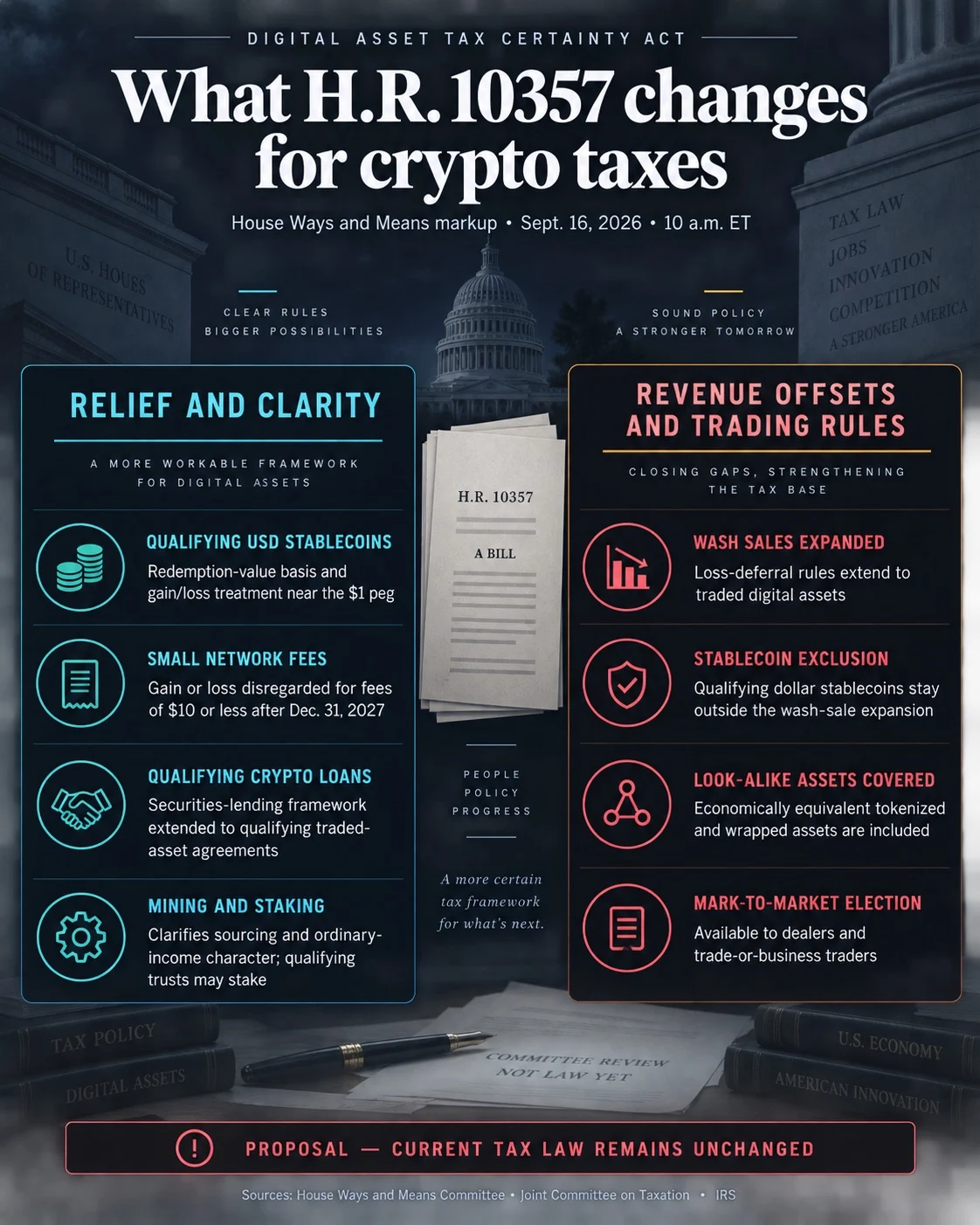
Firstly, the bill explicitly classifies income derived from blockchain validator activities – which encompass both mining and staking – as ordinary income. This classification, while consistent with current IRS guidance, solidifies the tax treatment within legislative text. Furthermore, it establishes clear rules for determining whether such income is sourced inside or outside of the United States, a critical distinction for international tax purposes and for taxpayers engaged in global blockchain operations. A particularly notable inclusion is a provision that would permit qualifying investment trusts to stake digital assets without jeopardizing their trust status, thereby opening avenues for traditional financial vehicles to participate more actively in the digital asset economy.
Beyond validator activities, the package introduces several other significant measures:
- De Minimis Exemption for Transaction Fees: To simplify compliance for common, low-value transactions, the bill proposes to prevent taxpayers from recognizing gains or losses when cryptocurrency is used to pay network or transaction fees, provided these fees do not exceed $10. This "de minimis" rule aims to reduce the administrative burden associated with tracking and reporting every micro-transaction, a common pain point for regular crypto users.
- Special Tax Treatment for Stablecoins: Recognizing the unique role of stablecoins in the digital economy, the bill proposes special tax treatment for "qualifying US dollar stablecoins." While the precise nature of this treatment is detailed within the lengthy document, it generally aims to differentiate stablecoins, often pegged to fiat currencies, from more volatile cryptocurrencies, potentially offering more favorable or simplified tax handling to reflect their stability and intended use as a medium of exchange.
- Non-Taxable Digital Asset Loans: The legislation would allow qualifying digital asset loans to occur without being immediately treated as taxable sales. This provision is crucial for the burgeoning decentralized finance (DeFi) sector, where lending and borrowing digital assets are fundamental activities. Treating every loan as a taxable event would stifle innovation and impose prohibitive tax burdens on participants, making this deferral a welcome clarification for many.
- Simplified Accounting and Expanded Rules: Other provisions aim to streamline the tax compliance process. These include offering simplified accounting methods for "widely traded crypto assets," which could reduce the complexity for investors dealing with popular cryptocurrencies. Moreover, the bill proposes to extend existing wash-sale and constructive-sale rules to digital assets. Wash-sale rules prevent investors from claiming a tax loss on the sale of a security if they buy a "substantially identical" security within 30 days before or after the sale. Extending these to crypto aims to close a perceived loophole that allowed investors to harvest tax losses while maintaining their market exposure.
- Voluntary Disclosure Program: In a move to encourage past compliance, the package also establishes a voluntary disclosure program for taxpayers seeking to rectify earlier digital asset tax violations. Such programs typically offer reduced penalties or immunity from criminal prosecution in exchange for full disclosure and payment of back taxes, providing a pathway for individuals and entities to come clean on previous tax oversights related to their crypto holdings.
These provisions, taken together, represent a significant step towards a more structured and predictable tax environment for digital assets, even as the debate over mining and staking reward taxation continues.
Industry Reactions and Advocacy
The crypto industry’s reaction to the current iteration of H.R. 10357 has been mixed, characterized by appreciation for the clarity in some areas but strong disappointment over the omission of the staking and mining deferral provision. As previously noted, leading advocacy groups like the Blockchain Association, the Crypto Council for Innovation, and the Digital Chamber have consistently championed the need for a tax framework that fosters innovation rather than hindering it.
Their primary argument against the immediate taxation of staking and mining rewards centers on the practical difficulties it creates. They contend that requiring taxpayers to pay taxes on rewards that may not have a readily accessible fiat value, or that they intend to hold for long-term network participation, creates an "illiquidity trap." This situation can force participants to sell their newly acquired assets, potentially at a loss or at an inopportune time, simply to meet their tax obligations. Such a requirement is viewed as punitive and a deterrent to individuals and entities engaging in activities critical for the security and functionality of blockchain networks. These groups have historically cited the precedent set by other forms of self-created property, such as crops harvested by a farmer, where tax is typically paid upon sale, not upon harvest.
The industry’s robust lobbying efforts in Washington D.C. have been instrumental in bringing these issues to the forefront of legislative discussions. Their advocacy highlights not only the technical nuances of blockchain but also the potential economic consequences of ill-conceived tax policies. The sustained push for Representative Carey’s original legislation, without restrictive amendments, underscores the industry’s belief that a well-designed tax framework is essential for the United States to remain competitive in the global digital asset landscape. The exclusion of this key provision from H.R. 10357 is therefore seen as a significant setback by many within the crypto community, who will likely continue to press for its reintroduction or for alternative solutions.
The Economic and Compliance Landscape
The provisions within H.R. 10357, particularly the absence of the staking and mining reward deferral, carry substantial implications for the broader economic and compliance landscape of digital assets in the US. For individual miners and stakers, as well as small businesses operating in this space, the immediate taxation of rewards can significantly impact their operational economics. It could lead to reduced profitability, increased administrative burden, and potentially force smaller participants out of the market, consolidating power among larger entities with greater liquidity. This could stifle decentralization, a core tenet of many blockchain projects.
From a broader economic perspective, a stringent tax regime on nascent digital asset activities could hinder innovation and capital formation within the United States. If the tax environment is perceived as unfavorable, it could incentivize blockchain developers, entrepreneurs, and investors to relocate their operations to jurisdictions with more accommodating regulatory frameworks. This "regulatory arbitrage" could see the US lose its competitive edge in a rapidly expanding global industry estimated to be worth trillions of dollars.
For the IRS, implementing and enforcing these new and clarified rules presents its own set of challenges. The complexity of tracking millions of on-chain transactions, accurately valuing assets at the moment of receipt, and distinguishing between various types of digital asset activities (e.g., active mining vs. passive staking) requires sophisticated infrastructure and trained personnel. While a voluntary disclosure program is a positive step for past compliance, ongoing enforcement will require significant resources. The risk of non-compliance could also increase if taxpayers find the rules too complex or onerous, leading to a broader "tax gap" in the digital asset sector.
Historical Context of Crypto Taxation in the US
The journey to establish a coherent tax framework for digital assets in the United States has been a protracted and often reactive process. The foundational guidance from the IRS dates back to Notice 2014-21, issued in March 2014. This seminal document declared that virtual currency would be treated as property for federal tax purposes, rather than currency. This classification, while providing some initial direction, immediately raised numerous questions, as existing property tax rules were not designed for the unique characteristics of digital assets, such as their divisibility, fungibility, and use in decentralized networks.
Following 2014, the IRS issued further guidance, including FAQs and revenue rulings, attempting to clarify specific scenarios like hard forks, airdrops, and the calculation of basis. However, these piecemeal clarifications often struggled to keep pace with the rapid innovation in the crypto space, particularly with the emergence of DeFi, NFTs, and increasingly complex staking and lending protocols. The lack of comprehensive, legislative guidance has left taxpayers and tax professionals alike navigating a complex and often ambiguous landscape, leading to inconsistent reporting and significant compliance uncertainty.
The shift from a niche technological curiosity to a significant financial instrument, with millions of Americans holding and transacting in cryptocurrencies, has amplified the urgency for legislative action. The current legislative efforts, including H.R. 10357, represent an attempt to move beyond ad-hoc guidance and establish a statutory framework that is both comprehensive and forward-looking. This historical context underscores the magnitude of the task facing lawmakers: to fit novel digital assets into existing tax frameworks while fostering innovation and ensuring equitable tax collection.
Looking Ahead: The Path Through Congress
The consideration of H.R. 10357 by the House Ways and Means Committee on Wednesday marks a critical juncture in its legislative journey. The committee markup process is where proposed legislation is debated, amended, and ultimately voted upon by committee members before being sent to the full House for a vote. This stage is highly dynamic, with potential for further amendments, negotiations, and even the reintroduction of provisions previously omitted, especially if industry pressure remains high.
Should the bill successfully clear the Ways and Means Committee, it would then proceed to a vote by the full House of Representatives. If passed by the House, the legislation would then move to the Senate, where it would undergo a similar committee review process (likely by the Senate Finance Committee) and potentially further amendments before a full Senate vote. The final version would then need to be reconciled between both chambers if there are differences, and ultimately, signed into law by the President. This multi-stage process means that the current form of H.R. 10357 is by no means final, and its ultimate shape could still evolve significantly.
The interplay with other crypto-related bills, such as the CLARITY Act, further complicates the legislative outlook. While distinct in their immediate focus, these bills reflect a broader congressional interest in establishing a holistic regulatory framework for digital assets. The success or failure of one piece of legislation could influence the momentum and political will behind others. The outcome of the debate over the staking and mining deferral provision, in particular, will be closely watched by the industry as a bellwether for how seriously Congress considers the unique operational realities of the digital asset ecosystem.
In conclusion, the Digital Asset Tax Certainty Act represents a pivotal legislative effort to bring much-needed clarity to the taxation of cryptocurrencies in the United States. While it offers significant advancements in many areas, the exclusion of a provision allowing for the deferral of mining and staking reward taxation remains a contentious point, highlighting the ongoing tension between ensuring robust tax compliance and fostering innovation in the rapidly evolving digital asset space. The debates within the Ways and Means Committee this week will undoubtedly set the tone for the future of crypto taxation in the nation.