admin
A monumental international crackdown, spearheaded by the United Arab Emirates, has successfully identified more than $39 billion in illicit funds and cryptocurrencies linked to widespread scam activities, culminating in over 960 arrests across 30 countries. The UAE Ministry of Interior officially announced the results of this three-month initiative, dubbed "Operation Confrontation Ghost," on October 22, marking a significant milestone in the global fight against transnational organized cybercrime. This landmark operation, which ran from July 1 to September 30, 2026, united law enforcement agencies, international bodies, and leading technology and financial companies against the burgeoning threats of AI-enabled fraud, digital financial fraud, and technology-facilitated sextortion.
The Genesis of "Operation Confrontation Ghost"
The increasing sophistication and global reach of cybercriminal networks have long posed a formidable challenge to national law enforcement agencies. Scammers exploit jurisdictional gaps, leveraging digital platforms to target victims across borders and launder proceeds through complex financial webs, often involving cryptocurrencies. Recognizing this escalating threat, the UAE initiated "Operation Confrontation Ghost" as a direct response to the urgent need for a unified, cross-sectoral approach. The operation’s strategic timing and focus underscore the growing alarm over the weaponization of artificial intelligence in fraud schemes and the pervasive nature of digital financial crimes and sextortion.
The initiative was forged through a unique coalition comprising law enforcement agencies from 30 nations, alongside critical international organizations like INTERPOL and the Global Anti-Scam Alliance (GASA). Crucially, the operation integrated 13 prominent companies from the technology and financial sectors, acknowledging their pivotal role in both facilitating and combating digital crime. This collaborative framework was designed to dismantle the operational infrastructure of scam networks, disrupt their financial flows, and bring perpetrators to justice. The results were formally presented in Vienna during a UAE-hosted side event at the 13th session of the Conference of the Parties to the United Nations Convention against Transnational Organized Crime (UNTOC COP13), highlighting the global recognition of the operation’s significance.
Unprecedented Global Reach and Impact
Operation Confrontation Ghost cast a wide net, extending its investigative reach across five continents. Over its three-month duration, investigators successfully identified more than 15,500 victims and pinpointed over 3,500 suspects, illustrating the vast scale of the criminal enterprises targeted. Authorities conducted raids on 29 fraud centers, which served as command hubs for these illicit activities. In a concerted effort to cripple the scammers’ outreach and money movement capabilities, over 570 social media accounts used for victim manipulation and fund transfers were shut down, and 4,126 bank accounts linked to fraudulent activities were flagged.
The success of the operation was underpinned by an unprecedented level of intelligence sharing among participating agencies. Over 9,000 pieces of intelligence were exchanged, enabling investigators to swiftly identify suspects, map the intricate operational structures of scam networks, and meticulously track illicit money flows across national borders. This continuous exchange of actionable intelligence facilitated a deeper understanding of criminal methodologies, allowing law enforcement to document distinct fraud patterns, recruitment tactics, victim deception strategies, and the complex processes used to launder proceeds.
The diverse array of participating countries underscores the truly global nature of this threat and the collaborative spirit required to combat it. Nations involved included the UAE, the United Kingdom, Canada, Japan, China, France, the Netherlands, Singapore, the Philippines, Myanmar, Indonesia, the Republic of Korea, Brazil, Kenya, Senegal, and Morocco, among others. While the Ministry of Interior did not provide a country-by-country breakdown of arrests or the specific locations of the raided fraud centers, the sheer geographical breadth of participation signals a unified global front against cybercrime. This international cooperation is vital, as cybercriminals often exploit the fragmentation of national jurisdictions, making cross-border collaboration the only effective countermeasure.
The Critical Role of Public-Private Collaboration
A distinguishing characteristic and a key factor in the success of Operation Confrontation Ghost was the integral involvement of private sector companies. These 13 partners, including Bayut, Crypto.com, Dubizzle, Feedzai, Ghostly Solutions, Group-IB, Huawei, Mastercard, Meiya Pico, Meta, Outseer, TikTok, and Trend Micro, represent a cross-section of industries whose platforms and payment systems are frequently exploited by scammers. This public-private synergy reflects a modern understanding that combating sophisticated digital fraud requires a multi-faceted approach, leveraging both governmental authority and private sector expertise and resources.
The mix of participating companies highlights the multi-channel nature of contemporary fraud. Social media giants like Meta and TikTok are often the initial points of contact for scammers, used to lure victims through elaborate schemes. Online marketplaces such as Bayut and Dubizzle can serve as fronts for fake listings or fraudulent transactions. Payment networks like Mastercard and cryptocurrency exchanges such as Crypto.com are crucial conduits for the rapid movement of illicit funds across jurisdictions, often obscuring their origins. Cybersecurity and fraud-detection firms like Feedzai, Group-IB, Outseer, and Trend Micro provide essential technological tools and intelligence capabilities needed to trace these complex digital flows and identify suspicious activities. Huawei and Meiya Pico, as technology providers, also bring valuable insights into digital infrastructure and forensics.
Colonel Dana Humaid Al Marzouqi, Director General of the International Affairs Bureau at the UAE Ministry of Interior, emphasized the transformative power of this collaborative model. She stated that the operation successfully converted shared intelligence into tangible, coordinated actions, demonstrating a pioneering approach. Colonel Al Marzouqi described the initiative as a "first-of-its-kind" endeavor, showcasing the UAE’s leadership in developing practical international responses to the evolving threats of AI-enabled fraud and cross-border scams. This model of cooperation is increasingly seen as the blueprint for future efforts against transnational cybercrime, acknowledging that neither governments nor corporations can tackle these challenges effectively in isolation.
The Evolving Threat: AI-Powered Fraud and Sextortion
Operation Confrontation Ghost specifically targeted three rapidly growing categories of crime: AI-enabled fraud, digital financial fraud, and technology-facilitated sextortion. The focus on these areas underscores their increasing prevalence and the severe harm they inflict.

AI-enabled fraud represents a new frontier in cybercrime. Criminal groups are increasingly leveraging artificial intelligence and machine learning to create highly convincing fake identities, voices, and messages. Deepfake technology, for instance, can generate realistic videos or audio recordings of individuals, making it possible for scammers to impersonate executives, family members, or trusted authorities with alarming accuracy. This makes scams significantly harder for victims to detect and enables criminal enterprises to operate at an unprecedented scale, automating parts of their deceptive processes. The psychological impact of such sophisticated deception can be devastating, eroding trust in digital communication.
Technology-facilitated sextortion, another priority area, highlights a particularly insidious form of crime. Officials noted that it frequently targets vulnerable populations, including children and teenagers, leaving lasting psychological trauma for victims and their families. Perpetrators typically lure victims into compromising situations online, often through dating apps or social media, before threatening to disseminate intimate images or videos unless a ransom is paid. The shame and fear associated with sextortion often prevent victims from reporting the crime, making it challenging for law enforcement to track and prosecute offenders. The operation’s attention to this crime signals a crucial effort to protect the most vulnerable online users.
Digital financial fraud encompasses a broad spectrum of illicit activities, from sophisticated phishing campaigns and investment scams to romance scams and fake online marketplaces. These crimes often rely on social engineering tactics, manipulating victims into divulging personal information or transferring funds voluntarily. The global financial losses from such fraud are staggering, with estimates placing annual damages in the tens of billions of dollars. For instance, the FBI’s Internet Crime Report often details billions in losses annually from various internet-enabled scams. The sheer volume and diversity of these schemes necessitated a comprehensive approach that could disrupt multiple facets of the criminal ecosystem.
The Complex Path to Asset Recovery
While the headline figure of $39 billion in identified scam-linked funds and digital assets is impressive, it comes with an important caveat: this figure represents funds that investigators have identified as connected to scams, not money that has been seized or returned to victims. This distinction is crucial in understanding the long and arduous process of asset recovery.
The UAE Ministry of Interior stated that participating countries, jurisdictions, and private-sector partners are actively working towards recovering these assets. However, no specific figures were provided regarding the amount recovered to date, nor was the exact share of the total held in cryptocurrency specified. This information gap is significant, as recovering digital assets, particularly cryptocurrencies, presents unique challenges due to their decentralized nature, pseudonymity, and the rapid speed at which they can be moved across global exchanges. Legal frameworks for seizing and repatriating crypto assets are still evolving in many jurisdictions, adding layers of complexity to the recovery process.
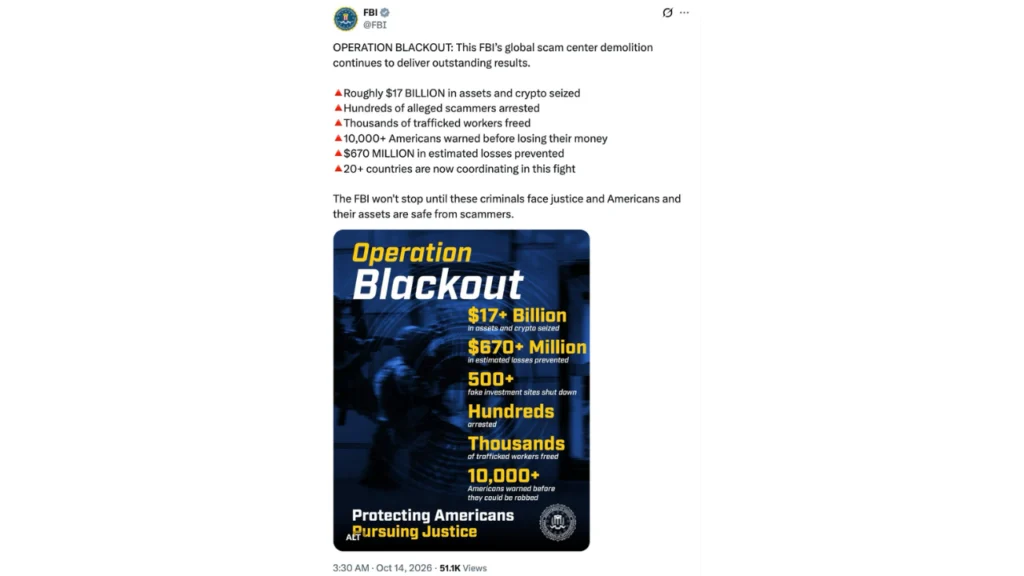
Comparing Operation Confrontation Ghost with other recent enforcement efforts further illustrates this challenge. INTERPOL’s Operation Serengeti III, conducted from late June through August 2026 across 20 African countries and the United States, reported 1,462 arrests and over $105 million in illicit funds recovered. Separately, the FBI announced on October 13 that its global Operation Blackout had seized roughly $1.7 billion in assets and cryptocurrency. These operations measure different metrics (identified vs. recovered/seized funds), and potential overlaps in their totals are unclear, meaning direct comparisons or combining figures would be misleading. The journey from identifying illicit funds to their actual seizure, forfeiture, and eventual return to victims is often protracted, involving complex legal processes, international cooperation agreements, and significant investigative resources.
International Acclaim and Future Imperatives
The United Nations Office on Drugs and Crime (UNODC) lauded Operation Confrontation Ghost, specifically commending the UAE’s leadership in orchestrating such a comprehensive multi-stakeholder initiative. The UNODC recognized the innovative framework that successfully brought together law enforcement agencies, financial institutions, and technology companies—entities that traditionally operate in distinct silos—under a single, unified banner. This recognition from a prominent international body underscores the significance of the operation as a model for future global anti-crime efforts.
Speaking at the UNTOC COP13 side event, UNODC Executive Director Monica Juma praised the UAE for leveraging its "convening power" to facilitate the operation, acknowledging the critical leadership role played by UAE President Sheikh Mohamed bin Zayed Al Nahyan in advancing this endeavor. The side event, aptly titled "From Cooperation to Action: How Law Enforcement, International Organizations and the Private Sector Can Jointly Counter Organized Fraud," focused on translating the lessons learned from Operation Confrontation Ghost into sustained cooperation and strengthening public-private partnerships. The discussions aimed to develop actionable strategies for long-term collaboration, recognizing that the battle against transnational organized cybercrime is an ongoing one that requires continuous adaptation and innovation.
The Road Ahead: Sustaining the Fight
Scam networks have historically thrived by exploiting the inherent gaps and differences between national jurisdictions. They operate with impunity, targeting victims in one country, executing their schemes from another, and meticulously moving illicit money through a third, often leveraging countries with lax financial regulations or limited enforcement capabilities. Operations like Confrontation Ghost are specifically designed to bridge these jurisdictional divides, creating a seamless network of investigators, digital platforms, and financial institutions committed to dismantling these global criminal enterprises.
The biggest unanswered question remains how much of the identified $39 billion will ultimately be recovered and returned to victims. The UAE Ministry of Interior reiterated that asset recovery efforts are ongoing and pledged continued collaboration with international and private-sector partners to strengthen cooperation against transnational digital fraud. This commitment highlights the understanding that the fight does not end with arrests and identification; successful asset recovery is crucial for deterring future crimes and providing justice to victims.
As cybercriminals continue to innovate, adapting to new technologies and exploiting emerging vulnerabilities, the need for sustained, dynamic international cooperation will only intensify. The success of Operation Confrontation Ghost provides a powerful blueprint for future endeavors, demonstrating that a coordinated, multi-stakeholder approach is not just desirable, but absolutely essential in safeguarding the digital economy and protecting individuals from the pervasive threat of global cybercrime. The lessons learned from this operation will undoubtedly inform future strategies, pushing for stronger legal frameworks, enhanced technological solutions, and deeper trust between public and private entities in the enduring war against digital fraud.