admin
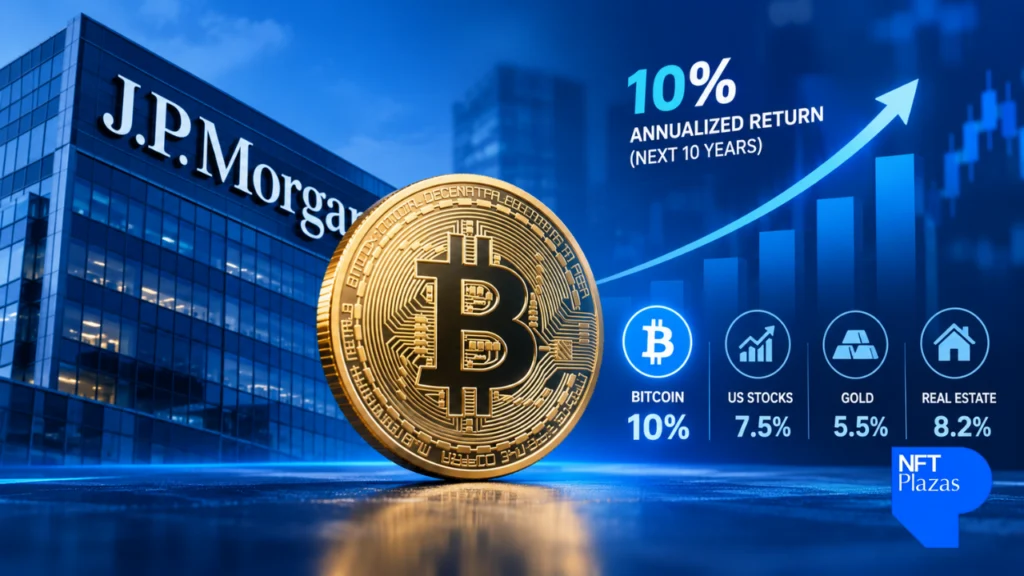
JPMorgan Asset Management, a titan in the traditional financial sector, has issued a remarkable forecast projecting Bitcoin (BTC) to deliver superior long-term returns compared to established asset classes such as US large-cap stocks, gold, and real estate investment trusts (REITs). This bold prediction, embedded within the firm’s influential 2027 Long-Term Capital Market Assumptions (LTCMA) report, signals a significant shift in the perception of digital assets within mainstream finance, even as persistent concerns regarding Bitcoin’s inherent volatility remain central to its evaluation.
The Shifting Institutional Tides: JPMorgan’s Landmark Forecast
The firm’s 2027 Long-Term Capital Market Assumptions report, a crucial document for institutional investors outlining expected returns across various asset classes over the next 10 to 15 years, positions Bitcoin at the pinnacle of its growth projections. Specifically, JPMorgan Asset Management anticipates Bitcoin to generate a robust 10% annualized compound return over this extended horizon. This figure notably surpasses the expected returns for several traditional benchmarks: US real estate investment trusts (REITs) are projected at 8.2%, US large-cap equities at 7.5%, and gold at 5.5%.
This forecast is not merely an interesting data point; it represents a profound endorsement for cryptocurrency investors, especially coming from an institution historically associated with one of Bitcoin’s most vocal skeptics, CEO Jamie Dimon. The LTCMA report is designed to guide sophisticated institutional clients in their strategic asset allocation, providing a framework for long-term portfolio construction. Bitcoin’s inclusion, let alone its top ranking, underscores a growing recognition of its potential as a legitimate, albeit distinct, investment avenue.
For investors operating with a multiyear investment horizon, the disparities in these projected returns are substantial. Bitcoin’s forecasted annual compound return outstrips that of US large-cap stocks by a considerable 2.5 percentage points and gold by an even more significant 4.5 percentage points. Furthermore, its expected return stands 1.8 percentage points above that of US REITs. The power of compounding magnifies these differences exponentially over time, suggesting that even seemingly modest annual differences can lead to vastly divergent wealth accumulation over a decade or more.
It is crucial to understand that these projections are based on assumptions about future market dynamics and are not guaranteed outcomes. They reflect a long-term outlook, detached from short-term market fluctuations or speculative trading. While Bitcoin’s projected compound return is 10%, JPMorgan also estimates its arithmetic average annual return at 20.9%. The substantial gap between these two figures – the compound return representing the actual wealth growth and the arithmetic return being a simple average – vividly illustrates the impact of extreme price fluctuations. Significant gains in some periods can be partially or fully offset by steep losses in others, making the path to long-term wealth far from smooth.
A Deep Dive into JPMorgan’s Long-Term Capital Market Assumptions (LTCMA)
The Long-Term Capital Market Assumptions report by JPMorgan Asset Management is an annual publication that serves as a cornerstone for institutional investors globally. It provides a comprehensive outlook on expected returns, volatilities, and correlations across a wide spectrum of asset classes, guiding strategic asset allocation decisions. The report is meticulously constructed using a blend of econometric models, historical data analysis, and forward-looking economic forecasts. Its primary purpose is not to predict immediate market movements but to inform long-term portfolio planning, typically over a 10-to-15-year horizon.
The inclusion of Bitcoin in such a foundational report marks a pivotal moment. Historically, LTCMA reports focused exclusively on traditional asset classes like equities, fixed income, real estate, and commodities. Bitcoin’s entry signifies a qualitative shift in how leading financial institutions categorize and evaluate digital assets. It suggests that, despite its unconventional nature and inherent risks, Bitcoin is increasingly being viewed through the same rigorous analytical lens applied to more established investment vehicles. This move indicates that the firm’s institutional clients are actively seeking guidance on how to incorporate digital assets into diversified portfolios, necessitating formal projections from their asset managers.
Navigating the Volatility: A Double-Edged Sword
While JPMorgan’s forecast highlights Bitcoin’s potential for high returns, it simultaneously underscores the significant risks distinguishing it from more established investments. The most potent qualification accompanying JPMorgan’s outlook is Bitcoin’s projected annualized volatility of 55%. This figure is astronomically higher than the volatility typically associated with major equity and gold markets. For context, the annualized volatility of the S&P 500 historically hovers around 15-20%, while gold typically exhibits volatility in the 10-15% range. This stark contrast signals that Bitcoin investors must be prepared for extreme price swings and potentially substantial drawdowns, even if the cryptocurrency ultimately achieves its projected long-term return.
This heightened volatility is not just a statistical anomaly; it presents tangible challenges for portfolio management. JPMorgan Asset Management has explicitly cautioned against treating Bitcoin as an ordinary portfolio holding. The firm has notably refrained from incorporating Bitcoin into its main covariance matrices, which are essential tools for investors to evaluate how different assets move in relation to one another. Covariance and correlation analysis are fundamental to building diversified portfolios, allowing managers to combine assets whose movements offset each other, thereby reducing overall portfolio risk.
As the firm stated, "The volatility and unstable correlation of assets like bitcoin (BTC) remain an obstacle to their widespread inclusion in portfolios." This distinction is critical for institutional investors who manage diversified portfolios with strict risk parameters. An asset can offer highly attractive expected returns but still present formidable challenges in risk management, portfolio construction, liquidity planning, and regulatory compliance. For individual investors, the forecast serves as a stark reminder that the allure of higher potential returns is invariably accompanied by greater uncertainty and increased risk exposure. Bitcoin’s long-term performance remains contingent on a confluence of factors, including evolving market demand, regulatory clarity, sustained institutional participation, and broader macroeconomic conditions.
The Jamie Dimon Paradox: A Firm’s Evolving Stance
The release of this forward-looking report from JPMorgan’s asset management arm brings into sharp relief the complicated and evolving relationship between the financial giant and the world of cryptocurrencies. This is particularly notable given the long-standing and often outspoken criticism from JPMorgan Chase CEO Jamie Dimon. For years, Dimon has been one of Bitcoin’s most prominent institutional detractors. In 2017, he famously labeled Bitcoin a "fraud," a statement that sent ripples through both traditional finance and the nascent crypto community. He later continued to express deep skepticism, at various times comparing it to a Ponzi scheme or a "pet rock."
However, even Dimon’s resolute stance has shown signs of softening over time, reflecting the undeniable growth and institutionalization of the crypto market. In May 2025 (as per the original article’s timeline), Dimon acknowledged that JPMorgan would permit its clients to buy Bitcoin, even while he maintained his personal reservations about the asset class. This pragmatic shift underscores the commercial imperative for large financial institutions to cater to client demand, regardless of internal executive sentiment.
The distinction between Dimon’s personal views and the asset management division’s analytical forecasts is crucial. A long-term capital market assumption is an objective investment projection, meticulously derived from quantitative and qualitative analysis. It is not a declaration of ideological support for Bitcoin, nor is it a universal recommendation for every client to hold the asset. Rather, it reflects a calculated assessment of potential risk and reward within the context of a diversified portfolio. Nevertheless, Bitcoin’s prominent appearance at the top of the return table within such an authoritative report powerfully illustrates how institutional analysis can diverge from, and even eventually override, an executive’s public criticism. It signifies an institutional acknowledgment that, despite personal biases, the market for digital assets has matured to a point where it warrants serious consideration and formal modeling.
JPMorgan’s engagement with blockchain technology extends beyond Bitcoin. The bank has been a pioneer in developing its own blockchain-based solutions, such as the Onyx platform and JPM Coin, aimed at streamlining interbank payments and wholesale transactions. This strategic embrace of the underlying technology, while maintaining a cautious approach to decentralized cryptocurrencies like Bitcoin, further exemplifies the nuanced and multifaceted strategy employed by leading financial institutions in navigating the digital asset landscape.

Industry Reactions and Validation
The publication of JPMorgan’s LTCMA report, particularly its Bitcoin forecast, immediately resonated across the cryptocurrency industry. Matt Hougan, the Chief Investment Officer at Bitwise, one of the leading crypto asset managers, welcomed the projections as another significant indicator of Bitcoin’s accelerating acceptance within the traditional financial ecosystem.
In a public statement on X (formerly Twitter), Hougan drew a stark contrast between the early dismissals of Bitcoin by established financial institutions and its current inclusion, and indeed leading position, in a major asset manager’s long-term return assumptions. He acknowledged that JPMorgan’s forecast came with important caveats, including pronounced concerns about Bitcoin’s volatility and its relative market maturity. However, he unequivocally described its inclusion and top ranking as a "notable development," signaling a paradigm shift.
This reaction from a prominent figure in the crypto space is indicative of a broader trend. The industry views such pronouncements from institutions like JPMorgan not just as academic exercises, but as critical validation points. They suggest that Bitcoin, once relegated to the fringes, is increasingly being subjected to formal investment frameworks and rigorous analytical processes, rather than being dismissed outright as a speculative fad or an illegitimate asset. This shift, while not equating to universal acceptance or blanket endorsement, implies that more financial institutions are becoming willing to objectively assess Bitcoin alongside conventional assets, while concurrently accounting for its distinct risk profile and operational complexities. The ongoing influx of institutional capital into Bitcoin exchange-traded funds (ETFs) and the development of robust custody solutions further underscore this growing comfort level among traditional finance players.
Beyond the Projections: Understanding the Nuances of Institutional Holdings
To provide further context, separate data from Santiment, a blockchain analytics firm, indicates that investment funds have consistently maintained holdings of more than 1 million BTC for several months. These figures suggest that a substantial amount of Bitcoin is currently held within various investment products, reflecting a baseline level of institutional engagement.
However, it is imperative to interpret this data with nuance. While stable holdings demonstrate persistent interest and a certain level of commitment from institutional players, they do not inherently prove that fresh capital is actively entering the market, nor do they confirm an increasing buying pressure. Stable holdings could simply reflect long-term HODLing strategies by existing institutional investors. To accurately assess new demand and the direction of institutional capital flows, investors would need to examine dynamic metrics such as changes in fund balances, net inflows and outflows into specific investment vehicles (like Bitcoin ETFs or institutional funds), and other measures of active buying or selling activity.
This distinction is particularly relevant when attempting to forecast Bitcoin’s price outlook. While consistent fund holdings offer valuable context regarding the institutional presence in the market, they do not independently establish the trajectory of future prices. New demand, regulatory developments, and broader macroeconomic factors remain the primary drivers of price movements, rather than static holding patterns.
Implications for Investors: Weighing Risk and Reward
JPMorgan’s projections offer profound implications for both institutional and individual investors, fundamentally altering the discourse around Bitcoin as an investable asset.
For Institutional Investors: The report compels a re-evaluation of traditional portfolio construction models. While the high projected returns are attractive, the extreme volatility (55% annualized) and "unstable correlation" pose significant challenges. Institutional mandates often prioritize capital preservation and stable returns, making the integration of such a volatile asset complex. Portfolio managers must grapple with questions of allocation size, risk budgeting, and the potential impact of large drawdowns on overall fund performance. The lack of inclusion in standard covariance matrices means that traditional diversification benefits may not apply in the same way, requiring innovative approaches to risk management. Furthermore, regulatory compliance, liquidity management, and the availability of robust custody solutions remain critical considerations for large-scale institutional adoption.
For Individual Investors: The forecast serves as a powerful illustration of the adage that higher potential returns come with greater uncertainty. Bitcoin’s projected 10% compound annual growth, if realized, would significantly amplify wealth over time. For example, a hypothetical $10,000 investment growing at this rate would approximately reach $25,937 over 10 years, before accounting for fees, taxes, and other costs. This vivid illustration of compounding underscores the long-term wealth generation potential. However, this is not a price target or a guarantee. Individual investors must critically assess their own risk tolerance, investment horizon, and financial goals. The 55% volatility means that the path to these returns will likely be fraught with dramatic peaks and troughs, requiring emotional resilience and a disciplined investment strategy, such as dollar-cost averaging, to mitigate the impact of short-term market timing errors.
The Road Ahead: Factors Influencing Bitcoin’s Future Trajectory
Bitcoin’s actual long-term performance will depend on a multitude of evolving factors. Should institutional demand weaken, if regulatory frameworks become more restrictive globally, or if broader market confidence in digital assets deteriorates, Bitcoin could fall short of these ambitious forecasts. Increased competition from other digital assets or a resurgence in the appeal of income-generating traditional assets, especially in a higher interest rate environment, could also divert capital away from Bitcoin.
Conversely, continued and broader adoption of Bitcoin as a store of value and a medium of exchange, coupled with sustained institutional investment demand, could bolster its long-term prospects. Technological advancements within the Bitcoin network (e.g., Layer 2 solutions like the Lightning Network) could enhance its utility and scalability. Clarity and favorable regulation across major economies could significantly de-risk the asset for a wider pool of investors. Macroeconomic conditions, such as persistent inflation or geopolitical instability, could further strengthen the narrative of Bitcoin as a "digital gold" or an uncorrelated hedge against traditional financial systems.
Conclusion
JPMorgan Asset Management’s landmark forecast for Bitcoin is more than just a projection; it’s a testament to the ongoing evolution of financial markets and the increasing mainstream acceptance of digital assets. The central message emanating from this influential report is not that Bitcoin has magically transformed into a low-risk investment. Far from it. Instead, the firm’s analysis suggests that Bitcoin’s substantial potential for long-term returns, even when weighed against its pronounced volatility of 55%, may now justify closer consideration from sophisticated investors.
The explicit trade-off between growth potential and risk is now officially acknowledged and quantified by one of the world’s leading financial institutions. Whether this trade-off ultimately proves worthwhile will hinge on the complex interplay of technological innovation, regulatory maturation, market sentiment, and macroeconomic forces that will shape the digital asset landscape over the coming decade. For now, JPMorgan’s forecast solidifies Bitcoin’s position as an asset demanding serious analytical engagement, marking a definitive shift from outright skepticism to strategic evaluation within the highest echelons of traditional finance.