admin
In the wake of a significant security breach targeting Binance’s hot wallets on October 29, the cryptocurrency exchange landscape has seen an unprecedented push for transparency regarding the security of customer assets. Crypto exchanges worldwide spent the first week of November disclosing a crucial metric they often kept private: the share of customer coins held in cold storage, meaning wallets kept entirely offline and inaccessible from the internet. The incident, where thieves reportedly took approximately $6.36 billion from Binance’s hot wallets—most of it within a rapid 20-minute window, according to blockchain analytics firm TRM Labs—sent shockwaves through the digital asset community, prompting immediate scrutiny of exchange security protocols and asset management practices.
The Anatomy of a High-Stakes Breach and Immediate Market Reaction
The October 29 attack on Binance’s hot wallets represents one of the largest reported cryptocurrency thefts, highlighting the persistent vulnerabilities associated with online "hot" storage solutions, designed for rapid transaction processing. While Binance CEO Richard Teng swiftly assured users that the "vast majority" of user assets were held in secure cold wallets and that "no user bears the loss," the sheer scale of the theft, measured in billions, underscored the critical importance of robust security measures and transparent asset segregation.
The market’s immediate reaction was palpable, though surprisingly resilient. On live Bitcoin (BTC) to USD charts, the attack manifested as a sharp slide below $78,000 in the hours following the theft. However, the market demonstrated a degree of resilience, with Bitcoin rebounding to $80,564 by November 5. This recovery suggested that investors largely perceived the incident as an isolated exchange-specific security failure rather than a fundamental flaw in Bitcoin’s underlying technology. Nevertheless, this recovery was short-lived, as a broader market sell-off saw Bitcoin slide further to $75,620 on November 6.
Chronology of Events and Bitcoin Price Fluctuations:
The period surrounding the Binance hack was marked by distinct shifts in Bitcoin’s valuation, influenced by both the security incident and wider macroeconomic factors.
- October 29, approximately 23:50 UTC: Hours after the hot-wallet theft was confirmed, Bitcoin’s price dropped below $78,000, representing an approximate 4.1% decline in a 24-hour period. This immediate dip reflected initial market apprehension and uncertainty following the breach.
- November 1, 10:18 UTC: As Binance progressively restarted withdrawals in phases, Bitcoin’s price stabilized around $78,064. This phased resumption of services, along with assurances from Binance leadership, helped to calm immediate fears.
- November 5: The market witnessed a significant rebound, with Bitcoin reaching $80,564, marking a 5.4% increase on the day. This recovery indicated a growing sentiment that the incident was being contained and that user funds were largely secured in cold storage.
- November 6, 04:00 UTC: A broader market sell-off, primarily driven by external factors unrelated to the hack, caused Bitcoin to fall to $75,620, a roughly 6% decline in 24 hours. This downturn was attributed to a general "risk-off" move across global markets, particularly impacting tech stocks and leading to the liquidation of approximately $1.25 billion in leveraged crypto positions within 24 hours. The Crypto Fear & Greed Index plummeted to 28 ("Fear") on this day, down from 50 ("Neutral") a day earlier, reflecting heightened market anxiety.
The sharp decline on November 6 is crucial to differentiate from the immediate aftermath of the hack. Market analysts largely attributed this move to a sell-off in AI and technology shares, coupled with discussions around potential tougher U.S. regulatory oversight, rather than direct repercussions of the Binance incident. This distinction underscores the complex interplay of internal crypto-specific events and broader economic trends in dictating digital asset prices.
Understanding Cold Storage Ratios: A Bulwark Against Digital Heists
At the heart of the post-hack transparency drive is the "cold-storage ratio"—the percentage of customer cryptocurrency an exchange securely holds in offline wallets. Conversely, the remaining portion resides in "hot wallets," which are continuously connected to the internet to facilitate rapid withdrawals and trading activities. While hot wallets offer unparalleled convenience and liquidity, their online connectivity makes them prime targets for sophisticated cyber attackers.
The October 29 attack on Binance served as a stark reminder of this fundamental security trade-off. Despite Binance’s rapid response and assurances that user losses would be covered, a theft of such magnitude compelled not only rivals but also regulators to demand clear, quantifiable metrics on asset security. This incident amplified existing calls for greater accountability, particularly given past high-profile exchange hacks that have eroded investor confidence.
South Korea stands out as a pioneering jurisdiction in this regard. The country’s Financial Supervisory Service (FSS) already mandates that exchanges operating within its borders maintain at least 80% of customer digital assets in cold storage, regularly collecting and reviewing these figures. This proactive regulatory stance has set a precedent, influencing global discussions on best practices for safeguarding digital assets.
A Wave of Transparency: Exchanges Disclose Their Cold Storage Ratios
In the wake of the Binance incident, numerous exchanges globally and within South Korea moved to publish their cold storage ratios, offering a rare glimpse into their asset security architectures. These disclosures ranged from just above the Korean regulatory minimum to more than 99%, demonstrating a varied approach to risk management across the industry.

| Exchange (as described in disclosures) | Cold Storage Share | Date of Figure |
|---|---|---|
| Large US-listed exchange | More than 99% of customer assets | Blog post, November 4 |
| South Korea’s largest exchange | 99.17% | End of September (FSS) |
| Second-largest Korean exchange | 94.76% | End of September (FSS) |
| Global exchange (security page) | More than 95% of client crypto | Updated September 18 |
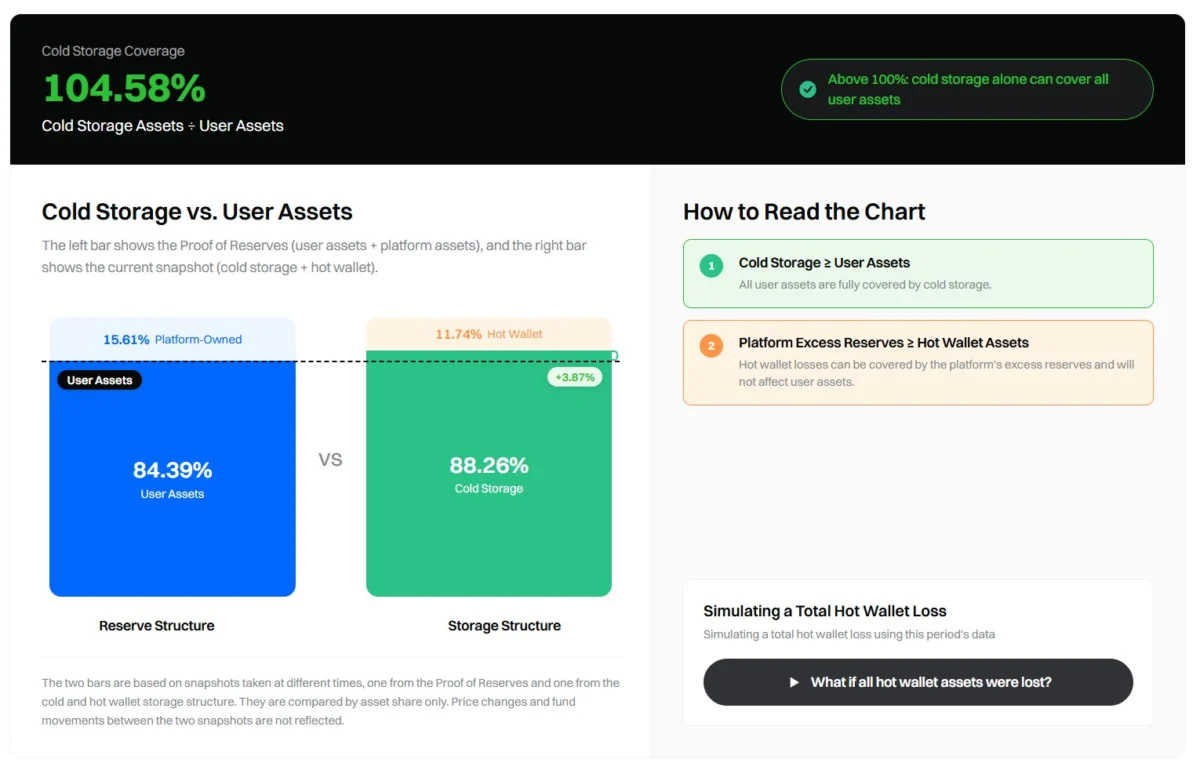
| Global exchange launching a “Proof of Security” report | 88.26% of total assets | November 5 |
| Three smaller Korean exchanges | 85%, 82.79% and 80.54% | End of September (FSS) |
Figures as reported by each exchange or by South Korea’s FSS. Descriptions are generalized to reflect the original reporting style.
These figures provide a critical benchmark for evaluating an exchange’s commitment to security. A higher cold storage percentage generally indicates a lower exposure to hot wallet compromises, offering a greater degree of protection for customer funds. However, the interpretation of these numbers requires a deeper understanding of both the volume of assets held and their fluctuating dollar value.
Beyond the Percentage: Introducing Proof of Security (PoSEC)
While a cold storage ratio offers valuable insight, some exchanges are pushing the boundaries of transparency further. On November 5, the exchange reporting an 88.26% cold storage ratio, Gate.io, launched an innovative framework it terms "Proof of Security (PoSEC)." This goes beyond the standard "Proof of Reserves" report, which merely verifies that an exchange holds sufficient assets to match customer balances.
PoSEC integrates a stress test scenario: it not only reveals how assets are distributed between hot and cold wallets but also assesses whether the cold storage reserves alone could fully repay all customers if every hot wallet on the platform were to be completely drained. Gate.io’s analysis yielded a "worst-case" coverage ratio of 104.58%, meaning its cold reserves would independently cover all customer assets even under such an extreme scenario. This implies that the total platform assets, according to our calculations (104.58 ÷ 88.26 ≈ 1.18), are roughly 118% of customer balances. Gate.io articulated that "PoSEC provides visibility into asset storage structures and their ability to cover potential losses under extreme scenarios." While this data was still undergoing review by a third-party audit firm at the time of publication, it represents a significant step towards enhanced transparency and accountability in the crypto industry.
Cold Storage in Dollar Terms: The Impact of Price Volatility
A cold storage percentage, while informative, only tells half the story. The true "dollar exposure" of an exchange’s hot wallet depends critically on two factors: the hot-wallet share and the current Bitcoin price. To illustrate this, consider a hypothetical exchange holding 50,000 BTC for its customers. At a price of $75,620 per coin (as recorded on November 6, 04:00 UTC), the total value of these holdings would be approximately $3.78 billion.
Let’s examine how different hot-wallet shares translate into dollar values at this price point:
| Hot-wallet share | BTC online | Dollar value on November 6 |
|---|---|---|
| 0.83% (99.17% cold) | 415 BTC | About $31.4 million |
| 1% (99% cold) | 500 BTC | About $37.8 million |
| 5% (95% cold) | 2,500 BTC | About $189 million |
| 11.74% (88.26% cold) | 5,870 BTC | About $444 million |
| 20% (Korea’s 80% minimum) | 10,000 BTC | About $756 million |
Calculation: BTC online × $75,620.19.
This table vividly demonstrates that even a small hot-wallet percentage can represent a substantial dollar value, underscoring the potential financial impact of a successful hot-wallet breach. Furthermore, the dynamic nature of cryptocurrency prices means that the dollar value of stolen funds can fluctuate significantly even without any movement of the underlying assets. For instance, the 18,270 BTC that blockchain trackers say the attacker still controls were worth approximately $1.47 billion at $80,564 on November 5. The very next morning, at $75,620, their value had dropped to about $1.38 billion, representing a swing of roughly $90 million without a single coin being moved. This volatility adds another layer of complexity to assessing the true cost of such security incidents.
Does a Higher Cold-Storage Ratio Protect the Bitcoin Price?
While a higher cold-storage ratio significantly enhances an exchange’s resilience against hacks, it does not directly "protect" the Bitcoin price. Bitcoin’s price is determined by the collective trading activity across the entire global market, influenced by a myriad of factors ranging from macroeconomic trends to regulatory news and broader investor sentiment. The week following the Binance attack underscored this, demonstrating that macro-level market movements can often exert a more profound influence on price than even a major exchange-specific incident. The swift recovery to $80,564 by November 5 largely suggests that the market perceived the theft as a company-specific operational risk, rather than an indictment of Bitcoin’s fundamental security or viability.
Nonetheless, a higher cold-storage ratio indirectly contributes to market stability by limiting the potential financial fallout from a single attack, thereby bolstering overall investor confidence in the security of centralized exchanges. The industry’s response to the Binance hack also played a crucial role in mitigating its broader impact. Blockchain analytics firm Elliptic estimated that approximately $2.85 billion of the stolen funds were frozen or seized. A significant portion of this success—roughly 94%—was attributed to the fact that many of the stolen assets were stablecoins, whose issuers possess the capability to block addresses, effectively immobilizing the funds. This ability to freeze stolen assets, while a point of debate for crypto purists, proved instrumental in limiting the attacker’s gains and preventing a wider market panic.
It is imperative to acknowledge that even cold storage is not entirely "bulletproof." Hong Kong’s Securities and Futures Commission (SFC) issued a warning in August 2025, cautioning exchanges that vulnerabilities in wallet systems, including those stemming from insider threats or sophisticated social engineering attacks, can compromise both hot and cold storage setups. Thus, while a high cold-storage ratio is a strong indicator of security commitment, it remains a crucial component of a broader, multi-layered security strategy, not a standalone guarantee against all potential threats.

Enhancing Personal Security: Checking Cold Storage and Self-Custody
For cryptocurrency users, understanding an exchange’s cold storage practices is a vital aspect of due diligence. Here’s a routine to assess an exchange’s security posture:
- Locate Security Disclosures: Visit the exchange’s official website and navigate to their "Security," "Transparency," or "About Us" sections.
- Find Cold Storage Ratios: Look for explicit statements or reports detailing the percentage of customer assets held in cold storage.
- Note the Date: Be aware of when the figures were last updated, as asset allocations can change.
- Cross-Reference with Market Data: Check a reliable Bitcoin price aggregator (like CoinGecko or CoinMarketCap) for the current BTC to USD rate.
- Perform a Quick Calculation: If the exchange provides total BTC held, you can estimate the dollar value of their hot wallet exposure using the current price and their stated cold storage percentage.
For long-term Bitcoin holders who rarely trade, the most secure approach remains self-custody. Storing coins in a wallet you control offline, such as a hardware wallet, completely removes exposure to an exchange’s hot or even cold wallet vulnerabilities. This "not your keys, not your coins" philosophy empowers individuals to be their own bank, albeit with the added responsibility of managing their private keys securely.
The Road Ahead: Evolving Security and Transparency in Crypto
The Binance hack and the subsequent industry response underscore a pivotal moment in the evolution of cryptocurrency security. It has accelerated a trend towards greater transparency, driven by both market demands for reassurance and burgeoning regulatory expectations. The introduction of frameworks like Proof of Security (PoSEC) signifies a maturation of the industry’s approach to asset protection, moving beyond simple reserve attestations to more comprehensive risk assessments.
As the crypto market continues to grow and attract a wider audience, the onus on exchanges to implement impregnable security measures and communicate them clearly will only intensify. The lessons learned from incidents like the Binance hot wallet breach will undoubtedly shape future regulatory frameworks, technological innovations in wallet security (such as advanced multi-signature schemes and secure hardware enclaves), and the overall trust landscape within the digital asset ecosystem. The ultimate goal remains to strike a delicate balance between the accessibility and liquidity that hot wallets offer, and the ironclad security that only robust cold storage solutions can provide.
FAQs
Why don’t exchanges keep 100% of crypto in cold storage?
Exchanges maintain a portion of funds in hot wallets to ensure rapid processing of customer withdrawals and facilitate active trading. Moving funds from cold storage typically involves manual approvals, multiple security protocols, and often takes several hours. Most large exchanges aim for a small hot-wallet buffer that can cover normal daily withdrawal volumes, replenishing it from cold storage as needed. This balances security with operational efficiency.
What is a proof-of-reserves report?
A proof-of-reserves report is an audit or public declaration by an exchange demonstrating that the total amount of cryptocurrency it holds on-chain matches or exceeds the total amount customers have deposited and are entitled to withdraw. Many exchanges now use cryptographic methods, such as Merkle trees, allowing individual users to verify their specific balance is included in the total without revealing other users’ information. It’s crucial to note the snapshot date, as asset balances are constantly changing.
Is cold storage the same as a hardware wallet?
They are closely related concepts. A hardware wallet is a specific type of cold storage designed for individual users, keeping private keys offline on a dedicated physical device. Exchanges, however, typically employ much larger and more complex cold storage setups. These often involve multiple hardware security modules (HSMs), multi-signature (multisig) schemes requiring several approvals, and highly secure physical facilities, all designed to ensure that private keys never touch an internet-connected device. The underlying principle of keeping keys offline to prevent theft remains the same.
What is a multisig wallet?
A multisig, or multi-signature, wallet is a type of cryptocurrency wallet that requires multiple private keys to authorize a transaction. For example, a "2-of-3" multisig wallet would require any two out of three designated keys to sign off on a transaction before funds can be moved. Exchanges frequently utilize multisig setups for their cold storage to enhance security. This prevents a single point of failure, such as a compromised laptop or a stolen password, from leading to fund depletion, as multiple individuals or systems would need to cooperate to move assets. The trade-off is often slower transaction processing due to the multi-approval requirement.
Why does the Bitcoin price differ slightly between websites?
Bitcoin prices can vary slightly between different websites or trading platforms because each source pulls data from various exchanges and updates at different intervals. Some platforms display the last traded price on a specific exchange, while others might show an aggregated average across multiple markets. These differences, usually a few dollars, are normal due to market inefficiencies and varying liquidity across platforms. For calculations or comparative analysis, it’s best to note the timestamp of the quote and consistently use the same data source to ensure accuracy.